Skip to content
DevMeme
5753 of 7435
Kotlin Developer Revisits Java and Gets a Culture Shock
Languages Post #6305, on Oct 11, 2024 in TG

Kotlin Developer Revisits Java and Gets a Culture Shock

Why is this Languages meme funny?

Level 1: Messy House Visit

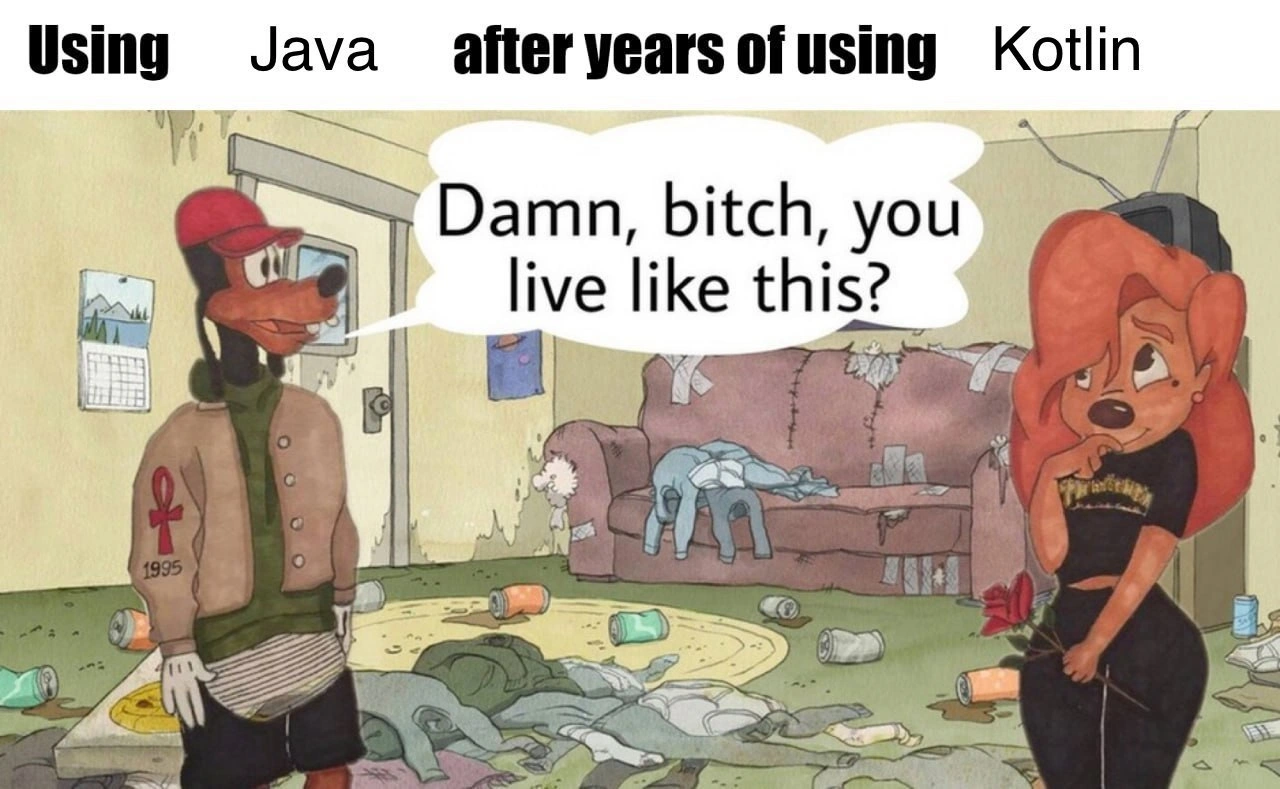
Imagine you’ve been living in a neat, modern house where everything is tidy and in its place. Now you go to visit an old friend who lives in a very messy house. There are clothes and trash all over the floor, the sink is full of dirty dishes, and you can barely find a clean spot to sit. You might turn to your friend and say, “Whoa! You live like this?!” in surprise, because you’re used to a much cleaner place. In this analogy, Kotlin is like the neat house – it’s new, organized, and everything is designed to be clean and easy to handle. Java is like the older messy house – it still works as a house, but it has a lot of clutter and things that haven’t been cleaned up in a long time. The meme shows a cartoon character (Goofy) acting like the person coming from the clean house, and he’s shocked at how messy the other character’s living room is. This is just like a developer who has been using a newer, cleaner style of coding (Kotlin) and then looks at an older style of code (Java) that has stuff everywhere. It’s funny because we can all picture that situation: one friend has gotten used to nicer, easier ways of doing things and can’t believe the kind of “mess” we used to put up with. The feeling behind the joke is a mix of surprise (“I can’t believe it was this messy!”) and a bit of teasing (“How did you even live in here?”). Even if you’re not a programmer, you know what it’s like to see a really messy room after being in a clean one – it’s a big contrast and a little shocking. In the same way, this meme is saying that once you know a cleaner way to code, seeing the old messy way is both funny and a little horrifying. It’s a playful reminder that as things improve over time, our old ways can start to look pretty rough in comparison.

Level 2: Kotlin Cleans House

Let’s break down why this scene is so amusing to developers by explaining the key differences between Java and Kotlin. These are both programming languages, but Java (born in 1995) is older and tends to be more verbose (wordy), while Kotlin (first released in the 2010s) is newer and designed to be more concise. When we say Java code can be messy or cluttered, we’re talking about all the extra lines and repetition often required to do fairly simple things – this extra code is fondly nicknamed “boilerplate.” Boilerplate code is like the paperwork of programming: necessary in Java’s case, but not particularly exciting or meaningful. Kotlin was created to reduce that boilerplate, making the code more compact and readable.

Imagine a simple task: you want to define a class to represent a Book with a title. In old Java, you’d have to write a lot of ceremony around that idea. For example, here’s how a basic Java class might look:

// A simple Java class with boilerplate
public class Book {
    private String title;                    // Field
    
    public Book(String title) {              // Constructor
        this.title = title;
    }
    
    public String getTitle() {              // Getter method
        return this.title;
    }
    
    public void setTitle(String title) {    // Setter method
        this.title = title;
    }
    
    @Override
    public String toString() {             // toString for printing
        return "Book{title='" + title + "'}";
    }
    
    // (Imagine also writing equals() and hashCode() for completeness)
}

That’s quite a lot of code for something as simple as a title holder! We had to declare the field, a constructor, and then write getter and setter methods just to read and modify the title. We even wrote a toString() to display the object nicely (and potentially equals() and hashCode() if we wanted full value semantics). All of this repetitive stuff is what we call boilerplate. It doesn’t contain real business logic – it’s just there because the language demands it for completeness.

Now, check out the equivalent in Kotlin:

// A simple Kotlin data class for the same concept
data class Book(val title: String)

That one line data class definition does everything the 15+ lines of Java did! Kotlin’s data class automatically generates the constructor, the getTitle() (actually in Kotlin you just use book.title as a property access), toString(), and even equals()/hashCode() behind the scenes. This is a prime example of Kotlin cleaning house: it eliminates boilerplate by giving the developer concise language tools. You don’t have to see or maintain all that clutter – the language handles it for you. For a junior developer, this means you can focus on the actual logic (like what to do with a Book) rather than writing a lot of boilerplate code over and over. It’s as if Kotlin comes with a built-in cleaning service for your codebase, tidying up all those wrappers and repetitive bits that Java left lying around.

Another big difference highlighted by the meme is null safety. In Java, any object reference can be null (which is like a variable having “no value”). If you try to use a null value (say, call a method on a null object), the program blows up with a NullPointerException (often abbreviated as NPE). Java doesn’t force you to handle null – it’s up to the programmer to be careful and add checks like:

String name = person.getName();
if (name != null) {
    System.out.println(name.toUpperCase());
} else {
    System.out.println("Name is missing.");
}

If you forget that else and name happens to be null, boom, NullPointerException at runtime – your program crashes or misbehaves. Kotlin, learning from this, makes you acknowledge nulls in the type system. By default, a String in Kotlin cannot be null. If a variable can be null, you declare its type with a ?, like var name: String? = .... Then, the Kotlin compiler won’t let you use name unless you handle the null case. Kotlin provides safe operators to make this easy: name?.toUpperCase() will call toUpperCase() only if name isn’t null (skipping it otherwise), and the Elvis operator ?: lets you provide a default. For example:

val name: String? = person.name
println(name?.toUpperCase() ?: "Name is missing.")

This one line in Kotlin does what the four lines of Java did. If name is null, it prints “Name is missing.”; if not, it prints the uppercased name. The result is fewer chances for mistakes (the compiler helps catch them) and cleaner code without a bunch of if (something != null) checks everywhere. For a junior developer, this means less worrying about did I forget to check for null? – Kotlin has your back, whereas Java will let you run with scissors and only complain when you trip (at runtime). That leads to what we call null-safety envy: Java developers often wish they had this feature, because it’s saved Kotlin developers countless hours of debugging.

We should also talk about checked exceptions, which are another cause of Java clutter. In Java, some errors are “checked” at compile time – the language forces you to anticipate certain exceptions (like IOException when reading a file) and either catch them with a try-catch or declare that your method throws them. It’s like the language saying, “You must deal with this potential problem right now.” While that sounds good in theory, in practice it means a lot of extra code that often doesn’t actually handle the error any better – it just wraps it. Developers sometimes ended up writing try-catch blocks that only logged or re-threw the error, just to satisfy the compiler. In our messy living room analogy, checked exceptions are like random tripwires you have to step over in the room – you keep adding more paths (code) to carefully navigate them. Kotlin decided to simplify things: it doesn’t have checked exceptions at all. You can still catch exceptions if you want, but if you don’t, the exception will just bubble up. This means Kotlin code doesn’t force a bunch of try-catch boilerplate on you for every little operation – again contributing to a cleaner look. (Of course, it puts more responsibility on the developer to handle errors appropriately, but it turns out most of us prefer that freedom over mandatory clutter.)

One more thing the meme hints at: Domain-Specific Languages (DSLs). The description mentions Kotlin’s “modern DSLs.” Kotlin lets developers create mini-languages for specific tasks using its flexible syntax – for example, building an HTML page or configuring a UI layout with code that reads almost like natural language. In Java, making a DSL is much harder – you’d likely end up with a very verbose builder pattern or a lot of nested objects. Kotlin’s features like lambdas with receivers, extension functions, and operator overloading let you design clean, declarative APIs. If a Kotlin developer goes back to a Java codebase and sees how, say, UI screens were built with tons of nested new Object() calls and manual configuration, it feels like visiting a kitchen where the cook has painstakingly hand-chopped and cooked everything from scratch, whereas Kotlin provided a set of pre-packaged recipes. It’s not that you can’t do it in Java; it’s just a lot more work and code.

All these differences boil down to developer experience: Kotlin was created by people who had years of Java experience and wanted to make daily coding more enjoyable and less error-prone. This is why a Kotlin fan revisiting Java code might react with a mix of surprise and horror, much like Goofy in the meme. It’s like revisiting a place from your past and seeing all the old inconveniences you’ve since learned to live without. For a new developer today, it’s important to understand that Java isn’t “bad” – in fact, it’s a very powerful, proven language that’s run everywhere. But it is older, and it shows its age in terms of verbosity and some design decisions (like how it handles nulls and errors). Kotlin is one of the newer languages that learned from Java’s experiences (and yes, mistakes) to provide a smoother, more concise coding style. The meme humorously captures the moment of realization: “Wow, the old way of doing things was really messy compared to the new way!” If you ever find yourself switching between two languages or technologies, you’ll likely have a similar feeling – it’s a normal part of the learning journey. And as frustrating (or funny) as it can be, it also gives you an appreciation for why language design and code quality matters. After writing in Kotlin, you start to see boilerplate and clutter for what it is, and you’ll probably try to avoid it even if you go back to Java (thankfully, modern Java has also improved, with features like lambdas and records to cut down on boilerplate). So, the next time you open up some old Java code and instinctively say, “Geez, it’s a mess in here,” just know that you’re living the exact relatable experience this meme is depicting – and many of us older devs are nodding our heads and chuckling with you.

Level 3: The Boilerplate Strikes Back

This meme hits home for any senior developer who’s lived through the Java vs Kotlin saga. Here we have Goofy (the Kotlin fan) stepping into a filthy living room (the old Java codebase) and recoiling in disbelief – “Damn, you live like this?” It’s a comically exaggerated take on legacy code shock: that feeling when you open a decade-old Java project after enjoying years of Kotlin’s clean syntax and wonder how we ever tolerated so much clutter. The living room debris – trash, torn furniture, junk everywhere – symbolizes Java’s infamous boilerplate hell. Think of all those getters and setters crowding every Java class, the verbose constructors, the repetitive equals() and hashCode() methods, the endless try-catch blocks for checked exceptions, and the parade of semi-colons and angle brackets. It’s as if every empty soda can on the floor is another piece of redundant code Java made us write. After you’ve tasted Kotlin’s concise style, returning to a Java codebase can feel like visiting your old college dorm room only to realize it’s basically a dumpster with a roof. Verbosity fatigue is real – once you get used to writing a data class in one line, having to maintain a 300-line Java class (90% of which is boilerplate) is physically painful. No wonder Goofy looks horrified.

What makes this scene painfully relatable is that so many of us have been in Goofy’s shoes. Perhaps you spent months writing sleek Kotlin, reveling in features like extension functions, lambdas, and null-safe operators. Then one day, you’re asked to debug or extend a legacy module written entirely in pre-Java 8 style. Suddenly you’re surrounded by old-school Java clutter: factories, builders, visitors, and utility classes galore. It genuinely feels like walking into chaos. The meme’s caption, “Using Java after years of using Kotlin,” nails that culture shock. It’s a humorous twist on developer experience (DX) – Kotlin gave you a taste of clean code heaven, so Java’s patterns now look like code purgatory. The sheepish look on Roxanne (representing the Java codebase) is spot on: the Java code isn’t proud of its mess either, but hey, it’s from another era. And check out Goofy’s jacket with “1995” on it – a cheeky nod to Java’s birth year. It’s as if the Kotlin dev traveled back in time to when Java was new and shiny…and is now utterly shocked by how antiquated it all appears. (In reality, many Java codebases are essentially stuck in 1995 design-wise.)

This comedic scenario also jabs at the ongoing language wars and developer humor around Java vs Kotlin. For years, Java was the undisputed workhorse, and it accumulated a lot of baggage in terms of patterns and verbosity. Kotlin was created by developers who lived through those pains and decided, “Enough! We can do better.” So when a Kotlin fan looks at a Java codebase, they often can’t help but groan or laugh at all the things they no longer have to do. It’s tech humor born from real improvement:

  • In Java, you’d write a verbose inner class or use the cumbersome visitor pattern to handle variants; in Kotlin, a sealed class plus a when gives you the same result with a fraction of the fuss.
  • In Java, every other line is a null check or a defensive Objects.requireNonNull(value) to avoid that dreaded NullPointerException; in Kotlin, you just use ?. and ?: (the Elvis operator) and move on with life, free from null paranoia.
  • Java devs have war stories of production crashes due to someone’s forgotten if (obj != null) check – the kind of thing that gives you PTSD and a healthy dose of null-safety envy when you see Kotlin’s approach.
  • Working in a large Java codebase often means wading through layers of design patterns and config files. Need to build an object? Cue the Builder Pattern with five additional classes. Want to iterate over a list pre-Java 8? Get ready for five lines of for loop. In Kotlin, you’d just call higher-order functions like filter or map in a single expression. The Developer Experience difference is like night and day.

The meme is funny because it exaggerates an everyday developer experience many of us have had: switching from a modern, expressive language back to an older, more verbose one. It’s like going from driving an electric car with autopilot back to a stick-shift beater with crank windows – you can do it, but oh boy, do you feel every bump and manual effort. The caption’s bold formatting (“Using Java after years of using Kotlin”) emphasizes the contrast. Kotlin’s name is highlighted at the end as the thing you got used to, the new comfy norm, while Java is at the start – the thing you’re now painfully returning to. That bold text mimics a shocked tone of voice, like the dev is almost yelling in disbelief at each word: “Using… Java… after years of using… Kotlin?!”. It’s a mix of horror and hilarity.

Importantly, this isn’t just trashing Java for the sake of it – it’s poking fun at code quality issues that arise in any older, large codebase. Java was designed with different constraints and priorities. Over the years, best practices emerged (like writing clean code, avoiding excessive object nesting, etc.), but older code often reflects the norms of its time. The mess in that living room? That’s what happens when a codebase ages without a refactor: quick fixes piled on quick fixes, outdated patterns never rewritten – essentially technical debt personified. A Kotlin dev peeking in feels like an Airbnb guest walking into a trashed apartment – sure, it’s technically functional, but it’s not what you’d call welcoming or efficient. And as the cynical veteran in us knows, nobody really wants to clean it up because “if it works, don’t touch it.” Java’s longevity means there’s a lot of such legacy code still running critical systems, and many of us have to tiptoe through that minefield. The humor carries a hint of trauma: we laugh, but we also remember being Roxanne, standing in that messy project, a bit embarrassed when a newcomer (especially one armed with a nicer language) sees what we’ve been living with. Ultimately, the meme resonates because it’s a tongue-in-cheek acknowledgment of progress: we can recognize how messy things were, and how much nicer they are now – and we cope with that reality by laughing at it together.

Level 4: Billion-Dollar Mistake

In the realm of programming language theory, null references are infamously dubbed “the billion-dollar mistake.” This meme slyly highlights that costly blunder: Java’s type system, designed back in 1995, made every object reference potentially null by default. That design seemed convenient at first (simpler compiler, easier interoperability), but it sowed the seeds for endless NullPointerException bugs. Renowned computer scientist Tony Hoare, who introduced null references in the 1960s, later lamented creating “a billion-dollar mistake” – the economic cost of countless runtime errors and system crashes caused by null over decades. Kotlin’s designers took that cautionary tale to heart. They upgraded the type system with built-in null safety: in Kotlin, a variable of type String can never hold a null value, and any variable that can be null is explicitly marked as String?. This small syntax change packs serious theoretical muscle – it transforms null-related runtime failures into compile-time errors. In other words, the Kotlin compiler acts as a vigilant guardian, refusing to compile code that might throw the very NPEs that haunt Java developers at 3 AM. Under the hood, Kotlin uses flow-sensitive typing (a form of static analysis): if you check that a nullable reference isn’t null, Kotlin will automatically treat it as non-null within that scope. This approach is rooted in type theory – akin to the Maybe/Option monad in functional languages or algebraic data types in ML – and it eradicates a whole class of bugs by construction. Seasoned devs who know the pain of hunting a stray NullPointerException in a 10,000-line Java codebase can almost hear angels sing when they realize Kotlin’s type system simply won’t allow those pitfalls. That envy-inducing feature leaves Java feeling like a legacy mess, where the absence of null safety now looks outright primitive.

Another deep-rooted issue highlighted by the meme’s garbage-strewn living room is Java’s historical over-reliance on boilerplate and design patterns for tasks that newer languages handle with first-class language constructs. Consider the visitor pattern – a classic Gang of Four object-oriented pattern often used in Java to simulate algebraic sum types (think of handling a fixed set of variant objects). The visitor pattern, while powerful, forces developers to write an elaborate dance of interfaces, visitor classes, and instanceof checks just to perform case-by-case logic on different subclasses. It’s a workaround for Java’s lack of concise pattern matching or sealed types, and it’s notoriously ceremonious. Kotlin, inspired by functional programming concepts, introduces sealed classes, which are essentially a way to declare “closed” class hierarchies. All possible subclasses of a sealed class are known at compile time, enabling the compiler to enforce that you handle every case in a when expression. This is effectively pattern matching on types, similar to Scala or Haskell, baked directly into the language. The result? A problem that would require a whole visitor framework in Java can be expressed with one neat when in Kotlin – no sprawling double-dispatch machinery, just straightforward code. This contrast is rooted in language design philosophy: Java emerged when design patterns were king, whereas Kotlin stands on the shoulders of modern language theory, incorporating concepts like algebraic data types and type inference to eliminate noise. Indeed, Kotlin’s type inference means you rarely have to declare variable types explicitly (var list = ArrayList<String>() is perfectly clear to the compiler), whereas Java, until recent versions, insisted on stating the obvious (ArrayList<String> list = new ArrayList<>();) everywhere. These theoretical improvements – strong static typing with null exclusion, first-class sum types, local type inference – significantly improve developer experience (DX) by reducing cognitive load. They also reflect how far language design has come in the 29 years since Java’s inception. The meme humorously magnifies this point: revisiting a Java codebase frozen in time feels like archaeologists unearthing a dusty relic, exposing just how far our tools have evolved. For a Kotlin fan steeped in modern language features, stepping back into Java’s world is a jarring time warp where every line of cluttered code stands out like a cautionary tale from the past.

Description

This meme uses the 'Damn, Bitch, You Live Like This?' comic format to compare programming languages. The top of the image has text that reads, 'Using Java after years of using Kotlin'. The main panel illustrates a scene where a cartoon character, styled after Max from 'A Goofy Movie', stands in a doorway looking disgusted at a female character, Roxanne, who is in an extremely messy, garbage-strewn room. A speech bubble from the male character says, 'Damn, bitch, you live like this?'. The technical humor lies in the metaphor: the messy room represents a typical Java codebase, which is often perceived as verbose, full of boilerplate, and lacking the modern conveniences and safety features of Kotlin. For senior developers, especially in the Android or backend ecosystems, who have migrated to Kotlin, going back to a legacy Java project can feel like a significant downgrade in developer experience, hence the look of disgust
Comments

7
Anonymous ★ Top Pick After years in Kotlin, opening a Java file feels like archaeology. You have to dig through five layers of boilerplate getters and setters just to find the fossilized business logic, all while praying you don't awaken a NullPointerException
  1. Anonymous ★ Top Pick

    After years in Kotlin, opening a Java file feels like archaeology. You have to dig through five layers of boilerplate getters and setters just to find the fossilized business logic, all while praying you don't awaken a NullPointerException

  2. Anonymous

    Going from Kotlin back to Java feels like downgrading from a sealed class hierarchy to a 600-line visitor pattern the intern auto-generated with Lombok - the garbage collector isn’t the only thing wading through trash

  3. Anonymous

    Going back to Java after Kotlin is like explaining to stakeholders why you need three classes, two interfaces, and a factory pattern just to pass a nullable string between activities

  4. Anonymous

    After years of Kotlin's null-safe bliss, returning to Java feels like debugging a NullPointerException in production at 3 AM - except the production environment is your entire codebase, and the exception is every line that doesn't have '?.let { }'. You thought you escaped the getter/setter factory pattern, but Java's sitting there with 47 lines of boilerplate for what Kotlin does in one 'data class' declaration, asking if you want to manually implement equals(), hashCode(), and toString() again 'for old times' sake.'

  5. Anonymous

    After a stint in Kotlin, opening a Java monolith feels like SSHing into a legacy VM: builders, DTOs and checked exceptions stacked to the ceiling, with Lombok acting as duct tape on the torn couch

  6. Anonymous

    After years in Kotlin, opening a Java file feels like disabling -Xboilerplate - getters, setters, and three checked exceptions guarding every null

  7. Anonymous

    After Kotlin data classes, crafting a Java POJO with equals/hashCode/toString is like hand-rolling cigarettes in a tobacco-free world

Use J and K for navigation