The Rust Evangelist at the Party
Why is this Languages meme funny?
Level 1: We Already Know
Imagine you’re at a birthday party, and one kid there is super excited about his special new cup. This cup has a tight lid and a straw, so he proudly says it never spills juice and he can still drink from it just as easily as a normal cup. He’s standing off by himself, thinking, “They don’t know my cup is spill-proof and super easy to drink from.” He’s feeling pretty smart because his cup keeps everything safe from messy spills without slowing him down. Now, the funny part is, he’s told everyone about this cup so many times already. Every time he comes to a party, he brags about the same cup. So this time, before he can even finish his thought, one of the other kids dancing to the music shouts, “We know!” And another kid, maybe a bit annoyed, says, “You never stop talking about that cup!”
The reason this scene is funny is because we all know someone like that kid – a friend who keeps bragging about the same thing over and over. It might be a cool toy, a fun fact, or something they’re really proud of. In the beginning, it’s interesting, but after hearing it ten times, everyone else is like, “Yeah, yeah, we got it already.” In the meme, the kid with the cup is like a developer who’s super excited about the Rust programming language (because Rust is very safe and fast, like the spill-proof yet easy-to-drink cup). He talks about it non-stop. The other kids at the party represent his friends who have heard this all before and just want to enjoy the party. They respond with “we know” because, of course, he’s always talking about that! The emotional core here is a mix of pride and annoyance: one person is proud and excited about something awesome they discovered, and the others are a bit tired of hearing the same boast again and again. It’s a playful way of saying “It’s great that you love this thing, but trust us, everybody already knows – you’ve told us many times!” So, the meme makes us laugh because we recognize both sides: being really excited to share something cool, and being on the other side when a friend just won’t drop their favorite topic.
Level 2: Rust: Safe and Fast
Let’s break down the key terms and ideas so that even a newer developer can catch the joke. Rust is a modern programming language (originally developed at Mozilla) that has become famous in the software world for two big reasons: it’s memory-safe and it’s super fast, like the low-level languages of old. Memory safety means Rust is designed to prevent a whole class of bugs that, in languages like C or C++, can cause your program to crash or even create security holes. For example, in C you might accidentally use a pointer to memory that was already freed (a dangling pointer) or forget to free memory (causing a leak), or write past the end of an array (a buffer overflow). These lead to nasty problems like segmentation faults (the program just crashes) or weird unpredictable behavior. Rust avoids these by being very strict at compile time: it checks how you’re using memory before it even lets the program run. It does this with something called the borrow checker – essentially a built-in set of rules inside the compiler that makes sure every piece of data is handled safely. The borrow checker ensures, for instance, that you can’t have one variable secretly invalidate another’s data without the compiler knowing. If you try to do something that might lead to a memory error (like keeping a reference to data that’s gone, or modifying data in two places at once in unsynchronized ways), Rust will stop you with a compile error. It’s like a super strict teacher: it might complain and force you to fix your code, but once it compiles, you can be much more confident that your program won’t randomly crash. In practical terms, Rust developers rarely see things like null-pointer errors or race conditions in their programs, because the language prevents those by design. That’s what the meme’s character means by “memory-safe” – Rust won’t let you make the usual mistakes that cause memory corruption.
Now, about the “zero-cost abstractions” part – this is another cornerstone of Rust’s appeal. Many programming languages offer you nice conveniences or high-level constructs, but there’s a catch: those conveniences might make the program slower or use more resources behind the scenes. For example, a garbage-collected language like Java or C# automatically cleans up memory for you (so you don’t have to manually free memory), but running that garbage collector can pause the program occasionally, which is a form of performance cost. In contrast, Rust has no background garbage collector; it relies on deterministic compile-time rules and structures like RAII (Resource Acquisition Is Initialization) to manage memory with zero runtime overhead. The phrase “zero-cost abstraction” means that using Rust’s fancy features doesn’t secretly tax your program. If you use a high-level construct like an iterator to loop through a collection, Rust will compile it down to machine code that’s just as efficient as a traditional C-style loop. If you use generics (say, a Vec<T> for a growable array of any type), Rust creates specialized versions of the code for each data type (a process called monomorphization), so that it’s as if you’d written a dedicated, optimal implementation by hand. There’s no slow “dynamic typing” or bulky runtime adding overhead in those cases. Essentially, Rust gives you the abstractions – the nice tools and safety nets – for free in terms of speed. You don’t have to trade performance to get safety and clarity. That’s why people often say Rust offers “C++ performance with memory safety.” It aims to be as fast as low-level languages like C/C++ (where the programmer usually has to manage memory manually) while automatically handling a lot of the hard safety stuff under the hood.
Now imagine you’re at a party with a bunch of programmers in early 2021. Rust had become very popular in the programming world by then, especially in systems programming and open-source communities. Our meme’s main character is a developer who loves Rust for the reasons we just discussed: no more mysterious crashes (thanks to memory safety) and no slowdowns or bloated runtime (thanks to zero-cost abstractions). He’s standing off to the side with this smug thought bubble, “They don’t know Rust is a memory-safe language with zero-cost abstractions,” as if he’s privy to some amazing secret. The other people dancing are also tech folks, and as the joke, they reply “we know” and “you never stfu about it.” That second line is internet-slang short for “you never shut up about it,” which is a not-so-polite way of saying, “you talk about this all the time.” So the group on the right is basically telling him: “We’re fully aware of Rust’s cool features – because you’ve told us again and again!” This plays on the idea that in many developer circles, Rust’s advantages (memory safety, speed, the famous borrow checker, etc.) have been a hot topic for a while. LanguageEvangelism is when someone is so excited about their favorite programming language that they try to convert everyone to it, almost like a missionary. And this often leads to friendly LanguageWars, where fans of different languages playfully (or sometimes seriously) argue over which language is superior. By 2021, a lot of people already knew about Rust and its selling points, so hearing one more person proclaim “Hey guys, did you know Rust prevents segfaults and has zero-cost abstractions?!” could be eye-roll inducing. The meme humorously illustrates that: the lone Rust fan thinks he’s dropping knowledge bombs, but his friends are like, “Yes dude, we’ve heard this a million times.” It’s developer humor highlighting how hype can turn into a running joke once everybody is in on it.
Level 3: Preaching to the Choir
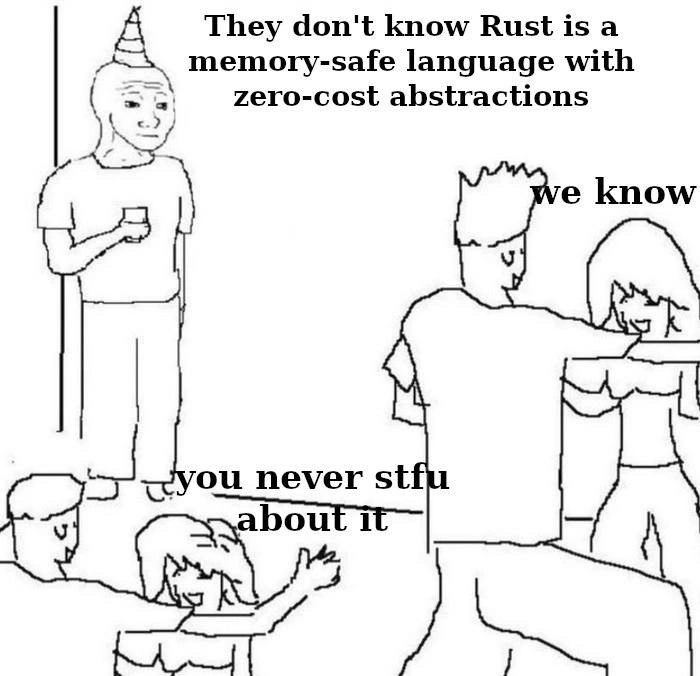
In this scene, our coned-hat loner is the quintessential Rust evangelist, and the meme captures the social backlash that often follows relentless hype. He’s thinking, “They don’t know Rust is a memory-safe language with zero-cost abstractions,” assuming he’s the lone bearer of enlightenment at the party. But the joke’s on him: the other stick-figure devs on the dance floor respond with “we know” and “you never stfu about it.” In other words, “Buddy, we’ve heard your Rust spiel a hundred times.” This is a classic case of preaching to the choir – he’s fervently promoting Rust’s greatness to people who are already painfully aware of those talking points.
Seasoned developers will recognize this scenario immediately. It lampoons the kind of language evangelism that pops up whenever a technology is riding a hype wave. Here it’s Rust, but it could just as easily have been Go at a cloud meetup a few years back, or Ruby on Rails at a 2008 startup party, or even Java in the late ‘90s. The pattern is always the same: an enthusiastic techie discovers a tool that solves problems in a new way, they fall in love with it, and then every conversation somehow circles back to that tool’s superiority. The DevCommunities tag is relevant because this is a social dynamic in developer culture – communities rally around languages, sometimes with almost religious fervor. We even have a term for these folks: “fanboys” or “zealots,” who just won’t let up. Rust, being a relatively new systems language that actually delivers on many promises (memory safety, speed, concurrency), developed a particularly vocal fan base. By early 2021, Rust had topped Stack Overflow’s “most loved language” charts for several years, and jokes about the aggressive enthusiasm of Rustaceans were well-entrenched. For instance, there’s a running gag about the Rust Evangelism Strike Force – a tongue-in-cheek reference to the idea that a secret squad of Rust fans scours the internet ready to inject “Have you considered rewriting it in Rust?” into any discussion about bugs or performance.
In the meme, the partygoers’ exasperated “you never shut up about it” perfectly encapsulates how many people feel after hearing the same hype repeatedly. It’s comedic hyperbole – obviously a real friend might not be so blunt – but in meme-land, it drives the point home. The humor also comes from the LanguageWars subtext: every time a shiny new language rises, it’s like a mini culture war in tech. You have the evangelists on one side, extolling virtues (here it’s memory safety and zero_cost_abstractions as Rust’s big selling points). On the other side, you have the skeptics or simply those exhausted by constant hype. They might respond with, “Yes, Rust is great, we get it, but it’s not a silver bullet” or roll their eyes because they’ve chosen different tools or just don’t appreciate the zeal. In workplaces, this dynamic can be amusing or annoying: that one colleague who tries to slip Rust into every project discussion, proudly bragging about the borrow checker preventing bugs, while others groan, “not this again…” It highlights a real social IndustryTrend_Hype: passionate developers can sometimes become unwittingly alienating if they can’t drop the subject.
The meme’s party setting amplifies the absurdity. Parties are usually for light chat – maybe talk about hobbies, last weekend’s game, or at most a funny work anecdote. But this guy’s internal monologue is a technical manifesto about his favorite programming language’s features. It’s socially awkward and humorous because we’ve all met someone who can’t separate their pet tech from any context. The other characters breaking the fourth wall to say “we know” flips the usual “They don’t know…” meme format on its head. Typically, that format has the main character feeling smug with secret knowledge while others dance cluelessly. Here the dancers effectively say, “Dude, we’re not clueless – you’ve been hammering this point forever. Give it a rest!” It’s an engineering-culture twist on a common social trope: the broken record tech friend.
In short, Level 3 reveals why this is funny to those in the know: it nails a shared experience in developer circles. Rust’s memory-safety and performance benefits are genuinely impressive – so impressive that its fans often become overzealous heralds. This meme lovingly pokes fun at that Rust fanboy energy. The senior dev reading this is likely chuckling and thinking of that one colleague (or themselves!) who wouldn’t stop going on about Rust’s wonders. It’s a wink and a nod to the community’s self-awareness: Yes, Rust is awesome, but if you keep hyping it in every conversation, don’t be surprised when your friends respond with “we KNOW.” Sometimes, even the best ideas can turn into party faux pas if you keep bragging about them long after everyone’s heard the news.
Level 4: Lifetimes of the Party
At the deepest technical level, this meme is riffing on Rust’s most lauded innovations: its compile-time approach to memory safety and the promise of “zero-cost abstractions.” The lonely party-goer isn’t just any developer – he’s a walking compendium of Rust’s technical guarantees, silently reveling in them. In his mind, Rust’s strict ownership model and borrow checker are like a hidden superpower that the others “don’t know” about. Let’s unpack that superpower: Rust’s compiler enforces an affine type system through ownership and lifetimes (each value can be used by only one owner at a time, unless safely borrowed). This comes from deep programming language theory – concepts akin to linear logic – but Rust makes it practical. The compiler meticulously tracks where every variable is valid and who can access it. If you try to use a piece of memory after it’s freed or have two parts of the program modifying the same data in conflicting ways, the compiler will throw a fit and refuse to build your code. In effect, Rust performs a form of static program verification for memory errors. It’s checking, before the program even runs, that you haven’t introduced any dangling pointers, double frees, or data races. The result? Safe code with guaranteed absence of the notorious C/C++ bugs – all without a garbage collector. This is what our enthusiastic Rustacean is hyped about: he knows his favorite language offers mathematical assurance (at least in the realm of memory usage) that once it compiles, it won’t segfault out of nowhere. It’s the kind of thing programming language researchers write papers about (indeed, Rust drew inspiration from research like the Cyclone language’s region-based memory management), and here it is in a real-world systems language. No wonder he’s bursting with pride – he’s essentially thinking, “I have an impossibly good tool – why doesn’t everyone realize how amazing this is?”
And then there’s the phrase “zero-cost abstractions.” This is a bold claim that high-level convenience in Rust costs zero at runtime – meaning you can write clean, abstract code and pay no performance penalty for it. It’s a philosophy inherited from C++ (think of Stroustrup’s “you don’t pay for what you don’t use” mantra), and Rust pushes it even further. Under the hood, Rust’s advanced compiler and LLVM backend will optimize things like iterators, closures, and trait-bound generics down to machine code as efficient as a hand-written C loop or function pointer. For example, iterating over a vector with a for x in &vec loop, using an iterator with fancy adapter methods, compiles to the same simple index increment logic you’d write by hand in C – the abstraction (the nice for-loop syntax and iterator protocol) doesn’t add extra overhead. Memory allocations in Rust are explicit and opt-in, so you’re never secretly creating garbage for a collector to clean up. Even features like trait objects (for dynamic polymorphism) or std::thread for concurrency come with well-defined costs that you can measure and avoid if needed. In simpler terms, Rust’s conveniences are designed not to make your program slower. Our party Rust evangelist is internally cheering about this: he can have his cake and eat it too – safe code that’s as blazing fast as traditionally unsafe C code. In the realm of systems programming, that’s a monumental achievement long thought to be near-impossible.
So at Level 4, the meme’s humor is grounded in the almost academic awe of Rust’s design: this lone developer is effectively reciting a PL (Programming Languages) 101 lecture in his head – “ownership, lifetimes, no segfaults, no GC pauses, zero-cost abstractions, oh my!” He’s at a social gathering physically, but mentally he’s at a tech conference marveling over Rust’s elegant solutions to hard problems. The irony is rich: these deep technical feats (normally discussed in whitepapers and hardcore languages meetups) are the very thing he can’t stop hyping, even at a casual party. The dev community inside-joke here is that Rust fans bring up the borrow checker and performance guarantees everywhere, even when everyone’s already well aware. It’s a collision of advanced language theory with everyday socializing – and that absurd mismatch sets the stage for the punchline.
Description
This is an instance of the 'I Wish I Was at Home' or 'They Don't Know' meme format, adapted for a tech audience. The image depicts a crudely drawn black-and-white party scene. In the top-left corner, a sad Wojak character wearing a party hat stands alone, thinking, 'They don't know Rust is a memory-safe language with zero-cost abstractions.' In the foreground, other partygoers are dancing and interacting. One character says, 'we know,' while another adds, 'you never stfu about it.' The meme humorously skewers the stereotype of Rust language enthusiasts as overly zealous evangelists who constantly praise its technical merits (like memory safety and zero-cost abstractions) to the point of social annoyance. It's a self-aware joke about the passion of the Rust community and how it can be perceived by other developers
Comments
10Comment deleted
The average Rust developer has two conversational states: 1) Not talking about Rust. 2) Lying
Rust evangelists at parties are like the borrow checker - claiming zero-cost abstractions while monopolizing the conversation’s mutable reference
The real zero-cost abstraction is how Rust developers abstract away their ability to have a conversation without mentioning the borrow checker, lifetime annotations, or how they're rewriting everything in Rust - including this party's small talk subroutines
The Rust community has achieved what no other language could: making memory safety so annoying that developers would rather risk segfaults than hear about the borrow checker one more time at a conference mixer
Rust: zero-cost abstractions, non-zero social cost - the ownership of this conversation is 'static' and the borrow checker won’t let me drop it
Rust’s zero-cost abstractions are real; the runtime overhead is just the 20-minute borrow-checker lecture I compile at every party
Rust's zero-cost abstractions: free performance, infinite evangelism
Rust is a piece of shit near Haskell Comment deleted
hey you, explain yourself Comment deleted
If only Haskell was suitable for day to day tasks rather than being a dildo for kinky academics. Comment deleted