Skip to content
DevMeme
2294 of 7435
When a Coworker's Code is *Chef's Kiss*
CodeQuality Post #2553, on Jan 5, 2021 in TG

When a Coworker's Code is *Chef's Kiss*

Why is this CodeQuality meme funny?

Level 1: A Rare Treat

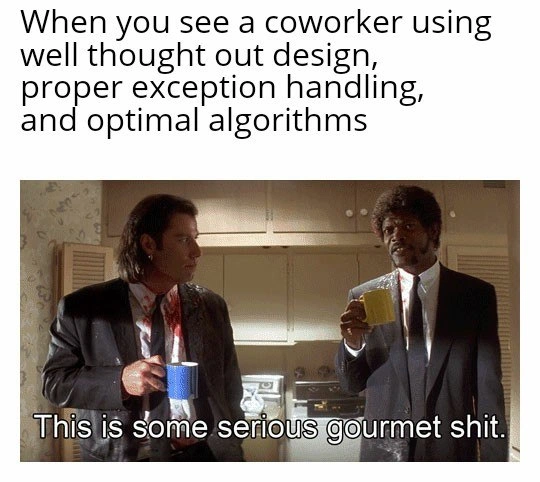
Imagine you’ve been eating plain peanut butter sandwiches for lunch every single day. One day, a friend surprises you with a homemade lasagna that’s absolutely delicious. You take a bite and your eyes light up – wow, this is something else! You’d probably say, “This is amazing, the best food I’ve had in a long time!” In the world of programming, that “lasagna moment” is when a developer sees a piece of code that is written really, really well. Normally code can be kinda sloppy or just average (like those plain sandwiches), but once in a while, someone writes code so clean and well-designed that it feels special. It’s easy to read, it doesn’t break when things go wrong, and it solves the problem in a clever way. The meme shows two characters from a movie praising a cup of coffee and calling it “serious gourmet” stuff. They’re basically acting super impressed. That’s exactly how programmers feel in that moment: astonished and happy. It’s funny because in everyday life we don’t usually gush over code like that, so when we do, we compare it to tasting a fancy treat. In simple terms, the meme is saying: “Finding really good code in a sea of messy code is such a nice surprise, it’s like tasting a gourmet dessert when you expected plain old oatmeal.” And that feeling is both heartwarming and humorous to anyone who writes code.

Level 2: Spaghetti vs Gourmet

For newer developers, let’s break down the feast of concepts here. The meme celebrates “gourmet” code – meaning code of exceptionally high quality – by comparing it to fancy food. Usually, in programming, we warn about “spaghetti code.” That’s a nickname for code that's tangled and messy, like a plate of spaghetti. Spaghetti code has no clear structure: imagine a single giant function doing ten things, variables changing unpredictably, and no comments to explain anything. It’s the kind of code that gives you a headache when you try to follow it. Gourmet code, in contrast, is more like a well-plated dish prepared by a skilled chef: organized, satisfying, and thoughtfully composed. In a team setting (like during code reviews), coming across gourmet code means you see code that is easy to read, well-organized, and works efficiently – basically, the Clean Code ideals you read about in books made real. It’s such a delightful surprise that you might react with an exaggerated compliment, much like tasting an unexpectedly delicious dessert.

Now, what exactly impressed our developer in the meme? First, well-thought-out design. This implies the code was designed with intention and probably follows good design principles. For example, maybe instead of one huge script doing everything, the functionality is split into classes or functions each handling a distinct responsibility (a nod to the Single Responsibility Principle). Perhaps the coworker even used a known design pattern – which is like a reusable recipe for solving a common coding problem. For instance, if the code needed to handle multiple ways of doing something (say different payment methods or different file formats), a junior might write a bunch of if/else checks for each case. But a well-designed approach could use the Strategy Pattern: define a general interface and have separate classes for each variation. The main code then doesn’t need to know details; it just calls the interface. This makes the system easier to extend in the future (you can add a new strategy without messing with the old code). Seeing such foresight in code is like finding a well-organized kitchen in a restaurant – all the tools in the right place, everything labeled, ready for any order.

Second, proper exception handling. Exceptions are errors or unexpected situations that occur when a program runs. Proper handling means the coder anticipated things that could go wrong (like a file not being found, or a network request timing out) and wrote code to deal with those cases gracefully. Poor exception handling would be ignoring errors (letting the program crash or produce wrong results without explanation) or catching every error in one big clump without handling them correctly. Proper handling is more refined. For example, if a function is reading a configuration file, a good developer will check: “What if the file isn’t there or is unreadable?” and then handle that scenario – maybe by using default settings and warning the user, rather than just blowing up with a cryptic error. In code, it might look like:

def load_config(path):
    try:
        with open(path, 'r') as f:
            data = json.load(f)
    except FileNotFoundError:
        log.warning("Config file not found, loading defaults.")
        data = DEFAULT_CONFIG  # use a safe default
    except json.JSONDecodeError as e:
        log.error(f"Config file is corrupt: {e}")
        raise  # rethrow if we can't recover
    return data

In this snippet, the code thoughtfully handles two specific problems: the file missing, and the file being present but containing invalid data. Each exception is caught and dealt with separately. A newbie might not catch these at all (leading to a crash), or might catch any Exception in one big net without distinguishing the cause. But here, the exception handling is precise and graceful. When a colleague does this throughout their code, it shows they care about reliability and user experience – a hallmark of high-quality code.

Finally, optimal algorithms and efficiency. This is about choosing the best method to solve a problem so the code runs faster or uses less memory. It ties into something called algorithm design and complexity (often measured in Big O notation). You might have learned, for instance, that searching for an item in a list one by one is linear time $O(n)$, whereas using a hash set or dictionary can give near constant time $O(1)$ lookups on average. An “optimal algorithm” in context means the coworker didn’t just write any solution, they wrote a good solution from a performance standpoint. For example, if the task was to sort a list of names, a naive approach might be fine for 100 names but terribly slow for a million names. A developer concerned with optimal algorithms might choose a well-known efficient sorting method (like Timsort, which Python uses, or merge sort) instead of trying something goofy like bubble sort (which is much slower at $O(n^2)$). Or they might realize that a task can be solved more directly with a formula instead of a slow loop. The meme likely assumes the coworker wrote code that scales well and doesn’t waste resources.

To give a simple illustration, imagine we need to check if a user ID exists in a list of IDs. A less experienced coder might do this with a loop:

# Inefficient approach:
found = False
for uid in user_ids_list:           # go through each ID one by one
    if uid == target_id:
        found = True
        break

This works, but if the list is huge (say millions of IDs), this check could take a long time in the worst case because it looks at each element. A more optimal approach is to use a data structure optimized for fast lookups, like a set:

# Optimal approach using a set for O(1) average lookup:
user_ids_set = set(user_ids_list)   # convert list to a set
found = (target_id in user_ids_set) # directly check existence quickly

In the second version, checking membership is typically much faster because sets are implemented like hash tables. A developer who consistently makes these kinds of choices is writing efficient, gourmet code. They’re not just solving the problem – they’re doing it in a way that scales and performs well.

When you’re new, you might not immediately see the difference between code that merely works and code that is well-crafted. Over time, though, you learn that things like clear organization (design), anticipating errors (exception handling), and efficient solutions (algorithms) make a huge difference in how easy it is to maintain and trust the code. So in a code review, when a junior dev sees a senior colleague’s code that uses these best practices, it’s eye-opening. You realize, “Oh, this is how it’s done by a pro.” It feels a bit like tasting a dish prepared by a master chef after you’ve been living on instant noodles – the depth of flavor (or in code, the clarity and robustness) is on another level. That’s why the meme jokes that developers declare it “serious gourmet” stuff: it’s half genuine admiration and half playful exaggeration, acknowledging that such perfectly engineered code is special and not encountered every day.

Level 3: Michelin-Star Code

In a typical enterprise codebase, quality can be as uneven as a potluck dinner. We've all slogged through spaghetti code sprinkled with global variables and half-baked functions. So when a developer stumbles upon a section of code with pristine architecture, it's shocking – the good kind of shocking. In this meme’s scenario, a senior engineer doing a code review unexpectedly finds a coworker's commit that has it all: well-thought-out design, proper exception handling, and optimal algorithms. It's the software equivalent of discovering a gourmet meal in a diner known for stale coffee. The image drawn from a Pulp Fiction reference cleverly exaggerates this feeling: two hitmen (our stand-in for seasoned devs) marveling at an exquisite cup of coffee amidst a messy kitchen. Likewise, a veteran programmer, used to wading through messy legacy code, is floored by a module that’s been crafted with almost artisanal care. They’re essentially declaring, “This is some serious gourmet code!” – equal parts praise and disbelief.

Why is this so funny and relatable to developers? Because it satirizes our everyday reality: robust design and clean code principles are well-known in theory, but seeing them flawlessly executed is rarer than a unicorn at a hackathon. The humor stems from this contrast. We preach about SOLID design and design patterns in conference talks, yet many real-world projects devolve into spaghetti unstructured chaos as deadlines loom. Exception handling, for instance, is often an afterthought – who hasn’t seen a try/except that just logs “something went wrong” (or worse, a bare catch(Exception) that silently swallows errors)? Optimal algorithms get traded for “just make it work” hacks. So when a colleague’s code actually checks all the boxes – a thoughtful design pattern here, a graceful error recovery there, plus an algorithm that isn’t O(n^3) – it’s both impressive and comical how unexpected it is. The meme captures that moment of reverence. Seasoned devs might chuckle and nod, remembering how many times they opened a pull request ready to battle a mess, only to be pleasantly surprised by gourmet craftsmanship. It’s a shared joke about our industry: we talk about being “software craftsmen” but are perpetually starved for well-crafted code. And when we finally taste it, we savor it like Jules sipping Jimmy’s premium coffee – eyes wide, exclaiming with genuine respect because we know how serious and rare that level of quality is.

Under the hood, this meme is also a gentle jab at our standards. We call it “gourmet” because truly elegant code is like fine cuisine: it requires skill, experience, and patience. Perhaps the author thoughtfully applied a classic design pattern (maybe a Strategy or Observer) to keep the code maintainable where a newbie might have written a tangle of if-else statements. Maybe they handled every edge case with proper exception handling, ensuring the program doesn’t crash even if it hits weird input or a network glitch. And they didn’t stop there – they picked an algorithm that scales well. (Picture replacing a clumsy quadratic search with a neat hash-map lookup for $O(1)$ efficiency – that kind of thing earns instant respect in a code review.) These choices are the mark of a developer who cares about craftsmanship over quick-and-dirty fixes. For battle-worn engineers (the Jules and Vincents of software), encountering such code is memorable. It highlights the gap between textbook best practices and what we usually encounter at 3 AM while fixing production: the gulf between code quality ideals and real-world codebases full of shortcuts and technical debt. The meme’s punchline lands because every developer can recall that one time they saw code so clean and well-designed that it felt like stumbling on a five-star meal after living on fast food. Such moments are equal parts inspiring and darkly funny – inspiring because they show how good things could be, and funny because of how absurdly rare they are.

Description

A two-part meme using a well-known scene from the movie Pulp Fiction. The top part has white background with black text that reads: "When you see a coworker using well thought out design, proper exception handling, and optimal algorithms". The bottom part of the meme is a still image from the film showing the characters Jules Winnfield (Samuel L. Jackson) and Vincent Vega (John Travolta) in a kitchen, both holding coffee mugs. They are dressed in black suits, and Vincent has bloodstains on his shirt. Jules is looking at Vincent and saying the line which is subtitled at the bottom: "This is some serious gourmet shit.". The meme equates the rare and delightful experience of encountering exceptionally well-written code in a professional setting to the experience of tasting gourmet coffee. It's a humorous expression of admiration and respect for a colleague's high-quality work, a feeling deeply relatable to senior engineers who have waded through countless lines of mediocre or poor code

Comments

7
Anonymous ★ Top Pick Finding code with proper design, error handling, and optimal algorithms in a legacy project is a rare delicacy. You feel obligated to write a unit test for it, not to validate its logic, but just to preserve it in a museum
  1. Anonymous ★ Top Pick

    Finding code with proper design, error handling, and optimal algorithms in a legacy project is a rare delicacy. You feel obligated to write a unit test for it, not to validate its logic, but just to preserve it in a museum

  2. Anonymous

    Code that’s SOLID, idempotent, and O(log n) is the engineering equivalent of single-origin espresso - everyone sips in awe, then quietly bets on who’ll be first to spike it with a static util and ruin the bouquet

  3. Anonymous

    After 15 years in this industry, finding code with actual error handling instead of empty catch blocks feels like discovering a unicorn that also writes unit tests

  4. Anonymous

    That rare moment when you're reviewing a PR and discover your coworker has implemented proper error boundaries, used appropriate data structures with O(log n) lookups, and even added comprehensive exception handling with meaningful error messages - it's like finding a unicorn that also writes documentation. You know they've been around the block when they preemptively handle edge cases you didn't even think to test for, and suddenly your 'LGTM' comment feels inadequate for the artisanal code craftsmanship you just witnessed

  5. Anonymous

    A PR with bounded contexts, a sane exception hierarchy, and O(n log n) made me double‑check the remote - did we fork into a Michelin‑star microservice kitchen?

  6. Anonymous

    Exception handling so proper it logs context without swallowing the stack trace - rarer than O(1) lookups in a NoSQL doc store

  7. Anonymous

    When a PR lands with a coherent domain model, exceptions with retry semantics, and O(log n) hot paths, I swirl the diff like a sommelier - crisp invariants, idempotent finish, hints of bounded context

Use J and K for navigation