Skip to content
DevMeme
3915 of 7435
Solving All Problems with Rust-Flavored Kool-Aid
Languages Post #4261, on Mar 3, 2022 in TG

Solving All Problems with Rust-Flavored Kool-Aid

Why is this Languages meme funny?

Level 1: Miracle in a Bottle

Imagine you have a bunch of big problems and you’re feeling overwhelmed, then you spot a huge magic bottle labeled “Solve All My Problems.” You grab it and hug it tight, thinking, “Yes! This will fix everything!” That’s essentially what’s happening in this picture, but for a computer programmer. The programmer’s “problems” are all the bugs and errors in their software. The big bottle is labeled with Rust, which is the name of a programming language that’s supposed to help keep your programs safe from certain kinds of mistakes (kind of like a strong medicine for buggy programs). The joke is that the developer is treating Rust like a magic potion or miracle drink that will make all the hard problems go away instantly. It’s funny because, just like in real life, there’s no one magical fix for everything. You still have to do the work, and no single tool can solve every problem. But we can all relate to that hopeful feeling: like finding a special trick or tool that we wish could just make things better in one gulp. The meme makes us smile because it shows that wishful moment in a silly, literal way—hugging a miracle bottle—reminding us of the times we’ve all hoped for an easy fix.

Level 2: No More Segfaults

Let’s break down why this meme makes developers grin, especially if you’re newer to the game. First, some background: Rust is a programming language that has become famous for its focus on memory safety and performance. It’s often discussed in the context of low-level programming, the kind of coding where you manage memory and performance very closely (like writing an operating system, game engine, or other programs where C and C++ historically have been used). In those older languages, it’s really easy to make certain kinds of mistakes:

  • You can accidentally use a null pointer – that’s when you have a variable that’s supposed to reference (or “point to”) some data, but instead it’s pointing to nothing (NULL). Using that null pointer (for example, trying to access the thing it’s “not” pointing to) causes a crash, often a segmentation fault. A segfault is basically the operating system stopping your program because it tried to access memory it shouldn’t – imagine walking through a door that says “Do Not Enter: Employees Only” and everything shuts down on you.
  • You can have data races – if you have multiple threads (think of them as parallel mini-programs) running at the same time, and two threads try to change the same piece of data simultaneously without any coordination, you get a race. The outcome can be unpredictable and lead to messed up data or crashes. It’s like two people trying to write on the same whiteboard at the same time; the result is gibberish.
  • You might trigger undefined behavior – this is a big term for “the program did something the language spec didn’t expect, so anything could happen now.” In C/C++, things like reading memory that wasn’t initialized (never given a value), going past the end of an array, or misusing a pointer can put your program into this ghostly realm where normal rules no longer apply. It might crash immediately, it might corrupt data silently, or it might seem to work and then fail later. Undefined behavior is a notorious source of bugs and security vulnerabilities.

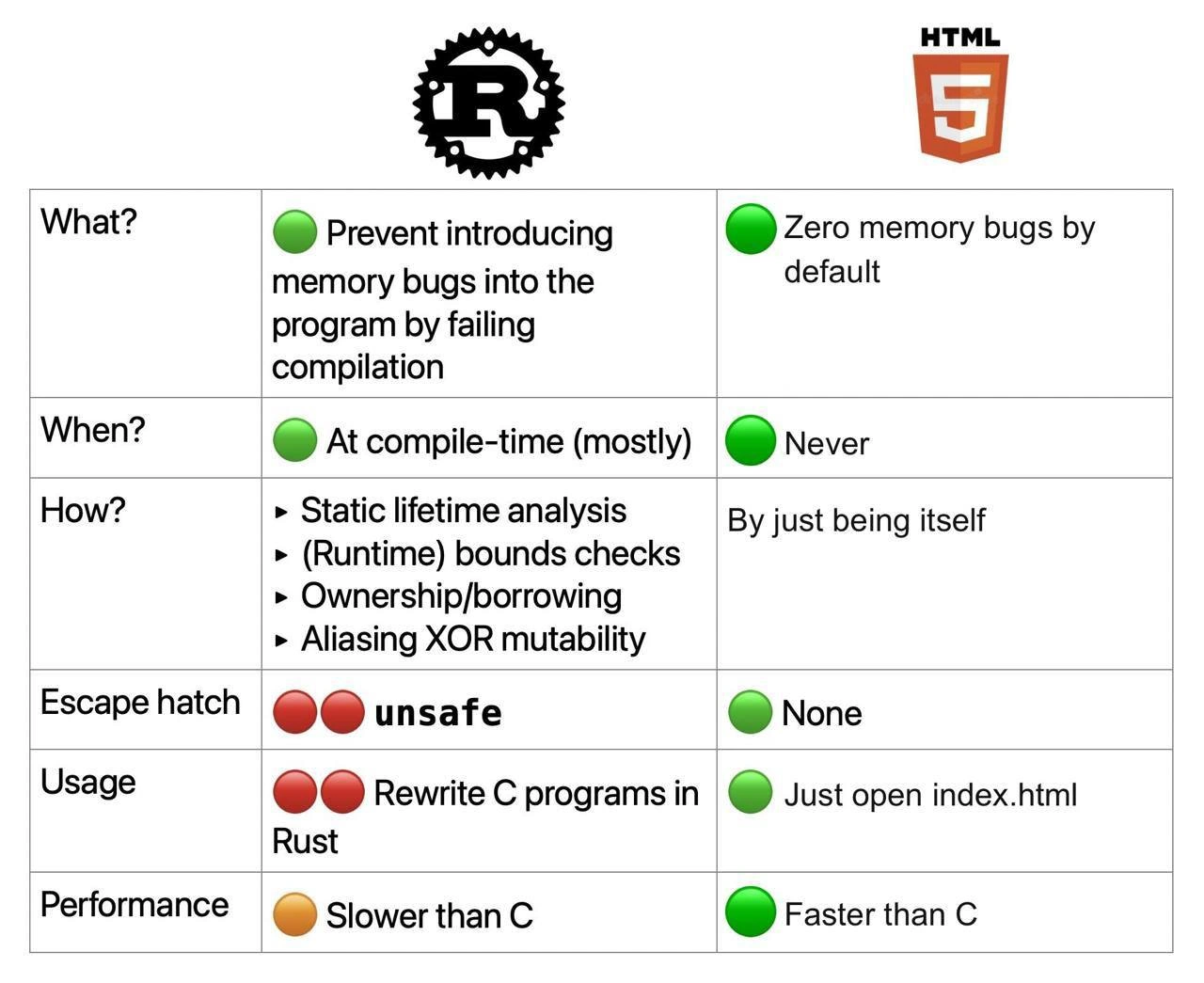
Now enter Rust. Rust was built to tackle those exact problems head-on, but without slowing programs down. The meme’s joke is basically saying: “I’ve got all these problems (null pointers, data races, weird bugs)… I’m going to grab Rust and glug them away!” How can a language be like the mega medicine for these bugs? Rust achieves it with some key features:

  • Ownership and Borrowing: Rust has a strict set of rules about who “owns” a piece of data and how long it’s valid. When a piece of data goes out of scope (like the end of a function), it gets automatically cleaned up (memory freed). You can also “borrow” data (kind of like lending a book) either mutably (you can edit it) or immutably (read-only), but Rust won’t let you break the rules. For example, you can’t have two people editing the same data at once without precautions – if you try, Rust won’t even compile your program. This prevents those data race conditions.
  • No Null by Default: Unlike C/C++ (and even languages like Java or Python where None/null exists), Rust doesn’t have a null reference in the usual sense. Instead, Rust uses the type Option<T> to represent “maybe there’s a value, maybe not.” If a function might return a value or might return nothing, it returns an Option. You as the programmer have to check that option (is there something inside or is it None?) before you use it. That way, you’ll never accidentally do the equivalent of calling something on null and crashing. It’s like Rust insists you look in the bottle to see if it’s empty before taking a drink, so you don’t hurt yourself with an empty glass.
  • Borrow Checker: This is the part of the Rust compiler that checks those ownership and borrowing rules. It’s like a strict safety inspector. If you have a mistake like using data after it’s been “freed” or having two mutable borrows (two “writers”) to the same data, the borrow checker will stop you with a clear error message. New Rust developers often wrestle with these errors, but they’re actually saving you from subtle bugs that would be much harder to diagnose at runtime.
  • Memory Safety without Garbage Collection: Languages like Java or C# use a garbage collector – a background process that automatically finds and frees unused memory so the programmer doesn’t have to. Rust does it differently: it’s more like C++ in that there’s no separate garbage collector, but thanks to the ownership rules, memory is freed deterministically when it’s no longer needed. The benefit is you get C/C++ level performance (no periodic GC pause) while still avoiding issues like double free or use-after-free. Rust developers like to say it gives you “fearless concurrency,” meaning you can write multi-threaded code without fear of data races, and “memory safety guarantees” without sacrificing speed.

So, in the meme, the developer is grabbing a bottle with Rust’s logo on it and saying “Time to solve my problems.” This is a playful way to say: “I’m going to rewrite my project in Rust and all these pesky bugs will go away.” In real life, many projects have indeed been ported from C or C++ to Rust specifically to fix memory safety bugs. It’s not instant magic—you have to actually do the work of rewriting or interfacing with Rust, and you need to learn Rust’s rules (which can be tricky at first). But the meme captures that optimistic moment when a dev thinks “Alright, I’ve had enough crashes and creepy bugs. Let’s bust out the Rust!”

For a newer developer, it helps to know the context:

  • Rust in developer culture: Rust has quickly grown a passionate community. You might have seen online discussions where people suggest using Rust for just about everything system-y. There’s a bit of a running joke about how enthusiastic Rustaceans (Rust fans) can be. They genuinely love that the language gives them confidence their code won’t randomly blow up due to the classic mistakes. So sometimes you’ll hear, “Why not just rewrite it in Rust?” as a half-joking suggestion whenever someone complains about C++ woes.
  • Language wars and silver bullets: In tech, there’s often a “new shiny” thing that people hype up. Before Rust, for example, a lot of folks hyped Go (Golang) as the simple language to rule them all, or Node.js for JavaScript everywhere, or years back it was Java being the enterprise solution to everything. The phrase “silver bullet” is used to mean a single solution that fixes all problems, like a mythical weapon that can slay any monster. The meme is hinting: “Some people talk about Rust like it’s a silver bullet for software bugs.” It’s wink-wink because experienced devs know there’s no perfect solution, but we still get excited about improvements.

In summary, Level 2 explanation: The picture humorously shows a programmer literally embracing Rust (the programming language, personified as a big bottle) to fix their bugs. The text “Time to solve my problems” is exactly what a lot of us think when we adopt a better tool or language: we hope it will solve the messes we’ve been dealing with. Rust in particular targets those really nasty low-level errors (null pointers, data races, etc.), so it feels like the right bottle to grab when you have those problems. The meme is funny because it exaggerates that hope—like Rust is an instant cure-all elixir—while poking a bit of fun at how developers can be overly optimistic (or just desperate!) about new technology. If you’ve ever been frustrated by a segfault in C or a weird pointer bug, the idea of Rust swooping in to save you is both relatable and comically idealized. It’s as if the developer is saying, “I can’t take these bugs anymore. Give me Rust, stat!” and expecting everything to be magically perfect afterward.

Level 3: Rust-Colored Glasses

Seasoned developers will chuckle at this meme because it captures a familiar trope: the silver bullet language mentality. The image of a dev lovingly grabbing a giant Rust-branded bottle and proclaiming “Time to solve my problems” is dripping with irony. It’s a commentary on the current industry hype around Rust and the perennial hope that this new technology will fix all our woes. If you’ve been around long enough, you’ve seen waves of enthusiasm for everything from garbage-collected languages (Java, C#) to scripting languages (Python, JavaScript) to JVM-with-a-twist (Scala, Kotlin). Each time, there’s that undertone of “finally, no more bugs!”—only for reality to set in that no language can single-handedly eliminate all complexity. This meme is essentially putting on Rust-colored glasses: seeing the world with an optimistic Rust tint, believing memory safety will equate to blissful, bug-free coding.

Why Rust specifically? By 2022, Rust had a well-earned reputation as the conquering hero of LowLevelProgramming. A lot of us have been scarred by hard-to-catch C/C++ bugs: the infamous segmentation faults at 3 AM, mysterious heap corruption, or the nightmare of chasing an intermittent data race in a multi-threaded codebase. The promise of Rust is to eliminate those particular demons. And indeed, companies like Microsoft and Apple started experimenting with Rust to rewrite low-level components, aiming to prevent security vulnerabilities caused by memory errors. The developer in the meme is basically saying, “I’m done with those nightmares—Rust will save me.” It’s funny because we know there’s truth there (Rust will stop null pointer dereferences, for example), yet it’s also exaggerated. The meme exaggerates that mindset to the point of a joke: hugging a bottle of Rust like it’s a beloved whiskey that can wash away the pain of legacy C++ code. There’s a dark subtext if you think about it—the parallel between a stressed engineer reaching for alcohol and reaching for a new language. It pokes fun at how we sometimes treat technology like a coping mechanism or escape.

In real development life, adopting Rust can indeed solve specific problems:

  • Use-After-Free bugs? Rust’s ownership rules won’t let you free memory and keep using it.
  • Null pointer dereferences? Rust has no null in its safe subset, forcing Option handling instead. Goodbye, null-dereference crashes.
  • Data races in threads? The compiler’s rules around Send and Sync traits ensure you can’t even compile shared mutable data across threads without proper locks or atomics.
  • Memory leaks? Well, Rust frees memory automatically when variables go out of scope (RAII style), and even though logical leaks are possible, you won’t accidentally forget to free in most cases.
  • General undefined behavior? Safe Rust is designed so that (barring compiler bugs) you can’t invoke undefined behavior at all. There’s an entire book chapter on how to write unsafe code if you really need to, but the meme isn’t about that path — it’s about the shiny safe Rust many adore.

However, a grizzled veteran will smirk because they remember Fred Brooks’ famous adage “No Silver Bullet”. The meme knowingly portrays Rust as a silver bullet language, a quick fix-all like a medicinal elixir. But in reality, Rust, like a stiff drink, might give you courage (and definitely safer memory handling), yet it doesn’t eliminate all problems:

  • Logic bugs: If your algorithm is wrong or you have a off-by-one error, Rust won’t magically correct it. You can’t drink your way out of fundamental logic mistakes.
  • Complexity: Rust has a learning curve. The joke hides the truth that embracing Rust means wrestling with the borrow checker, at least at first. Many a newcomer has spent hours fixing compiler errors to get their code to compile. It’s like a tough love situation—the compiler is strict for your own good, but it can be frustrating.
  • Performance trade-offs: While Rust is designed for speed, sometimes pure safe code might need unsafe for ultra-low-level tasks. The meme doesn’t delve into that nuance; it just shows pure blissful confidence. Seasoned devs know that there’s always a trade-off or an edge case lurking. For example, integrating Rust into an existing C codebase means dealing with FFI (Foreign Function Interface) boundaries, which can themselves become tricky spots for bugs if not handled carefully.
  • Human factors: A language can’t fix a team’s communication issues or bad project management. If “my problems” include unclear requirements or unrealistic deadlines, Rust isn’t a magic cure (though its community might offer moral support!).

The humor also resonates because Rust has been idolized in developer culture recently. Stack Overflow surveys crowned Rust the “most loved language” for multiple years in a row. That hints that many developers genuinely enjoy using Rust and feel confident in it. So the meme riffs on that enthusiasm—Rust evangelists sometimes have almost zealous energy, touting how Rust will prevent all segfaults and secure your software. The character’s happy face and tight hug reflect that almost romantic infatuation with the language. For those of us who lived through earlier “Language Wars,” it’s a familiar sight: whether it was Ruby on Rails solving all web dev issues, or Go eliminating all complexity with simplicity, there’s always something new being hugged like the miracle solution.

So, this meme cleverly combines two references:

  1. Drinking to solve problems – a tongue-in-cheek reference to how developers joke about hitting the bottle when overwhelmed by bugs. Except here the bottle’s label isn’t Jack Daniels, it’s Rust. It’s poking fun at the coping mechanism idea: instead of drowning sorrows in alcohol, the dev wants to drown them in a sea of Rust code. MemorySafety beverage, anyone?
  2. Rust as a silver bullet – the notion that migrating your project from C/C++ to Rust will magically remove all the hard parts. This is the rust_fix_all_bugs meme tag: in reality, Rust fixes memory bugs, but you might get other kinds of headaches (or at least a hangover from fighting the borrow checker at 2 AM).

For a senior engineer, the meme is a wry reminder: yes, Rust is fantastic for certain classes of problems, but let’s not get intoxicated on the hype. It’s hilarious because we’ve all been that optimistic at some point—believing that a new language or framework will be the panacea. And we’ve also been soberly proven wrong later. The seasoned perspective appreciates the meme’s double-edged truth: Rust will help, but it’s not literally a genie in a bottle. Still, we can’t help but smile at the wide-eyed optimism of hugging that Rust bottle. After all, wouldn’t it be nice if solving bugs was as easy as uncorking a new programming language?

Level 4: Type-Checked Tonic

At the cutting edge of systems programming, Rust offers a kind of type-checked tonic for our most pernicious bugs. This meme’s core joke—using Rust as a universal fix—touches on deep technical ambitions. Rust’s design draws on formal language research to eliminate entire classes of errors at compile time. In practice, Rust enforces memory safety through a strict ownership model and the famed borrow checker. Under the hood, every reference in Rust has an associated lifetime and the compiler performs a static proof (of sorts) that no reference can outlive the data it points to. This is akin to having a built-in theorem: if your Rust code compiles, it won’t exhibit undefined behavior like dangling pointers or double frees in its safe portions. It’s almost as if Rust distills decades of type theory into a bottle labeled “No More Memory Corruption.”

Null pointers become a non-issue in Rust because there’s literally no direct way to use a null reference in safe Rust; instead you use the Option<T> type which forces you to handle the “empty” case explicitly. That’s a concept straight out of type theory (the Maybe monad in functional programming, if you want to get fancy) ensuring you can’t just ignore the possibility of “no value.” Data races (two threads unsafely mutating the same memory) are prevented by Rust’s compile-time rules about aliasing: you can have either any number of read-only references or exactly one writeable reference to data at a time, and this is checked before the program ever runs. In concurrency contexts, Rust leverages its type system to require explicit synchronization (Arc<Mutex<T>>, atomic types, etc.) for sharing data across threads, guaranteeing thread safety in safe code. These rules stem from concepts in academia like linear types and ownership types, brewed down into something practical. It’s almost like formal verification lite: while not a full proof of program correctness, Rust’s compiler proves certain bad states are impossible.

To an experienced low-level engineer, this is powerful stuff. We can draw parallels to prior research and languages: for example, the historical Cyclone language was an early attempt at a safe C, and Rust refines similar ideas with modern ergonomics. The meme’s subtext “Time to solve my problems” winks at this grand promise. It’s exaggeration, of course—logic bugs and design flaws won’t vanish just because you’re using Rust—but the technical essence is that Rust does solve memory safety problems by construction. It’s like an antidote concocted from strong compile-time guarantees and zero-cost abstractions (so you don’t pay a penalty for safety in runtime overhead). The humor has a kernel of truth: in theory, if your bugs are the kind that involve segmentation faults, buffer overflows, or race conditions, Rust’s type checker is the guardian that simply won’t let those bugs take a single sip of execution. The language’s ferrous (iron-like) resolve against these issues is so strong that developers joke about Rust as if it were a magic potion. The meme bottles up that sentiment literally.

Let’s peek at a tiny example of Rust’s preventative magic in action, which might be one of the “problems” our meme protagonist hopes to solve:

let mut s = String::from("Rust");
let r1 = &mut s;
let r2 = &mut s; // error[E0499]: cannot borrow `s` as mutable more than once at a time
println!("{}, {}", r1, r2);

In C or C++ you could easily create two pointers to the same string and modify it concurrently (or accidentally use one after freeing the memory). Rust’s compiler bars the door: the second mutable borrow r2 here triggers a compile-time error. This is the famous borrow checker yelling “You shall not pass!” at a potential data race or misuse. The code won’t compile until you fix the access pattern (for instance, by limiting to one mutable reference at a time or using explicit synchronization for multi-threading). In other words, Rust acts like a wise bartender refusing to serve a dangerous drink—preventing that undefined behavior hangover before it happens. This is the technical foundation behind treating Rust as a panacea: it’s built on well-researched principles that genuinely curb memory bugs that have plagued developers for ages.

Description

This image uses an anime art style to depict a character with black hair and a blissful expression, lovingly hugging a giant bottle of what appears to be wine or liquor. The original label on the bottle has been replaced with the official logo for the Rust programming language - a capital 'R' inside a gear. A caption at the bottom of the image reads, 'Time to solve my problems.' The scene is set against a light blue, cloudy sky. The humor is a multi-layered joke for experienced developers. On the surface, it portrays the act of turning to Rust to fix software issues with the same desperate enthusiasm one might turn to alcohol for life's problems. It plays on the reputation of Rust evangelists ('Rustaceans') who passionately advocate for the language as a solution to systemic issues like memory safety bugs and data races that are common in languages like C++. For senior engineers, it's a witty commentary on the 'silver bullet' mentality, where a technology is seen as a panacea, while also acknowledging the genuine power Rust has in preventing entire classes of critical bugs

Comments

9
Anonymous ★ Top Pick My problems were segfaults and race conditions. Now my main problem is the borrow checker. I've successfully refactored my bugs into compiler errors
  1. Anonymous ★ Top Pick

    My problems were segfaults and race conditions. Now my main problem is the borrow checker. I've successfully refactored my bugs into compiler errors

  2. Anonymous

    Nothing like cracking open the Rust bottle - segfaults vanish instantly, but the borrow checker makes you sit through a full retrospective of every lifetime decision you’ve ever made

  3. Anonymous

    After three sprints of fighting the borrow checker, you finally understand why your C++ colleagues keep their distance at conferences

  4. Anonymous

    Rust does solve your problems - it just makes you fight the borrow checker until you forget what they were

  5. Anonymous

    Ah yes, Rust - the language where you spend three days fighting the borrow checker to prove your code is memory-safe, only to realize you could have shipped the feature in C++ yesterday and let production find the segfaults. But here we are, voluntarily subjecting ourselves to compile-time existential crises because 'fearless concurrency' sounds better on our resumes than 'occasional data races.' The real joke? After six months of Stockholm syndrome with the compiler, you'll find yourself unable to write code in any other language without feeling deeply uncomfortable about who owns what

  6. Anonymous

    Rust fixes our segfaults; shame the borrow checker can’t reject undefined requirements at compile time

  7. Anonymous

    CAP theorem fails again? This bottle delivers perfect eventual consistency

  8. Anonymous

    Time to solve my problems - rewrite in Rust: trades 3 a.m. segfaults for daytime meetings about lifetimes and FFI boundaries, and the pager finally sleeps

  9. @interfejs 4y

    more like create way, way more just to give up and return to the old ones

Use J and K for navigation