A Developer's Hierarchy of Intimacy
Why is this VersionControl meme funny?
Level 1: Secret Club vs. Secret Chat
Imagine two friends at school both want to be close to the same person. One friend can send that person a private note during class, but the other friend gets invited over to help work on a secret science project in that person’s garage. They are not the same. The note-passing is like a little personal chat – it’s nice, but it’s something almost anyone could try. Helping with the secret project, though, is like being part of an exclusive club – you get to see and do things that outsiders can’t. The meme is funny because it’s saying that building something together (like sharing a secret project) means you’re a lot closer than just exchanging messages. In simple terms: one person is just talking to him, but the other person is actually trusted to join in something special. That’s why the second person jokingly says, “we are not the same” – it’s a playful way of bragging, like saying “I’m on a totally different level of friendship!”
Level 2: Access Explained
Let’s unpack why this is funny by explaining the terms and context. DM stands for Direct Message, which is a private one-on-one chat, often on social media like Twitter. For example, if you “slide into someone’s DMs,” it means you send them a private message, usually to start a casual conversation (often with a hint of flirting or personal interest). It’s a common phrase outside tech too – basically “I messaged him in private.” There’s nothing hugely official about it; if two people follow each other or have open message settings, a DM is just a click away.
Now, contrast that with being in someone’s private GitHub repository. GitHub is an online platform for developers to host and collaborate on code using the Git version control system. A repository (repo for short) is like a project folder that tracks every code change. There are public repos (anyone can see the code) and private repos (only invited people can access the code). When a repo is private, it’s hidden from the public – you can’t even find it by searching. The only way “in” is for the owner to add your username as a collaborator or team member. That’s an explicit permission you can’t get just by asking casually; the owner has to trust you enough to let you in. Think of it like a secret shared Google Doc: you need that special invite link or permission from the owner, otherwise it’s completely off-limits.
So, if someone says “I’m in his private GitHub repo,” they mean the repository’s owner gave them access to a code project that outsiders can’t see. Maybe he added her as a collaborator, meaning she can pull (download) the code, and possibly even push (upload) changes. That’s a lot more involved than just texting. In developer terms, it implies “we work on important stuff together.” Early-career developers quickly learn the significance of this. For instance, the first time you contribute to a friend’s closed-source app or you join a company, you get added to their private repos. Suddenly, you see all their code, their commit history, maybe even their embarrassingly funny variable names. It’s a moment of trust and inclusion. Not everyone on the internet can get into these projects – you have to be on the inside.
Meanwhile, being “in his DMs” only means you’re talking privately. It could be meaningful on a personal level, but it doesn’t require any special skill or formal invite beyond perhaps mutual social media followings. Almost anyone can attempt to DM another person; they might get ignored or left on read, but it’s not a protected resource in the same sense. There’s no GitHub-like approval process to send someone a message (aside from maybe them accepting message requests). It’s basically just showing up in their inbox.
The joke here is comparing that normal social interaction with the more “elite” status of coding collaboration. In dev communities, people joke about things like having contributor status on a cool project as a badge of honor. This tweet is saying, “You might be flirting with him in chat, but I have something better: I’m actually writing code with him!” It’s funny because it’s an exaggerated comparison – most people wouldn’t normally compare romantic messaging with programming together, right? But for developers, sharing a private repo can be a pretty big deal. It means you’ve entered a trusted circle where you two might be building software or at least sharing nerdy ideas. It’s a bit like saying, “Sure, you have his attention for a moment, but I have his long-term collaboration.” One is a quick conversation, the other is an ongoing partnership (at least in code).
For a junior developer or someone new to version control, think of it this way:
- Direct Message (DM) – A private text message on platforms like Twitter, Facebook, etc. It’s personal communication, often used to chat or flirt. For example, if you admire a programmer on Twitter, you might send a DM saying “Hi, I love your work!” hoping they respond. It’s informal and not visible to others.
- GitHub Repository – A project space for code. It contains all the files, folders, and history of changes (using Git). Developers share code here. If it’s a public repo, anyone can see the code and even suggest changes (via something called a pull request). If it’s private, only the owner and invited collaborators can access it.
- Private Repo Access – Being invited to a private repo means the owner trusts you with their code. You’d get a notification like “You have been added as a collaborator to the repository
him/secret-project.” After that, the repo appears in your GitHub view and you cancloneit to your computer, read the source code, run it, and maybe contribute. It’s akin to being on a special team. If you’re a new developer, imagine a senior at your school or your mentor gave you access to their cool app’s code – you’d likely feel pretty special! - Permissions and Trust – GitHub doesn’t let just anybody write to someone else’s repo; you need write access. This is often controlled by role (for example, Admin, Maintainer, Collaborator, etc. in a project). Being on that list is like being in a trusted circle. Juniors experience this when joining their first team project – you can’t push code until someone gives you the rights. That’s why being "in his private repo" is brag-worthy in the meme: it implies “I’ve leveled up from fan to collaborator.”
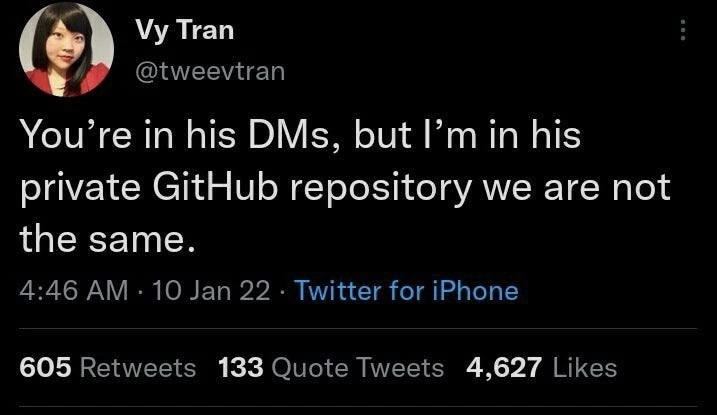
The tweet format itself – a screenshot of a Twitter post – is a common way tech jokes spread. The author, Vy Tran (@tweevtran), is making a playful comparison that hits home for people who live and breathe code. It’s mixing the language of relationships with the language of repositories. Many people in tech find this hilarious because it’s an inside joke about what we value. It’s saying, in effect, developer relationships sometimes have their own milestones: not just anniversaries or Instagram selfies, but things like “we share a private repo.” 😄 For someone outside our tech bubble, the idea of equating GitHub access to relationship status might seem bewildering – and that contrast only makes it funnier for those in the know. In summary, the meme exaggerates how important version control and coding collaboration are to developers, by jokingly ranking it above a normal social media interaction. It’s a geeky twist on the classic “we are not the same” meme format, and it’s funny because it’s partially true: in the software world, working on a private project together is a special kind of bond.
Level 3: Role-Based Romance
This meme plays on developer culture by comparing two very different kinds of “access” in a person’s life: sliding into their DMs versus being added to their private GitHub repository. The punchline “we are not the same” highlights a tongue-in-cheek hierarchy of trust. In the world of software development and version control, having collaborator access to someone’s private repo is a big deal – it’s an exclusive, permissioned role – whereas anyone with a social media account might try to send a direct message. It humorously frames social relationships in terms of access control: one person has basic user privileges (just a casual chat), but the other boasts elevated rights (code collaboration). In dev-speak, the meme is a permissions flex. Only a select few get added as collaborators on a private code project, so it’s like saying: “You might have his attention in chat, but I have his trust in code.”
From a senior developer’s perspective, this joke lands because it conflates romantic rivalry with repository access levels. It’s the classic “You’re in his DMs” meme format applied to DevCommunities values. In a team or open-source context, inviting someone to a private GitHub repo implies a strong working relationship (or at least that you’re co-conspirators on some top-secret project). The meme taps into that insider feeling: GitHub is essentially a social network for code, so being “in his private repo” is like being in an inner circle. Developers guard their private projects carefully – whether it’s a stealth startup idea or an embarrassingly hacky hobby app – and they don’t hand out access to random people. That exclusivity makes for a great contrast with the common act of messaging. After all, in tech terms, reading someone’s commit history or having the power to git push to their repository can feel more intimate than liking their Instagram post. It’s collaboration vs. flirtation, pull requests vs. pickup lines. No wonder the tweet garnered thousands of likes: it speaks to our shared experience that building things together (even just code) signals a deeper connection in our nerdy hierarchy of affection. We laugh because it’s a bit absurd yet relatable – only in a developer’s world would repository access be the ultimate relationship flex!
To break down the difference, consider how each scenario would be viewed in tech terms:
| Sliding into DMs 🚪💬 | Accessing Private Repo 🔐💻 |
|---|---|
| Social media approach: sending a private message on Twitter or another platform. It’s a personal text, often casual or flirty. | Developer approach: getting an invite to someone’s GitHub project. Now you can see and contribute to their codebase. |
| Low barrier: if their inbox is open, almost anyone can try a DM. It doesn’t require special skills, just courage (or luck that they read it). | High barrier: you can’t even see a private repository without explicit permission. Only trusted collaborators or team members are let in. |
| Ephemeral interaction: DMs are basically chat – they might be deep conversations or just memes, but they leave no lasting mark on the person’s work. | Lasting contribution: repository access means you could actually shape their project. Every commit you make is recorded in version history (a permanent log of your involvement). |
| Indicates personal interest, sure – you have their username and some rapport if they reply. But it’s one-on-one and off the record from a coding perspective. | Indicates professional/creative trust – you have their project’s keys. It’s like being on the “dev team.” Your relationship is now on the record in code. |
| Example: sending him a funny coding meme via DM. Everyone does that. | Example: opening a pull request in his private repo. Not everyone gets to do that! |
In other words, private repo access is an exclusive club. The tweet exaggerates the pride of that technical closeness. It resonated especially with developers who might jokingly value a GitHub collaboration as a higher plane of friendship (or courtship 😅). It flips the script: typically, people brag about romantic or social achievements, but here the brag is purely nerdy – “I have push access, beat that!” It’s funny because it’s true in its own way: merging code together can be a more significant bond for two devs than exchanging a few DMs. The meme is winking at how we in the tech community sometimes prioritize version control trust over social convention. And honestly, if someone invites you to their super secret project repo, that’s basically the developer equivalent of meeting the parents. We’re not the same; one of us is running git clone on the important stuff!
# Who's closer? A playful pseudo-code comparison
user_A = "DM contact" # just chatting casually
user_B = "Repo collaborator" # trusted to collaborate
if user_B == "Repo collaborator":
print("Access granted to private code 🎉") # Big trust move
else:
print("Stuck sending DMs 😜") # Just a casual acquaintance
Description
This image is a screenshot of a tweet from user Vy Tran (@tweevtran) on a black background with white text. The tweet reads, 'You're in his DMs, but I'm in his private GitHub repository we are not the same.' Below the main text, the timestamp '4:46 AM · 10 Jan 22 · Twitter for iPhone' is visible, along with engagement metrics showing over 4,600 likes. The profile picture shows a woman with dark hair. The humor is derived from the 'We Are Not The Same' meme format, which asserts superiority by contrasting two different situations. In this context, it humorously reframes the concept of relationship intimacy from a developer's perspective. While being in someone's Direct Messages (DMs) implies a degree of personal connection, being granted access to a private GitHub repository signifies a much deeper level of trust and collaboration. For experienced engineers, sharing a private codebase is an act of significant professional vulnerability and respect, making it a tongue-in-cheek indicator of a more serious 'commitment' than a simple social media chat
Comments
10Comment deleted
Getting DM access is like a 200 OK. Getting private repo access is like being added to the sudoers file
Keep flexing about being in his DMs; I’m in his CODEOWNERS file - every merge still needs my blessing
The real intimacy test in tech isn't sharing your Netflix password - it's adding someone as a collaborator to your private repo where they can see your commented-out console.logs, that TODO from 2019, and the commit messages you wrote at 3 AM that just say 'fixed stuff'
Repo access is the deeper intimacy: DMs show you what he wants you to read, the commit history shows you who he really is at 3am
Being granted access to someone's private GitHub repository is the developer equivalent of getting the keys to their apartment - except the commit history reveals way more embarrassing secrets than their browser history ever could. It's not just about trust; it's about being willing to see their 3 AM 'fix typo' commits and that experimental branch they swore they'd delete two years ago
She's in his DMs, I'm in his .env file - we're galaxies apart
You’re in his DMs; I’m in his private GitHub with admin RBAC - one of us triggers a typing indicator, the other can trigger a company-wide PagerDuty
DMs are fleeting; write access to a private repo survives CODEOWNERS, branch protection, and SOC2 - that’s commitment
:D: Comment deleted
Ofc not the same. He is his boyfriend. You are just a labor to him. Comment deleted