
DataFormats Post #4260 · source on Telegram
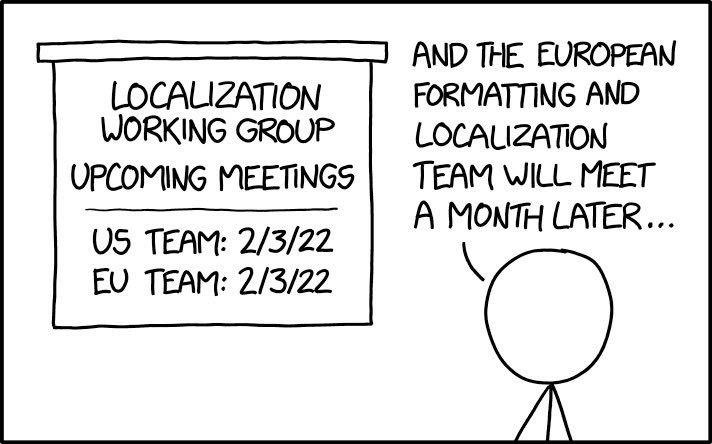
Localization Meets Ambiguous Date Formats
Description
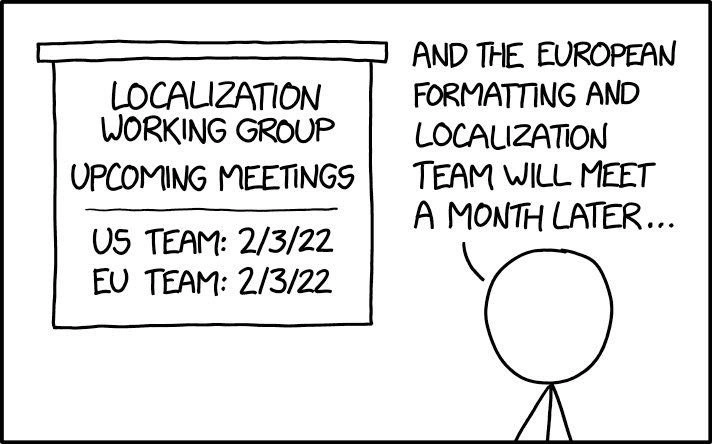
The image is a black-and-white hand-drawn comic about a localization working group. A sign reads "LOCALIZATION WORKING GROUP", "UPCOMING MEETINGS", "US TEAM: 2/3/22", and "EU TEAM: 2/3/22". A stick figure on the right says, "AND THE EUROPEAN FORMATTING AND LOCALIZATION TEAM WILL MEET A MONTH LATER..." The joke is that the same date string means February 3 in common US formatting and 2 March in common European day-first formatting, which is exactly the kind of ambiguity localization teams exist to prevent.
More like this
More like this in DataFormats →
Use J and K for navigation
Comments
52Comment deleted
ISO 8601 exists because `2/3/22` is a distributed-systems bug wearing a calendar costume.
ffs Comment deleted
Oh, I think they are too busy right now for this Comment deleted
The best time format is 2022 3. 4. 14:41 (YYYY MM DD hh:mm) Comment deleted
March 4, 2022 is written? Comment deleted
Yes Comment deleted
why dots Comment deleted
Why not also that part I dont care about Comment deleted
aaah now understand Comment deleted
This is written like numbers (biggest value in the front smallest to the end) Comment deleted
lets go for base10 in datetime Comment deleted
https://m.xkcd.com/1179/ https://ijmacd.github.io/rfc3339-iso8601/ Comment deleted
yay Comment deleted
The best one is the one plasing everything ontop of eachother Comment deleted
Idk why US citizens use even for thier dates little endian Comment deleted
Also idk why germans write 137 but pronounce it as "100, 7 and 30" Comment deleted
Russia: 6 шесть 10 десять 5 пять 65 шестьдесят пять (6 * 10 + 5) looks logical? yes 37 тридцать семь (3 * other_10 + 7) looks logical? probably yes 42 сорок два (40? + 2) 96 девяносто шесть ("9 but 100"? + 6) 9 девять 100 сто looks logical? probably no 11 одиннадцать (1 + other_10) 12 двенадцать (2 + other_10) 30 тридцать (3 * other_10) 13 тринадцать (3 + other_10) what the fuck... Comment deleted
What is the word for 10? Comment deleted
fixed Comment deleted
Ah Comment deleted
"десять", but in older times it was "дцать" (?) Comment deleted
Ah Comment deleted
42 сорок два (40? + 2) because there is no четырдцать because nobody wants to traumatize the tongue 96 девяносто шесть ("9 but 100"? + 6) because there is no девядцать 11 одиннадцать (1 + other_10) what's the problem? Comment deleted
1387465 is pronounced as: 1000000, 300, 7 and 80000, 400, 5 and 60 Comment deleted
what the.... Comment deleted
Hungarian it is: 1 egy 2 kettő 3 három 4 négy 5 öt 6 hat 7 hét 8 nyolc 9 kilenc 10 tíz 11 tizenegy 12 tizenkettő 13 tizenhárom 19 tizenkilenc 20 húsz 21 huszonegy 24 huszonnégy 30 harminc 31 harmincegy 40 negyven 41 negyvenegy 50 ötven 60 hatvan 70 hetven 80 nyolzvan 90 kilencven 100 száz 101 százegy 200 kettőszáz 200 kétszáz 202 kettőszázkettő 202 kétszázkettő Comment deleted
@yuki0iq Comment deleted
Looking Comment deleted
I think it is very logical to pronounce. (Could be only because this is my primary language) Comment deleted
1 egy 10 tiz -- what 11 tiz en egy (10 en 1) 2 ketto 20 husz -- what 21 husz on egy (20 on 1) -- what? 3 harom 30 harminc -- maybe 31 harminc egy (30 1) -- what? 4 negy 40 negy ven (4 ven) -- maybe, no hope... 41 negy ven egy (40 1) looks logical 100 szaz 200 ketto szaz (2 100) -- logical? 200 kettszaz -- what? Comment deleted
1* tizen* 2* huszon* You cant say "húsz on" it makes not much sense. Its really be understood that way Comment deleted
what are "en" and "on"? Comment deleted
Its not a seperate word. Its just that its twenty and something Comment deleted
why not for 30-90? Comment deleted
Because Harminc is from "older?" numbers Comment deleted
ahhh, legacy Comment deleted
Egy Két Há Négy Öt Hat ... Comment deleted
Used in musical tacting for example Comment deleted
Also look what happens to the marking in tíz húsz etc Comment deleted
ohhh Comment deleted
Probably because you cant say the full numbers in one tact😂😂😂 Comment deleted
I mean you can Comment deleted
But it's not sounding good/understandable Comment deleted
Btw: cs dz dzs gy ly ny sz ty are one sound and are also defined as 1 letter Comment deleted
but are people throwing it away or is it persistent? Comment deleted
The dzs is only used in 2 words so idk why its still in our alphabet... but everything else is very important Comment deleted
You also can never split them Comment deleted
If you want to double them, then you only double the first one (dzs can't be doubled and there are literally 2 words that use it) Like double sz would be ssz Comment deleted
L sounds just like the L in hello. But LY sound like Y in you. The J sound exactly the same. This is the only thing in Hungarian writing that has no true rule. Because it doesn't matter which one you use while writing. In spoken language its the same Comment deleted
write 100 + 20 + 3 in flie names: 123 for everyday stuff: 321 Comment deleted
days change quicker, years you need not very often Comment deleted
sort to folders like 2022-03 Comment deleted