The Judgmental Rubber Duck
Why is this Debugging Troubleshooting meme funny?
Level 1: Talking to a Toy
Imagine you have a really tricky problem to solve, like a difficult puzzle or you can’t find where you left your favorite toy. You try and try, but you just can’t figure it out. So, you grab your teddy bear (or any toy) and start telling it the whole story of the problem: what you’ve done, what you’re looking for, every little detail. Now, the teddy bear isn’t going to talk or give you answers (it just sits there with a cute, blank face). But while you’re talking it through, something magical happens — you suddenly realize the answer all by yourself! Maybe you remember that you left your toy under the bed when you’re describing your day, or you notice a missing piece of the puzzle as you explain each part. The teddy bear didn’t say a word, but just talking out loud helped you think better and solve the problem.
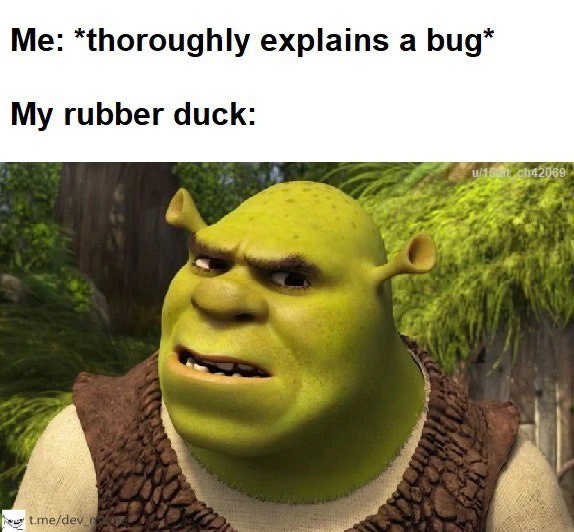
That’s exactly what this funny picture is about. In the picture, a programmer (someone who writes code) is stuck on a bug (which is like a mistake in a computer program). They “explain the bug” to a rubber duck, which is like them talking to a toy. The rubber duck (shown with a silly Shrek face for fun) just listens quietly and doesn’t respond. And guess what? By doing that, the programmer figures out the solution! It’s funny because normally you’d think you need a smart friend or a teacher to help, but sometimes even a silent toy friend can help you solve something just by listening. The joke is showing that talking to a toy (even a goofy one) can make a tough problem suddenly become clear — and that can feel both hilarious and awesome when it happens.
Level 2: Debugging Out Loud
At its core, this meme is about rubber duck debugging, a well-known technique in programming. The term comes from the idea of literally keeping a toy rubber duck at your desk and explaining your code problems to it. Here’s how it works in practice: you hit a bug (i.e., an error or unexpected behavior in your code) and you’re not immediately sure what’s causing it. Instead of jumping straight into random fixes, you take a step back and verbally walk through the problem, as if the duck is your coworker. You might say, for example, “Okay, Duck, I fetch the user data, then parse it, but at this next step the value is null... why?” As you describe each part of the process to this silent listener, you often catch the mistake yourself — maybe you realize you never initialized a variable, or you notice a logic flaw in what you’re describing. The duck, of course, doesn’t actually respond or give advice (it just stares blankly, like Shrek in the image), but the act of explaining the bug thoroughly helps you see the issue from a clearer perspective. It’s like having an unbiased, non-judgmental pair of ears that forces you to slow down and hear what you’re really saying.
In the meme, the top caption is written in a familiar format that sets up a scene:
- Me: “thoroughly explains a bug” – This implies the developer is going over every detail of the problem out loud. The asterisks around the phrase indicate it’s an action being performed (not literally spoken, but happening).
- My rubber duck: – This is the “listener” in the scenario. What follows is just an image (since a rubber duck can’t speak). The meme uses a picture of Shrek with a neutral, almost confused expression as a stand-in for the duck’s reaction.
Why Shrek? Shrek is a funny choice because he’s a big green ogre from the animated movie "Shrek", known for his quirky personality. Here, his face has been edited slightly (blurred with a green rectangle) to anonymize him, but you can still tell it’s Shrek giving a kind of vacant stare. The shrek_blank_stare is just a humorous way to show the duck’s completely silent, unblinking response. In other words, the rubber duck (a small cheerful toy) is being humorously represented by Shrek (a large ogre) for comedic effect. There isn’t a deep connection between Shrek and debugging – it’s funny precisely because it’s a random, absurd pairing. The contrast between the developer “thoroughly explaining a bug” and Shrek’s dumbfounded look really drives home the joke: the duck doesn’t need to say anything at all. It just sits there, perhaps with the same facial expression Shrek has, and that’s enough for the developer to figure things out.
This scenario is extremely relatable in terms of DeveloperExperience_DX and SharedPain:
- RelatableDeveloperExperience: Almost every programmer has experienced being stuck on a bug, then discovering the answer only when they tried to describe the problem to someone else. Sometimes you draft a long question for Stack Overflow or start to ask a colleague for help, and halfway through writing or speaking, you go “Never mind, I found the solution.” It’s both a huge relief and a bit funny that explaining it was the key.
- SharedPain: We joke about it because it’s a shared little frustration — you might spend hours confused, but the moment you calmly explain the code from start to finish (even to a silent partner like a duck), the bug becomes obvious. It’s almost like the bug was hiding until you approached it methodically.
Let’s break down the elements:
- “Me: thoroughly explains a bug” – The developer is going step-by-step through the code or the problem scenario. This indicates a very detailed explanation, just as one might do when seeking help from a senior engineer. It implies the person is desperate enough to articulate everything clearly.
- “My rubber duck:” – The rubber duck is the “person” listening. Of course, a toy duck can’t actively listen or respond, but the phrase sets up that the duck is playing the role of an assistant or pair programmer here.
- Image of Shrek with blank stare – This image is the punchline. It visually shows the duck’s “reaction” as absolutely no reaction. Shrek’s face looks a bit puzzled or blank. That’s exactly the face a little rubber duck would be making (if it had a face capable of expression) while you unload all your technical troubles onto it. It’s like the duck is saying, “...uh, okay?” in the most neutral way possible — which is perfect, because the duck isn’t actually going to solve the bug for you.
The comedy comes from the idea that the rubber duck is effectively your senior debugging partner. In a real workplace, a “Senior Engineer” or “Senior Developer” is someone with a lot of experience who mentors others and helps debug really tough problems. They often cost a lot to hire and have deep knowledge. The meme tongue-in-cheek suggests that a $3 rubber duck can perform a similar role in debugging. Of course, the duck isn’t actually writing any code or giving you expert tips, but simply acting as a silent listener. Sometimes, that’s all you really needed: just someone (or something) to listen patiently while you unravel the issue yourself. It’s a gentle jab at how sometimes even the most expensive and sophisticated resources aren’t as immediately helpful as simply talking out loud. And it’s also a testament to how quirky and creative the developer community can be — we’ll use anything, even a bath toy, to improve our coding process!
For a newcomer or junior developer, this meme is a playful introduction to an important lesson: when you’re stuck on a coding problem, try explaining it out loud. It might feel weird, but it often works wonders. You don’t literally need Shrek or a rubber duck; any object (or even just pretending someone is listening) will do. The key is the process: by explaining, you’re forced to organize your thoughts and often you catch the bug on your own. So the next time you see a programmer with a toy on their desk, now you know — that’s not just decoration, that’s their debugging buddy!
Level 3: The $3 Senior Engineer
In the realm of debugging, sometimes a $3 rubber duck can feel like the most experienced engineer on your team. This meme riffs on the beloved practice of rubber duck debugging – a technique where programmers explain their code, line-by-line, to an inanimate object (often a little yellow duck) in order to find mistakes. It sounds silly, but every senior developer knows the shocking efficacy of this method. Why does it work? Because articulating a problem out loud forces you to mentally step through your logic and assumptions. In essence, you’re performing a meticulous code review on yourself, with the rubber duck as your silent auditor.
The humor here is that the duck’s blank stare – represented by Shrek’s deadpan face – is all it takes to trigger an epiphany. We’ve all had that uncanny moment where we start describing a nasty bug to a teammate, only to blurt out "Oh wait, I see the issue now". In many cases, the teammate barely said a word! Rubber duck debugging formalizes this self-discovery process: instead of bothering a colleague (or waking your lead at 3 AM), you grab your trusty toy duck and start talking. The meme caption nails this dynamic:
Me: thoroughly explains a bug
My rubber duck: [blank Shrek stare]
That vacant Shrek expression is exactly the non-reaction you get from a plastic duck — and ironically, that’s all you needed. The joke is calling the duck your “senior debugging partner,” implying this cheap little listener is as good as a high-paid senior engineer when you’re troubleshooting. It’s poking fun at the fact that often the act of explaining a problem is what catalyzes the solution, not some magical advice from on high. In other words, the silent listener (be it a duck or a disinterested ogre) helps you solve the bug by forcing you to hear your own logic.
There’s an unspoken camaraderie in this meme too. DeveloperExperience_DX often includes long hours of frustration with elusive bugs. When you finally crack the issue by talking it out to a duck, it’s a triumphant moment only other devs truly appreciate. It’s both humbling and hilarious: humbling because you realize the answer was in your head the whole time, and hilarious because your “mentor” was a $3 bath toy. The shared pain of Debugging_Troubleshooting is what makes this so relatable and funny. Every developer from newbie to veteran can recall a facepalm moment where after hours of tearing your hair out, simply narrating the problem out loud made the solution blindingly obvious. Hence the meme’s popularity in DeveloperHumor circles — it’s basically a rite of passage to discover that your most reliable debugging buddy might just be a piece of rubber that never even blinks.
To really appreciate the satirical “senior engineer” comparison, consider how a real senior colleague might help versus the duck:
| Helping Hand 🧑💻 (Senior Dev) | Helping Quack 🦆 (Rubber Duck) |
|---|---|
| Listens patiently while you describe the problem. | Listens silently without interrupting. |
| Occasionally asks a simple question like "Have you checked the input?". | Stares blankly, making you fill the silence with more explanation. |
| Might point out the mistake after hearing enough. | Makes you realize your own mistake as you explain it. |
| Isn’t always available (they need sleep or coffee). | Available 24/7 on your desk, no complaints at 3 AM. |
| Costs a full salary (senior devs aren’t cheap!). | Costs $3 one-time (plus a few odd looks if coworkers catch you talking to it). |
By juxtaposing Shrek’s face with the phrase “My rubber duck:”, the meme exaggerates how utterly unresponsive our debugging partner is — yet that’s perfectly okay, even ideal. The blank look is, in effect, the duck performing its job: no matter how convoluted or absurd your explanation gets, it just keeps “listening”. Chuckling behind the scenes is the implicit understanding that this goofy technique actually stems from solid cognitive principles. In fact, the idea was popularized decades ago (legend has it that “The Pragmatic Programmer” book introduced the rubber duck idea) and has saved countless developers from endless print-debugging or fruitless Google searches. The experienced perspective here is clear: sometimes the most advanced debugging tool isn’t a fancy IDE or a stack trace, but simply explaining the problem out loud to an indifferent audience. This meme celebrates that insider knowledge with a wink — your senior debugging partner might not even have a pulse, but hey, it gets the job done!
Description
A two-part meme about the software engineering practice of 'rubber duck debugging.' The top part consists of two lines of text: 'Me: *thoroughly explains a bug*' and 'My rubber duck:'. The bottom part is a close-up image of the animated character Shrek, who is shown with a skeptical, confused, and slightly judgmental expression. The humor lies in personifying the inanimate rubber duck with Shrek's expressive face. The joke is that when a developer explains a problem out loud to an object, they often realize the solution on their own, and the 'duck's' imagined reaction is one of disbelief at the obviousness of the mistake the developer was just making
Comments
7Comment deleted
My rubber duck is the best pair programmer I've ever had. It doesn't argue about tabs vs. spaces, and its silence is less judgmental than a senior dev's
Amazing how a decade of distributed-tracing budgets can’t beat the ROI of verbally diff-ing your stack trace to a bath toy
After 15 years in the industry, I've realized my rubber duck has heard more about race conditions, memory leaks, and distributed consensus failures than most junior developers - and it still gives me the same skeptical look when I blame the compiler
The rubber duck debugging method works brilliantly until you realize your duck has the same facial expression as your tech lead during code review - that moment when you're three sentences into explaining why you needed a nested ternary operator inside a switch statement wrapped in a try-catch, and you suddenly understand why your PR has been sitting there for two weeks
Shrek's glare: the ultimate reminder that your 'thorough' bug explanation just proved it's an off-by-one in a 10k LOC monolith
My duck exposes the ideal debugging API: zero methods, five‑nines uptime, and somehow converts Heisenbugs into deterministic repro steps just by letting me stream logs verbally
After 20 years, my rubber duck is a more effective SRE assistant than our $3M observability stack - every time I narrate the incident, the Heisenbug collapses into a missing null-check