Skip to content
DevMeme
815 of 7435
Python's Invisible Menace
Languages Post #922, on Dec 19, 2019 in TG

Python's Invisible Menace

Why is this Languages meme funny?

Level 1: The Invisible Block

Imagine you're building a tower out of toy blocks, and one of the blocks is completely invisible. You start stacking, but suddenly your tower collapses because that invisible block was out of place and you couldn't see it. You’d feel confused and a bit annoyed, right? You might even jokingly blame that invisible block for knocking everything over. In this meme, a hidden space in the code is like that invisible block causing the whole thing to fail. The programmer gets so frustrated that they jokingly call this sneaky invisible piece a very rude name (like a big bad insult) to vent their feelings. It sounds exaggerated, but that's what makes it funny – they're basically yelling at an empty space for being a troublemaker and messing up their work, which is a silly way to deal with the frustration.

Level 2: Invisible Whitespace Woes

In Python, how far you indent a line (adding spaces or a tab at the beginning) determines the code's structure. Many other languages use braces {} or keywords to mark a code block, but Python uses indentation levels. For example, after a statement that ends with a colon :, like a function definition or an if statement, Python expects the next lines to be indented to form a block of code under it. If that next line isn’t indented, or isn’t indented correctly, you'll get an error like IndentationError: expected an indented block. In plain terms, Python is telling you "Hey, I was expecting you to indent some code here, but I didn't find it."

Let's look at a simple example. This code will trigger an indentation error because the print line is not indented under the function:

# Incorrect Python code - missing indentation
def oven_timer():
print("Ding!")  # This line should be indented, but it isn't
# If you run this, Python will complain:
# IndentationError: expected an indented block

To fix it, you simply indent the print line (usually by 4 spaces):

# Correctly indented code
def oven_timer():
    print("Ding!")  # Now it's indented inside the function block

Now Python is happy because it sees the indented block of code it expected.

The tricky part for beginners is that indentation uses whitespace characters that are normally invisible. A space is the character you get by pressing the spacebar (it just looks like an empty gap), and a tab is the character from the Tab key (which moves the text cursor over by several spaces, usually). When looking at code in a normal editor, you usually can't tell just by looking whether a line is indented with spaces or with a tab character, or how many of them there are. This can lead to confusion:

  • You might think two lines line up perfectly, but one line has, say, 4 spaces and another line has a tab character. Visually they can look identical, but Python sees them as different indentation.
  • Python 3 actually forbids mixing tabs and spaces for indentation because it can’t consistently interpret the code block if you do that. If you mix them, you'll get another kind of error ("inconsistent use of tabs and spaces in indentation").
  • You might also accidentally add whitespace to an empty line. An empty line that has one space on it is not truly empty – that space can make Python think your block of code hasn't ended yet, leading to confusion or errors.

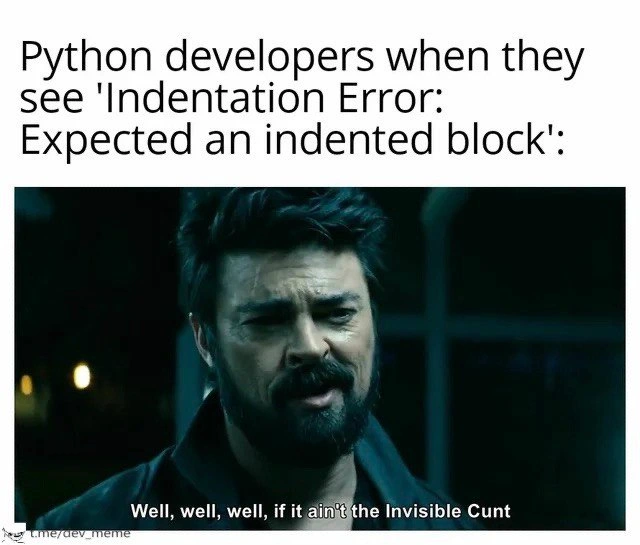
These are the whitespace woes that the meme is pointing out. The top text specifically mentions the error message 'Expected an indented block' which every new Python coder encounters sooner or later. It’s practically a rite of passage. The bottom image is from the TV show The Boys, where the character Billy Butcher sarcastically says, "Well, well, well, if it ain’t the Invisible C**t," to an enemy who can turn invisible. In this meme, that quote is aimed at the invisible troublemaker in our code – the hidden whitespace error. It's a crude joke, but it's poking fun at how something we can't even see (an "invisible" space or tab) can break our program and drive us a bit crazy.

So, if you're a newer developer and you see this IndentationError:

  • Don’t panic. It usually just means you need to indent or fix the indentation on one or more lines.
  • Check that every line that should be part of a block (after a def, if, for, etc.) has extra spaces in front of it. By convention, Python uses 4 spaces for each indent level (and many editors will insert these automatically when you press Tab).
  • Make sure you're consistent: use the same thing (spaces versus tabs) for all your indents. A common recommendation is to use spaces only (that’s what most Python developers do, as per PEP 8 style guidelines) because mixing tabs and spaces can easily cause these errors.
  • If you're really stuck, try turning on a feature in your code editor to display whitespace characters. This will put little symbols (like dots or arrows) where your spaces and tabs are, so you can literally see the invisible characters and figure out where the indentation went wrong.

In short, this meme is a funny exaggeration of a simple Python mistake. It’s saying: "We’ve all been there, frustrated by an invisible space that broke our code." Once you learn about Python's indentation rules, you'll understand why the developer in the meme greets that error message with snarky, exasperated humor.

Level 3: Crouching Tab, Hidden Space

Ah, the dreaded IndentationError: expected an indented block. Seasoned Python developers greet this message like an old nemesis showing up uninvited to the party. The meme nails the reaction: a weary, deadpan line straight from Billy Butcher:

"Well, well, well, if it ain't the Invisible Cunt."

This NSFW quip from The Boys perfectly personifies that invisible whitespace character wreaking havoc in our code again.

Why does one invisible character cause so much carnage? In Python, whitespace is syntactically significant. This language follows the off-side rule, meaning indenting code isn't just for pretty formatting – it's how the interpreter knows what's inside a loop, function, or if statement. No curly braces {} or end keywords to fall back on. So if a code block isn't indented properly, Python flips out with an IndentationError. It's an elegant idea for readability that sometimes feels like a booby trap. One stray space or a misaligned tab can make an entire program belly-flop. And the kicker? You can't even see the culprit without special editor settings – it's literally an invisible troublemaker lurking in your text.

Veteran devs have all been blindsided by this. Maybe you copied some snippet from Stack Overflow that had a mix of tabs and spaces (the classic Tabs vs Spaces war leaving mines in your code). Or perhaps you deleted a line and accidentally left a phantom tab at the start of the next line. Hours of debugging later, you realize the only thing wrong was a single whitespace character. It's the kind of bug that makes you want to both laugh and cry. By the tenth time, you develop a gallows humor about it – hence the meme's snarky tone. We don't even get mad anymore; we just smirk and mutter, "here comes that invisible troublemaker again," every time the interpreter throws that error.

Industry veterans might recall this isn't Python’s first rodeo with unseen pests. Makefiles demand tab indent for commands and will refuse to run if you used spaces – talk about invisible syntax rules. And let's not forget YAML configs where an extra space can indent a value just enough to break your deployment (nothing like debugging Kubernetes issues only to find a rogue space was the culprit). Python's indentation errors are cut from the same cloth. The shared trauma of hunting a missing or extra space is exactly why this meme resonates. It’s a collective "ugh, been there!" moment among developers.

Under the hood, Python’s interpreter turns indentation into INDENT and DEDENT tokens that mark the start and end of blocks. When you see "expected an indented block", it means Python hit a line where it expected a new block (after a :) but didn't find the indent it needed. In other words, you forgot to indent when required, or your indentation wasn't as deep as Python expected. The interpreter basically throws its hands up and says, "I was expecting some indented code here, but I got nothing (or something out of place)." Cue the facepalm.

So how do battle-hardened devs deal with this? Many of us preempt the issue by enabling "show invisibles" in our editors or by using linters that yell about indentation issues and trailing whitespace. These tools draw little symbols or highlight tabs and spaces, making the invisible visible. But even with precautions, one sneaky uninvited tab can still slip in and crash the party. When that happens at 2 AM, and you finally find the culprit, sometimes the only thing to do is let out a stream of colorful language and laugh it off. The meme's profane one-liner is exactly that — an over-the-top reaction that releases the frustration.

In the end, this meme humorously captures a universal Python experience: the epic tussle between programmers and invisible whitespace. We laugh not because broken code is fun, but because we've all been defeated by a tiny unseen space before. By greeting it with a sarcastic one-liner, we're turning pain into punchline — a coping mechanism as old as debugging itself.

Description

A two-part meme about a common frustration for Python developers. The top section contains white text on a plain background that reads, 'Python developers when they see \'Indentation Error: Expected an indented block\':'. Below this text is a screenshot of the character Billy Butcher from the Amazon Prime series 'The Boys'. He has a cynical, knowing look on his face. The subtitle at the bottom of the image reads, 'Well, well, well, if it ain\'t the Invisible Cunt'. The humor stems from the fact that Python uses whitespace for code structure, making `IndentationError` a frequent and frustrating bug caused by 'invisible' characters like a missing space or tab. The profane and aggressive quote from the show is used to personify this invisible-yet-critical error, perfectly capturing the developer's exasperation

Comments

7
Anonymous ★ Top Pick Ah, Schrödinger's bug: it both is and is not there until you configure your editor to show whitespace characters
  1. Anonymous ★ Top Pick

    Ah, Schrödinger's bug: it both is and is not there until you configure your editor to show whitespace characters

  2. Anonymous

    If only PEP 8 mandated a LIDAR scanner so our CI pipeline could spot ghosts in the whitespace before they made it to prod

  3. Anonymous

    After 20 years in this industry, I've debugged race conditions in distributed systems, untangled circular dependencies in microservices, and even made sense of a Perl codebase from 2003. But nothing humbles you quite like spending 45 minutes hunting for a rogue tab character that some junior's IDE helpfully inserted while you were reviewing their PR

  4. Anonymous

    Ah yes, Python's 'IndentationError: expected an indented block' - the compiler's passive-aggressive way of saying 'I can see your tabs and spaces are having an existential crisis.' It's the only language where your code fails not because of what you wrote, but because of what you can't see. Senior engineers know the real horror isn't the error itself - it's explaining to a junior why their code that 'looks perfectly fine' won't run because they mixed spaces and tabs like some kind of whitespace anarchist. At least in other languages, your syntax errors have the decency to be visible

  5. Anonymous

    Python's whitespace: the only 'invisible' force field that repels promotions for senior devs still hunting tabs in prod code

  6. Anonymous

    The most dangerous microservice in a Python monorepo is a zero‑width space after a colon - enable pre‑commit black and “Show whitespace” or enjoy 3am IndentationErrors

  7. Anonymous

    Python proves whitespace is a governance model - mix tabs and spaces and your architecture fails with IndentationError faster than any design review

Use J and K for navigation