Modern GPUs Meet Their Match: The Unoptimized Beast of Cities: Skylines II
Why is this GameDev meme funny?
Level 1: The Bonfire Challenge Analogy
Imagine you have a very strong friend who loves challenges. Let’s call him Greg (short for GPU 😉). Greg is known as the strongest guy in town – he can lift really heavy things without breaking a sweat. One day, you bring him a big rock (that rock is like the game Crysis). Greg lifts the rock easily. He says, “That wasn’t challenging at all, give me something harder!” So next, you bring Greg an even bigger boulder (that’s like the game Cyberpunk 2077, which is harder). Greg struggles a bit more but still manages to lift it. He’s panting a little, but instead of being tired, he’s excited and says, “No, I want a real challenge!”
Now you scratch your head and think, “Alright, what’s the toughest thing I can give Greg to lift?” And you decide to ask him to lift an entire small city – imagine all the buildings, cars, and people of a city somehow bundled into one huge weight. It sounds absurd, right? But Greg is up for it. He attempts to lift this city. This is like the game Cities: Skylines II – it’s incredibly heavy for him. Greg starts lifting… and oh boy, he’s finally met his match. He’s straining so hard that steam is coming out of his ears. In fact, he’s getting so hot from the effort that he looks like he’s catching on fire! 🔥
Yet, even with his arms shaking and on fire (cartoon-style), Greg has a big grin on his face and says, “Perfect!” Why would he say that? Because Greg, being the crazy challenge-loving friend he is, is happy that he finally found something that really tests his strength to the max. In other words, the city was the ultimate challenge that made even the strongest guy almost burn up.
The meme is just like that story, but with computer games and a graphics card. The joke is that a city-building game (something that you wouldn’t think of as super hard for a computer to run) turned out to be the thing that makes a powerful graphics card work so hard it’s like it’s on fire. It’s funny because it’s unexpected – kind of like if a champion weightlifter said the toughest thing they ever had to lift was… a feather pillow stuffed with secrets (when actually that pillow was strangely much heavier than it looked!).
So in simple terms: The meme is comparing tough video games to heavy weights. Crysis was a heavy weight, Cyberpunk was an even heavier weight, but Cities: Skylines II is the surprise giant weight that almost “burns out” the super strong computer. It makes us laugh because we don’t expect the city simulation game to be the final boss that beats the mighty machine, but apparently, it is!
Level 2: GPU vs. City at 6 FPS
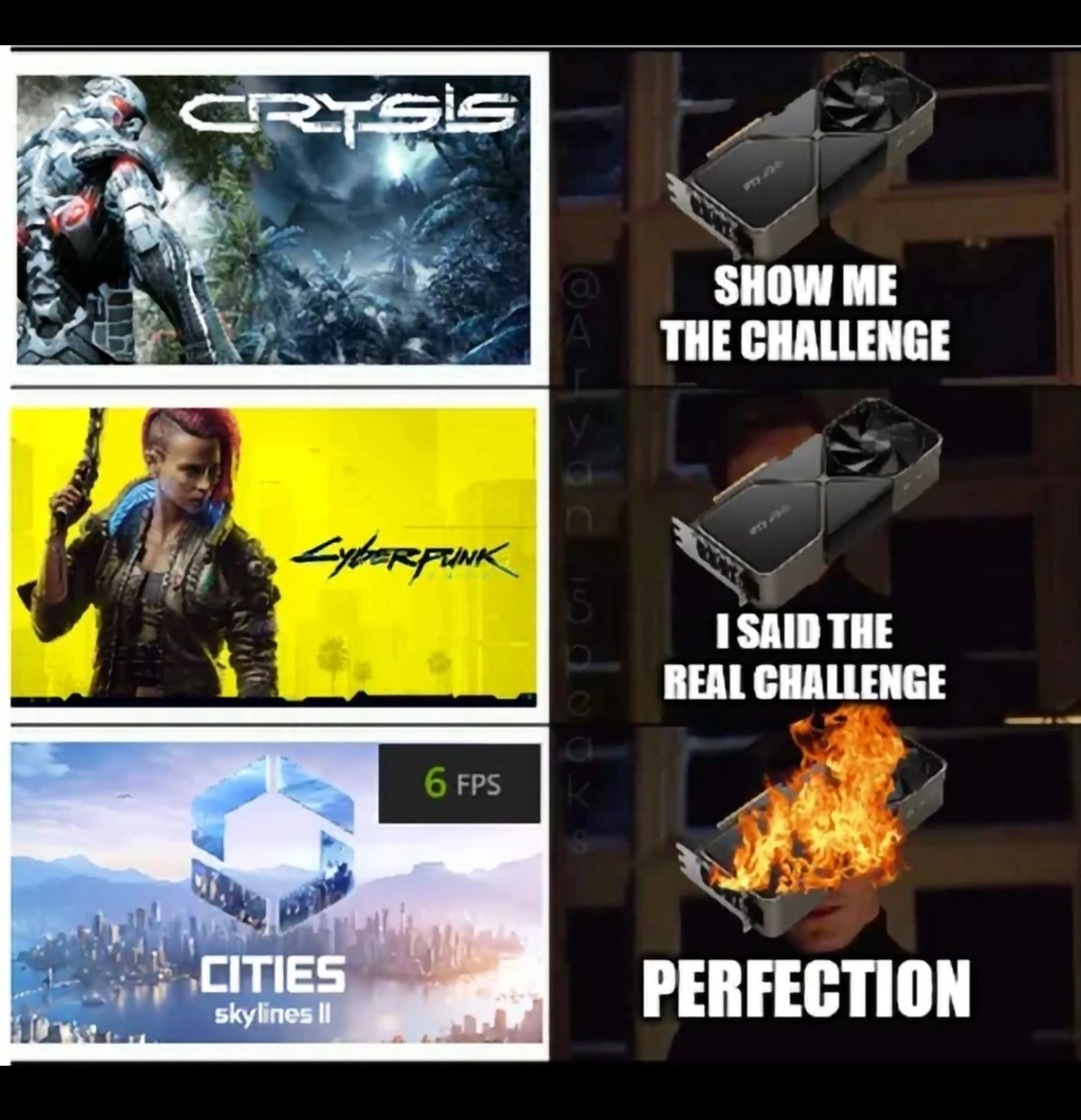
Let’s break down what’s going on in this meme in simpler terms. The meme shows three different video games on the left and a reaction on the right. The idea is to compare how hard each game pushes your computer’s graphics card (the GPU, or Graphics Processing Unit). The GPU is basically the part of your computer responsible for rendering images and graphics, especially in games. When people talk about a game being “demanding” or causing “performance issues,” they usually mean it makes the GPU work so hard that the frame rate (how smoothly the game runs) drops.
In the top-left panel, we see Crysis. This is a famous game from 2007 known in the tech world for its incredible graphics at the time – and for being so heavy to run that it became a meme. People would ask “Can it run Crysis?” whenever a new GPU or PC came out. If the answer was yes, that meant the hardware was really powerful. Crysis was like an early benchmark or test: it had dense jungles, advanced lighting, and physics that made even high-end PCs struggle back then.
The middle-left panel shows Cyberpunk 2077, a game released in 2020. This game is set in a neon-soaked futuristic city and is known for its stunning visuals, especially if you turn on a feature called ray tracing. Ray tracing is a cutting-edge graphics technique that simulates realistic lighting and reflections, but it’s extremely computationally intensive (meaning it asks the GPU to do a lot of work). When Cyberpunk 2077 first came out, many people with decent PCs found they had to lower settings or upgrade their GPUs to get good performance. It’s another game that became synonymous with pushing hardware to its limits – at least in the modern era. It had a lot of hype, and part of that hype was, “this game is going to really test what your machine can do.” So if Crysis was the big bad boss of performance in 2007, Cyberpunk 2077 was one of the bosses in the 2020s.
Now, the bottom-left panel – Cities: Skylines II. This game came out in late 2023 and is a sequel to a popular city-building game (Cities: Skylines). Unlike Crysis or Cyberpunk, this isn’t a shooter or action game; it’s a simulation game where you construct a city, zone areas for development, manage roads and traffic, and basically act as the city’s planner and mayor. Typically, these kinds of games don’t have the reputation of needing a super powerful GPU for graphics because the concept is more about strategy and simulation. However, upon release Cities: Skylines II surprised (and frustrated) a lot of players by running very slowly, even on high-end computers. People reported extremely low FPS (frames per second), like on the order of 10 FPS or, as the meme highlights, around 6 FPS in some cases. To put that in perspective, 60 FPS is usually the target for smooth gameplay; 30 FPS is acceptable to some; but 6 FPS is almost a slideshow – you would literally see the screen updating only six times a second, making everything feel laggy and unresponsive.
The meme explicitly labels Cities: Skylines II with “6 FPS” to drive home just how badly it performs. This number became a bit of a joke in online discussions, sort of a badge of “wow, this game is really tough on hardware or really poorly optimized (or both).” So in context: Crysis might have run at, say, 30 FPS on an average PC of its time, Cyberpunk 2077 maybe 30-60 FPS on an average PC of 2020 (if settings tweaked), but Cities: Skylines II is crawling at 6 FPS on some pretty good 2023 PCs. That’s why it’s being crowned the new king of hardware stress in this meme.
Now look at the right side of the meme – this uses a popular format from an X-Men movie scene. Originally it’s the character Magneto saying, “Show me the real X… No, the real X… Perfection,” as a way to humorously compare three things. Here, instead of Magneto, we have an image of a modern GPU (it looks like one of those big NVIDIA GeForce RTX cards). The GPU is personified – it’s like the graphics card itself is talking and evaluating these games as challenges. In the first part, the GPU says “SHOW ME THE CHALLENGE,” and it’s presented with Crysis. In the second, it says “I SAID THE REAL CHALLENGE,” and it gets Cyberpunk 2077. Finally, when Cities: Skylines II at 6 FPS is shown, the GPU responds with “PERFECTION,” and in that panel the GPU is engulfed in flames.
This is a humorous way to say: Crysis was a challenge, Cyberpunk was an even bigger challenge, but Cities: Skylines II is the ultimate challenge – so much so that it sets the GPU on fire. Of course, GPUs in reality shouldn’t catch fire (if they do, something is very wrong!), but we do use phrases like “my GPU is on fire” metaphorically to mean it’s running extremely hot. High-performance graphics cards consume a lot of power and can get hot enough that the cooling fans have to work overtime. Gamers often monitor their GPU temperature; anything above, say, 80-85°C is quite hot. If a game pushes the GPU to 100% usage for a long time, the card might hover at high temps and even thermal throttle (which means it will intentionally slow down a bit to avoid overheating). The meme exaggerates this to actual flames for comedic effect. It’s playing on the idea that Cities: Skylines II turns your fancy expensive GPU into a literal bonfire. The word “bonfire” in the title and the flames in the image both convey that sense of “burning up.”
Let’s talk a bit about why Cities: Skylines II might be such a performance hog, in simpler terms. In games, you generally have two big things happening: 1) game logic/ simulation (which the CPU handles) and 2) rendering the graphics (which the GPU handles). For a shooter like Crysis or Cyberpunk, a lot of the heavy work is in the graphics – drawing realistic trees, explosions, lighting effects, character models, etc. The CPU does AI and physics too, but often the GPU is the part working hardest in those games (we call that GPU-bound). In a city sim like Cities: Skylines II, the graphics can still be heavy (after all, you might see an entire detailed city on screen), but there’s also an immense amount of CPU work to simulate the city’s inner workings. Think about it: if you have 100,000 citizens in your city, the game might be calculating what each one is doing – are they going to work? Which route are they driving? Is there a traffic jam on their way? Did a building catch fire and a fire truck needs to navigate there? All those elements are part of the simulation. That can be very computationally intensive, especially if the game tries to be realistic. And unlike graphics (where the GPU can draw many pixels in parallel), these simulation calculations often have to happen in sequence or in complicated interdependent ways, which means even if you have a multi-core CPU, it might not use all the cores efficiently. We call a game like that CPU-bound (limited by the CPU’s speed more than the GPU).
So, quite possibly, Cities: Skylines II at launch wasn’t optimized well enough to distribute all that work across multiple cores, or the work itself was just huge. The end result: the CPU struggles and feeds updates to the GPU slowly, which results in that very low FPS. Meanwhile, when the GPU does get the data (like the positions of all the cars and people and the state of all buildings), it then has to draw a lot of stuff. If you zoom out, you see an entire city with thousands of buildings and moving vehicles – drawing all of that can also stress the GPU. Every building or car drawn might involve a draw call, which is like the game engine saying “Hey GPU, draw this object now.” Tens of thousands of these per frame is tough for the system to handle. Game developers usually try to reduce the number of draw calls by combining objects or simplifying what’s drawn in the distance (techniques called level of detail (LOD) scaling), but if those aren’t effective, the GPU ends up having to work on a ton of separate little tasks, which is inefficient.
All this technical stuff boils down to: Cities: Skylines II managed to be a “perfect storm” where both the CPU and GPU are pushed to their limits. This is why people in tech find it funny enough to meme – it’s ironic and unexpected. Usually, you’d think a graphically intense shooter is what justifies buying a $1000+ graphics card. But here comes a city sim, of all things, that makes even the best card struggle. It’s the kind of situation where a gamer or developer chuckles and says, “Well, I guess my new top-tier GPU found its match!”
So, the meme’s joke in plain language: An incredibly powerful graphics card is asking for the hardest test. People first show it Crysis (a known hard test), but the card isn’t impressed. Then they show Cyberpunk 2077 (a newer hard test), and the card still wants more. Finally, they show Cities: Skylines II running at an awful 6 frames per second, and the graphics card says “Perfect!” — implying “Yes, that’s the challenge I was looking for!” But the twist is the card is now on fire because the game was so demanding. It’s a nerdy joke about computer performance, referencing gaming history and the current state of that new game. If you’ve ever heard your computer’s fans roar like a vacuum cleaner during a tough game, you can appreciate the humor. This city-building game turned the scenario up to eleven, and the community reacted in the most internet way possible: making a meme out of it.
Level 3: The New ‘Can It Run Crysis?’
For seasoned developers and gamers alike, this meme hits on a very familiar trope: every few years, a new game becomes the unofficial yardstick by which all hardware is measured. Back in the late 2000s, that was Crysis. The game was so ahead of its time in graphics fidelity (thanks to the CryEngine’s lush jungles, advanced lighting, and physics) that it spawned the legendary question, “But can it run Crysis?” Everyone in PC gaming circles knew that phrase – it humorously implied your rig isn’t truly high-end unless it can handle Crysis at max settings. Fast forward to 2020, and we got Cyberpunk 2077, another title hyped not only for its gameplay but for pushing graphics technology to the edge. Cyberpunk with all the sliders maxed (especially with ray tracing on) turned top GPUs into groaning, red-hot devices struggling to stay above 30 FPS in 4K. It became the new go-to answer for “what will melt my graphics card?” Many of us upgraded our GPUs or enabled DLSS (AI upscaling tech) just to get Night City looking good without a slideshow framerate. So in the meme’s first two panels – Crysis and Cyberpunk – we’re looking at the historical heavyweights of performance stress-testing. The GPU (personified as Magneto in the template) is basically saying, “Alright, I’ve seen these so-called challenges. They were tough, sure, but I handled them. Show me something even more brutal.”
Enter Cities: Skylines II as the punchline – and that’s what delights the inner veteran engineer here. This is a city-building simulation, a genre not typically known for bleeding-edge graphics, but rather for complex simulation threads. The meme slaps a big “6 FPS” on it, broadcasting that this game runs abysmally slow on current hardware. The humor is that a title nobody expected to be a hardware crusher has apparently outdone the likes of Cyberpunk in bringing a GPU to its knees. The right-hand meme format (“I said the real challenge” / “Perfection”) underscores this reversal of expectations. The final panel crowning Cities: Skylines II as “Perfection” – with the GPU literally on fire – suggests that this is the true gauntlet thrown at modern PCs. It’s the new answer to “What will max out my system?” and the GPU is perversely proud of finding a worthy opponent. It’s as if the graphics card is a battle-hardened warrior who finally met an enemy that requires its full power (and then some), and it’s loving it. Hardware humor often personifies components this way, and here the GPU has a bit of a masochistic streak: happy to burst into flames for the ultimate challenge!
Now, why is this so relatable (and funny) to experienced tech folks? Because we’ve all been there: You buy or build a high-end computer, expecting to breeze through any task, and then some piece of software comes along that pegs your performance meters to 100% and makes you question if your system is already outdated. It’s a mix of frustration and dark comedy. In professional settings, we encounter this with poorly optimized code or unexpectedly heavy workloads – that one process that makes the fan spin up like a jet engine. In gaming, it’s almost tradition: no matter how advanced GPUs get, game developers find ways to use every ounce of power (and often inadvertently demand even more). Seasoned devs chuckle because the cycle is so predictable. We went from “Crysis will never be topped” to “hold my beer, here’s Cyberpunk” and now a seemingly innocuous city sim says “hold my entire city’s worth of pathfinding calculations.” There’s a tongue-in-cheek understanding: software bloat or ambition expands to fill the capacity of available hardware (and then usually spills over).
Digging into the specifics, a senior developer sees Cities: Skylines II’s 6 FPS not just as a haha moment, but as a textbook performance issue narrative. It likely indicates the game is doing something very expensive each frame. For instance, consider urban simulation: the game might be simulating tens or hundreds of thousands of citizens – where they live, where they work, how they drive through your road network. That means running pathfinding algorithms (like Dijkstra’s or A* search) for a huge number of agents. Pathfinding is notoriously CPU-intensive, and doing it at scale in real-time is an epic challenge. If that part of the code isn’t highly optimized (or if it's inherently hard to optimize because of the game’s design), it becomes a huge CPU-bound bottleneck. Meanwhile, the graphics engine might also not be as optimized as it could be. Maybe the developers didn’t expect players to zoom out and see the entire metropolis frequently, and when you do, the engine dutifully tries to draw every building, car, and citizen in detail. That could result in thousands of draw calls per frame, overloading the CPU-GPU communication, or simply overwhelming the GPU’s ability to rasterize and shade so many objects. It’s a classic case of overengineered graphics vs. complex AI: doing either one at extreme scale is tough; doing both at the same time is how you get a tire fire in your PC case.
There’s also an implicit commentary here on game development realities. Performance optimization is hard work and often gets pushed towards the end of a project. Due to deadlines or feature creep, a game might ship in a less-than-ideal state performance-wise, with the plan to patch it later. Early adopters of Cities: Skylines II in October 2023 discovered that even the best consumer GPUs struggled to hit playable frame rates. This isn’t the first time a game launched with such issues – Cyberpunk 2077 also had its fair share of performance and bugs at launch, and many developers recall countless “death marches” trying to optimize big titles in the final weeks. The meme jabs at that situation: we have this ridiculously powerful hardware (the kind that can do real-time ray tracing, or push 4K resolution at high refresh rates), and yet here we are with a cartoonishly low 6 FPS because the software isn’t optimized or simply is that demanding. It’s funny in the way that absurd extremes are funny. It resonates especially with developers who have had the experience of chasing down a nasty bottleneck. You can almost hear them saying, “Yup, been there – when one unoptimized system makes the whole app chug.” There’s a mix of empathy (for the devs and the players) and schadenfreude (enjoying the crazy scenario) when we see a flagship GPU get humbled.
The Magneto meme format (“Show me the challenge… I said the real challenge… Perfection”) is a brilliant choice for delivering this joke. In the original, Magneto is demanding to see the real form of a shape-shifter, and when he finally does he says “Perfection.” Here the GPU is Magneto, and the shape-shifting “challenge” is represented by different game box arts. For those familiar with meme culture, this format sets up a comedic escalation: the first offering is insufficient, the second still isn’t enough, but the third one nails it. So the progression of Crysis → Cyberpunk 2077 → Cities: Skylines II (6 FPS) is an escalation from “traditionally hard” to “modern hard” to “unexpectedly and absurdly hard.” The final state showing the GPU on fire with the caption “Perfection” is the exclamation point on the joke. As experienced techies, we might also read a subtext: Crysis pushed the envelope in graphics, Cyberpunk pushed it in graphics (and maybe a bit in world complexity), but Cities: Skylines II is pushing it in an entirely different way (massive simulation + modern graphics) – and that combination is the ultimate challenge. It’s like the meme is an ode to how far we’ve come in straining our computers: from graphical masterpieces to whole simulated worlds.
Another layer here is pure gaming culture and communal experience. PC enthusiasts often joke that their expensive rigs double as space heaters – and in the winter, firing up a demanding game can noticeably warm up a room. Seeing a GPU engulfed in flames is a comical literalization of that joke. It’s saying, “This game gets my GPU so hot, you might as well roast marshmallows on it.” Any gamer who’s felt the hot exhaust of their graphics card after a long session can relate. And any developer who’s monitored system temperatures while stress-testing code knows the slightly nervous excitement of seeing those degrees Celsius climb. The meme takes that relatable scenario and pushes it to cartoonish extremes for humor.
In summary, at a senior perspective this meme is both a trip down memory lane and a knowing grin at present-day challenges. It’s packed with references: the CryEngine benchmark legend, the Cyberpunk 2077 performance saga, the new contender with its 6 FPS infamy, and even a popular meme format from the Magneto scene – all converging to deliver a punchline that techies can appreciate on multiple levels. It says: “We keep making faster hardware, and software keeps finding a way to use it all – sometimes to the point of insanity. And isn’t that both frustrating and a little bit awesome?”
Level 4: Amdahl's Law City Edition
At the most granular level, this meme highlights a perfect storm of computing bottlenecks in modern game engines. Cities: Skylines II isn't just any game – it's a case study in pushing both CPU and GPU to their limits simultaneously. To a performance engineer, it screams a classic parallel-processing conundrum. Why? Because one part of the game (the city simulation) is CPU-bound and not easily parallelized, while the other part (the graphics rendering) is GPU-bound and extremely demanding. This is where Amdahl's Law comes into play. Amdahl’s Law tells us that no matter how many processing cores or threads you throw at a problem, the overall speed-up is limited by the portions that must run sequentially. In Cities: Skylines II, if the simulation thread (governing citizens, traffic, economy, etc.) can only effectively use one or few cores, it becomes a hard floor on frame rate, even if the GPU is a powerhouse. Essentially, one slow thread can stall the whole show – the game loop can’t proceed to render a new frame until the simulation step is done.
Consider the pseudocode for a frame update in a game engine:
while (game_is_running) {
updateSimulation(); // CPU-heavy: e.g. AI, pathfinding, city economy
renderFrame(); // GPU-heavy: draw the city with all details
}
If updateSimulation() takes, say, 150 milliseconds because it's calculating thousands of agents’ paths and decisions (and can't easily split that work across 16 cores), then the maximum frame rate is about 6–7 FPS, regardless of how fast renderFrame() can be. Even a top-tier GPU sitting on millions of shader cores and executing tens of trillions of operations per second can't make the game run smoother if it spends most of its time waiting for the simulation. This is the parallelization predicament at the heart of the meme’s joke.
Now, on the rendering side, Cities: Skylines II challenges the GPU in ways that are a bit different from the usual flashy shooter. Rendering a sprawling city with thousands of buildings, roads, and moving vehicles can create an enormous number of draw calls – each individual object that the CPU asks the GPU to draw. Historically, game developers feared the “draw call overhead”: if you naively try to draw, say, 10,000 building models separately in one frame, the CPU struggles to issue those commands, and the GPU driver overhead skyrockets. Modern graphics APIs (like Vulkan or DirectX12) mitigate this with better batching and multithreaded command buffers, but the problem still exists. If Cities: Skylines II isn’t efficiently batching these draw calls or using level-of-detail (reducing detail for far-away objects), it could be overloading even a monster GPU with trivial-sounding work – like telling it to draw one more house 10,000 times. It’s death by a thousand paper cuts in terms of performance. Each draw call might be fast, but the CPU-GPU synchronization and state changes between them add up significantly.
Then there’s the actual GPU load per frame. A high-end card (think the latest NVIDIA or AMD flagship) can normally churn through cutting-edge visuals – Cyberpunk 2077’s ray tracing, for example, lights up a scene with realistic reflections and global illumination using dedicated RT cores and a lot of math. Those are textbook GPU-bound tasks: the graphics card is doing the heavy lifting and will hit 99% utilization, while the CPU mostly waits. Cities: Skylines II might not look as bleeding-edge in graphics as a cyberpunk future city, but it can still be GPU-intensive in subtler ways: rendering a huge cityscape with possibly high view distances, dynamic shadows for thousands of objects, and maybe some fancy atmospheric effects (like volumetric clouds or depth of field) can tax the GPU shader pipelines thoroughly. So in the worst case scenario, Cities: Skylines II is hitting the hardware trade-offs on both fronts – the CPU is maxed out computing the simulation, and the GPU is simultaneously straining to draw the detailed city each frame. It’s like a tag-team of bottlenecks, ensuring no silicon in your PC gets to slack off.
Finally, let’s talk about that thermal envelope – the phrase that describes the power and heat limits of hardware. High-end GPUs today can easily consume 300-450 Watts under full load, which generates a lot of heat. They rely on robust cooling (multiple fans, heat sinks, maybe liquid cooling) to stay within safe temperatures. When a game workload is described as turning your GPU into a “bonfire,” it’s riffing on this idea: the GPU is working so hard that it’s outputting heat like a small furnace. In extreme performance burns (for example, running stress tests like the notorious FurMark which gamers jokingly call a “GPU burner”), a graphics card can indeed hit temperature limits and throttle down to avoid damage (this is thermal throttling). In rare catastrophic cases, if something goes wrong with cooling or power delivery, components can literally burn out – there were even reports of certain new GPU power connectors melting in real life because of the immense power drawn. So the meme’s flaming GPU image is a comedic exaggeration of a real risk: Cities: Skylines II is such a demanding piece of software that it figuratively sets the GPU on fire by pushing it to maximum capacity. It’s a wry nod to the laws of physics: all those billions of transistor switches flipping in the GPU to render frames consume energy, and that energy ends up as heat. We’ve essentially found a workload that feeds a top-tier GPU so much work that it reaches its thermal design limits and says “I’m about to spontaneously combust here.” In performance engineering terms, that’s both terrifying and darkly hilarious – the game is doing exactly what a power virus or worst-case synthetic benchmark would do, intentionally or not.
In essence, the deep technical humor of this meme comes from recognizing that even the most advanced hardware can be humbled by a sufficiently complex and poorly-optimized software scenario. It’s a confluence of hardware architecture limits and software design challenges: the CPU can’t share the load enough (enter Amdahl’s Law), the GPU is either starved and then overfed in bursts, or consistently overworked, and the whole system is running hot. To an expert, Cities: Skylines II hitting 6 FPS on a beast PC is like a lab experiment highlighting how parallel computing, real-time graphics, and thermal dynamics intersect in the real world. Absurd? Yes. Inevitable given the circumstances? Also yes. And that absurd inevitability is what makes it so ingeniously funny – the meme is saying “we threw the kitchen sink at this GPU, and we finally found its breaking point.”
Description
This is a three-panel meme using the 'Perfection' format from X-Men, comparing the performance demands of different video games. The left column lists three games: the historically demanding 'Crysis', the graphically intensive 'Cyberpunk', and finally 'Cities: Skylines II' with a '6 FPS' badge. The right column shows a high-end NVIDIA RTX graphics card reacting to each. For 'Crysis', the caption is 'SHOW ME THE CHALLENGE'. For 'Cyberpunk', it's 'I SAID THE REAL CHALLENGE'. For 'Cities: Skylines II', the graphics card is depicted engulfed in flames with the caption 'PERFECTION'. The humor comes from positioning 'Cities: Skylines II' as a system-destroying piece of software, even more demanding than legendary performance benchmarks. For experienced software engineers, the joke isn't about the game's graphical fidelity but its severe lack of optimization, implying that its poor performance is a result of inefficient code rather than advanced technology, making it a 'perfect' challenge in the worst way possible
Comments
7Comment deleted
It's not a memory leak, it's 'dynamic VRAM immolation.' The GPU isn't crashing; it's achieving thermal runaway as a service, perfectly optimizing for its own immediate and fiery disassembly
Sure, ray-tracing is expensive - but try running a city-wide A* on the main thread and watch even a 4090 beg for garbage collection
Cities: Skylines II achieving what decades of CUDA optimization couldn't - turning your GPU into an actual space heater while somehow still running single-threaded pathfinding for 100,000 agents
When your GPU finally encounters a game that makes Crysis look like a screensaver, and you realize that 'Can it run Crysis?' has evolved into 'Can it survive Cities: Skylines II without becoming a space heater?' The real challenge isn't rendering millions of polygons - it's doing it without triggering your smoke alarm
GPUs can path-trace 4K; hand them a single-threaded O(n^2) city-sim tick and that 16 ms frame budget turns into a space heater
RTX obliterates ray-traced dystopias, but 100k citizens gridlocking your A* pathfinder? That's simulation-scale humility
My 4090 melted not on ray tracing, but waiting for a city‑sim’s O(n^2) pathfinding, single‑threaded main loop, and per‑frame GC - teraflops don’t fix architecture