Root Access With A Pocket Lighter
Why is this Security meme funny?
Level 1: The Magic Key Spark
Imagine a castle has perfect locks, perfect guards, and perfect rules about who can enter each room. Then someone discovers that if they make a tiny spark near the castle map, one room is mislabeled for a second and they can walk into the treasure room. The meme is funny because the "tool" for beating the castle is not a master key or a supercomputer. It is a cheap lighter.
Level 2: Lighter Privileges
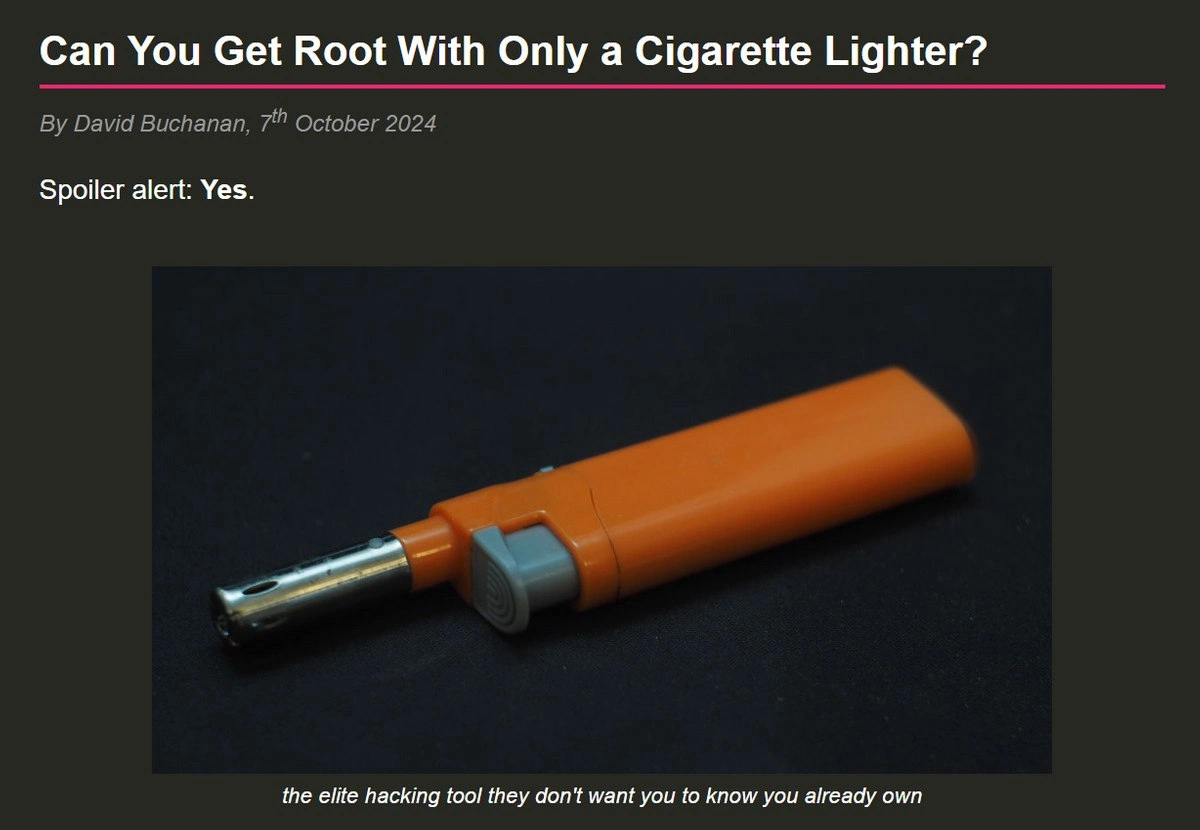
The visible page shows a blog-style post by David Buchanan with a large photo of an orange cigarette lighter. The basic idea is electromagnetic fault injection: create a burst of electrical noise near hardware so a computer makes a tiny mistake. A normal bug is when the code is wrong. A fault-injection bug is when the hardware performs the right code incorrectly for one instant.
Root is the administrator account on Linux and other Unix-like systems. Privilege escalation means starting with limited permissions and finding a way to gain stronger ones. DRAM is the main memory where running programs store data. CPU cache is faster memory inside the processor that avoids reading DRAM constantly. Page tables are the operating system's maps from virtual addresses to physical memory. If those maps can be confused, the system's permission boundaries can be confused too.
For a developer, the wild part is that none of this looks like normal programming. There is no obvious if password == wrong_password mistake. The attack lives between hardware behavior and operating-system internals. That is why the lighter is such a good visual punchline: it makes an extremely technical exploit look like the setup for a bad life hack video.
Level 3: Root By Spark
The image is funny because it looks like a parody of security clickbait, but the headline is dead serious. Root means the highest privilege level on a Unix-like system. Getting root from an unprivileged account is the classic local privilege escalation dream: not just "I crashed the program," but "the operating system now does what I say." The screenshot frames that goal beside a cigarette lighter, then dares the reader to accept that both objects belong in the same sentence.
The veteran pain underneath is that security boundaries often depend on boring assumptions: memory reads return the value that was stored, page-table walks are reliable, CPU caches and DRAM buses behave within spec, and physical attackers are outside the threat model. Hardware fault injection attacks are what happens when those assumptions get an invoice. Software can be formally beautiful and still run on hardware that occasionally experiences a hostile spark.
The meme also pokes at the security industry's tool fetish. There is a whole market for polished devices that inject glitches, probe buses, dump firmware, and make conference slides look expensive. Then someone shows up with a lighter and a messy laptop and demonstrates the same general family of idea. That is funny in the same way all good exploit development is funny: the system was engineered by committees, protected by layers, documented in acronyms, and then disturbed by pocket junk.
It also illustrates why memory management is such a rich attack surface. Page tables, caches, TLB behavior, physical memory reuse, and page cache effects are supposed to be invisible plumbing. When an attacker can influence that plumbing, abstractions leak upward. A user-space program can end up touching structures that were supposed to belong only to the kernel. Somewhere, a design document says "the process cannot write this," and the memory bus says, "about that."
Level 4: Glitching The Matrix
The screenshot headline asks:
Can You Get Root With Only a Cigarette Lighter?
Then it immediately answers:
Spoiler alert: Yes.
The technical absurdity is that the orange lighter shown in the image can be treated as a crude fault injection tool. A piezo lighter generates a sharp electrical pulse. If that pulse couples into the right hardware path, it can disturb a data transfer, not by politely exploiting a software bug, but by making the machine briefly lie about a bit. That is why the meme belongs in hardware hacks, low-level programming, Linux, and privilege escalation at the same time.
The deeper trick is that modern operating systems are built on the illusion of virtual memory. User programs do not directly use physical RAM addresses; they use virtual addresses translated by page tables and cached by the TLB, the Translation Lookaside Buffer. A page-table entry is just structured data in memory, but it is data the CPU trusts to decide what a process can access. If a hardware glitch corrupts a page-table-related read at exactly the wrong moment, the system can briefly believe a mapping points somewhere more interesting than it should.
At that level, security stops feeling like passwords and starts feeling like physics. The exploit chain is not "guess the admin password." It is closer to:
lighter click -> electromagnetic disturbance -> DRAM bus bit flip
-> corrupted pointer or page-table entry -> unintended memory access
-> write primitive -> root-owned code path altered -> root shell
This is why the caption under the lighter, the elite hacking tool they don't want you to know you already own, works so well. Expensive EMFI rigs, lasers, oscilloscopes, and precision trigger hardware sound like a lab. A disposable lighter sounds like something found in a kitchen drawer. The joke is the collapse of that distance: the same category of attack, only with all the professional dignity removed and replaced by a clicky orange rectangle.
Description
A dark blog-page screenshot shows the headline "Can You Get Root With Only a Cigarette Lighter?" with the byline "By David Buchanan, 7th October 2024" and the line "Spoiler alert: Yes." Below is a photo of an orange cigarette lighter on a dark surface, captioned in italic text, "the elite hacking tool they don't want you to know you already own." The referenced article demonstrates low-budget electromagnetic fault injection, using a piezo lighter to induce DRAM bus bit flips and eventually turn memory corruption into Linux root access. The meme works because a throwaway household object is framed as a serious hardware exploitation instrument.
Comments
14Comment deleted
The exploit chain is basically `sudo make coffee`, except the coffee is a DRAM bit flip and the sudoers file never saw it coming.
Also you can implement sudo rm -rf / with this tool, even without a terminal Comment deleted
But can it run Doom? Comment deleted
theoretically, if you can zap the cpu precisely enough Comment deleted
Fixed title: Can you get root with full physical access, solder iron and programm user access Comment deleted
Can you get root with full physical access to a root user, and a soldering iron? Comment deleted
Not if you have drive encryption Comment deleted
Solvable. You just stick паяльник to other place Comment deleted
Ha-ha, this is classic. Comment deleted
Real Comment deleted
Seriously where do you get that cheap wrench? I remember the alt text saying something about it, but prices have only been going up Comment deleted
Bruh, you can borrow someone's wrench from his basement for free or even find a $1 wrench. An old rusty wrench dipped in cold water is just fine🌚 Comment deleted
https://termorect.narod.ru/ Comment deleted
*soldering iron Comment deleted