Skip to content
DevMeme
5788 of 7435
AI Model Explains Its Own Flawed Logic
AI ML Post #6344, on Oct 25, 2024 in TG

AI Model Explains Its Own Flawed Logic

Why is this AI ML meme funny?

Level 1: When Numbers Have Stories

Think of the AI like a very well-read but sometimes confused student. You ask this student a simple question: “Which number is larger, 9.11 or 9.8?” Now, instead of just seeing two plain numbers, this student’s mind starts drifting: “9.11… hmm, that reminds me of September 11th, a really big historical event. And 9.8… oh, that makes me think of gravity, like the force that makes things fall.” The student is supposed to just compare the size of the numbers, but they get distracted by those memories. It’s as if each number whispered a story in their ear – one number whispered something dramatic (a big event), and the other number whispered a science fact. So our poor distracted student blurts out, “9.11 is bigger than 9.8,” because in their mind they’re thinking about the importance of those stories, not the actual quantity of the numbers.

This is basically what happened with the AI. It’s funny in the same way it’s funny if a child answered a math question in a totally off-the-wall manner because a word reminded them of something. Imagine asking a friend, “What’s larger: an apple or a watermelon slice?” and the friend suddenly remembers that watermelons are huge fruits and says, “Watermelon!” – even if you were holding just a tiny slice of watermelon. You’d chuckle because they clearly got carried away by the idea of a watermelon instead of looking at the actual slice in front of them. In the meme’s case, the AI should have looked at the “size” of 9.11 and 9.8 as numbers, but instead it got carried away by the ideas those numbers reminded it of. The result was a silly mistake that makes us laugh, and the researchers even had to play detective to find out which “little voices” (or neurons) inside the AI’s head caused the confusion. In simple terms: the AI’s brain was listening to the stories behind the numbers instead of the math, which is why it gave a goofy answer.

Level 2: Neurons, Bias & Debugging AI

Let’s break down what’s happening in this meme in simpler terms. We have a Large Language Model (LLM) – basically an AI system trained on tons of text to answer questions and generate responses. One example of an LLM is the Llama model family (like the Llama-3-1.8B mentioned), which has billions of parameters (the weights and "neurons" that store what it learned). These models don’t “think” like humans or do step-by-step math; instead, they have layers of simulated neurons (nodes in the neural network) that activate for certain patterns in text.

In the meme, someone asked the model, “Which is bigger, 9.11 or 9.8?” – expecting the model to compare the two numbers. Mathematically, 9.11 (nine-point-one-one) is actually less than 9.8 (nine-point-eight) because 9.11 is roughly 9.110 and 9.8 is 9.800. So the right answer should be “9.8 is bigger than 9.11.” But the model answered incorrectly that “9.11 is bigger than 9.8.” This is the numeric comparison error described. Why did it mess up something so basic? That’s where the fun (and the AI humor) comes in: the model got confused by associations rather than the actual values.

During its training on the internet, the model saw the string “9.11” many times, often in contexts like “9/11” referring to September 11, 2001, a very significant historical date. It also saw “9.8” often in contexts like “9.8 m/s^2”, which is the acceleration due to gravity on Earth (a physics fact). So, in the model’s huge memory of text, “9.11” is linked with big impactful events (and even things like emergency phone number 911), while “9.8” is linked with gravity and physics formulas. These are what the meme calls the “Sept. 11th neuron” and the “gravity neuron” – essentially neurons in the model that respond strongly whenever those topics come up.

Now, ideally, when comparing two numbers, the model should rely on whatever it knows about numbers themselves. But large language models don’t have a dedicated, separate module for math; they just have all their knowledge mixed together in their network. So here the LLM’s limitations show up: the concepts it learned are interfering with the task at hand. We call that a kind of bias – not bias in the social sense, but a bias in the model’s behavior caused by its training data. The september_11_bias meant the model saw "9.11" and internally leaned towards treating it as something significant (not just a number). The gravity_bias meant seeing "9.8" brought up thoughts of gravitational acceleration. Because of these influences, the model ended up outputting a flawed answer, almost as if it thought the question was asking “which is more important or notable, 9.11 or 9.8?” rather than which is numerically larger.

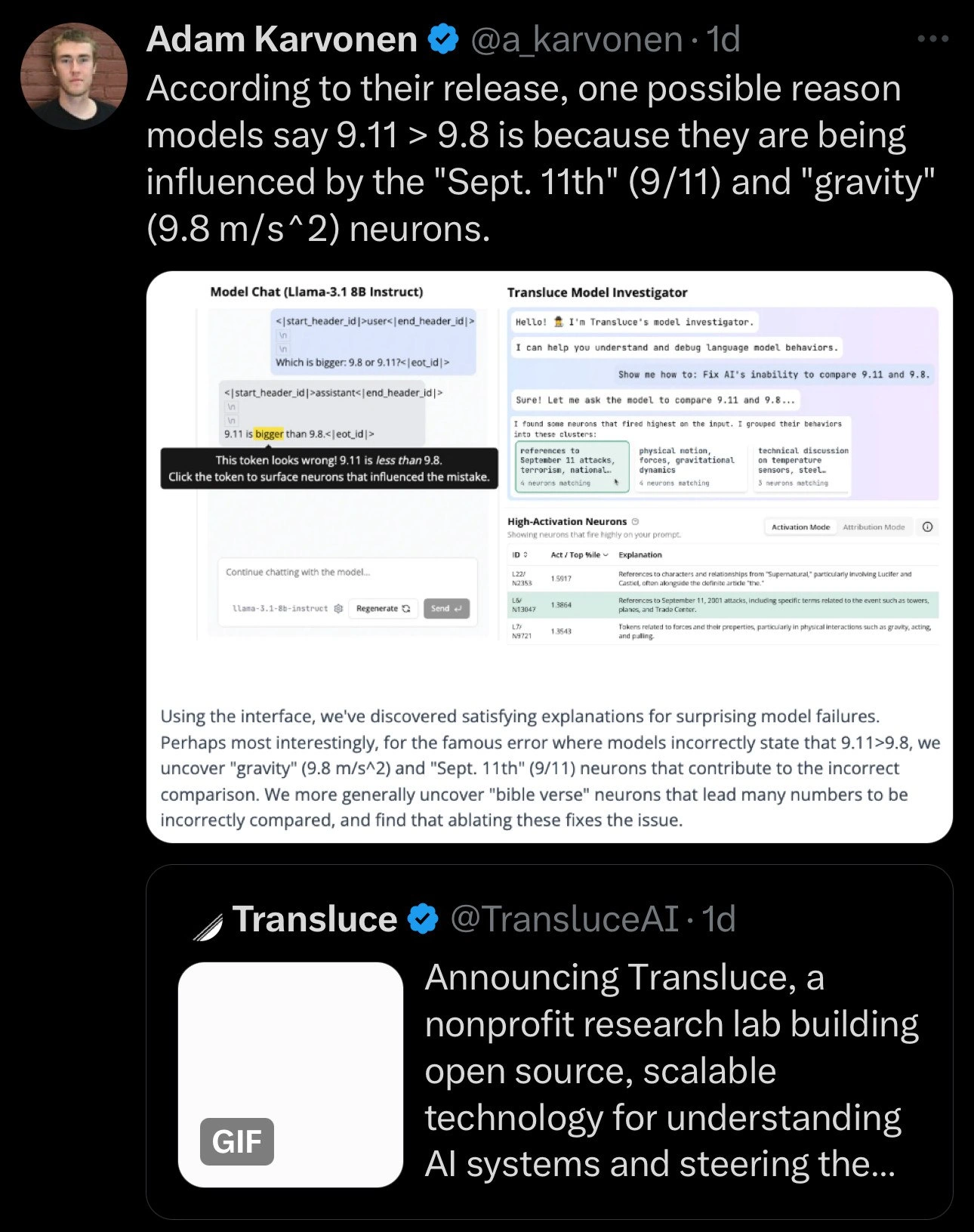
The meme shows a screenshot of a special tool – the Transluce Model Investigator, a UI designed for mechanistic interpretability. Interpretability in AI is all about trying to understand and explain why an AI model made a certain decision. This tool let the researchers peer inside the model’s “brain” to see which neurons were super active when it said “9.11 is bigger than 9.8.” In the screenshot, after the model gives the wrong answer, the interface flags that token (“9.11 is bigger...”) and says “This token looks wrong!... Click to surface neurons that influenced the mistake.” When they did that, the tool pulled up a list of the most active neurons contributing to that part of the answer. The labels like “physical motion, orbits; gravity” and “Sept. 11th references” are descriptions of what those neurons seem to be about. In plainer terms, the tool is saying: “Hey, when the model decided to say 9.11 is bigger, it had some internal signals strongly pointing to concepts of gravity and September 11th.” That’s a big clue! It suggests those concepts were muddling the comparison.

To confirm this, the researchers did something called model ablation as a fix. Ablation means removing or disabling something to test its importance (like removing a spark plug from an engine to see if it’s causing a problem). In this case, they “ablated” the identified neurons – essentially turning off or reducing the effect of the “Sept. 11th” neuron and “gravity” neuron – and then asked the model the question again. Once those were out of the way, the model answered correctly that 9.8 > 9.11. This is fascinating because it’s like debugging a program, but instead of a line of code, you’re tweaking internal neurons in the AI’s network to see if the bug (the wrong answer) goes away. And indeed, removing those concept neurons fixed the issue. That means those neurons were a key part of why the AI was wrong – they were effectively distracting the model from the real task.

All of this underscores a point familiar to anyone learning about AI: these models are extremely powerful but also a bit scatterbrained. They soak up all sorts of associations from their training data – that’s why they can be so versatile (knowing about history, science, pop culture, etc.). But without careful control or additional logic, they might apply the wrong bit of knowledge at the wrong time. Explainable AI tools like this Transluce Investigator are an attempt to peek under the hood and do debugging and troubleshooting when an AI fails. Just like a junior dev might use a debugger to step through code and see why a variable has the wrong value, AI researchers are starting to use neuron investigation UIs to see why a model came up with a wrong answer. The comedic angle here is that the “bug” turned out to be something so odd – neurons attuned to September 11 and gravity were overpowering simple math. It’s both an example of AI humor (the idea that an AI could mix up such things is absurdly funny) and an educational example of AI_ML interpretability work (showing exactly how a model’s overfitting to training data patterns can lead to mistakes).

Level 3: Gravity of 9/11 Logic

From a seasoned developer’s perspective, this meme is hilariously on point about the bizarre bugs that can lurk in AI systems. Imagine you’ve seen all sorts of software bugs, but now you have an AI that argues 9.11 > 9.8. Any senior engineer knows computers are deterministic--except when a machine learning model comes along and says, “hold my beer.” Here, the humor comes from the AI’s absurd reasoning path: instead of doing a normal numeric comparison, the LLM’s answer was swayed by completely unrelated knowledge: September 11 and gravity. It’s as if the model’s brain free-associated its way to an answer. We all joke about LLMs sometimes “overfitting” on their training data quirks, and here we have a prime example: the model isn’t comparing numbers; it’s comparing the ideas those numbers conjure up in its training memories. 9.11 reminds it of a huge historical event (literally a big deal), while 9.8 triggers thoughts of a fundamental constant (important, but maybe the model doesn’t attach bigness to gravity in the same way). The end result is an answer that makes a dev go, “Wait, what? It’s comparing apples to oranges – or rather, tragedies to physics – to decide a simple math question.”

What really tickles the tech funny bone is how this was debugged. In regular software, if a function gives the wrong result, you’d step through code, inspect variables, maybe find a misused operator. But in an LLM, you can’t just print a variable called miscomparison_reason – you need interpretability tools that act like a debugger for the neural network’s hidden layers. The meme shows the Transluce Model Investigator UI doing exactly that: it let the researchers click on the suspicious output token ("9.11 is bigger...") and trace back which neurons fired abnormally. Seeing labels like “Sept. 11th references” and “physical motion, orbits; gravity” pop up is both enlightening and comical. It’s enlightening because it offers a rare peek into the black box (“Ah, so those neurons were shouting their unrelated opinions when the model should’ve been doing math.”). And it’s comical because it personifies the model’s mistake – it’s like discovering that the reason your AI won’t output True > False correctly is because there’s a little homunculus inside it yelling “But 9/11 was huge!”. It’s the kind of surreal debugging story only an AI could produce.

Every experienced dev has battled weird bugs where some context bleed or misinterpreted data caused havoc. Maybe a parsing function read 9/11 as a date because of a locale setting, or maybe a poorly named variable caused a collision of concepts in code. This meme’s scenario is the ML equivalent: the model’s training data was so broad and overfit to patterns that a numeric string like "9.11" triggered non-numeric context. It’s reminiscent of the old joke that “It’s not a bug, it’s a feature.” Here the AI quite literally has features (neurons) that were too eager to help. The explainable AI angle – where they “ablate” neurons to fix the output – would make any seasoned engineer chuckle in disbelief. We’re essentially performing a live hotfix in the model’s neural circuit. It’s like finding out the reason a web app was crashing was due to an easter-egg function nobody knew about, and then commenting it out to restore normal behavior. The Transluce tweet at the bottom is announcing this new lab and tool, which in developer terms feels like the launch of a much-needed AI debugging kit. Experienced folks in AI_ML know that LLM humor often comes from these peculiar failure cases, and this one nails it: a large language model, confused by its own encyclopedic but unwieldy knowledge, makes a childlike mistake in basic math. The relief (and laughter) comes from finally understanding why: those darn “gravity” and “Sept. 11” neurons had hijacked the calculation. For any developer who’s spent late nights debugging, the idea of drilling down to rogue neurons influencing model output is both an impressive technical feat and a source of dark comedy. It implies that modern AI debugging sometimes feels like a séance with the model’s inner ghosts – in this case, exorcising the ghost of 9/11 from a math problem. Now that’s a story to tell at the engineering stand-up!

Level 4: Polysemantic Neurons Overloaded

Deep inside an LLM like Llama-3-1.8B, each "neuron" in the network isn’t a simple one-to-one map to a single concept. Instead, neurons often carry polysemantic roles – meaning a single neuron can respond to multiple, seemingly unrelated themes. This meme highlights a perfect storm of that phenomenon. The model likely has a neuron (or a direction in its high-dimensional embedding space) that fires for anything related to “Sept. 11th” and another that fires for “gravity”. Normally these features stay in their lane, but here they’re colliding. The question “Which is bigger, 9.11 or 9.8?” should be a straightforward numeric comparison. Yet the model’s latent space is entangled: the token 9.11 activated a September 11 bias neuron (associating "9.11" with the significant event 9/11), and 9.8 lit up a gravity bias neuron (associating "9.8" with the 9.8 m/s^2 gravitational acceleration constant). In the vector calculus of the transformer’s layers, these concept activations bled into the output computation. Essentially, the model’s numerical reasoning circuitry got overpowered by its world-knowledge associations.

Under the hood, the LLM doesn’t truly “calculate” like a calculator; it predicts text based on training data patterns. If the training corpus often saw 9.11 in contexts of dramatic events or even as part of Bible verses (e.g. “Chapter 9 Verse 11”), and 9.8 in physics contexts (always paired with “m/s^2” or discussions of gravity), the model’s weights compress these contexts into neurons. When asked to compare 9.11 and 9.8, instead of activating a pure "numeric magnitude" detector, the model’s attention heads and feedforward layers inadvertently pulled in these off-topic features. This is a classic case of what interpretability researchers call feature superposition – multiple concepts crammed into the same neuron or vector subspace because the network has limited dimensions to represent an enormous world of data. One neuron might jointly encode “physical motion; orbits; gravity” and also bits of numeric magnitude, while another encodes “September 11 references” along with a dash of “something important or alarming”. The humorous twist is that these neurons influenced a basic comparison, tipping the scales so the model insists 9.11 > 9.8. It’s as if the latent weights decided a historically significant number must be “greater” than a mere physics constant, mathematically be damned.

The Transluce interface shown in the meme is performing mechanistic interpretability at a granular level. By tracing which hidden units (neurons) had unusually high activation values when the model made the mistake, they identified clusters of neurons related to those concepts. The UI even offers human-readable labels for them (like “Sept. 11th references” or “gravity”), likely derived from analyzing what prompts strongly excite those neurons. This is cutting-edge ExplainableAI work: it’s not just guessing why the model erred, it’s pinpointing where in the network the error arose. The fact that ablating (i.e. zeroing out or otherwise disabling) those neurons fixes the issue is a strong clue that those features were indeed causal to the bug. In other words, by temporarily turning off the “9/11” neuron and “gravity” neuron, the model’s numeric comparison sanity is restored and it correctly realizes 9.8 > 9.11. It’s a bit mind-bending: they debugged the AI bug by performing a virtual brain surgery on the model’s neurons! This kind of deep dive explains the meme’s punchline at a technical level – the LLM’s insistence on the wrong answer was literally due to rogue neurons cross-wiring numerical logic with real-world associations, a vivid example of the AI limitations we face when models have to juggle both world knowledge and simple math in the same parameters.

Description

This image is a screenshot of a tweet by Adam Karvonen (@a_karvonen) discussing a new tool from a research lab called Transluce. The tweet explains why some AI models incorrectly state that 9.11 is greater than 9.8. The accompanying image shows the Transluce Model Investigator, a tool designed to debug and understand language model behavior. The tool analyzes a Llama-3.1 8B model's incorrect comparison and identifies that the model's reasoning is being influenced by neurons associated with 'Sept. 11th' (9/11) and 'gravity' (9.8 m/s^2). The investigator highlights the specific tokens and surfaces the high-activation neurons, providing a look into the 'black box' of the AI's decision-making process. The technical context is about the challenge of model interpretability and alignment, showing how unrelated but numerically similar concepts in the training data can lead to logical errors. It's a fascinating insight for a technical audience into the concrete reasons behind abstract AI failures


Comments

17
Anonymous ★ Top Pick So the AI is basically pattern-matching numbers to traumatic historical events and fundamental laws of physics to decide which is bigger? Looks like we've successfully modeled the thought process of a freshman philosophy major
  1. Anonymous ★ Top Pick

    So the AI is basically pattern-matching numbers to traumatic historical events and fundamental laws of physics to decide which is bigger? Looks like we've successfully modeled the thought process of a freshman philosophy major

  2. Anonymous

    Today’s incident report: LLM claims 9.11 > 9.8 because the “Sept-11” neuron pre-empted the “gravity 9.8 m/s²” neuron - classic priority inversion, just happening inside the embedding layer. Somewhere, Dijkstra is filing a post-mortem

  3. Anonymous

    After 20 years of explaining that strings shouldn't be compared numerically, we've successfully taught AI models to make the same mistake junior devs make with version numbers - except now they're doing it with historical trauma and physics constants as feature vectors

  4. Anonymous

    Turns out LLMs have the same problem as junior developers reading requirements: they see '9.11' and immediately think of September 11th instead of doing the actual math. At least when we ablate the 'bible verse neurons' the model gets fixed - if only refactoring legacy codebases were that straightforward. This is what happens when your training data includes more Wikipedia articles about historical events than floating-point arithmetic tutorials

  5. Anonymous

    Proof the model’s greater‑than operator is a relevance ranker - 9.11 outranks 9.8 because ‘9/11’ and g=9.8 spike activations; ship the hotfix by ablating vibes and add a “numeric mode” toggle

  6. Anonymous

    Only in LLM land do we fix 9.11 > 9.8 by ablating the “9/11” and “gravity” neurons - feature flags for arithmetic

  7. Anonymous

    LLMs: where numerical stability bows to the inescapable gravity of training data black holes at 9.8 m/s² and 9/11

  8. dev_meme 1y

    https://fxtwitter.com/mengk20/status/1849213929924513905?s=46&t=biVr1JgtTsyuW1jnCS1l7Q

    1. @turleo 1y

      9.11 actually looks bigger than 9.9

      1. @ageek 1y

        👍👍

  9. dev_meme 1y

    Adam also missed point about setting activation to 0 for neurons related to biblical verses, which also resolves this comparison problem

  10. @Algoinde 1y

    Removing religion causes LLMs to be more rational? Curious...

  11. @SamsonovAnton 1y

    sort -V

    1. @colllapse 1y

      invokes js

  12. @Algoinde 1y

    🤔

    1. dev_meme 1y

      Important to keep in mind that by default all chats work with non-zero temperature and in general single correct answer is not enough

  13. @Algoinde 1y

    So the issue here is primarily loose typing itself, not the foreign concepts one more confirmation that loose typing sucks

Use J and K for navigation