Google AI's Insightful Take on the Passage of Time
Why is this AI ML meme funny?
Level 1: A Silly Answer to a Simple Question
Imagine you ask your friend, “Hey, what will the time be 31 hours from now?” and your friend just shrugs and says, “31 hours from now, it’ll be 31 hours later than it is right now.” That would probably make you give them a funny look, right? Because you were expecting something like “It will be [a specific time], like Tuesday at 5 o’clock,” but instead they basically repeated your question back to you. That’s exactly what happened here, except the “friend” is Google’s fancy new AI feature. It’s funny in a goofy way: the computer was supposed to be super smart, but it ended up sounding like a wisecrack giving an obvious answer. It’s like asking a robot, “What’s 2 + 2?” and the robot proudly responds, “2 + 2 is the sum of two and two.” Technically correct, but totally not the actual answer you wanted (which is 4). We laugh because we expected a clever, helpful response, and instead got something any kid could have told us: that 31 hours later is just… 31 hours later. It’s a simple joke about how even really advanced machines can sometimes miss the point and state the obvious, making us realize they’re not as magically smart as all the hype might make us think.
Level 2: Stating the Obvious
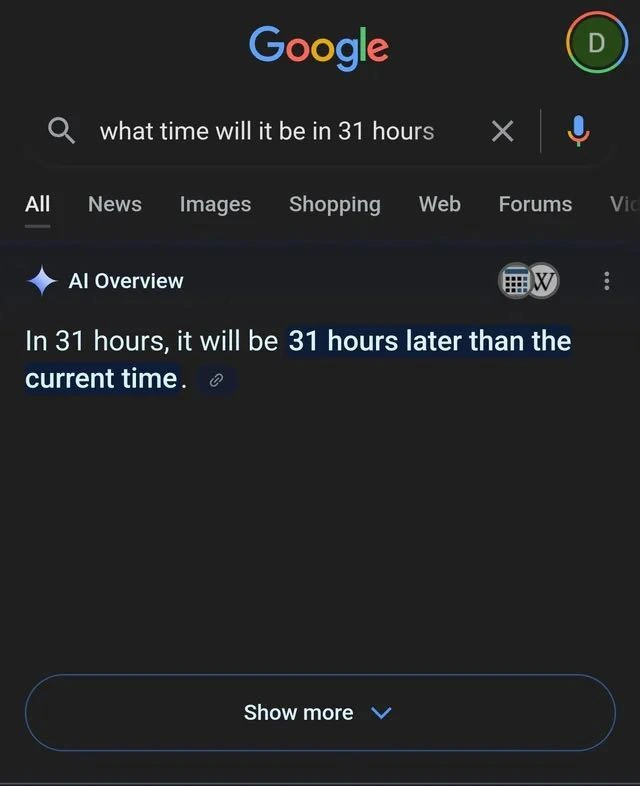
Let’s break down what’s happening here in simpler terms. The image is a screenshot of a Google search on a phone in dark mode. The user typed “what time will it be in 31 hours” into the search bar. Normally, one might expect Google to simply calculate that for you. For example, if it’s currently 3:00 PM and you ask for the time 31 hours later, the correct answer would be 10:00 PM tomorrow (because 24 hours brings you to 3:00 PM next day, then +7 hours = 10:00 PM). Google usually has built-in tools for things like math, unit conversions, or time zone calculations. In fact, traditional Google Search might show a quick result or use something like datetime under the hood to figure that out.
However, in this screenshot, instead of the normal direct answer, we see an “AI Overview” response. This is part of Google’s new AI-powered search features (currently experimental in 2024). Think of it like Google having its own version of a ChatGPT-style assistant that tries to summarize answers for you. The response from this AI is highlighted in blue and says: “In 31 hours, it will be 31 hours later than the current time.” That’s it. No actual clock time given, no date, nothing useful – just basically restating the question. This is what we call a tautology or tautological answer: it’s true by definition, but it doesn’t tell you anything you didn’t already implicitly know. It’s like asking “how do I double this number?” and the answer is “by making it twice as large.” Technically true, zero help.
Now, why did the AI do this? The key is understanding what a Large Language Model (LLM) is. An LLM is a type of AI model trained on a huge amount of text (like books, articles, websites) so that it can generate human-like text. Models like these (for example, GPT-4, which is similar to what might be powering this Google feature) are great at sounding convincing and answering general questions that have descriptive answers. But they don’t have a built-in fact database or calculator unless explicitly connected. They operate by predicting likely sequences of words. Here, the model probably has seen sentences about time in training, but it doesn’t actually know “the current time” at the moment of the question – that’s a piece of live data outside its static training. If not programmed to fetch the current time or do the calculation, it’s essentially guessing or defaulting.
What likely happened:
- The AI saw the question “what time will it be in 31 hours”. It doesn’t have an internal clock or direct access to say “it’s 5:00 now, plus 31 hours equals …”.
- It also doesn’t want to make up a random time (that would be a hallucination – when an AI gives a confident answer that’s completely made-up or wrong).
- Lacking a tool to compute the answer, the safest thing it “knew” how to do was to rephrase the question into an answer form. So it coughed up basically, “31 hours from now is 31 hours later than now.”
For a junior developer or someone new to AI, this highlights a key limitation: AI assistants can’t do dynamic calculations or fetch real-time info unless they are explicitly designed to. This Google AI Overview seems not to have that capability here. In coding terms, think of it like this: if you wrote a program to parse human language but never taught it how to use a datetime function or an API to get current time, it won’t magically know the time. The program might end up doing something silly like string manipulation. In fact, here the AI essentially did string manipulation on the question.
To illustrate how trivial the expected answer should be for a computer, here’s how you could do it in Python:
from datetime import datetime, timedelta
hours_ahead = 31
future_time = datetime.now() + timedelta(hours=hours_ahead)
print(f"In {hours_ahead} hours, it will be {future_time.strftime('%Y-%m-%d %H:%M:%S')}.")
This little snippet gets the current time (datetime.now()), adds 31 hours (timedelta(hours=31)), and prints out the result. A basic script like that would give a precise answer (including date and time). The AI, on the other hand, didn’t execute any code; it just used language knowledge. It’s as if the AI has read a lot about time but never learned how to count hours in a functional way. So it produced an LLM limitation showcase: great at sounding fluent, bad at time_calculation without help.
For context, tech folks label this kind of quirky output as AI humor. It’s funny to us because it shows the gap between AI hype and reality. Big companies hype up their AIAssistants as super smart, almost human-like in understanding. Yet here we see the AI not understanding what we actually wanted. A human, even a child, would know you expect a specific time of day as the answer. But the AI gave a literal, unhelpful response. You might also hear this called a hallucination or just a failure mode of the AI. “Hallucination” usually means the AI is confidently wrong; in this case it’s confidently saying basically nothing of value, which is a slight twist on that concept – we could say the AI “hallucinated” that re-stating the obvious was a good answer.
Another term in the tags is prod_feature_gap: that’s developer slang for the difference between how a feature is supposed to work in theory and how it actually works in production (with real users). Here the gap is almost comical. In theory, integrating an AI into search would give us smarter answers. In production, at least for this query, it gave a dumb answer that any basic program could’ve improved on. Developer_snark ensues, meaning developers are making snide jokes about it. For instance, one might joke: “Google finally achieved time travel – it takes you right back to where you started.” Or “I asked for the time in 31 hours and all I got was this obviously true statement.” This is the kind of thing devs share on Twitter or Reddit as lighthearted proof that fancy AI can trip over simple tasks.
In summary, the screenshot is poking fun at Google’s AI in Search because it failed at a very elementary question. It shows the limitations of current AI models: without explicit instructions or tools, they can end up saying something that sounds correct but isn’t useful. For a junior techie or anyone new to this: don’t be mystified by the AI label – under the hood it still might need basic programming logic to handle certain queries. When those pieces are missing, you get outcomes like this tautological_answer: true, sure, but facepalm-worthy.
Level 3: AI Search Facepalm
Welcome to the AI-powered future, where even Google managing to state the obvious becomes a meme. This screenshot captures one of those classic “hype vs reality” moments in tech. The user asks Google’s shiny new AI Overview in search, “What time will it be in 31 hours?”, expecting a helpful answer like “It will be 3:45 PM on Sunday” (or whatever the actual time would be). Instead, the AI responds with:
“In 31 hours, it will be 31 hours later than the current time.” 🤦
This is the definition of a tautological_answer – the answer basically repeats the question’s premise without adding any new info. It’s as if you asked a highly trained assistant for a solution, and it just echoed back a reworded question with a period at the end. The humor isn’t just in the AI making a mistake; it’s in the gloriously underwhelming way it did so. We have here a multi-billion-dollar tech conglomerate deploying advanced AI assistants to augment search… and the result is on par with a snarky teen saying, “well, duh.” It’s AIHumor at its finest because it highlights AILimitations in such a stark, deadpan manner.
From a developer’s perspective, this triggers a collective chuckle and a weary sigh. 🤖 LLMHumor like this stems from an open secret: large language models often don’t know things in the way a database or a traditional program would. They generate plausible-sounding text based on patterns. Here, the plausible pattern for “What time will it be in X hours?” – without actual context – devolved into restating the question. The system refused to hallucinate a specific time (good, it didn’t invent a false timestamp), but it also failed to fetch the real answer. It’s a classic llm_failure_mode where the model, lacking proper tool-use or data retrieval, ends up giving a response that’s technically true yet totally unhelpful.
Why is this so relatable (and funny) for developers? Because it exposes the prod_feature_gap between AI hype and implementation. We’ve sat through keynote demos where AI is promised to revolutionize everything. But when rushed into production, reality can be… awkward. Google likely rushed this ai_overview_feature into Search to compete with Bing’s AI and the general AI assistant wave. In doing so, they hit an edge case that wasn’t explicitly handled. A straightforward time math question fell through the cracks of the AI’s training data and the product’s logic. Any senior engineer can imagine the post-mortem: “Why didn’t we just use our trusty old time calculator? Who thought the LLM alone would handle this?” This is developer_snark gold because it’s a multilayered facepalm:
- The obvious solution existed – a normal Google search or a simple script could answer this in milliseconds. Heck,
Date.now() + 31*3600*1000would have done it. - They didn’t integrate it – the AI wasn’t hooked into the part of Google that knows current time or how to add hours. Possibly the AI took over the query and suppressed the standard result.
- The AI’s answer is hilariously useless – It reads like a profound statement, but it’s content-free. This is the kind of answer you joke about: “Thanks, AI, very cool.”
In the broader context of IndustryTrends_Hype, it’s another cautionary tale. We saw similar flubs with early Siri, Alexa, and especially with ChatGPT-like models integrated hastily into products. Remember when Bing’s AI chatbot went on weird tangents or when Google Bard famously fumbled a fact about the James Webb telescope in its debut? Compared to those, this one is low-stakes and comedic – nobody is misled, they’re just baffled at how silly the response is. It’s like asking an intern to calculate 2+2 and they answer, “2+2 equals the sum of two and two.” True… but not the 4 you were looking for.
The meme nails AIHypeVsReality: we have all this fancy AI_ML tech, yet the end-user experience sometimes regresses. The old Google (pre-AI) likely would have either shown a direct calculation or at least not highlighted such a dumb result. But the new AI-powered Google confidently delivered a null-value answer as if it’s useful. It’s the Clippy moment for 2024’s AI – reminiscent of that Microsoft Office assistant popping up to say, “It looks like you’re writing a letter!” when you clearly weren’t. Here it’s the AI cheerfully stating, “It’ll be 31 hours later, boss!”
For seasoned devs, there’s also an element of schadenfreude: we know how complex these systems are, and we’ve all released code that didn’t account for a simple use case. This glitch likely escaped testing because who thinks to QA a question this basic? It exposes how prod differs from theory – in production, real users will type things you never expected. One could imagine a harried developer seeing this screenshot on Twitter and muttering “oh no, we forgot that scenario”. Or perhaps it was known, but product managers decided to ship anyway to meet a deadline (AI everywhere by Q4!). The developer_snark comes from empathy and exasperation: we’ve been there, if not with AI then with some feature that behaved embarrassingly in front of users.
In summary, this meme is funny-’cause-it’s-true for anyone following the AI craze. It condenses a lot of AI limitations into one sentence highlighted in blue. It’s a playful reminder that behind the slick AI assistants branding, these systems can still royally screw up trivial tasks. The next time someone says “AI will replace programmers,” show them this – an AI that can’t even replace the humble DateTime library without human help. The community’s verdict: great potential, but HumanVsAI moments like this prove we’re not obsolete just yet. Instead of delivering a useful answer, the AI gave us a perfect joke – one that the entire dev community can laugh at while shaking their heads.
Level 4: Temporal Tautology
At the cutting edge of AI, we’re witnessing a Large Language Model (LLM) accidentally perform the identity function on a time query. Under the hood, Google’s AI search assistant is powered by a Transformer-based model – a heavyweight neural network trained on terabytes of text. It can eloquently discuss quantum theory or code in Python, but here it punts on basic arithmetic. Why? Because an LLM is essentially an expert in textual pattern recognition, not a built-in clock or calendar. The user asked a time-shift question (“what time will it be in 31 hours”), which from a computer science standpoint is a straightforward calculation: just add 31 hours to the current timestamp. However, the AI’s text-generation brain doesn’t truly know the current time, nor does it inherently perform math or maintain state about “now.” Unless explicitly given a tool or function for temporal reasoning, the model treats the query like any other sentence to complete. The result? A tautological answer – the model rephrased the query’s premise as the answer. Formally, it answered with something of the form t + 31h = t + 31h. In logic, that’s akin to saying “X is X,” an always-true statement that provides zero new information. This highlights a fundamental limitation: without specialized prompting or external calculators, even an advanced AI reverts to statistical parroting. The Transformer architecture enables impressive emergent abilities, but precise, grounded computations (like date or time math) fall outside its natural skillset. We’re basically seeing the AI’s language model fail open – rather than risk a wrong guess, it defaulted to a trivial truth. It’s a snippet of accidental metamathematical humor: the system implicitly tells us, “I know 31 hours from now is 31 hours later than now – beyond that, I’ve got nothing.” This is a perfect illustration of the difference between syntactic intelligence and semantic utility: the AI produced a grammatically and logically correct sentence that is utterly useless. In academic AI terms, it’s an alignment miss on a straightforward query – the model wasn’t aligned to perform actual time calculation, exposing a gap between the AI’s linguistic prowess and its inability to execute even grade-school arithmetic without extra help. The humor here taps into our understanding of how these black-box models can spectacularly miss the mark on corner cases. It’s an inadvertent reminder of the old computing adage: garbage in, garbage out – or in this case, no reasoning in, no answer out. We’ve built a fantastically advanced text generator that can simulate understanding in many domains, yet when confronted with a simple temporal inference, it produces a Zen-like tautology. This deep irony – that a multi-billion-parameter AI can expound on AI_ML research trends but can’t tell you the time tomorrow – tickles the seasoned engineer’s funny bone. It’s a collision of theoretical AI brilliance with the hard limits of practical reasoning. Essentially, the AI Overview feature just demonstrated Gödel’s incompleteness theorem for hype: there will always be a simple question that stumps the complicated system by exposing its blind spots.
Description
This image is a screenshot of a Google search result in dark mode. The user has typed the query, 'what time will it be in 31 hours'. Below the search bar, a section titled 'AI Overview' provides the answer: 'In 31 hours, it will be 31 hours later than the current time.' The answer is highlighted, drawing attention to its hilariously unhelpful and tautological nature. The humor stems from the failure of a sophisticated AI system to perform a simple calculation, instead offering a statement that is technically correct but provides no actual information. For a technical audience, this is a relatable example of AI models providing confidently incorrect or useless answers, highlighting the gap between the hype of AI capabilities and their practical, sometimes flawed, execution. It's a critique of LLMs' tendency to produce syntactically correct but semantically empty statements

Comments
15Comment deleted
The AI has clearly been trained on stakeholder requirements. It's a 100% accurate, perfectly useless statement that avoids committing to any specific deliverable
Nothing screams “AI transformation” like replacing DateTime.now().addHours(31) with a 175-billion-parameter model that deadpans, “in 31 hours it’ll be… 31 hours later.”
After 20 years of building distributed systems that handle time zones, DST transitions, and leap seconds, I've finally found an AI that understands time exactly as well as my junior developers who store everything in local time strings
When your LLM passes all unit tests with 100% accuracy but fails the 'does this actually help anyone' integration test. Google's AI Overview here demonstrates perfect mastery of temporal tautology - technically flawless, semantically useless. It's the software equivalent of implementing a function that returns its input parameter with extra steps and calling it 'AI-powered transformation.' Senior engineers recognize this as the production manifestation of 'the model learned the training data distribution perfectly but completely missed the underlying task.' Ship it with confidence: zero hallucinations, infinite unhelpfulness
Ask what time it’ll be in 31 hours and the AI says, “31 hours later than now.” Finally, a datetime API that’s DST-proof and utterly useless - technically correct as a service
RAG without Date.now() access is the new eventual consistency - impossible to be wrong, guaranteed to be useless
AI with 1.6T params rediscovering that time.add(hours) skips the modulo 24 - because why solve when you can state the obvious?
Not true Comment deleted
You are right. I apologize for my confusion. In 31 hours it will be the current time plus the 31 hours which equals t+31h. I hope this helped. Ask me how else I can help you. Comment deleted
LMFAO Comment deleted
AI joke or AI logic?, this AI wants to conquer the world! Comment deleted
This is more like google's llm is garbage Comment deleted
Right it is. Yours sincerely, Captain Obvious Comment deleted
Sorry I didn't mean to do that Comment deleted
perfect Comment deleted