Skip to content
DevMeme
3610 of 7435
A Shy Proposal for a Secure Public Key Exchange
Security Post #3947, on Nov 19, 2021 in TG

A Shy Proposal for a Secure Public Key Exchange

Why is this Security meme funny?

Level 1: Keys to My Heart

Imagine you have a special locked box where you keep all your secret letters. You have a key to lock and unlock it, and you can make a copy of a “lock” that anyone can use, but only your key can actually open it. Now, let’s say you really like someone. Instead of giving them a kiss, you hand them a copy of that lock and say, “here, you can use this to send me secret notes and only I will be able to open them.” In return, they give you their special lock so you can send them secret messages too. That’s basically what’s happening in this meme! Two coder friends are swapping their secret message locks (that’s what a public encryption key is) as a way of showing trust and affection. It’s super nerdy: most people would just hug or hold hands, but these two are basically saying “you have the key to my heart” with actual digital keys. It’s funny and sweet because they’re treating computer security like a love language. Even if you don’t get the computer stuff, the idea is like passing a note in class written in a secret code that only your crush can decode. It’s both silly and heartwarming – they’re so geeky that sharing encryption keys becomes their version of a romantic moment. In other words, they found a high-tech way to say “I like you and trust you,” and that’s why we can’t help but smile at it.

Level 2: Encrypted Love Letters

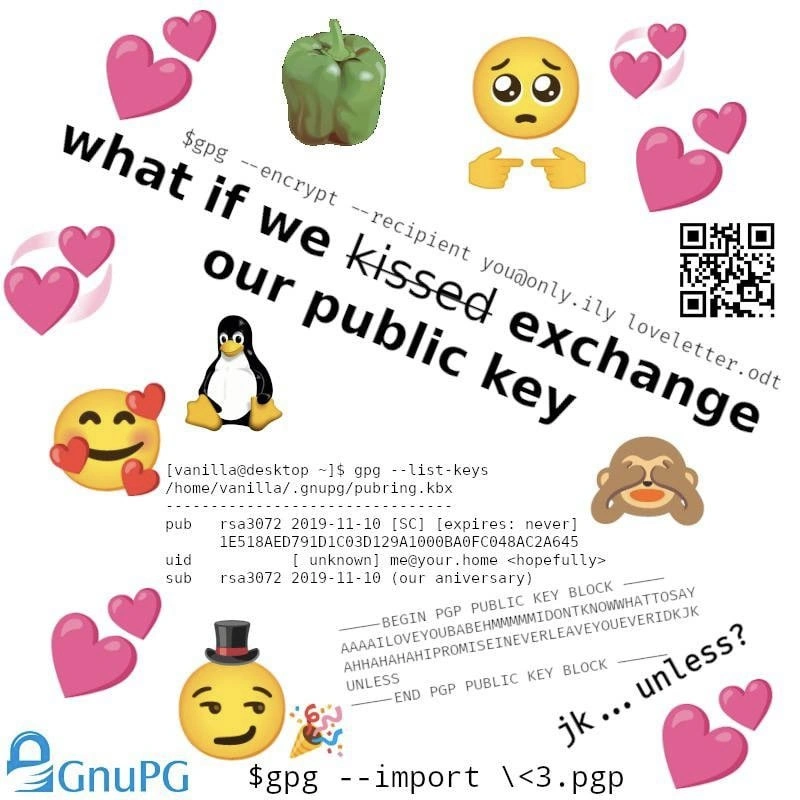
For those newer to this, let’s break down what’s happening. This meme imagines two developers flirting by using GnuPG (GPG), a popular encryption tool, instead of doing normal lovey-dovey stuff. GnuPG is a program you run in a Command Line Interface (CLI) (a text-based terminal) to encrypt or sign things. So picture a black terminal window where you usually type nerdy commands – the meme turns it into a stage for romantic gesture. The big joke text says: “what if we kissed exchange our public key”. They crossed out “kissed” and replaced it with “exchange our public key”. Exchanging public keys is something tech people do when they want to send each other secret messages or verify each other’s identity. Instead of exchanging phone numbers or actual house keys, these two are exchanging cryptographic keys. It’s like saying, “Let’s be secret message buddies!” in developer language.

Here’s how that works in real life: Public-key encryption involves two keys for each person – a public key you can share with everyone, and a private key you guard closely. If I have your public key, I can encrypt a file or message that only you can decrypt with your private key. It’s a cornerstone of Security in the digital world. So in the meme, when one dev suggests giving their public key to the other, they’re effectively saying, “I want to send you encrypted love notes that only you can read.” It’s an over-the-top nerdy form of affection, because normally people might just send a text or a handwritten letter – not spin up GPG on Linux to do it.

The image is full of hearts and cute emojis to set a lovey tone. For example, the pleading face emoji (🥺👉👈) – with little fingers pointed inward – is the universal body language of “aww shucks, would you maybe...?”. It shows the dev is shyly asking, “Would you like to exchange keys with me?” You’ll also spot heart emojis everywhere (😍🥰💖) amplifying the Valentine vibe. In contrast, you see Tux the penguin, which is the mascot of Linux. That penguin tells us: this is happening in a Linux-y world (since GPG and such tools are commonly used on Linux systems). The mix of hearts and a Linux penguin is already silly – it’s combining romance with nerdy operating system culture.

Let’s decode the text snippets shown:

  • $ gpg --encrypt --recipient [email protected] loveletter.odt
    

    This is a command one would type into a terminal. It means “use GPG to encrypt the file loveletter.odt for the recipient [email protected].” The joke here is the recipient’s name looks like an email, [email protected], which sounds like “you at only dot I-L-Y”. “ILY” is chat slang for “I love you.” So it’s like the recipient’s address literally says "you, only, I love you." Pretty adorable and corny! The sender named their file loveletter.odt (a love letter document), and they’re encrypting it so that only the person with that email’s corresponding private key can read it. In other words, they’re digitally locking their love letter so that only their crush can unlock it. How sweet, in a geeky way.

  • Next, we see a terminal prompt [vanilla@desktop ~]$ gpg --list-keys and the output of listing the keys. This output is showing the contents of the user’s keyring (a storage of known keys). It has a public key labeled as rsa3072 (meaning it’s an RSA key, 3072 bits long, which is a strong encryption key). It shows the key was created on 2019-11-10 and doesn’t expire (expires: never). Under it is a uid (user ID) line: [unknown] [email protected] <hopefully>. In GPG, the uid usually includes the person’s name or email. Here it’s formatted like an email: “[email protected]” with a comment “hopefully”. This is a playful fake email implying “me at your home, hopefully.” It’s basically the key owner cheekily saying they hope to be “at your home.” 😉 Following that, there’s a subkey (a secondary key used typically for actual encryption tasks) also rsa3072 created on 2019-11-10 labeled “(our aniversary)”. They even treated the subkey’s creation date as “our anniversary”! It’s a humorous little detail – normally subkeys can have a usage label, but writing “our anniversary” personalizes it as if the day they generated these keys became a special date for them. This is the kind of detail that’s pure TerminalHumor: only someone comfortable reading gpg --list-keys outputs would catch the romance hidden in that text.

  • The big block that starts with -----BEGIN PGP PUBLIC KEY BLOCK----- and ends with END PGP PUBLIC KEY BLOCK is designed to look like an actual public key block. In reality, when you export a GPG public key, you get a chunk of seemingly random letters and numbers in between these lines (usually in base64 encoding). It’s basically a text version of the key data, sometimes shared via email or files. In the meme, inside that block, they’ve inserted strings that look like gibberish but are actually goofy love messages, e.g., AAAALOVEYOUBABEMMMIDONTKNOWWHATTOSAY.... It’s not a real key, just a simulation full of romantic gibberish. This mocks the way real encrypted data or keys look like nonsense to humans. So it’s as if their romantic feelings were encoded into a PGP key! If you tried to actually import that, it wouldn’t work – but it sure gets the joke across that “my public key contains all my love”.

  • There’s a tiny QR code shown next to the main text. A QR code can encode text or a link, and techies sometimes use them to share their public keys or fingerprints (a fingerprint is a short unique code for a key) at meetups or online for convenience. In the spirit of the meme, imagine it contains the person’s public key or maybe a cute hidden message like “Scan this to get my key (and maybe my heart).” It’s another way the meme blends real security practices (QR codes for key exchange are actually a thing in some communities) with the fun of a love note.

  • Finally, at the bottom, the command: $ gpg --import <3.pgp followed by “jk….unless?”. This shows the other side of the exchange – importing someone’s public key into your keyring. The filename <3.pgp is a crafty way to sneak a heart symbol (“<3” looks like a heart) into a file name. So it reads like “import heart.pgp”. If you ran that, it would import a file named <3.pgp (presumably the other person’s public key file) into your GPG keyring. By saying “jk… unless?”, the meme is mimicking a flirty punchline: “Just kidding… unless you really want to!” In plain terms, the dev making this meme is joking about importing your key (meaning, committing to this secure relationship) – but if you’re actually willing, they’re totally serious. It’s the classic playful dare wrapped in command-line form.

In summary, the meme uses Encryption and command-line CLITools as metaphors for closeness and trust. It’s explaining “I like you” in the nerdiest way possible. If two developers share their public keys, they’re basically saying “Let’s communicate in our own private channel.” It’s akin to passing notes in class, but those notes are locked with a code only you two can read. All the visual elements – the hearts, the 🐧 Linux penguin, the 😂 monkey covering its eyes (as if blushing “I can’t believe we’re actually doing this!”) – drive home that this is a developer in love moment. Even if you’re new to GPG or never encrypted anything, you can see it’s a mashup of love and tech. It’s funny because it’s a bit absurd: most people woo by writing poems or giving flowers, but here our lovebirds are geeking out with cryptography algorithms and terminal commands. For a junior dev or anyone unfamiliar with these tools, just know this: exchanging public keys is a very geeky way of saying “I trust you and want to share secrets with you”. And turning that into a pretend romantic meme is just the tech community’s quirky sense of humor. 💓🔐

Level 3: Cryptographic Courtship

This meme is essentially a developer valentine, mixing infosec savvy with classic flirty meme culture. It’s riffing on the popular “what if we kissed ... (jk, unless?)” meme format, but giving it a hardcore nerd twist: “what if we kissed exchanged our public keys.” For seasoned devs, the humor comes from the collision of two vastly different worlds – smitten romance and dry command-line Terminal operations – to create a security_romcom scenario. The large diagonal text mimics a cheesy pickup line, but instead of a spot under the mistletoe, the rendezvous is on a Linux terminal. It’s hilariously relatable to any engineer who’s ever used gpg or managed SSH keys; sharing a public key is normally a mundane security step, yet here it’s portrayed as an intimate act. Why is that funny? Because in tech circles, trusting someone with your keys is a big deal – almost akin to trusting them with your secrets or your heart. Exchanging keys means “I want to communicate with you securely and I trust you won’t misuse this.” That’s arguably more commitment than a fleeting kiss! The meme doubles down on this with obvious Valentine’s tropes: heart-eye emojis, pink hearts, the pleading “🥺👉👈” emoji combo of a shy crush – all scattered around Linux Tux and encryption commands. It’s the ultimate TerminalHumor tableau: literally love in a CLI.

Look at the details a senior dev would appreciate:

  • The GnuPG (gpg) commands are real. Example: $ gpg --encrypt --recipient [email protected] loveletter.odt – this is exactly how you’d encrypt a file (here humorously named "loveletter.odt") for someone’s eyes only. The joke is that our smitten developer is actually crafting a secure love letter, using encryption as foreplay. It’s a playful jab at how Encryption has become a love language for those who eat, sleep, and breathe command-line tools.
  • In the screenshot of the key ring (gpg --list-keys output), the user ID is set to [email protected] <hopefully>. Seasoned users know a GPG key’s uid often contains your email and a comment – here it reads like “me at your home (hopefully)”, a cute easter egg implying “hopefully one day I’ll be at your home”. 😏 It’s a flirty hidden message masquerading as an email address. And the subkey has “(our aniversary)” as its label – implying they consider the key’s creation date their anniversary. This is both geeky and endearingly corny. A dev will smirk at the misspelling “aniversary” – perhaps intentionally goofy, as if the excitement made them typo, or just part of the meme’s chaotic charm.
  • The presence of Tux the penguin (the Linux mascot) cements the context: this is a Linux/OSS geek’s idea of romance. Only in an open-source love story does the penguin third-wheel the date! It implies the environment is Linux, where tools like GPG are native. Devs see Tux and immediately think “aha, a fellow Linux user is involved in this love story,” which deepens the insider camaraderie.
  • Even the random green bell pepper emoji in the collage might elicit a chuckle from meme-savvy developers. It seems totally out-of-place amid hearts and penguins – which is exactly the point. A bit of absurd visual humor: perhaps it’s there “to spice things up” (pepper = spice, get it?) in this romantic encryption scene. Tech meme culture often throws in one wacky element for comedic randomness, and a bell pepper serves that role here.
  • The “jk… unless?” at the bottom is the cherry on top, a phrase synonymous with the flirty meme format. It translates to: “I’m just kidding… unless you’re actually into this 😉.” That self-aware tone nails the social awkwardness many devs feel – it’s like the meme is blushing and saying: “Haha, just a nerdy joke… (but seriously, I’d love to swap keys if you’re down).” It’s painfully relatable for those of us who half-joke about our passions, testing the waters to see if the other person shares our weird interests.
  • There’s also a tiny QR code placed near the text. To an experienced eye, this might hint at how techies share keys or contact info nowadays. Security conferences often have attendees exchange public keys or fingerprints via QR codes for convenience. In a romantic parody context, it’s as if our love-struck dev made a QR code of their public key (or perhaps a cutesy secret message) for their crush to scan – a modern “call me maybe.” It’s an extra detail that deepens the public_key_exchange theme by referencing how keys can be shared visually and securely.

Overall, the meme lands so well with experienced developers because it satirizes our reality: We often joke that “my crypto keys are more protected than my dating life.” This image asks, why not both at once? It’s lampooning how we sometimes prioritize tech rituals (like verifying key fingerprints) as highly as personal relationships. Seasoned folks know that GPG and CLI tools are powerful but notoriously user-unfriendly; using them to flirt is comical because it’s the least smooth, most overly technical way to show you care. The joke’s on us – the people who find generating keys and encrypting files a fun bonding activity. In short, Cryptographic Courtship is the ultimate nerd flex: seduction via Security protocol. It tickles that shared experience where love and encryption both require trust, and it wraps it in the familiar, goofy format of a meme. No doubt, any programmer who’s struggled with gpg key setups or attended a key-signing party will laugh and perhaps secretly find it kind of sweet that someone thought to mix openpgp with PDA (Public Display of Affection, literally!). After all, nothing says “I trust you” like adding someone’s public key to your keyring. 💖🔑

Level 4: One-Way Functions, Two Hearts

At its geeky core, this meme flirts with the fundamentals of public-key cryptography as a love language. Exchanging GPG public keys in lieu of kisses is humorous precisely because it’s rooted in serious math: one-way functions and trapdoor secrets. In cryptography terms, sharing a public key is like handing someone an open padlock that only your secret key can open. The RSA 3072-bit key shown (see the rsa3072 in the output) relies on the difficulty of factoring a huge number into two prime factors – a one-way mathematical process. It’s easy to multiply primes (like locking the padlock), but virtually impossible to undo (unlock) without the private key. Here, the notion of encryption is romantically repurposed: by giving their public key, one developer is saying, “You now have a way to send me secrets that only I can ever read” – an intimate promise sealed by math. This playful scenario actually echoes real cryptographic protocols: a shared key exchange (think Diffie-Hellman rendezvous) is normally a cold technical step to establish secure communication, yet the meme reframes it as a tender moment. Beneath the silliness lies a subtle appreciation for how Cryptography turns trust into equations – and vice versa. The meme even nods to the OpenPGP standard’s culture: those dash-framed blocks (-----BEGIN PGP PUBLIC KEY BLOCK-----) are called ASCII armor, traditionally used to safely share keys via plain text. By filling that block with faux base64 love babble (AAAILOVEYOUBABE...), it irreverently merges rigorous security format with heartfelt (albeit scrambled) sentiment. There’s an almost poetic contrast: Pretty Good Privacy (PGP’s namesake) protecting some pretty strong feelings. For the crypto-savvy, this is adorable and absurd in equal measure – combining the Security of prime-number algorithms with the vulnerability of romance. And yes, consummate nerds will chuckle at the “expires: never” on the key listing – a tongue-in-cheek way of saying our love will never expire in cryptographic terms (because normally keys, like feelings, can expire or get revoked if trust breaks!). By invoking concepts like key validity and the Web of Trust (the GnuPG ethos of personally verifying and signing keys), the meme winks at the almost ceremonial importance of key exchange. In fact, it evokes those old-school key-signing parties where tech folks meet in person to verify each other’s identities and swap public keys; except here, it’s portrayed as a quirky date. The deep irony (and nerd appeal) is that something as abstract and secure as cryptographic key exchange – backed by all the complexity of modular arithmetic and prime factorization – is being used as a coquettish “do you like me?” gesture. It’s a wonderfully over-engineered take on courtship: proving love with a digital signature and a mathematically unbreakable secret, rather than a bouquet of roses.

Description

This meme is a chaotic collage with a 'cringe-core' or 'shitpost' aesthetic, blending themes of awkward online romance with advanced cybersecurity concepts. The central text, distorted and rotated, reads, 'what if we kissed our public key exchange'. The background is cluttered with various emojis including hearts, a pleading face, a blushing face surrounded by hearts, and a monkey covering its eyes. It also features disparate images like a green bell pepper, Tux (the Linux mascot), and the GnuPG logo. The core of the meme lies in the embedded terminal commands and outputs related to GnuPG (GPG), a popular open-source encryption software. Commands shown include `gpg --encrypt --recipient [email protected] loveletter.odt` and `gpg --import \<3.pgp`. There's also the output of `gpg --list-keys`, showing an RSA key with a user ID of `[email protected] <hopefully>` and a subkey creation date commented as `(our aniversary)`. A PGP public key block is shown with a fake Base64 string containing 'AAAILOVEYOUBABE'. The joke culminates with the classic internet phrase 'jk... unless?', making the entire thing a nerdy, shy proposal to establish secure communication. The humor comes from personifying the dry, technical process of PGP key exchange as a romantic, intimate act

Comments

23
Anonymous ★ Top Pick My love is like this GPG key: publicly declared, privately held, and set to never expire. So... wanna import my key, or should I just pipe it to you?
  1. Anonymous ★ Top Pick

    My love is like this GPG key: publicly declared, privately held, and set to never expire. So... wanna import my key, or should I just pipe it to you?

  2. Anonymous

    Dating as a senior dev: first verify the fingerprint via three independent channels, build a transitive Web-of-Trust path, then finally decrypt feelings.asc - only to discover it was signed with their long-expired subkey

  3. Anonymous

    After 20 years in tech, I've seen countless key exchange ceremonies, but none as intimate as when two developers share their public keys over coffee, knowing full well they're about to establish a trust relationship that no certificate authority can revoke - though the real romance dies when you realize they still haven't signed each other's keys at the next key signing party

  4. Anonymous

    Nothing says 'I trust you with my heart' quite like exchanging 4096-bit RSA keys with no expiration date. Though I notice they went with rsa3072 - clearly this relationship has *some* boundaries. The real red flag isn't the key size though, it's that ASCII-armored confession embedded in the key block. Everyone knows you should keep your key material and your feelings in separate, properly encrypted containers. At least they're using GPG instead of trusting a centralized key server - that's the kind of commitment that lasts forever, or until quantum computers break RSA, whichever comes first

  5. Anonymous

    Senior dev courtship: exchange public keys, verify fingerprints offline, sign each other’s subkeys - and swap revocation certs, because even love needs a rollback plan

  6. Anonymous

    PGP courtship: Share public keys on date one, but your private key? That's 'trust on first use' till revocation

  7. Anonymous

    Nothing says long‑term commitment like “expires: never” on an RSA‑3072 master key - I'll import your <3.pgp if you’ve got the revocation cert in an air‑gapped drawer

  8. @Benito_Zara 4y

    Вирус

    1. @sylfn 4y

      use english please approximate translation: it's a rickroll

      1. @affirvega 4y

        lmao

      2. @Benito_Zara 4y

        Virus

        1. @affirvega 4y

          Why

          1. @Benito_Zara 4y

            Idk

            1. @affirvega 4y

              That's not a virus, it's a text file. Try to open in a notepad. It's not even instructions

              1. @sylfn 4y

                it has begin and end so it should be pascal code

                1. @affirvega 4y

                  It's just a big number in base64, nothin' shady here

                  1. @sylfn 4y

                    not the https://en.wikipedia.org/wiki/Illegal_number yes?

                    1. @affirvega 4y

                      > # Illegal prime > ...Its binary representation corresponds to a compressed version of the C source code... Impressive

              2. @SamsonovAnton 4y

                This is also a text file, but also a fully working x86 code that can be run in DOS when saved with .com extension: X5O!P%@AP[4\PZX54(P^)7CC)7}$EICAR-STANDARD-ANTIVIRUS-TEST-FILE!$H+H* Go give it a try with your antivirus (provided that it is EICAR-aware).

      3. @dsmagikswsa 4y

        This translation is gold.

  9. @sylfn 4y

    ! Use English here !

    1. Алексей 4y

      sorry

  10. @sylfn 4y

    ! Use English here !

Use J and K for navigation