Skip to content
DevMeme
1204 of 7435
How Coders Celebrate 4/20: Rolling Hash
CS Fundamentals Post #1345, on Apr 20, 2020 in TG

How Coders Celebrate 4/20: Rolling Hash

Why is this CS Fundamentals meme funny?

Level 1: Celebrate with Code

Imagine there’s a special day when a lot of people are having a certain treat or doing a fun activity that you don’t have. Instead of feeling left out, you decide to have fun in a different way that just sounds the same. That’s what’s happening here. On April 20th (“4/20”), many grown-ups joke about using something called “hash” (a kind of cannabis, which is like a plant people smoke to feel funny). But these programmers don’t have any of that, so they do something nerdy that has the exact same word in it: they look up “rolling hash” – which isn’t a treat at all, it’s actually a computer puzzle! In simple terms, a rolling hash is like a math trick with words that they find really cool.

So the joke is comparing two things that sound alike: one is rolling a hash (making a smoke with a drug), and the other is rolling hash (studying a computer algorithm). The programmers choose the second one. It’s as if everyone else is eating candy, but these guys are reading about how candy is made. It’s funny because they celebrated in such a super geeky way. They’re basically saying, “Who needs fancy stuff or drugs to have fun? I’ll just play with some cool computer math!” It shows how programmers sometimes enjoy themselves with knowledge and jokes, doing things with code when everyone else might be doing something completely different. The humor comes from that big contrast – and from using the same word “hash” to mean two very different things. It’s a silly, clever way to celebrate: no smoke, just code.

Level 2: Not That Hash

Let’s break down the joke in plain terms. First, in programming, a hash function is a process or formula that takes some input data (like a piece of text or a file) and churns out a number – usually a shorter, fixed-size number that kind of represents the input. Think of it like a digital fingerprint for data: if two pieces of data are different, a good hash function will (most of the time) give you two different fingerprints. For example, you put in "Hello" and maybe you get out 95827724 as the hash. Put in "Hell0" (with a zero) and you get a totally different number. Hash functions are super useful in computing for things like quickly looking up data, verifying integrity, or detecting duplicates. But importantly, a hash function usually works on the entire input as a whole.

Now, a rolling hash is a special type of hash function. “Rolling” here means that as you move along your input (like sliding a window over a text), you can update the hash little by little instead of recalculating it from scratch. Imagine you have a window of 4 letters looking at ABCD in a text, and you have a hash for ABCD. Now you slide that window one step to the right so it covers BCDE next. A rolling hash lets you quickly compute the hash of BCDE just by tweaking the hash of ABCD – basically removing the effect of the A and adding the effect of the new E. It’s like saying, “I know the fingerprint of this 4-letter chunk, so I can get the fingerprint of the next chunk by just updating what changed.” This sliding window strategy is common in algorithms: you maintain some calculation on a small part of the input and move that part step by step. It’s used in many efficient solutions, for example in finding a smaller string inside a larger string (the string matching problem). One famous algorithm, Rabin-Karp, uses a rolling hash to hunt for a pattern in a text. Instead of comparing the pattern to every substring of the text directly (which is slow), it compares hash values – a much faster shortcut – and only does a detailed check when the hashes match. Rolling hashes make that possible by giving a quick way to get each substring’s hash as you slide along the text.

Alright, that’s the computer science side of “hash”. Now let’s talk about the other meaning of hash. Outside of coding, hash can refer to hashish, which is a drug made from compressed cannabis (marijuana). People often smoke it, and colloquially they might just say “hash”. And 4/20 (April 20th) is widely known as a day when a lot of people celebrate and indulge in cannabis culture – you’ll hear jokes about “4/20 blaze it” or people lighting up joints at 4:20 PM or on April 20. So, on that day, if someone says “rolling hash,” most folks would think of rolling a hash joint (rolling a cigarette or joint that contains hashish). “Rolling” is the act of making a hand-rolled cigarette or joint. Basically, April 20 is like a little holiday for smoking weed and hashish among enthusiasts.

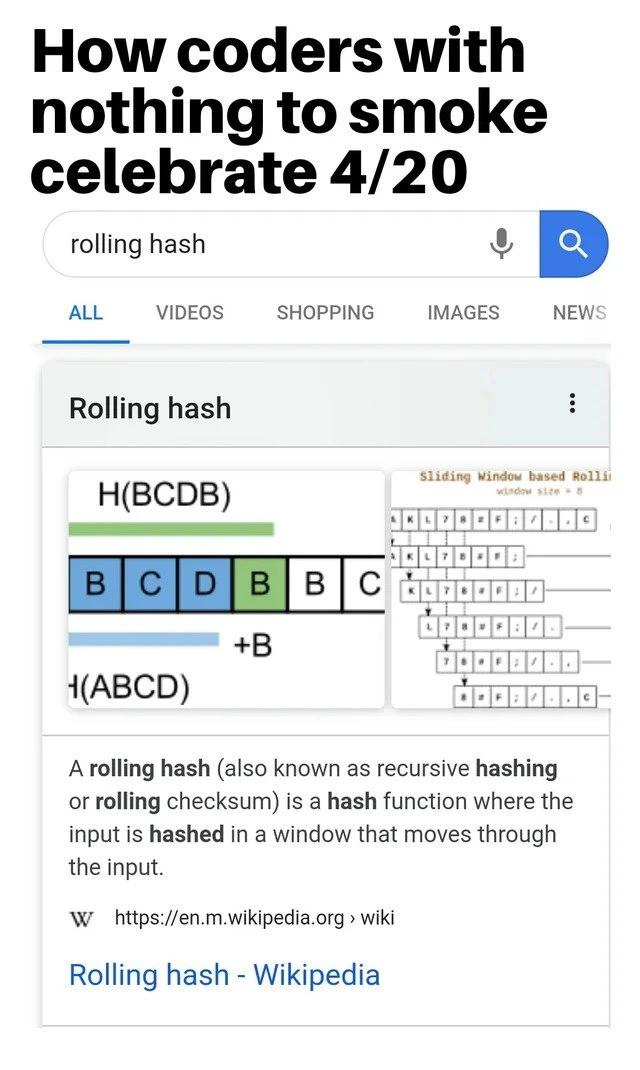
Now look at the meme: The top text literally sets up that scenario – “How coders with nothing to smoke celebrate 4/20”. So it’s implying, what does a programmer do on 4/20 if they don’t have any weed/hashish to smoke? The answer: they type “rolling hash” into Google and hit search! The screenshot shows the search results for rolling hash, and of course it’s completely about the technical topic (hash functions and algorithms) and not at all about drugs. The Wikipedia snippet even defines rolling hash in algorithm terms, mentioning hashing in a moving window, with a little diagram. So the punchline is, the coder is celebrating 4/20 by immersing themselves in this nerdy subject that just happens to have the word “hash” in it. They found a way to join the 4/20 fun in name only, by choosing an activity that sounds the same but is actually about computer science fundamentals.

This is a classic example of developer humor and a bit of a coder lifestyle joke. Instead of doing what non-coders might do on a popular culture day, programmers often make jokes by connecting it back to tech. It’s a kind of inside joke: if you know both what 4/20 means in pop culture and what rolling hash means in computing, you get why it’s funny. Basically, they replaced smoking hash (drug) with studying hash (algorithm). It’s a harmless, geeky substitute. The meme format (a Google search screenshot) makes it extra clear – the person is literally searching for the term. You can almost imagine a coder sitting at home on April 20, kind of joking to themselves, “Well, I have no weed, might as well learn about rolling hash functions!” and then actually doing it. It’s humor by contrast: everyone else is getting high, and here we are reading Wikipedia about algorithmic hashes. 🎉

To a junior developer or a student, the takeaway is: hash has more than one meaning! In computing, it’s about algorithms and data fingerprints. In common slang, it’s about cannabis. This meme leans on that double meaning. It also highlights how programmers sometimes take pride in being different or nerdy. While others party in a conventional way, coders might celebrate by doing something techie. It’s a playful poke at ourselves – finding joy in knowledge and code even during a cultural moment that’s totally unrelated to computers. And hey, if you ever find yourself bored on 4/20 (or any day) and not into the smoky festivities, now you’ve got a fun algorithm to lookup: rolling hash! It’s more educational than getting stoned, and your brain will thank you later. 😉

Level 3: Hashing Not Hashish

“How coders with nothing to smoke celebrate 4/20.”

That bold caption sets the scene: it’s April 20th (4/20), the unofficial holiday for, well, smoking weed. But here we have coders who either don’t have any hashish (a form of cannabis often just called “hash”) or choose not to partake. Instead, they’re getting their kicks from a completely different kind of hash – the geeky kind that lives in algorithms and code. The meme shows a Google search for "rolling hash", and the irony is delicious: on a day famous for rolling joints of hash, these programmers are happily reading about rolling hash functions. It’s a perfect wordplay pun that only a tech audience would concoct. The phrase sounds the same, but the meaning couldn’t be more different (one’s a drug reference, one’s a computer science technique).

The humor works on multiple levels of insider knowledge. First, you have to know that “4/20” is slang for a weed celebration. Then you need to know that “hash” in that context means hashish, something people might smoke or roll into a joint. Now, if you’re a developer or CS student, you also recognize rolling hash as a legit technical term – a neat algorithm trick for updating hash values on the fly. When an experienced dev hears “rolling hash”, they don’t think of smoke at all; they think of sliding window algorithms, maybe recalling the Rabin-Karp pattern-matching from their algorithms class or an interview question. So when both meanings collide in one phrase on this special date, it’s hard not to crack a grin. It’s the classic “only a programmer would find this funny” situation.

The Google search screenshot format adds to the joke. It’s as if some coder literally typed their nerdy 4/20 celebration into Google. The top result shown is a Wikipedia snippet explaining rolling hashes, complete with a diagram of moving letter blocks and formulas. To a non-tech person, that result card might look boring or baffling – definitely not what they’d expect for “hash on 4/20”. And that contrast is exactly the point: this is how coders party. Instead of getting high on substances, they get a kick out of high-level algorithms. It’s a bit of self-deprecating humor about the coder lifestyle: rather than doing “cool” rebellious things, we’re at our desks, debugging or reading Wikipedia articles for fun. As the saying goes, “the only hash I roll is a hash function.”

Seasoned developers might also appreciate the deeper irony: we often joke about being “addicted” to solving problems or getting a “rush” when a tricky bug is fixed or a complex algorithm clicks. Here that idea is literalized – they’re treating an algorithm like it’s their 4/20 celebration treat. There’s also a nod to professionalism and legality: bringing actual hashish to work (or even admitting to it) would be a big no-no in most companies, but joking about a hash function? Totally HR-safe and nerdy to the core. In a way, it’s safer and smarter fun.

The meme’s specific wording “with nothing to smoke” hints that these devs might have joined the cultural bandwagon if they had the chance, but since they didn’t, they turned to the next closest thing in name. It’s tongue-in-cheek implying, “Well, we can’t light up, so let’s fire up an algorithm instead!” It’s an absurd equivalence that makes you laugh because it underscores how differently programmers think. We turn even a weed joke into a lesson in computer science. For those of us who have been around tech communities, this kind of humor is endearingly familiar. It’s the same energy as celebrating Pi Day (3/14) by reciting digits of π, or making a joke on May the 4th with Star Wars references. On 4/20, the developer crowd finds a way to join the fun with our own twist: not rolling papers, but rolling hash algorithms.

In summary, the meme pokes fun at how devs and engineers often enjoy intellectual play on words more than actual partying. It’s a senior dev’s chuckle at the dual life we lead – fluent in everyday pop culture but always ready to redirect it to ComputerScienceHumor. After all, what better way to celebrate a stoner holiday than by geeking out over a concept from your CS fundamentals toolkit? This is one of those jokes where if you get it, you secretly feel a sense of pride. You’ve leveled up in both meme literacy and algorithm knowledge. And if you laugh, you’re basically affirming, “Yep, I’d totally spend 4/20 learning about sliding window algorithms instead of lighting anything up.” That’s developer humor in a nutshell (or perhaps in a hash function)!

Level 4: High on Polynomials

Under the hood, a rolling hash is all about some beautiful math that can get a coder feeling a different kind of high. It treats a string of text like a giant number in some base and uses modular arithmetic to keep the number manageable. Imagine the string "ABCD" being turned into a number like:

  • A * B^3 + B * B^2 + C * B^1 + D * B^0 (here each letter is converted to a numeric value and $B$ is a chosen base).

A rolling hash computes something like this, then slides the window one position. For example, when the window moves to "BCDB", you don’t recompute from scratch – you adjust the previous hash. Mathematically, if ABCD shifts to BCDB, the algorithm subtracts the contribution of A, multiplies by the base, and adds the new B. In formula form:

$$ H_{\text{new}} = \big[(H_{\text{old}} - \text{val}(A) \times B^{m-1}) \times B + \text{val(new B)}\big] \bmod M $$

Here $m$ is the window size (4 in this case), and $M$ is a large modulus (often a prime) to keep the hash within a fixed range. This nifty formula updates the hash in O(1) time per step, instead of recomputing an entire substring from scratch. It’s like doing a tiny fix-up to the old result to get the new result – dynamic programming in spirit, but for string fingerprints. The snippet in the meme’s image (with colored blocks and labels like H(BCDB) and +B) is illustrating exactly this process: the previous hash H(ABCD) is transformed into H(BCDB) by removing A and adding a new B.

This concept is classic in computer science. The Rabin-Karp algorithm for fast substring search is a textbook example: it uses a rolling hash to find a pattern in a text in (on average) linear time. Instead of checking each possible substring character by character (which would be very slow, $O(n \times m)$), Rabin-Karp computes a hash for each substring of length m in the big text as it slides along. If a substring’s hash matches the pattern’s hash, it signals a potential match in constant time (with a quick extra verification to avoid the occasional hash collision where two different strings share the same hash). With a well-chosen base and modulus, collisions are rare, and you get a really efficient search. String-matching algorithms love this trick because it drastically cuts down comparisons.

Rolling hashes aren’t just theoretical playthings; they show up in real systems. For instance, the rsync file synchronization tool uses a form of rolling checksum to quickly detect which parts of a file have changed. It computes a lightweight hash on each block of a file, and as it slides through, it can compare these hashes with those of the other file to find matching blocks without sending the whole content. It’s the same principle: a rolling checksum that updates as the window moves. This idea is also used in data deduplication and integrity checking, where you need a quick way to compare lots of overlapping chunks of data.

In short, a rolling hash is a gem of algorithm design in CS fundamentals — using polynomial math and mod arithmetic to make sliding through data extremely efficient. It’s a sober, elegant high: instead of altering your mind, it blows your mind with how clever it is. No wonder some coders get more excited about polynomial hashes than about anything you could literally smoke. After all, implementing a neat algorithm and seeing those hashes line up perfectly can give a brainy buzz of its own. Who needs cannabis when you have computations? 😄

Description

A meme built around a screenshot of a Google search. The top text in bold black letters reads, "How coders with nothing to smoke celebrate 4/20". Below it, the Google search bar contains the query "rolling hash". The search result displayed is the Wikipedia page for "Rolling hash", with a diagram illustrating the algorithm and a definition: "A rolling hash (also known as recursive hashing or rolling checksum) is a hash function where the input is hashed in a window that moves through the input." The humor is a classic pun, playing on the double meaning of "rolling hash." In cannabis culture, "hash" is a drug and "rolling" is the act of preparing it for consumption, both relevant to the 4/20 date. For developers, a rolling hash is a well-known computer science algorithm used for efficient string matching (like the Rabin-Karp algorithm), making it a perfectly nerdy, non-literal way to interpret the phrase

Comments

7
Anonymous ★ Top Pick My 4/20 celebration is just running a rolling hash over a large text file. The only collision I'm worried about is in the hash table, and the only high is the constant time complexity
  1. Anonymous ★ Top Pick

    My 4/20 celebration is just running a rolling hash over a large text file. The only collision I'm worried about is in the hash table, and the only high is the constant time complexity

  2. Anonymous

    Skip the dispensary - nothing hits harder on 4/20 than watching a Rabin - Karp rolling hash glide one byte and recompute in O(1) time… right up until security says, “Nice, now switch it to FIPS-approved SHA-256.”

  3. Anonymous

    When you've optimized your Rabin-Karp implementation so well that even your hash collisions are getting high

  4. Anonymous

    When you're the only one on the team who gets excited about O(n) substring search on 4/20, you know you've truly embraced the rolling hash lifestyle. While others are discussing strains, you're debating whether Rabin-Karp's polynomial rolling hash is superior to the cyclic polynomial approach - and honestly, the dopamine hit from optimizing that sliding window is probably healthier anyway

  5. Anonymous

    Told SecOps we’re rolling hash in prod; panic ensued until they realized it’s Rabin - Karp for rsync, not a new employee wellness program

  6. Anonymous

    Rolling hashes on 4/20: the only high where your window slides in O(1) without paranoid rehashing every substring

  7. Anonymous

    4/20 on the backend: we roll hashes - Rabin - Karp sliding windows for rsync diffs; fun until someone proposes using it for passwords

Use J and K for navigation