Skip to content
DevMeme
1203 of 7435
The Documentation Dilemma: Draw 25
Documentation Post #1339, on Apr 20, 2020 in TG

The Documentation Dilemma: Draw 25

Why is this Documentation meme funny?

Level 1: Avoiding the Boring Chore

Imagine your teacher gives you a choice:

"Do this one little homework assignment now, or tomorrow you'll have to do 25 assignments."

And you really hate that one assignment so much that you reply:

"I'll take the 25 assignments!"

Sounds silly, right? You're choosing a ton more work just to avoid one small boring task. This meme is joking about the same idea. In the picture, writing some instructions to explain the code is the little "chore" that the developer finds boring. But instead of doing it, he chooses to take on a huge heap of trouble later (kind of like getting 25 extra tasks in a game). It's funny because it's such a bad deal — a reminder that people sometimes avoid a simple task even when skipping it makes everything much harder in the long run.

Level 2: Write Now or Pay Later

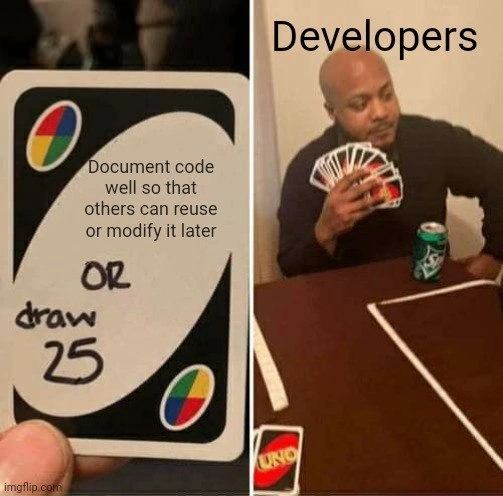
This meme presents a familiar choice for anyone who writes code: write documentation for your work or deal with the consequences of not doing it. In the image, the UNO card says "Document code well so that others can reuse or modify it later OR draw 25." Drawing 25 in UNO is a massive penalty (you have to pick up 25 extra cards!), which is normally a terrible move. The joke is that the developer, labeled "Developers" in the second panel, happily chooses to draw those 25 cards rather than write the documentation. This comedic exaggeration highlights a real tendency in programming culture: an aversion to documentation. In other words, many programmers would rather take on a lot of extra work later than do the boring writing part now.

Documentation in a programming context means any written explanation about what the code does, how to use it, or why it was written a certain way. It can be as simple as comments in your code (for example, // calculate the total price with tax) or as detailed as a separate README file or wiki page describing the entire project. Good documentation helps other developers (and your future self) understand and reuse or modify the code with confidence. When code is well-documented, you don't have to play detective to figure out what each function or module is supposed to do.

By skipping documentation, developers often incur technical debt. Technical debt is a metaphor: if you take a shortcut now (like not writing docs or not writing tests), you'll likely pay for it later with extra work and problems – kind of like borrowing time and having to pay interest on it. Not writing docs is a classic example: it saves time in the moment but creates a "debt" of missing knowledge. Later on, when someone new looks at the code (or even the original author after a few months), they'll have to spend much more time understanding it than it would have taken to write a few comments or a quick guide. This makes the code harder to maintain. Maintainability just means how easy it is to fix, update, or expand the code in the future. Code that isn't documented is less maintainable because nobody is sure what it's supposed to do or how to safely change it.

New developers are often told to "comment your code" and write docs because it's a good habit. However, in real teams there's a common tendency to postpone or skip these tasks. People might think, "I'll add the docs later when I have time," or assume that their code is self-explanatory. Unfortunately, "later" often never comes. The result? Other team members get confused, and tasks that should be simple (like reusing a library or updating a feature) turn into scavenger hunts through the code. Lacking documentation is a huge source of frustration and a frequent developer pain point. Without a guide or comments, even straightforward changes can require combing through unfamiliar code and guessing what it does – which is no fun for anyone.

So the message of the meme is clear: avoiding a small task now (writing some docs for your code) can lead to a much bigger hassle later (dealing with a giant pile of confusion, like drawing 25 extra cards). It's a light-hearted reminder that for developers – especially those early in their careers – writing a bit of documentation is almost always worth the effort. In short: write it down now, or be ready to deal with the mess later.

Level 3: Bigger Deck, Bigger Debt

This meme captures a classic coding culture scenario: given a choice between doing the responsible thing (writing comprehensive documentation) or taking on a ridiculous penalty, developers often cheerfully choose the penalty. The UNO draw 25 card here symbolizes an absurd load of extra tasks (drawing 25 cards is a huge self-inflicted disadvantage in UNO), and the developer gleefully grabs the entire deck instead of writing docs. It's absurd humor grounded in reality – an exaggeration of how far engineers will go to avoid writing things down. The combination of documentation aversion and technical debt is what makes experienced devs both laugh and wince: we've all seen codebases where the original authors clearly picked "draw 25" rather than spending an hour on documentation.

In real projects, skipping out on writing docs is like swiping a company credit card labeled 'technical debt'. It feels free and easy at first – you save time today – but you incur a steep interest payable in confusion and maintainability problems later. The wild part is how universal this joke is across the industry. Everyone from a junior coder to a senior architect has witnessed this pattern: features get shipped fast, with minimal comments or README updates, all while hoping that "the code is self-documenting". (Spoiler: it almost never is.) Instead, a few weeks or months down the line, another developer (or future you) has to dig through that code like an archaeologist, piecing together clues because no one left a simple map. That's one of the developer pain points this meme nails – the painful irony that taking on a heavier workload (like 25 mystery UNO cards of tasks) is a self-inflicted wound we prefer over the comparatively small effort of writing things down.

The humor also lies in the expression of the developer in the right panel. He's holding an absurdly large hand of cards with a smug, satisfied look, as if saying "Yup, I'd rather handle this mess than write docs." It's a shared joke because we've been that person or worked with that person. A seasoned engineer might chuckle (and cringe) here: they've likely spent sleepless nights firefighting or rewriting spaghetti code because the original authors refused to jot down what their code was supposed to do. It's common to find // TODO: add docs comments left in critical modules – a sign that someone procrastinated on documentation and never came back. This behavior is practically an industry meme in itself: developers often refuse to document their code and then act surprised when things go wrong.

From an organizational perspective, this highlights deeper issues with developer experience (DX). Good documentation is a pillar of maintainable software – crucial for onboarding new team members and enabling code reuse – yet it's often undervalued or left out of the "Definition of Done" in fast-paced environments. Management might push to close tickets and add features, implicitly encouraging engineers to "draw 25" (i.e. skip docs) to meet deadlines. Over time, this accumulates a deck of unwritten knowledge – tribal lore that lives only in the original coder's head or scattered in chat logs. When that person goes on vacation or leaves, everyone else pays the price. That's where ignoring documentation bites hardest: the late-night panic when a critical system breaks and nobody knows how it's supposed to work because those documentation woes were swept under the rug.

Ultimately, this UNO meme format perfectly exaggerates a truth every seasoned developer knows. The setup is playful (cards and games), but the underlying message is serious. It's poking fun at our own bad habits. We laugh because it's easier than admitting "I really should have written those docs." As one might jokingly warn on a software team: Write the docs or draw 25 – and far too many of us are sitting there with a giant hand of cards, pretending that was a good idea.

Description

A two-panel meme using the 'UNO Draw 25' format. The left panel shows a hand holding a custom UNO card that reads: 'Document code well so that others can reuse or modify it later OR draw 25'. The right panel, labeled 'Developers', shows a man at a card game holding a massive stack of cards, implying he chose to draw 25 rather than document his code. The meme humorously captures a widespread stereotype in software development culture: the strong aversion many developers have to writing documentation, even when it's crucial for team collaboration and long-term project maintainability. It's a relatable joke for any engineer who has inherited an undocumented codebase or has put off writing docs themselves

Comments

7
Anonymous ★ Top Pick My code is self-documenting. The function named `process_data_final_v2_for_real_this_time()` makes its purpose perfectly clear
  1. Anonymous ★ Top Pick

    My code is self-documenting. The function named `process_data_final_v2_for_real_this_time()` makes its purpose perfectly clear

  2. Anonymous

    Architect: “Update the ADRs or debug 25 3 AM Sev-1s next quarter.” Senior dev - grabbing the whole deck: “On-call pages are just real-time documentation, right?”

  3. Anonymous

    The same developer who wrote "self-documenting code" in the PR description is now spending three hours in a Slack thread explaining what their code does to the person who inherited it

  4. Anonymous

    The meme perfectly captures the industry's unspoken truth: we'll spend 40 hours refactoring to avoid 4 hours of documentation, then wonder why the next engineer rewrites everything from scratch. It's not that we can't document - we've just optimized our workflow to ensure job security through code archaeology

  5. Anonymous

    Choosing draw 25 over docs works until the first Sev-1, when the interest on that debt is paid in 4am Slack archaeology and a bus factor of 1

  6. Anonymous

    Skipping docs for 'draw 25': because future you debugging spaghetti code needs the real boss-level challenge

  7. Anonymous

    Given “document the code or draw 25,” we pick draw 25 - aka 25 Slack threads, 6 hours of Confluence archaeology, and a 2 a.m. incident to rediscover why process() returns true

Use J and K for navigation