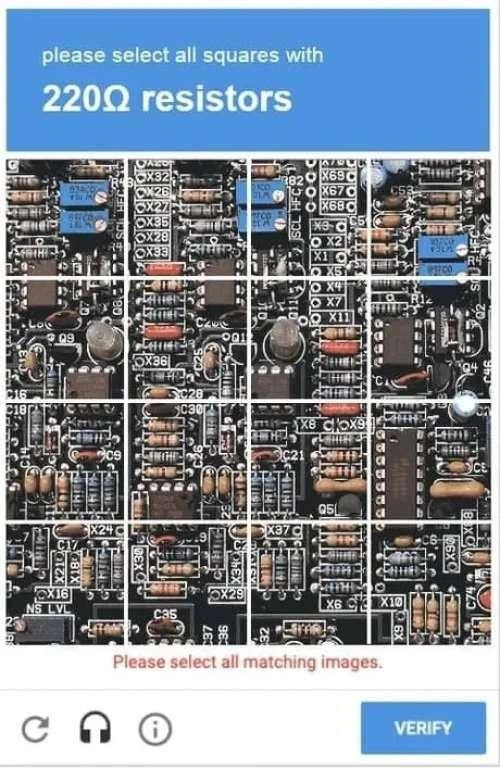
CAPTCHA-Induced Existential Crisis
Why is this Security meme funny?
Level 1: Are You a Robot?
Imagine you’re about to enter a playground, and there’s a goofy security guard who asks every single person, “Hey, just checking – you’re not a robot, right?” You’re clearly a kid, not a robot made of metal and wires, so you might giggle and say, “No, of course not!” Now picture one day a very tired kid who’s been doing homework like a machine hears this question and pauses for a second with a funny blank face, almost thinking, “Hmmm, I do feel like a homework robot… Am I?” It’s a silly thought because we all know he’s human, but him hesitating makes everyone laugh.
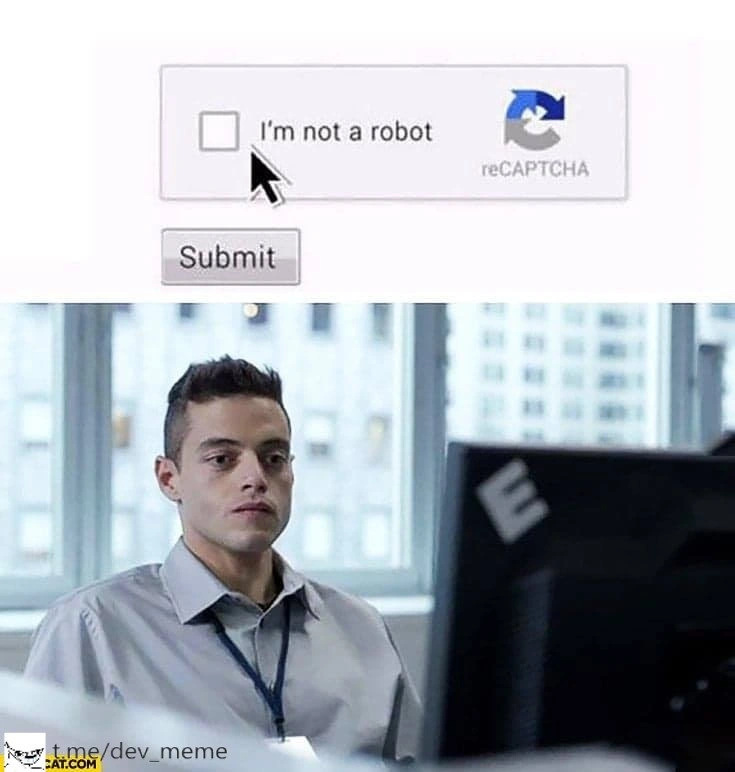
That’s exactly what this meme is about. Websites sometimes ask, “Are you a robot?” with a little box you check to say “I’m not a robot.” It’s a way to keep out fake users. The top picture shows that yes/no question box. The bottom picture shows a real person (a software guy) looking at the screen super seriously, as if he’s not 100% sure he isn’t a robot. It’s funny because real people don’t usually doubt that! It’s like a joke you’d do with your friends: someone asks, “You’re not an alien in disguise, are you?” and you playfully pause and raise an eyebrow, “Hmm, let me think… nope, I’m pretty sure I’m human.” The humor comes from that tiny moment of pretending to be unsure about something so obvious.
So in simple terms: The computer is asking the man to prove he’s a real human. The man knows he is, but he’s play-acting a little confusion like, “Am I a robot? Nah!” This makes us laugh. The meme is showing how even a normal task on the internet can spark a funny little moment where a person jokingly questions themselves. It’s a bit like a knock-knock joke in tech form – cute, light-hearted, and easy to get: of course he’s not a robot, and that’s why it’s silly he even had to hesitate!
Level 2: Proving You’re Human
Let’s break down what’s happening in this meme in simpler terms. The top image is something many internet users have seen: a little check box next to the words “I’m not a robot.” This is part of a system called a CAPTCHA, specifically Google’s reCAPTCHA service. Websites use it as a quick test to tell real people apart from automated programs (bots). In web development, especially in Frontend work, adding a CAPTCHA to a form (like a sign-up or comment form) is a common way to add some security. It’s basically asking the user, “Hey, confirm you’re a real person and not an automated script trying to spam us.” The user typically proves it by performing an action that’s easy for humans but hard for bots – in this case, simply clicking a checkbox. Sounds almost too easy, right? But if you’re a bot, even moving a mouse convincingly or having the right cookies can be difficult. That’s how this botDetection trick works.
So, the top panel shows this everyday human_verification_ui element. The bottom panel shows a developer (a person who writes software) sitting at his desk, staring blankly at the screen where that prompt is. The funny part is why he’s pausing. The text implies he hesitates before ticking “I’m not a robot,” almost as if he’s considering, “Wait, am I a robot?” Of course, he’s human – the scene looks like a normal office with a real person in front of the monitor – but the joke is that being asked such a question can momentarily give you pause, especially if you’re a developer who works with machines all day.
Now, why would a developer find this scenario particularly chuckle-worthy? Think of a developer’s daily life: writing code, automating tasks, sometimes feeling like a cog in a machine. Developers often jokingly refer to themselves as “code monkeys” or say things like “ugh, I’m just a keyboard robot today writing the same script for the 100th time.” They spend so much time with computers that a silly prompt asking “Are you a robot?” is oddly relatable. It’s as if the computer is playfully teasing: “You sure you’re not one of us?”
This meme falls into FrontendHumor because it involves a user interface element (the checkbox) and a developer’s reaction to it. It’s also about WebSecurity practices: CAPTCHAs like this are a security step on websites to stop bots. When you click “I’m not a robot,” the website’s code (often JavaScript on the front-end) communicates with the reCAPTCHA service. If everything looks good – meaning you seem human – the checkbox will just get a little checkmark and perhaps a green light, indicating you passed. If something is suspicious (say you clicked it instantly with no mouse movement, or from an unusual network), then the site might say, “Additional verification needed.” That’s when you get those grids of images asking you to find all the buses or crosswalks – basically puzzles that real people can solve but bots struggle with. This extra step is the system double-checking that you’re not a sneaky program.
For newer developers: adding a reCAPTCHA to your web form involves including Google’s reCAPTCHA widget. You sign up for an API key pair (site key and secret key), include a script in your HTML, and place a special <div> where the checkbox should appear. When the user clicks it and submits the form, your website receives a special code (token) that you then send to Google’s servers to verify. If Google says “yes, token is valid, we trust this user is human,” your form submission can proceed. If not, you typically ask the user to retry or complete a bigger challenge. This entire flow is a browserSecurity mechanism to reduce spam and abuse.
Now back to the humor: The phrase “I’m not a robot” has become a bit of a cultural meme itself. People sometimes joke about it because obviously real robots aren’t going to honestly announce themselves. It’s a quirky thing computers ask us to do. In the image, the developer’s face (which, fun fact, is actor Rami Malek from a show about hackers) is so still and emotionless that he almost looks robotic. He’s like a perfect straight man in a comedy sketch. The contrast between the lively action we expect (quickly ticking the box) and his stoic hesitation makes it funny. It’s as if he’s momentarily role-playing a robot who’s not sure how to respond. This is the developer_identity_crisis at play – a tiny, humorous identity crisis where the dev jokingly wonders, “Have I become one of the machines I work with?”
Also, consider that developers themselves sometimes have to pass their own CAPTCHAs when testing their sites. Imagine building a login page for your app and putting a CAPTCHA on it to keep out bots. You run through dozens of test accounts or form submissions. After a while, the reCAPTCHA system might start challenging you more, because from its perspective, “Hmmm, this one user (you) has attempted to log in 20 times in 2 minutes – could be a brute-force bot.” It doesn’t know you’re the developer doing rapid-fire tests. So you, the human developer, suddenly have to assure the system again and again that you’re human. This gets old fast! The meme’s joke plays off that common annoyance. A junior dev who’s experienced this will relate: you grin and shake your head when a dialog pops up insisting you identify all the tiny blurry traffic lights in a grid, thinking, “I built this feature, I’m obviously not a malicious bot!” But you solve the puzzle anyway because, well, that’s the process.
In summary, at Level 2 understanding:
- CAPTCHA: A challenge-response test used in WebDevelopment to tell real users apart from bots. Stands for “Completely Automated Public Turing test to tell Computers and Humans Apart” (yes, the acronym itself hides the word Turing – a nod to the famous “are you human?” test).
- reCAPTCHA: Google’s popular implementation of CAPTCHA, often seen as the “I’m not a robot” checkbox or image selection challenges. It’s a drop-in tool for developers to secure forms (part of WebSecurity).
- Bot: A program that can simulate a real user to do things automatically (like fill forms, click links). Bots can be bad news if they’re trying to spam or break into websites. BotDetection tools like CAPTCHAs help stop them.
- Developer hesitating: The funny twist that a person who clearly isn’t a robot is momentarily unsure about clicking the checkbox, highlighting the absurdity of the question. It’s humor that mixes technology and a pinch of existential silliness.
- Meme format: It’s a two_panel_meme_format – the setup (the challenge) is shown first, and the punchline (the reaction) is below. Even without words, the images convey the story: Website asks if he’s a robot → Developer stares, momentarily baffled.
This joke resonates with anyone who’s ever been asked to prove they’re human by a website. It underscores how ingrained these little security checks have become in our lives, to the point that even the people implementing them find them amusing. If you’re new to web dev, don’t worry – you’ll likely integrate a CAPTCHA someday and then laugh at yourself when you have to check that box on your own site. Just remember: even the pros who build the systems sometimes get a tiny laugh from the question, “Are you a robot?”
Level 3: The Human-Bot Paradox
In this meme, a developer sits before a computer screen, hesitating at a familiar reCAPTCHA prompt: the checkbox stating "I'm not a robot." For experienced engineers, this triggers a knowing smirk. We recognize this as a mini Turing test embedded in everyday web forms – a moment where a website challenges us to prove our humanity. The humor comes from the developer’s deadpan pause, as if he’s genuinely unsure he can truthfully claim to be human. It’s an absurd identity crisis for someone who writes code all day: am I a human who programs like a robot, or a robot programmed to act human?
From a senior WebDev perspective, this hits close to home. We spend our days automating tasks and writing scripts (little bots) to do our bidding. Then we encounter our own handiwork – CAPTCHA mechanisms we integrated into sites as a security measure – now daring to ask us for proof of humanity. The irony is delicious. After grinding through repetitive coding sessions on autopilot, even a flesh-and-blood developer might chuckle, "I’ve been coding for 12 hours straight, I feel like a robot – will I even pass this bot detection?!"
Technically, that innocuous “I’m not a robot” checkbox is part of an anti_bot_form defense. It’s powered by Google’s reCAPTCHA v2, a sophisticated BotDetection service. Under the hood, it’s far more than a simple boolean check: it’s analyzing your browser’s behavior and metadata in the background. The browserSecurity context is sneaky here – when you hover and click that box, the widget is monitoring things like your mouse movements, timing, even how you navigated to the page. All this feeds a risk analysis engine. A real human tends to have slight jittery motions and delays that scripts don’t easily emulate. A bot might click the checkbox too perfectly or from a suspicious script environment. The result of this analysis is a secret token sent to the server to verify if you likely are human. If anything looks “off”, the system will throw up additional challenges (like identifying images of traffic lights) to really make sure. It’s essentially a human_verification_ui conducting a quick Turing Test each time a form is submitted.
Now imagine being the developer who implemented this very system. You’ve added the reCAPTCHA JavaScript to your site’s frontend, gotten the API keys, and placed the widget on your signup form. Perhaps you’ve even seen its inner workings: when the form is submitted, your code grabs a g-recaptcha-response token and calls Google’s API to check its validity. You know the drill:
# Pseudocode for server-side reCAPTCHA verification
token = form.get('g-recaptcha-response')
result = call_google_api(secret_key, token)
if not result.success:
print("Access denied: Are you a bot?") # Ironic message to the dev themselves
As a seasoned dev, you’ve been on both sides of this equation – building the gatekeepers and also being gated by them during testing. That creates a funny dynamic. In real deployments, you might run through your form dozens of times to debug it. Suddenly Google’s like, “Hmm, 50 form submissions in 5 minutes from the same IP – this might be a script.” The reCAPTCHA starts getting stricter, making you, the legit developer, solve image puzzles to proceed. It’s a classic “I swear I’m not a bot, I just have fast fingers!” frustration. The meme captures that exact too real moment: the blank stare of a dev who now must convince a program of his humanity.
There’s also a delightful meta-reference here: the man in the bottom panel is actor Rami Malek portraying a hacker in Mr. Robot. The meme creator likely chose this image quite intentionally. It doubles the joke – a developer from Mr. Robot hesitating at an “I am not a robot” prompt. It’s a nerdy little wink. For those in the know, FrontendHumor like this thrives on layered meaning. The two_panel_meme_format sets it up perfectly: the first panel shows the recaptcha_checkbox (the trigger), the second panel shows the reaction (the dev’s existential quandary). The contrast between a dry UI element and a human’s emotional response is the core comedic tension.
From an industry standpoint, this meme pokes fun at the necessary evil of WebSecurity. We’ve reached a point where bots are everywhere – scraping content, spamming forms, trying to break into accounts. So we put up these clever roadblocks to stop them. Yet, by doing so, we occasionally annoy or even momentarily bewilder real users. Developers understand this trade-off deeply: every added security layer (2FA, CAPTCHAs, email verifications) can improve safety but adds friction. Here the friction is trivial – just a checkbox – but the meme magnifies it into a philosophical funny moment. Why is it funny? Because truth is, no normal person actually stops to wonder if they’re secretly a robot. But coders? We joke about living on coffee, functioning like machines, and being on autopilot in the glow of multiple monitors. The caption “Developer hesitates before ticking…” nails that inside joke: after deploying countless automation scripts, a dev might half-jokingly question their own organic status.
In summary, the meme’s humor operates on multiple levels for the seasoned engineer:
- Tech irony: A cutting-edge bot detection system ends up interrogating the very human who coded it. It’s as if Frankenstein’s monster turned around to ask Dr. Frankenstein for ID.
- Relatable pain: Every web dev has cursed at CAPTCHAs – whether implementing them or struggling to pass them while testing. That ugh, fine I’ll prove it feeling is real.
- Existential zing: Burnout or heavy workflow can make one feel like a coding robot. The meme playfully jabs at that blurred line between human creativity and robotic routine in dev life.
It’s a perfect blend of WebDevelopment in-joke and lighthearted Security satire. After all, if anyone might hesitate at claiming “I’m not a robot,” it’s the sleep-deprived programmer who’s been automating their entire job with scripts. The meme winks at us and asks: Are you a human who codes, or a code that humans? And every developer laughs, because on a tough day, we’re not always sure.
Description
A two-panel meme that contrasts a mundane web task with a moment of deep introspection. The top panel shows a standard Google reCAPTCHA v2 element, with a cursor hovering over an unchecked box next to the text 'I'm not a robot', and a 'Submit' button below. The bottom panel features a still image of the character Elliot Alderson (played by Rami Malek) from the TV show 'Mr. Robot'. He is sitting in a sterile office environment, staring intently and with a look of serious contemplation at his computer screen. The joke lies in the juxtaposition: for most people, the CAPTCHA is a simple, mindless click, but for a character like Elliot, who constantly questions reality, his identity, and the systems controlling society, the prompt 'I'm not a robot' becomes a profound, philosophical, and potentially unanswerable question, causing him to pause and reflect
Comments
7Comment deleted
I'm not saying I'm a robot, but after failing my fifth CAPTCHA in a row, I'm starting to think Google's risk analysis engine has access to my therapy notes
reCAPTCHA asks if I’m a robot; after wiring a GitHub Action that writes, reviews, and deploys my code, I’m basically a recursive Makefile with health insurance
When your entire identity is a carefully crafted persona to infiltrate corporate systems, but Google's tracking cookies already know you better than your therapist
Every senior engineer who's tried to automate E2E tests knows this exact moment - when your perfectly crafted Selenium script confidently clicks 'I'm not a robot' and you realize you've just created an existential paradox. Bonus points if you've spent three sprints implementing a CAPTCHA solver service that costs more than the manual QA team you were trying to replace
Built distributed systems that scale to millions, yet reCAPTCHA treats me like a suspicious Selenium script
Built a horizontally scalable scraper; reCAPTCHA added a single-threaded human mutex on the hot path
DevOps in one sentence: clicking "I'm not a robot" to approve the robot that deploys to prod