Skip to content
DevMeme
1747 of 7435
The Treasure at the End of the Jenkins Pipeline
BuildSystems CICD Post #1952, on Aug 22, 2020 in TG

The Treasure at the End of the Jenkins Pipeline

Why is this BuildSystems CICD meme funny?

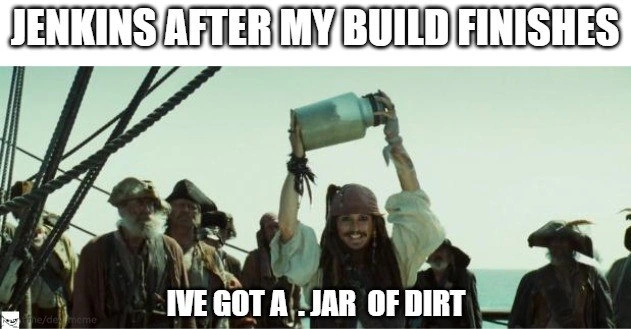
Level 1: I Got a .jar of Dirt

Imagine you’re playing a game of pirates in your backyard. You dig a little hole in the ground and scoop some dirt into a jar, pretending it’s a chest full of treasure. You’re so proud of this jar of dirt that you hold it up high and shout to your friends, “I’ve got a jar of dirt!” with a huge grin on your face. It’s a silly kind of pride, right? You know it’s just dirt, but to you it means you finished your pirate mission and found something.

Now think of Jenkins like that excited friend. Jenkins is a tool (kind of like a friendly robot helper) that helps developers by taking all the code they wrote and putting it together into something that can run. When Jenkins is done with its job, it ends up with a file that has all the program code inside – basically the result of all that work. In the meme, Jenkins is shown as if it were a pirate jumping for joy, holding up that file like a jar of treasure. It’s funny because Jenkins is essentially celebrating, just like a kid would celebrate finding “treasure” that’s actually just dirt. The core feeling here is excitement and pride after finishing a task. Even if the prize seems small or ordinary (a simple jar with stuff in it), what matters is the job is done and the mission is accomplished. The meme makes us laugh because we’ve all had moments where we’re really happy about something that other people might not realize is a big deal – like being super proud of a little project or a finished chore. Jenkins holding up the jar (the file it made) is just like a kid proudly showing off their jar of dirt: it might look funny to others, but to the one holding it, it’s a moment of triumph.

Level 2: CI Treasure Chest

Let’s break down what’s happening in this meme in simpler terms. Jenkins is a popular tool for automating software builds, tests, and deployments – a cornerstone of Continuous Integration (CI) in the software world. Think of Jenkins as a helpful robot butler for developers: whenever you make changes to your code and push it to a repository, Jenkins can automatically pull those changes and run a series of steps (called a build pipeline or JenkinsPipeline) to make sure the code compiles, tests pass, and everything gets packaged properly. This automation is part of what we call CI/CD (Continuous Integration/Continuous Delivery), which is all about integrating code regularly and delivering updates faster with the help of automation. In the category of BuildSystems_CICD, Jenkins has been a long-standing go-to, especially for teams working on Java projects.

Now, Jenkins itself isn’t usually visual or anthropomorphic – it’s basically a server application with a web interface. But developers often joke about it as if it’s a team member. In the meme, Jenkins is imagined as a pirate celebrating a successful build. Here’s the scenario: your code has finished building on Jenkins, and the outcome of that build is a file with a .jar extension. A .jar file stands for Java ARchive, which is the standard package format for Java applications. When you build a Java program (for example using tools like Maven or Gradle), all the compiled .class files and resources get bundled up into one neat .jar file (essentially a zipped archive of your program). This .jar is the artifact of the build – basically the end product that you can run or deploy. In CI/CD terms, Jenkins often stores this artifact for you. The meme text “I’VE GOT A .JAR OF DIRT” is a playful modification of a funny line from Pirates of the Caribbean. The extra space before "JAR" highlights that we’re talking about a .jar file artifact, not just any jar. So Jenkins is humorously saying, “Hey look, I built your code and now I have the .jar file!” – but phrased like “I have a jar of dirt,” because .jar sounds like a jar (the container) and to non-developers a jar file is as meaningless as a jar filled with dirt.

Let’s connect to a real-life dev scenario: imagine you’re working on a Java application. You commit and push your code changes. Jenkins notices the new code (via a webhook or scheduled polling) and triggers a build pipeline. This pipeline might have steps roughly like:

  1. Checkout code – Jenkins pulls the latest code from your repository.
  2. Compile and package – e.g. run mvn clean package (a Maven command) to compile the Java source and package it into a .jar.
  3. Test – Run your automated tests to make sure the code works.
  4. Archive artifact – If all goes well, save the generated .jar file.
  5. Deploy (optional) – Maybe even deploy that .jar to a test server or deliver it to an artifact repository (like Nexus or Artifactory) for safe keeping.

At the end of this pipeline, the key output is that .jar file containing your application. Jenkins will often log something like “Archiving artifact: my-app.jar”. In other words, “I’ve got your jar!” This is analogous to putting the finished product into a treasure chest for later use. In fact, in Jenkins, the archived artifacts are accessible after the build – you can go to the Jenkins job page and literally download the .jar that was built. It’s your loot from the successful build.

To illustrate, here’s a tiny snippet of what a Jenkins pipeline might look like for a Java project:

pipeline {
    agent any 
    stages {
        stage('Build') {
            steps {
                sh 'mvn clean package'  // compile code and create the .jar file
            }
        }
        stage('Archive') {
            steps {
                archiveArtifacts artifacts: 'target/*.jar', fingerprint: true  // Jenkins saves the .jar artifact
            }
        }
    }
}

Above: A simplified Jenkins pipeline with a build stage and an artifact archive stage. After the mvn package command, a .jar file (say, MyApp.jar) is produced in the target directory. The archiveArtifacts step tells Jenkins to keep that .jar as an artifact of the build. This is essentially Jenkins putting the “treasure” (the built code) safely in its chest for you.

Now, why the pirate theme and the jar of dirt? In Pirates of the Caribbean: Dead Man’s Chest, there’s a comedic scene where Jack Sparrow dances around with a jar full of dirt, singing “I’ve got a jar of dirt!” to taunt the other pirates. It’s a silly, iconic moment from the movie. The meme replaces Jack with Jenkins (hence the pirate holding up a jar in the image is labeled as Jenkins) and replaces his quote with the build context. The joke is that Jenkins, after finishing the arduous journey of building your software, is proudly announcing its prize: a .jar file (which phonetically and visually is like a jar, and humorously compared to a jar filled with dirt). It’s an absurd way to highlight how sometimes, after a complex automated build process, what we physically end up with is just a single file — small, unassuming, perhaps as unglamorous as a jar of dirt, but critically important to us as developers.

For a junior developer or someone new to DevOps: imagine the first time you set up a Jenkins job or any CI system for your project. You push your code, Jenkins starts doing its thing, you see logs of build steps flying by, maybe some tests running. If everything is configured right, you eventually get a nice message that the build succeeded. Jenkins might show a green checkmark or send a notification. And importantly, it will have packaged your application. For a Java app, that’s a .jar (or sometimes a .war file for web applications). There’s a mix of pride and relief — “Yay, it built!” You might even go to Jenkins and click to download the artifact, just to see it sitting there. It’s not gold doubloons, but it’s the fruits of your automated labor. This meme exaggerates that moment: Jenkins itself is personified as celebrating wildly, holding up that file like a trophy in front of everyone (just as Jack Sparrow proudly showed off his jar of dirt to a confused crew). It’s a bit of developer humor that combines our world (software builds, Jenkins jobs, .jar files) with a funny pop culture reference. Once you know these pieces — what Jenkins does, what a .jar file is, and that Jack Sparrow scene — the meme clicks into place: Jenkins is joyfully proclaiming it has the artifact from the build, in the silliest way possible.

Level 3: Butler to Buccaneer

Jenkins has metaphorically traded in its servant's bow tie for a pirate's bandana here. In this meme, our trusty CI/CD butler transforms into Captain Jack Sparrow, triumphantly hoisting a prized build artifact overhead. The top text "JENKINS AFTER MY BUILD FINISHES" sets the scene: Jenkins — the ever-diligent continuous integration server — has just completed a build. The bottom text parrots Jack Sparrow’s famous line: "I’VE GOT A . JAR OF DIRT", with an extra space to emphasize the .jar file extension. It’s a punny treasure: in developer terms, a .jar file (Java ARchive) is the output of a Java build, essentially a container full of compiled code. The meme hilariously equates that .jar output to Jack’s jar of dirt from Pirates of the Caribbean. Why? Because after a long build process, that little .jar can feel as precious as pirate booty — even if, to the uninitiated, it’s as trivial as a jar filled with dirt.

On a technical level, this image references the culmination of a Jenkins pipeline. Jenkins, a staple of BuildSystems_CICD, automates steps like compiling code, running tests, and packaging applications. For many Java projects (the context here), a successful build produces a .jar artifact. Jenkins then often archives this .jar (using plugins or build steps) so it can be deployed or downloaded. The humorous twist is treating that mundane file output as a celebrated treasure. It’s poking fun at how CI servers (and their human users in DevOps) can get oddly excited when a build passes and an artifact is produced. Anyone who’s dealt with flaky pipelines or build automation quirks knows the feeling — after a series of failed runs or thorny bug fixes, seeing Jenkins finally declare a Build Success and hold up that file feels like victory. In a sea of build failures, the one green build is gold.

There’s an element of shared developer trauma and triumph here. Jenkins is powerful but notoriously finicky; it’s not uncommon for a misconfigured environment or a subtle code issue to make builds fail repeatedly. The meme exaggerates Jenkins’ reaction to a success, as if the CI server itself is gleefully declaring “I’ve got the artifact!” Developers recognize this scenario: after babysitting a fragile JenkinsPipeline through rough waters (flaky tests, dependency hell, maybe an it’s-always-DNS moment thrown in), getting a .jar out of it feels like finding treasure. The DevOps/SRE folks in charge of pipeline reliability might chuckle here too — they’ve seen Jenkins act like an old pirate ship, creaking under heavy workloads. A passed build with an artifact can indeed be cause for a little celebration (or relief). This meme nails that sentiment with a pop culture reference: Jenkins jubilantly brandishing the output like Jack Sparrow taunting “I’ve got a jar of dirt!” (in the movie, he’s teasing that what he holds will keep the mythical Davy Jones at bay — an absurdly low-tech solution to a high-stakes problem, much like a .jar file solving the high-stakes continuous integration quest).

From an industry perspective, the humor also pokes at the idea that after all the expensive tools, cloud servers, and complex CI/CD pipelines, what we tangibly get at the end is just a file — often a .jar for Java apps. It’s a tongue-in-cheek reminder that even the grandest automated build process ultimately hands you something as simple as an archive file. In pirate terms, Jenkins’ “treasure” is literally a jar. The meme’s pirates_of_the_caribbean_reference cleverly underscores how over-the-top it can feel when Jenkins finally succeeds. We imagine the Jenkins butler (usually prim and proper) turning into a rowdy buccaneer celebrating the loot. It’s a playful contrast that lands especially well with developers who have waited for a slow Jenkins job to finish, watching the console logs scroll by like waves lapping at a ship’s hull. As soon as that “Finished: SUCCESS” appears and the artifact is stashed, you can almost hear Jenkins/Jack singing “I’ve got a jar of dirt!”. The crew (fellow devs) might look on in amusement or confusion, much like Jack Sparrow’s bewildered crew in the movie — because only the one who fought through the build process truly appreciates why that jar (file) is so important.

Ultimately, this meme fuses developer humor with a beloved movie scene to convey a simple truth in DevOps: sometimes the smallest deliverable (a .jar file) feels like a major triumph. It’s a lighthearted take on continuous integration culture. Jenkins, a workhorse of countless build pipelines, is rarely fun, but imagining it with Jack Sparrow’s swagger gives us a laugh. We’ve all been there, configuring Jenkins jobs or Jenkinsfiles late into the night, and when it finally works, we feel a bit like an eccentric pirate victoriously declaring our prize. In the daily grind of software development, even a jar of dirt can be treasure if it means the build passed. So Jenkins hoisting that freshly-built .jar is our inner pirate’s moment of glory — the build is done, the artifact’s in hand, and for a brief moment, Yo-ho-ho, it’s a developer’s life for me.

Description

This is a meme based on a scene from the movie 'Pirates of the Caribbean: Dead Man's Chest'. The image shows Captain Jack Sparrow on the deck of a ship, triumphantly holding a large glass jar filled with dirt high in the air. He has a wide, proud grin. The meme has a top caption that reads, 'JENKINS AFTER MY BUILD FINISHES', and a bottom caption that reads, 'IVE GOT A JAR OF DIRT'. The joke lies in comparing the output of a software build process from Jenkins, a popular CI/CD tool, to a seemingly worthless 'jar of dirt'. For developers, getting a successful build artifact after a long, complex, or previously failing pipeline can feel like a monumental achievement, even if the artifact itself (like a .jar file or a Docker image) is just an opaque binary to an outsider. The developer's triumphant feeling, like Jack Sparrow's, is disproportionate to the perceived value of the object itself
Comments

7
Anonymous ★ Top Pick My Jenkins pipeline just produced the artifact. I call it the 'Jar of Dirt' because it's full of opaque dependencies, nobody else understands its true power, and if you drop it, you unleash a terrible curse on production
  1. Anonymous ★ Top Pick

    My Jenkins pipeline just produced the artifact. I call it the 'Jar of Dirt' because it's full of opaque dependencies, nobody else understands its true power, and if you drop it, you unleash a terrible curse on production

  2. Anonymous

    Let Jenkins wave that .jar like pirate loot - the real voyage is smuggling it past Sonar, Artifactory, Helm, two change boards and the Friday deploy freeze without walking the pager plank

  3. Anonymous

    After 47 minutes of pipeline execution across 12 parallel stages, Jenkins proudly delivers a 2GB artifact directory containing node_modules, .git history, and a JAR file that nobody remembers why we're building anymore

  4. Anonymous

    That euphoric moment when Jenkins finally shows green after you've spent three hours debugging why the build failed because someone committed a merge conflict at 4:47 PM on Friday. You're not celebrating the jar of dirt - you're celebrating that you won't be spending your weekend SSH'd into the build server explaining to stakeholders why the release is delayed. The jar of dirt has more value than your Kubernetes config at this point

  5. Anonymous

    Jenkins calls it SUCCESS once archiveArtifacts('target/*.jar') runs - shame prod still needs a signed image, DB migration, and rollback plan that won’t fit in that jar

  6. Anonymous

    Jenkins after a green build: proudly hoisting gigabytes of logs - because in CI/CD, victory tastes like dirt

  7. Anonymous

    Jenkins says SUCCESS, ships app-1.2.3-dirty.jar, and Artifactory keeps it forever - congrats, our CI/CD now supports geological versioning

Use J and K for navigation