Rebranding your simple web app as a sophisticated platform for extra clout
Why is this Marketing meme funny?
Level 1: Fancy Costume, Same Bear
Imagine you have a regular teddy bear that you play with. It’s soft, cuddly, and just a normal teddy bear. Now let’s say you dress up this teddy bear in a little black tuxedo and a bow tie. He suddenly looks very fancy! Then you tell all your friends, “This isn’t just any toy – this is Sir Bearington, the Amazing Bear Platform!” That sounds super important and impressive, right? But here’s the funny part: under that tiny tuxedo, it’s still the same teddy bear you’ve always had. Nothing about the bear itself changed. You just gave it a fancy outfit and a fancy name.
This meme is joking about the same idea, but with a software twist. The “web app” in the first picture is like the regular teddy bear. It’s plain and simple, just called what it is. The “platform” in the second picture is like the teddy bear in the tuxedo with a grand title – it sounds much more important. People sometimes do this in real life: they take something simple and relabel it with bigger words to make it seem new or significant. It’s kind of like playing pretend or dress-up with words. We all know the bear is still a bear, and the toy is still the same toy, no matter what outfit it wears. In the same way, calling a small web app a “platform” doesn’t actually transform it into something else – it just makes it sound fancier. That’s why it’s funny: everyone recognizes that the change is only on the surface, and the meme makes that obvious by literally showing Pooh Bear getting dressed up even though he’s still Pooh inside.
Level 2: Web App vs Platform
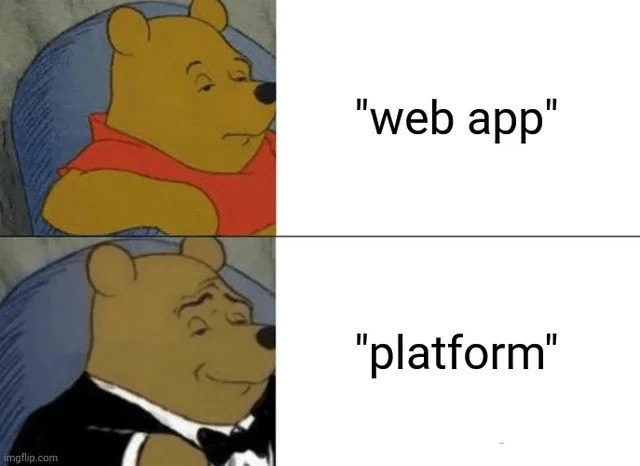
Let’s break down the joke in simpler terms. The meme shows Winnie-the-Pooh in two different scenarios. In the first panel (on the top), Pooh is in his normal red shirt, looking unimpressed, and next to him the text says “web app.” In the second panel (bottom), the same Pooh character is wearing a black tuxedo and bow tie, looking very pleased with himself, and the text says “platform.” The joke here is that by literally dressing Pooh up and changing one word, the thing being described seems a lot more important. It’s poking fun at how people sometimes take something ordinary and try to make it sound fancy just by changing the name.
Now, what exactly is a web app? That’s short for “web application.” It means an application (a software program) that you access through a web browser (like Chrome, Firefox, or Safari). Instead of installing it on your computer, you just go to a URL and use it online. For example, a simple to-do list you use in your browser is a web app. Gmail, Facebook, or an online shopping site – those are all web apps too. They can be very simple or quite complex, but generally when we say “web app,” we mean a specific application focused on a particular function or set of features, delivered through the web. It’s a fairly ordinary term in tech – if you tell someone “I built a web app,” it sounds humble and straightforward. It implies, “Hey, I made a website that lets users do X, Y, Z.”
And what is a platform? In tech jargon, a platform is something broader and more powerful-sounding. A platform isn’t just a single application – it’s more like a foundation or stage on which many things can be built or run. For instance, think of Windows OS or Android – those are platforms because other developers can create apps on top of them. Or consider AWS (Amazon Web Services) – it’s a cloud platform providing lots of services that others use to build complete applications. When a company calls their product a “platform,” they’re suggesting that it’s not limited to one narrow purpose; instead, it’s a base that could support multiple add-ons, integrations, or services. It’s like saying, “We haven’t just made an app, we’ve made the base of an ecosystem.” For example, if you create a website where teachers can post homework, that’s a web app. If you call it an “Educational Learning Platform,” it implies teachers, students, parents, and maybe other developers could all interact with it or build upon it in various ways – even if in reality it might still just be that homework-posting site. The word “platform” carries a swagger: it hints at scale, extensibility, and importance.
In this meme, the web app vs. platform distinction is all about marketing and perception. The content itself (the product) hasn’t changed at all – only the label. Companies and marketing departments sometimes choose a bigger, more impressive word for something because it sounds better to audiences or investors. This is a case of “marketing vs reality.” The reality might be a simple website that lets you, say, order pizza. But the marketing will call it “a food delivery platform revolutionizing hunger management.” 😅 Why do they do that? Because using a buzzword like “platform” makes the product seem visionary and significant.
Let’s explain a couple of terms here:
- Buzzword: A buzzword is a word or phrase that becomes really popular in an industry, to the point of being overused. In tech and corporate settings, people drop buzzwords to sound up-to-date or to impress others, even if the word is vague. For example, words like “synergy,” “disruptive,” “ecosystem,” or “platform” often get used as buzzwords. They’re not bad words inherently – a platform is a real thing – but when everyone starts calling their product a platform, the word loses clear meaning and just becomes something to win attention. In our meme, “platform” is used as a buzzword. It’s a perfectly valid concept, but here it’s likely just a fancy synonym for the same old web app.
- Stakeholders: These are people who have a stake (an interest or investment) in something. In a company, stakeholders could be the CEO, investors, customers, or team leads – anyone who cares about the success of the project. Often, stakeholders who are not deeply technical might be more impressed by big strategic-sounding words. So if you present your project as a “platform,” a non-technical CEO might think, “Oh, this is big; it can become the next Uber or the next Amazon!” whereas calling it a “web app” might make it sound small or trivial to them.
Now, imagine you’re a junior developer or someone new in a tech company. You build a neat little web app that does its job well. Then you hear the project manager or marketing team start referring to it as a “platform.” You might scratch your head for a second. Did the project suddenly grow huge when I wasn’t looking? Probably not. What’s happening is a bit of branding/marketing spin. They want to present your work in the most grandiose way possible to attract attention or funding. If you’ve ever seen a tech startup pitch, they almost never say “We made a website that sells shoes.” Instead, they’ll say something like “We created a commerce platform that connects consumers with personalized footwear solutions.” It’s essentially the same information, but wrapped in bigger, fluffier words.
The Winnie-the-Pooh meme format is great for highlighting this because it visually shows Pooh becoming “classy” after the name change – just like the product is being made to sound classy. In plain terms: web app = normal, straightforward; platform = fancy, impressive (at least in wording). The developers (the folks coding it) often joke about this because to them, unless you actually rewrite or expand the software, it’s still the same thing no matter what you call it. But they also understand why the terminology is being inflated: it’s all about impressing the stakeholders or keeping up with industry trends.
This is a bit of a running joke in the tech world. There’s even a saying, “Drink the Kool-Aid,” which means buying into your own hype. Sometimes companies start believing their own grand words a little too much. A junior developer learning the ropes might find it confusing or funny that the code they wrote for a web app is being hailed as a platform in meetings. Don’t worry – you’re not missing something. It’s mostly about branding. As you gain experience, you’ll see that this happens often: it’s half marketing strategy, half optimism about the future direction of the product.
So to sum up this level: The meme is contrasting a “web app” with a “platform” to show how just changing what you call something can alter people’s perceptions. Web app is the term engineers use for a normal project. Platform is the jazzed-up term used to make it sound like a big deal. The content (Pooh, or the product) hasn’t changed at all between the two panels – only his outfit and expression have, just like only the wording changed in real life. It’s a playful jab at marketing vs. reality in the tech industry, something that even newcomers will start noticing once you’ve sat in a few product meetings or pitches.
Level 3: Bowtie Buzzwords
This meme spotlights a classic quirk of corporate tech culture: using grandiose buzzwords to inflate a product's perceived importance. In the top panel, Winnie-the-Pooh looks bored at the plain term “web app”, reflecting an engineer’s straightforward perspective – it’s just a simple web application. In the bottom panel, Pooh is all dressed up in a tuxedo, grinning smugly at the word “platform”. This represents how marketing or executives feel when they use a fancier label. The humor comes from the stark contrast: by merely swapping terminology, a humble project is portrayed as something far more impressive. It’s a perfect satire of hype-driven branding in tech, where calling your product a “platform” instantly jazzes it up for stakeholders and investors, even if nothing else has changed.
From a senior developer’s viewpoint, the difference between a web app and a platform isn’t just semantics – it’s huge in technical scope. A web app is typically a single-purpose application running on a server, serving content (like HTML pages or JSON data) to users over the internet. It might be a neat little CRUD system (Create, Read, Update, Delete) with a database, doing one main job well. A platform, on the other hand, implies a broad foundation that others can build upon. Think of an operating system or a cloud service: they provide tools or services so multiple applications or modules can plug in. Building a true platform is a serious engineering endeavor. It means designing a modular architecture, defining stable APIs for third-party developers, supporting plugins or extensions, handling multi-tenant data (many users or clients on the same system), and ensuring robust scaling, security, and performance. In short, platform usually means “complex ecosystem”, whereas web app means “single application”.
In practice, teams don’t just decide one day that their simple app is magically a platform; it takes major refactoring and new infrastructure to earn that title. But in the world of tech hype, you’ll often see what is basically a single web application being marketed as a “complete platform” long before it truly deserves the name. This gap between marketing imagination and technical reality is exactly what the meme mocks. It’s term inflation at its finest – as if calling your product by a bigger name instantly gives it more clout. Seasoned engineers recognize this pattern and often smirk at it, having survived many a marketing rebrand that promised the moon while the codebase was still firmly on Earth.
So why do companies do this platformification? In one word: clout. Labeling your product a "platform" gives it an aura of importance and limitless potential. It signals to investors, executives, and other stakeholders that you’re not offering just a small feature or service, but a foundation for an entire range of solutions. In tech business lingo, “platform” implies scalability, ecosystem, and big future growth – all very exciting to the people who control budgets. Startups especially love calling themselves a “platform” because it sounds like they could become the next Google or Facebook (which are true platforms with vast ecosystems). It’s like tech buzzword bingo: everyone wants to drop the hot terms that make ears perk up. If AI, blockchain, or platform are the magic words of the year, you can bet marketing will want them in the press release. Calling a basic web app a “platform” is a quick way to make it seem grander than it is, tapping into those industry trends where every product aspires to be an all-encompassing ecosystem.
There’s a shared, slightly war-torn humor about this among veteran developers. We’ve sat through meetings where a straightforward app is suddenly reintroduced as an “innovative platform solution” because someone upstairs thought it would sound sexier in a PowerPoint slide. One day you’re deploying a neat little web service, and the next day the company wiki declares it’s part of a Next-Gen Experience Platform™. 😏 The code didn’t change overnight – only the words did. This can lead to a bit of Marketing vs Reality whiplash. The engineers roll their eyes because they know renaming a thing doesn’t magically add new capabilities. Meanwhile, the non-technical higher-ups get excited, thinking the team built something bigger than it actually is. It’s a form of organizational theater: put a top-hat on the project and give it a grand introduction, and hope everyone applauds.
To illustrate, imagine a meeting at a tech startup:
Executive: “We’re not just building another app, folks. We’re delivering a sophisticated platform that will leverage synergies across verticals and revolutionize our industry.”
Engineer (quietly, to self): “Right… our little to-do list web app is now a ‘sophisticated platform’. Got it.”
In this hypothetical exchange, the executive’s speech is dripping with buzzwords (“sophisticated”, “leverage synergies”, “revolutionize”) – classic marketing speak to jazz up the product for the boardroom. The engineer’s inner voice is dry and grounded, recognizing that under the grandiose language, it’s still the same simple application it was yesterday. This captures the meme’s essence perfectly. The top-panel Pooh (in a plain red shirt) is like the engineer hearing “web app” – calling it what it is without ceremony. The bottom-panel Pooh (in a tux) is the executive or marketing person saying “platform” – essentially the same thing, but dressed up to impress.
Historically, this kind of term inflation isn’t new – it evolves with tech fads. In the early 2000s, every company suddenly had a “portal” (just a website with login) because that word was the hot marketing term. A bit later, anything that hosted content became a “framework” or “ecosystem”. Fast forward, and “platform” became the catch-all upgrade word. It’s gotten to the point where even a modest app might be called an “X Platform” (fill in X with whatever domain: education, health, finance) in press releases. Industry veterans have a chuckle about it because we’ve seen so many “ordinary thing rebranded as revolutionary platform” stories play out. We know the corporate culture pressure that drives it: everyone wants to sound cutting-edge and important. And to be fair, sometimes the rebrand is aspirational – the team plans to expand this web app into a real platform someday. But in the moment, it’s mostly about presentation. As the meme jokes, you can put a tuxedo on Pooh Bear and call him something fancy, but he’s still the same Pooh Bear who loves honey.
In the codebase or documentation, this kind of rebranding can be almost comically superficial. Imagine a Git commit that does nothing except update terminology:
- // Initialize web app configuration
+ // Initialize platform configuration
No functionality changed at all – just the word “web app” replaced with “platform” in comments and docs. 😅 That’s essentially what’s happening at the business level when they relabel the product. It’s the same software, wearing a fancier nametag. Experienced developers find this both funny and a bit exasperating because it happens so often. The meme gets a laugh by capturing that shared experience: we’ve all seen an ordinary project get a luxurious verbal makeover for the sake of hype. It’s a knowing wink that says, “Yep, we’ve been there – just polish up the wording and suddenly everyone thinks it’s something profound.” In the end, the Pooh Bear in a tux is a perfect metaphor: a tuxedo of jargon might make something look more distinguished to the uninformed, but underneath, it’s still the same bear with the same capabilities (and perhaps the same appetite for honey).
Description
Two-panel Winnie-the-Pooh meme: in the top panel, a regular Pooh in a red shirt reclines in an armchair with a bored, half-lidded stare; the right side contains the text "web app" in quotation marks. The bottom panel shows the same bear now wearing a black tuxedo, white shirt, and bow tie, sporting a smug, approving grin; the right side reads "platform" in quotes. The visual gag highlights how merely swapping vocabulary elevates perception - from an ordinary web application to a grander "platform." It satirizes corporate marketing habitually inflating product descriptions to impress executives, investors, and stakeholders, a trope familiar to seasoned engineers who must translate buzzwords back into technical reality
Comments
6Comment deleted
Rename the two-node Rails box to “platform” and suddenly we need governance, SDKs, and a partner ecosystem - funny how the only thing that scales is the slide deck
The moment your CRUD app with a REST API becomes a 'platform' is precisely when you need to justify that Series B valuation to investors who think 'synergy' is still a cutting-edge concept
Ah yes, the classic pivot from 'web app' to 'platform' - because nothing says 'we're ready for Series B funding' quite like adding 'platform' to your pitch deck. It's the same CRUD app with a React frontend, but now it's a 'multi-tenant SaaS platform with extensible microservices architecture.' The VCs eat it up every time, and suddenly your $50/month subscription service is valued at $100M. Bonus points if you can work 'ecosystem' and 'marketplace' into the same sentence
Put a tux on the monolith and call it a “platform”; now you owe tenant isolation, versioned APIs, RBAC, SLAs, plugin sandboxing, and a deprecation policy that outlives the founders
Web app + API endpoints = platform. Just don't peek under the hood at that eternal monolith
Add OAuth, a public Swagger page, and a marketplace slide - boom, your CRUD monolith is a ‘platform’ and finance just doubled the ARR multiple