Skip to content
DevMeme
4385 of 7435
Trying to Understand the Project Requirements
Stakeholders Clients Post #4800, on Aug 15, 2022 in TG

Trying to Understand the Project Requirements

Why is this Stakeholders Clients meme funny?

Level 1: Robot Guard’s Trick

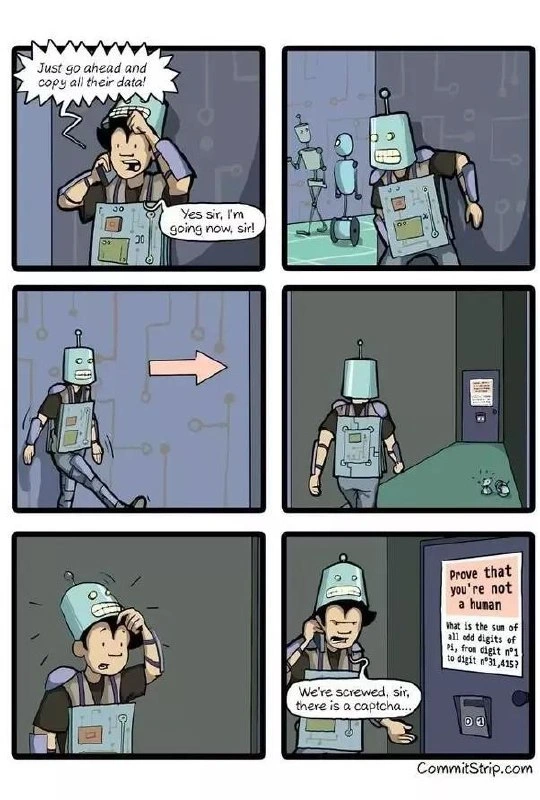
Imagine you’re trying to sneak into a secret candy store that only robots are allowed to visit. You put on a silly robot costume, walking stiffly and saying “beep boop” to act like a robot so that the robot security guard will let you in. You almost get to the candy, but then the guard stops you at the door with a special test. The guard says, “I only let robots in here. Prove you’re a robot by answering this question.” Then he asks something crazy hard, like “What’s the sum of a bazillion specific numbers?” – basically a HUGE math problem that a real robot could calculate instantly, but no normal person could ever do in their head.

You lift up your robot mask, sweating, because you have no idea how to solve that math problem. You realize you’re caught. Defeated, you speak into your walkie-talkie to your boss saying, “It’s no use... they have a test to make sure I’m not human!” In other words, the robot guard gave you a trick question that only a real robot can answer, so your disguise didn’t work.

It’s funny because usually it’s the other way around – we often have tests on websites to prove you’re not a robot (like picking out pictures or typing words) so that bad computers can’t get in. But here, the roles are flipped: the robot guard only wants robots inside, so he made a test to keep humans out. It’s like a club with a sign that says “No humans allowed,” where the bouncer asks you a super hard puzzle to make sure you’re actually a machine. The poor guy in the comic tried to cheat by dressing up, but the clever robot door still caught him! The humor comes from this role-reversal and from the guy’s over-the-top attempt to sneak in, only to be foiled by a simple question that exposed him.

Level 2: Robot Disguise Fail

Let’s step back and explain the key pieces of this meme in simpler terms. The comic is highlighting something about CAPTCHAs, which are those little tests you often see on websites asking you to prove you’re not a bot. CAPTCHA stands for Completely Automated Public Turing test to tell Computers and Humans Apart. In practice, a CAPTCHA might be checking a box that says “I am not a robot,” identifying objects in pictures (like “click all the buses”), or typing letters from a distorted image. Websites use these to prevent bots (automated programs) from doing things like spamming comments, creating fake accounts, or scraping data. Bots are basically scripts or programs that can mimic a user’s actions on a site but often for malicious or undesired purposes. Bot detection is the broader term for all techniques used to catch these automated intruders, and CAPTCHAs are one common tool.

The usual CAPTCHA is designed to be easy for a human (because we can recognize images or decipher slightly mangled text) but hard for a computer, which historically struggled with those tasks. This comic strips that idea and flips it. The setting is a secret mission to scrape data (meaning extract or copy large amounts of information, likely without permission). The boss on the radio tells the agent basically to “go steal the data.” Instead of writing a traditional bot script, the agent here goes physically undercover – he’s actually wearing a costume to pass as a robot. This is a goofy literal take on the idea of a bot: he’s making himself look like one of the service robots in the facility so he can wander in without raising suspicion. Think of it like a spy putting on a guard’s uniform to sneak into a secure building, except the guard uniform is a crappy DIY robot outfit!

Now, as he sneaks in (“tip-toeing” past real robots in panels 2 and 3), everything seems fine. The twist comes when he encounters a security door with a panel that gives a challenge: “Prove that you’re not a human.” This is essentially a reverse CAPTCHA. Normally, a CAPTCHA might say “prove you’re human” to keep bots out. Here it’s the opposite: the system only wants robots or automated systems, and it’s trying to weed out any humans. So it asks a question that only a machine could easily answer. The question shown is “What is the sum of all odd digits of π, from digit #1 to digit #31,415?”

Let’s unpack that: π (pi) is the mathematical constant ~3.14159... (an infinite non-repeating decimal). The question is asking: look at the first 31,415 digits of pi after the decimal point, pick out all the ones that are odd (1,3,5,7,9) and add them up. The number 31,415 is huge – that’s thirty-one thousand four hundred fifteen digits! And fittingly, 31,415 echoes 3.1415 (the start of pi), so it’s a cheeky choice. No human being can realistically calculate that on the fly. It’s a monstrously tedious arithmetic task. But a computer could do it in a snap by brute force. The challenge is basically saying: “If you’re really a robot, this math won’t be a problem.” It’s the exact mirror of a normal CAPTCHA like “identify the stop signs in these photos” which is something any adult can do quickly but used to stump computers.

So in panel 5, we see our protagonist lift his robot helmet, sweating bullets. He’s panicking because he knows he’s caught. Panel 6 confirms it: he reports over the radio, “We’re screwed, sir, there is a captcha…” He recognizes that this security measure is specifically designed to foil people like him (humans trying to get in). Just as an automated bot might say “uh-oh, there’s an ‘I am not a robot’ check, I can’t get past that easily,” here the human is saying he can’t get past this reverse test. The humor is that he’s a human complaining about a CAPTCHA – which is common – but in this scenario it’s funny because the CAPTCHA is explicitly to keep humans out, not bots.

For a junior developer or someone new to security, the takeaway is how this illustrates the idea of matching your security to the threat. CAPTCHA challenges usually target bots because bots lack general intelligence or vision (at least historically). But if you had a scenario where only automated systems should be present (say an internal API or a machine-only interface), you could imagine doing the opposite: challenge any client with something only a legitimate program could do quickly. In reality, we don’t often see “reverse CAPTCHAs” like that (because usually we want to allow humans, not block them!), but the comic creates a funny hypothetical.

It also underscores the frustration that these tests cause. If you’ve ever failed a CAPTCHA multiple times (wondering if you’re secretly a robot because you missed a sneaky traffic light in one image), you can empathize with this guy. CAPTCHA systems are a classic example of what we call the Security vs. Usability trade-off: making things more secure often makes them less convenient for users. Too weak, and bad bots get through; too strict, and real users get annoyed or, worse, locked out. Here the dial is turned to max security – zero usability for humans – which is absurd but gets the point across. It’s a comedic way to show the extreme end of anti-bot measures.

Lastly, this is a CommitStrip comic, which is known for its tech humor. They often personify or literalize tech concepts to make jokes (like someone physically doing what a program does). So the “robot disguise” is a humorous visualization of how people might try to trick a system, and the huge math problem is a visualization of an anti-bot test. Even if you don’t get every reference, the panels tell a clear story: a spy tries to sneak in, but a tricky question on a computer screen stops him in his tracks. The tech-savvy details (like referencing π and using a math puzzle) are there to give tech folks an extra chuckle, but the concept is broad enough that you can find it funny just seeing a man in a robot suit defeated by a brain-busting question.

In summary, this meme is playing with the concept of CAPTCHAs in a novel way. It shows a data privacy/security mechanism (the CAPTCHA on the door) turning the tables on an intruder. The tags like Authentication and SecurityVsUsability highlight that theme: verifying identity (or non-human status, in this case) and how it can conflict with ease of access. A junior dev can appreciate how every security measure can become a hurdle – sometimes for the right people. It’s a fine balance, and going too far can lead to scenarios that are secure but a bit ridiculous. The comic exaggerates it for humor, imagining a world where robots are citizens and humans are the suspicious ones. It’s a fun reminder that in security design, you have to consider who you might accidentally lock out.

Level 3: No Humans Allowed

For seasoned developers and security engineers, this comic lands as a hilarious exaggeration of the security vs. usability dilemma and the endless cat-and-mouse game of anti-bot measures. In practice, we implement bot detection systems to keep out malicious scrapers, spammers, or automated exploits. Things like CAPTCHAs, rate limiters, and behavior analysis are our bouncers at the door of a web service. The typical pain point is that these defenses annoy legitimate users – those warped text CAPTCHAs that you fail three times even though you are human, or those image grids asking you to identify every tiny traffic light. It’s a running joke that sometimes humans feel like aliens trying to prove their humanity to a cold algorithm. This comic runs with that frustration and inverts it: now it’s a hapless human intruder who can’t pass a verification test designed for robots. SecurityTheater is one of the tags, and indeed the scenario satirizes over-the-top security measures that create more problems than they solve. If your anti-intruder system is so strict it stops real people but lets perfectly programmed bots through, you’ve kind of missed the point (and gotten a good laugh in the process).

Let’s break down the scenario. We have a guy trying to perform illicit data scraping – essentially, copying all of someone else’s data without permission. His boss (through the headset) orders him: “Just go ahead and copy all their data!” This already hints at something shady or at least aggressive, maybe corporate espionage or a penetration test scenario. Instead of writing a script or using a typical bot, this operative hilariously dons a low-tech robot disguise (cardboard and metal costume) to physically infiltrate what looks like a facility of actual service robots. It’s a comic literalization of what happens in software: bots often try to masquerade as legitimate users (faking user-agent strings, mimicking human-like browsing patterns) to sneak past detection. Here the human is literally pretending to be a robot to sneak into a robots-only area! The absurd cardboard robot suit is an analog for how clumsy or obvious some bot disguises can be to a trained eye – or maybe how desperate one gets trying to bypass security.

As he tip-toes past real robots, everything seems to be going smoothly. But then he encounters the final security checkpoint: a high-tech door that presumably protects the data he wants to steal. Next to the door is a panel with instructions: “Prove that you’re not a human.” Boom – the ultimate twist on the familiar “prove you’re not a robot” CAPTCHAs we see on websites. This is essentially a reverse CAPTCHA, custom-built for a world where perhaps the trusted entities are machines (like authorized bots or robots) and the intruders are flesh-and-blood humans. In universe, maybe this is a data center where only pre-approved robots or automated systems should be operating. So how do they keep pesky humans out? By asking a question only a robot could answer.

And what a question it is! “What is the sum of all odd digits of π, from digit #1 to digit #31,415?” This is a wonderfully geeky and overkill challenge. To an experienced developer, it’s immediately funny because it’s such a computational task, not a reasoning one. No human could solve that on the spot without significant computing aid – you’d need either a program or an army of mathematicians with years of free time. Meanwhile, any half-decent script could calculate it in milliseconds. The humor is reinforced by the specific number chosen: 31,415. That’s a playful reference to $\pi$ (since 3.1415 are the first five digits of $\pi$). CommitStrip, the comic’s author, loves sneaking in these programming and math jokes. The number of digits (31,415) is huge enough to be utterly impractical for a human, but it’s also a tongue-in-cheek nod to $\pi$ itself – making the puzzle self-referential. It’s like the door is saying: “We’re not even going to pretend this is human-solvable; here’s a ridiculously precise math chore only a silicon brain would bother doing.”

For a senior dev, this immediately triggers memories of dealing with CAPTCHA nightmares and anti-bot systems. Perhaps you’ve written a web scraper that suddenly started encountering Cloudflare’s bot challenge page, or your continuous integration tests got stymied by a surprise CAPTCHA on a third-party API. The feeling of “we’re screwed, there’s a CAPTCHA…” is all too real when you’re trying to automate something and you hit that wall. In the comic, the spy’s defeated line “We’re screwed, sir, there is a captcha…” lampoons that scenario. You can imagine his boss on the other end facepalming. It’s funny because in a normal web-scraping operation, hitting a CAPTCHA means you either give up or start working on a workaround (maybe using CAPTCHA-solving services or computer vision). Here, our poor spy can’t exactly whip out Python and solve it, because he is the bot in this physical infiltration plan. The mission is foiled by a simple question on a screen. In real-life terms, it’s as if your elaborate hacking scheme was stopped cold by a login prompt asking for a 2FA code that you don’t have – a very mundane, unglamorous failure.

This speaks to the broader arms race in security. Developers implement CAPTCHAs to foil increasingly sophisticated bots. Bot creators respond with more advanced AI to solve CAPTCHAs or by routing CAPTCHA challenges to cheap human labor sweatshops for solving. Security engineers respond by making CAPTCHAs even harder or using behavioral analysis (e.g., tracking mouse movements, timing, etc., to guess if you’re human). It’s a constant back-and-forth: one side’s innovation becomes the other side’s new baseline. The comic exaggerates this to the point where the only surefire way to keep humans out is to demand something as crazy as summing tens of thousands of digits – basically outsource the verification to a computer’s strengths completely. It’s poking fun at how sometimes our security measures can overshoot. Security vs. usability is always a balancing act. If you crank security to 100, you often get situations that are user-hostile. A classic real example: some secure facilities require long PIN codes, biometric scans, and multiple checkpoints – very secure, but also a huge hassle for authorized people. On websites, if you required solving a calculus problem to log in, you’d cut out 99.9% of your legitimate audience – and definitely get some angry support tickets.

The phrase SecurityTheater (tagged in this meme) refers to security measures that are more about appearing secure than actually providing real protection, often to the detriment of convenience. In this comic’s fictional world, maybe they’ve implemented an overzealous measure: a door that only opens to bona fide robots. It will keep humans out, sure – but imagine the maintenance guy or a new human engineer at that facility trying to get through! It’s impractical to the point of comedy. This highlights a real-world insight: if you make your anti-bot filters too strict, you might end up blocking real users (false positives) and only the most determined attackers (with custom code) get through. We’ve seen this with spam filters that sometimes block legitimate emails because they’re tuned too aggressively, or forums that accidentally ban real users thinking they’re bots. The security-vs-usability trade-off means you must decide how much friction to introduce. This comic takes that trade-off to an absurd conclusion: perfect security (no humans whatsoever can get in) at the expense of total loss of normal usability (even authorized humans are locked out by a ridiculous test).

Another angle familiar to veteran devs is the idea of automating the automators. The spy’s failure is essentially because he didn’t automate enough. If instead of physically going in, he had let an actual program handle the data theft, that program could have solved the π puzzle easily. The undercover human is ironically the weak link. This tickles those who have seen scenarios where manual intervention fails but automation would have succeeded (the opposite of usual situations!). It’s a tongue-in-cheek reminder that sometimes computers do certain tasks far better than we do – and when security is targeted at stopping computers, a human trying to imitate one is way out of his league. You might even read it as a sly commentary on how, in some environments (like high-frequency trading or algorithmic processes), humans just can’t compete with machine efficiency – a humorous nod to the idea that if a system really expects machine precision, a person pretending to be a machine will get exposed.

In summary, at this senior level, the humor comes from recognizing the mirror image of everyday web security. We usually worry about bots sneaking in as humans; here it’s a human sneaking in as a bot. We usually deploy CAPTCHAs to protect data; here a CAPTCHA protects data from us. It lampoons the frustration when legitimate actors get caught in security measures (how many times have you yelled at a login form "I swear I’m not a robot!"). The situation is absurd yet relatable: we see the kernels of truth from our industry exaggerated into a funny little story. For anyone who has ever implemented a security feature and accidentally locked out the wrong people (oops!), or anyone who’s had to solve 10 CAPTCHAs just to log into their own account, this comic hits a nerve in the best possible way. It’s both a laugh at the situation and a subtle reminder: don’t let your anti-bot crusade go so far that it becomes a parody of itself.

# Imagine solving the door's challenge with a script:
pi_digits = get_first_n_digits_of_pi(31415)  # get digits of π (this is conceptual)
total = 0
for d in pi_digits:
    if int(d) % 2 == 1:       # check if the digit is odd
        total += int(d)
print(total)  # a real bot could do this in a blink!

Above: A quick pseudocode sketch of how trivial this "reverse CAPTCHA" is for a computer program. The poor human spy, unfortunately, can’t compete with a few lines of code.

Level 4: Reverse Turing Test

At the most abstract level, this comic riffs on the theory behind CAPTCHAs and the classic Turing Test. In Alan Turing’s original vision, a human judge tries to distinguish a human from an AI through conversation. A CAPTCHA flips that: it’s a fully automated test designed by a machine to tell humans and bots apart. Traditionally, CAPTCHAs exploit tasks that are trivial for humans but hard for algorithms – think of recognizing distorted text, identifying objects in images, or parsing noisy audio. These are sometimes called AI-hard problems: they leverage the vast gap between human perceptual skills and machine algorithms (at least, until recent AI advances caught up).

What the comic shows is a reverse CAPTCHA – essentially a reverse Turing test. Here, the system demands the user prove they’re not human by solving a puzzle only a computer could handle easily. The challenge on the door’s screen, “Prove that you’re not a human”, is a direct inversion of the usual “I am not a robot” checkbox we’re used to. It asks for “the sum of all odd digits of π, from digit #1 to digit #31,415”. This is a ludicrously complex calculation for any person unaided – summing 31,415 digits by hand is practically impossible – but trivial for a sufficiently programmed bot. In computational terms, summing N numbers is an $O(N)$ operation, so for a computer this scale is no big deal (31k additions is nothing for modern CPUs). But for a human brain, that’s an insurmountable cognitive load. It’s a brilliant illustration of a task asymmetry: the complement of a normal CAPTCHA. Instead of an AI-hard, human-easy task, it’s a computer-easy, human-impossible task.

This reversal touches on the fundamental security concept of exploiting differences in capability. In theoretical computer science and security research, there’s a notion of using computational puzzles to differentiate or gatekeep access – for instance, cryptographic proof-of-work schemes (like Hashcash or Bitcoin mining puzzles) require significant computation to solve. Those aren’t about human vs. machine, but they similarly leverage that certain tasks are straightforward for a computer (given time) but infeasible for a casual human effort. Here the “prove you’re not human” puzzle is like an extreme Turing Test where the roles are flipped: the machine (the security system) needs to verify the user is mechanical, not organic. It’s a comedic exaggeration of the idea that as bots get more human-like, perhaps security tests could get more machine-like.

From a historical perspective, CAPTCHAs evolved as an arms race between bot developers and security engineers. Early CAPTCHAs (around the early 2000s) used simple distorted text because optical character recognition was still weak there. As AI improved, CAPTCHAs became more elaborate – warping text, adding background noise, or switching to image recognition (“click all images with a traffic light”). Each step tried to stay ahead of bots that learned to solve the previous generation of puzzles. The comic takes that escalation to a satirical extreme: if bots eventually beat all human-oriented puzzles, the final boss-level defense would be puzzles so draconian that only bots can solve them! It’s as if the security measure has done a full 180-degree turn, crossing into the realm of absurdity. Yet, this absurdity is grounded in a real concept: a completely automated reverse Turing test that only a machine can pass, excluding any organic intruder. In academic jargon, you might call it a “Computational Supremacy CAPTCHA” – proof that the solver has machine-like computational power.

Notice the geeky detail of using $\pi$’s digits: the number 31,415 is an obvious nod to $\pi \approx 3.1415…$. It’s a little Easter egg that underscores the nerdiness of the challenge. Summing odd digits of π is a task with no shortcut other than brute-force iteration through each digit – ideal for a program with a loop, but utterly pointless for a human with a pencil. This evokes the concept of algorithmic efficiency vs human intuition. A human’s strength lies in pattern recognition and abstract reasoning, not crunching thousands of digits. The reverse CAPTCHA exploits that by picking a problem where no amount of clever human insight helps; you just have to grind through arithmetic, something machines excel at. It’s the theoretical mirror image of what CAPTCHAs traditionally do.

So, at this deep level, the meme highlights the duality of human vs machine capabilities and how security tests leverage those differences. It’s poking fun at the continual escalation in bot detection mechanisms – positing a scenario where authentication systems have become so strict that they’ve paradoxically locked out the very humans they were meant to protect. It’s a commentary on the threshold where security measures overshoot practicality, grounded in notions of Turing tests and computational complexity. Essentially, the comic asks: what if the only way to keep out crafty humans is to require acting like a machine? That’s a theoretical puzzle and a punchline rolled into one.

Description

A meme using the 'Unsettled Tom' meme format. Tom, from the cartoon 'Tom and Jerry,' is shown with a disturbed and confused expression on his face. The caption reads 'Me trying to understand the project requirements after the third meeting with the client.' This meme hilariously captures the feeling of confusion and bewilderment that developers often experience when trying to decipher vague, contradictory, or constantly changing project requirements. Senior developers can deeply relate to this, as they have spent countless hours in meetings trying to extract clear and concise requirements from clients who don't always know what they want

Comments

7
Anonymous ★ Top Pick The project requirements are like a Schrödinger's cat. They are both complete and incomplete until you start coding
  1. Anonymous ★ Top Pick

    The project requirements are like a Schrödinger's cat. They are both complete and incomplete until you start coding

  2. Anonymous

    Reverse-CAPTCHA level: we whitelist any client that can sum 31,415 odd digits of π in <200 ms - humans go 403, the scraper’s Lambda gets a VIP pass

  3. Anonymous

    After 20 years of implementing CAPTCHAs to keep bots out, we've successfully trained AI to solve them better than humans - meanwhile, our senior engineers still can't reliably identify all the traffic lights in those grainy 3x3 grids during critical production deployments

  4. Anonymous

    The beautiful irony: we spent decades teaching machines to pass Turing tests and solve CAPTCHAs, only to realize the real security challenge is proving you're NOT automated. This robot just discovered what every senior engineer knows - the hardest part of any automation project isn't the 99% you automated, it's that one legacy system with a CAPTCHA that asks you to calculate odd digits of pi to position 1,453. At that point, you realize your entire infrastructure modernization just hit a $0.02 anti-bot widget, and you're back to manual data entry like it's 1995

  5. Anonymous

    We over‑engineered exfil with headless Chrome and proxy rotation; the defender shipped a reverse CAPTCHA - classic architecture mismatch, we automated the wrong user

  6. Anonymous

    Zero-day exploit meets COBOL mainframe: 'Error: punch card not recognized in EBCDIC'

  7. Anonymous

    Our scraper passed as a bot until the site threw a reverse Turing test - turns out the human-in-the-loop was our SPOF

Use J and K for navigation