Skip to content
DevMeme
4386 of 7435
When the Code Works and You Have No Idea Why
Bugs Post #4801, on Aug 15, 2022 in TG

When the Code Works and You Have No Idea Why

Why is this Bugs meme funny?

Level 1: Magic by Believing

Imagine you and a friend both build a little machine out of random stuff – like cardboard, tape, and spare toy parts. You don’t really know anything about engines or electricity; you just glue things together and hope it works. Now, somehow your weird little machine does turn on and move! You’re excited and shocked, right? In a fantasy story, maybe your belief and make-believe is what made that machine run. In real life, sometimes grown-up engineers feel the same way about the things they build on computers. They write some code, poke around, and the program runs, but it feels kind of like luck or magic that it works at all.

This meme jokes that a fictional alien ork and a real programmer are shaking hands because they both share that “Wow, it’s running but I don’t know how!” feeling. It’s like two people high-fiving because they both accidentally did a magic trick. It’s funny (and a bit silly) because usually when you make something, you’re supposed to know how it works – but in this case, even the creators are bewildered. The humor comes from that surprise and relief, just like if you built a LEGO robot randomly and it actually started rolling around, you’d laugh and say, “I can’t believe it worked!” Both the Ork and the programmer are basically doing that: celebrating their lucky creations and bonding over the mystery of how on earth it all came together.

Level 2: Cargo Cult Coding

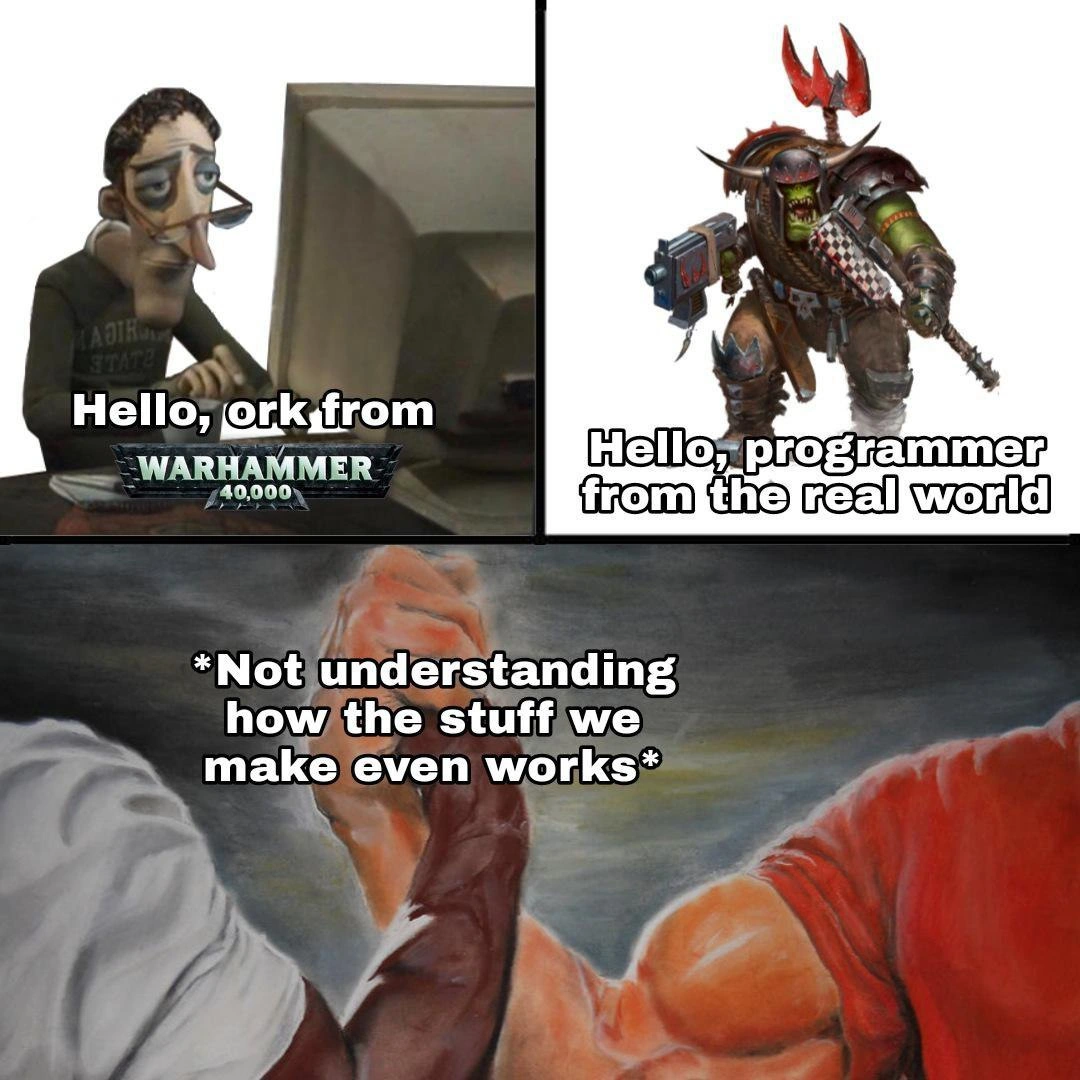
This meme uses a handshake template to show two very different people finding common ground. On the left side, we have a real-world programmer (the gamer-looking fellow at his PC). On the right side, we have an Ork from Warhammer 40k – a fictional, green-skinned alien from a sci-fi universe known for being warlike and chaotic. In the bottom image, their arms are clasped together in a strong handshake, and the text in the middle says they both bond over “Not understanding how the stuff we make even works.” Let’s break down what that means in simpler terms.

  • Warhammer 40,000 Ork: Warhammer 40k (short for Warhammer 40,000) is a popular science fiction tabletop game and setting. In that universe, Orks are a brutish alien species who love to fight and tinker with machinery. The funny thing about Orks is how their ork_engineering works: they cobble together machines (like guns, tanks, and spaceships) from junk. Technically, those machines shouldn’t work — imagine building a car engine out of random scraps with no proper design. But in Warhammer lore, Orks have a subconscious psychic ability (often called the “Waaagh!” field) that makes things they believe in actually function. So if enough Orks think a pile of scrap will run like a truck, somehow it starts running. They might even say, “Red ones go fasta!” and truly by believing it, a red-painted car does go faster in their world. It’s basically software_magic in a fantasy flavor: technology powered by belief rather than sound engineering. Ork technology is often a black box even to the Orks — they don’t understand the science, they just know “if I bang it and shout, it might work.”

  • Real-world Programmer: Now consider a programmer or software engineer in our world. We use computers and code to build applications and systems. But modern software can be extremely complex. A lot of times, especially when we’re new or under pressure, we write or use code that we don’t fully understand. For example, a junior developer might copy a snippet of code from Stack Overflow (a Q&A site for programmers) to fix a bug, without really grasping why it works. Or a team inherits a big codebase that’s messy, with lots of old parts (we call that TechDebt, short for technical debt, meaning the code has unresolved problems or quick-and-dirty solutions that were never cleaned up). They might run the app and it works, but nobody on the current team truly knows how it’s working behind the scenes. It feels a bit like magic or luck. This is often described by the term cargo_cult_programming. That term comes from a bit of history: after World War II, some isolated Pacific islanders built fake airports hoping to attract airplanes with cargo — they mimicked the form without understanding the cause. In programming, cargo cult coding means copying code or doing things because “that’s what others did” without understanding why. Early in your career, you might do this a lot: you see some configuration or code that fixes your problem and you include it, crossing your fingers that it solves the issue, even if you can’t explain the internals.

So the meme’s handshake is saying: The Ork and the Programmer both create things without fully knowing how those things work. This is the shared joke. The Ork builds a crazy gun that fires because he believes in it; the programmer builds an app using, say, five different frameworks and some mysterious settings that make it run, kinda like “it works... I don’t know why, but it does!” Both are experiencing HiddenComplexity: stuff is happening under the hood that they are oblivious to.

For a junior developer, this scenario is very relatable. Think about the first time you managed to get a web server running or a piece of code to compile after hours of trying. You might have added some random flag or changed a configuration just because someone on a forum suggested it. Suddenly it worked! You were happy, but also thinking “I have no clue which change actually made it work, but I’m not touching it now!” That mix of relief and confusion is exactly what this meme is highlighting. Debugging & Troubleshooting in those moments can feel like guessing which wire to cut on a bomb – you’re not sure, you just hope. If you’ve ever fixed a bug by doing something that shouldn’t logically fix it (like reordering two lines of code or adding a short delay), you might joke that it’s “voodoo” or that the codebase has a mind of its own. We sometimes say the code is held together by “magic” or by “prayers.” Those are humorous ways to admit we don’t fully understand our own creation.

This situation also touches on code quality issues. Good code quality usually means code is clear, well-documented, and understandable. But in real life, with tight deadlines and large teams, code can become an opaque mess. “Opaque” in this context means you can’t see through it to understand what it’s doing – just like a black-box. If a piece of software is a black-box to you, you only know its inputs and outputs, not its inner workings. For example, you call a library function and it returns what you need, but internally it might be doing 100 complex steps you know nothing about. A junior dev might import a library to handle, say, image processing, and it works like magic. But if something goes wrong inside that library, debugging it is a nightmare because you never studied how it works. That’s when you feel exactly like the Ork: hitting the side of the machine and grumbling, hoping it starts up again.

Even as you gain experience, you’ll encounter DeveloperPainPoints where no one on your team understands a legacy system completely. You’ll hear things like, “We’re not sure why the server needs to be restarted every 24 hours, but if we don’t, it crashes,” or “Don’t touch that piece of code! It’s fragile and we’re just glad it still works.” This is the professional equivalent of believing the engine only runs if you kick it just right. It’s funny in a tragic way, and that’s why developers share this meme – we’ve all been there, bonding over the absurdity that sometimes we feel as clueless as an Ork banging on a console, yet our product miraculously runs.

Level 3: Black-Box Bonding

At first glance, this meme forges an unlikely alliance between a Warhammer 40,000 Ork and a real-world software developer. It’s an absurd EngineeringAbsurdity that makes senior engineers smirk because it hits on a painful truth: much of our tech seems to work by sheer luck or WAAAGH!-fueled willpower. In Warhammer 40k lore, Orks build wild contraptions out of scrap metal and believe they function – and thanks to their collective psychic field (the Orks’ mysterious energy called the Waaagh!), those janky machines actually do function. This is played for comedy in the game’s universe: an Ork’s rusty gun might fire rounds or a junkyard spaceship might fly largely because the Orks think it should. It’s a literal interpretation of “sufficiently advanced ignorance is indistinguishable from magic.” Sound familiar? Because in the software world, we often have systems held together by optimism and duct tape, seemingly running on the power of belief as well.

The top panels greet each other:

Hello, ork from Warhammer 40,000
Hello, programmer from the real world

This tongue-in-cheek introduction sets up the crossover. These two characters are meeting across universes, only to find they’re kindred spirits in a very specific way. The bottom panel’s classic muscular handshake meme (inspired by the over-the-top arm clasp from the movie Predator) labels their common ground: “Not understanding how the stuff we make even works.” This is the core joke. It’s highlighting a shared experience between a fictional green-skinned alien brute and a modern software engineer: both create complex things they don’t fully comprehend. It’s a comedic take on HiddenComplexity and the unsettling reality of our craft. Seasoned developers recognize this ironic union immediately. We’ve all had those DeveloperPainPoints where a system miraculously functions and we’re half-convinced it’s by the grace of some code deity rather than our own understanding.

From the senior perspective, this meme nails a prevalent anti-pattern: cargo cult programming. That term refers to copying patterns or code without understanding the underlying mechanism – just as islanders in the original “cargo cults” built fake airstrips hoping to summon supply planes, junior devs and even teams sometimes mimic code or rituals hoping for the same results. In the meme, the Ork represents the ultimate cargo-cult engineer: sticking random bits together based on superstition (“paint it red to make it go faster!”) and then unbelievably getting a working product. The real-world programmer, meanwhile, might slap together libraries, copy Stack Overflow snippets (solveMyProblemFast(); // magic incantation from internet), and deploy a feature that somehow doesn’t crash. Both are crossing fingers that their black-box creations keep humming along. This shared reliance on “it works, don’t ask why” is hilarious because it’s uncomfortably true in practice.

Why do experienced devs find this so relatable? Because under deadlines and sprawling CodebaseChaos, even good engineers sometimes deploy code they don’t fully grok. Maybe it’s a legacy microservice nobody wrote documentation for, or a chunk of dark sorcery critical algorithm written by a long-gone coworker. Over time, teams accrue TechDebt – quick fixes and kludges made under pressure – and the system becomes as arcane as an Ork’s scrap-built tank. You end up with modules that “just work” and nobody wants to disturb them. It’s the software equivalent of an Ork’s talisman: if we fiddle with it, the magic smoke might escape. So developers treat these fragile components with reverence (and a bit of fear), much like Orks revering their weird, smoke-spewing machinery.

The humor also pokes at the imposter syndrome many devs feel. No matter how advanced the stack or how many fancy design patterns we apply, there’s always that haunting thought: “Do I actually know what’s happening under the hood?” We’ve deployed machine learning models we barely understand the math for, or configured cloud infrastructure by furiously Googling and hoping we didn’t open a security hole. When it miraculously works in production, we cheer – then quietly think “Whew, it’s alive... but why is it alive?” The Ork in Warhammer doesn’t care why pulling the trigger makes his ramshackle gun shoot – and often, in crunch time, neither does the engineer care why toggling a certain flag fixed the bug. Both are shouting “WAAAGH!” (or perhaps “YOLO”) as they smash that deploy button, amazed when the thing doesn’t explode.

On a systemic level, this meme underscores how modern software development is stacked with countless abstractions – frameworks, libraries, APIs, container orchestration, you name it – such that no single person can fully understand every layer. The result is a kind of black-box engineering culture where we often trust components without peeking inside. Just as an Ork might not comprehend physics but trusts that bolting an engine to a chassis makes a vehicle, a dev might plug in an open-source package for, say, image recognition and trust it to work without delving into the implementation. Senior engineers know that this blind trust can lead to nasty surprises (Bugs that defy logic, Debugging_Troubleshooting sessions at 3 AM that feel like séances communicating with ghost code). Yet, it’s also inevitable – complexity has grown beyond human-scale. We collaborate with code written by others worldwide; some parts of our app are effectively a mystery, even with documentation. In a grimly funny way, sometimes programming is praying: you perform the ritual (writing code/config), deploy it, and hope the tech gods (or the Ork gods, Gork and Mork!) favor you with a working system. When it works, you and your inner Ork high-five, marveling that the abomination runs at all.

The handshake image perfectly captures this camaraderie. It’s two buff arms labeled as two very different engineers, clasping hands over the shared triumph and confusion of “It works, but I have no idea how.” It’s a satire of TechIrony in both fantasy and reality: In Warhammer’s grimdark future, hyper-advanced machines run on crude faith; in our modern reality, cutting-edge software sometimes runs on hastily copied code and blind faith. Both scenarios are ridiculous if you think about it – and that ridiculousness, that RelatableDeveloperExperience of surviving via lucky engineering, is exactly why developers are laughing (and maybe groaning) at this meme. We laugh because we’ve all been the Ork at some point, thumping our code with a wrench (or a quick reboot) when it didn’t work, and being absurdly happy when that inexplicably fixed it. It’s a cautious laugh, though, because we know the flip side: just as an Ork contraption might spectacularly fail if the collective belief falters, our software might collapse the moment our luck or “magic” runs out. And then, like battle-scarred veterans, we’ll be back in the trenches of debugging, muttering “I knew it was too good to be true” as we sift through the chaos we inadvertently created.

Description

A meme showing a developer with a look of pure confusion on their face, staring at a computer screen with the caption 'When the code finally works, but you have no idea why.' This is a common experience for developers of all levels, but it's especially relatable for senior developers who have worked on complex systems where the interactions between different components are not always obvious. The meme captures the feeling of relief and bewilderment that comes with fixing a difficult bug, without fully understanding the root cause of the problem. It's a humorous reminder that sometimes, even the most experienced developers have to rely on a bit of luck and intuition to get the job done
Comments

7
Anonymous ★ Top Pick I'm not saying I'm a wizard, but sometimes I write code that works and I have no idea how
  1. Anonymous ★ Top Pick

    I'm not saying I'm a wizard, but sometimes I write code that works and I have no idea how

  2. Anonymous

    Prod Kubernetes is just Ork wargear for adults - held together solely by the team’s collective belief in a suspiciously green Grafana dashboard

  3. Anonymous

    After 20 years in tech, I've realized our entire industry runs on the same principle as Ork technology: if enough developers believe the npm package works, it manifests into production

  4. Anonymous

    The Orks' WAAAGH!-powered technology and our production systems have more in common than we'd like to admit: both work through mechanisms nobody fully understands, both rely on collective faith that they'll keep running, and both have a disturbing tendency to catastrophically fail the moment someone tries to explain how they actually function. At least the Orks are honest about their tech being held together by belief and duct tape - we just call ours 'battle-tested legacy infrastructure.'

  5. Anonymous

    Prod is Ork science: belief-based consistency - enough LGTMs and Grafana stares and the microservices work; plus the red dashboards make it go faster

  6. Anonymous

    Orks make red trukks faster with WAAAGH; we make prod faster with a flaky cache and three implicit retries - same theology, different SLOs

  7. Anonymous

    In the grim darkness of the far future, there is only undocumented legacy code

Use J and K for navigation