When the Documentation is Outdated
Why is this Documentation meme funny?
Level 1: Two Ways, One Result
Imagine two friends are given a simple addition problem, like “find the sum of two numbers.” The first friend takes a piece of paper and writes down the solution step by step: “Take the first number, add it to the second number, and here’s the answer.” The second friend just quickly says the answer out loud in one go, without writing anything down. In the end, both friends get the same correct answer, but now they start arguing over whose method is better! It’s like they turned a tiny homework task into a big rivalry. One friend insists, “I explained it clearly, so everyone can follow along,” and the other friend replies, “I did it faster and it was so simple, why make it long?” They’re both technically right, but each thinks their way is the best. The whole situation is funny because they’re treating a small problem as if it’s a huge deal – almost like superheroes fighting over how to save the day, even though either way, the day gets saved and the sum is correct.
Level 2: Dueling Definitions
In Python, there are two common ways to define a simple function, and this meme is comparing them as if they’re two superheroes facing off. The first way uses the def keyword – the normal, explicit way to create a function. The second way uses a lambda expression – a shorter, one-line way to create a function. Let’s look at the exact code from the meme in a more straightforward context:
# Using the standard function definition (def)
def add_def(x, y):
return x + y
# Using a lambda expression to define a function on the fly
add_lambda = lambda x, y: x + y
# Both approaches create a function that can add two numbers:
print(add_def(5, 7)) # Output: 12
print(add_lambda(5, 7)) # Output: 12 (they produce the same result)
What’s happening?
The first method,
def add_def(x, y): return x + y, explicitly defines a function namedadd_def. Inside the function, it addsxandyand returns the result. If someone reads this code, they immediately see a function named “add_def” and know what it does: it adds two numbers. This is the classic way you learn to define functions in Python. It’s clear and easy to recognize. You can later calladd_def(5,7)anywhere, and it will do the addition. You could also expand it later (for example, add error checking or print debugging info) by adding more lines inside the function if needed.The second method,
add_lambda = lambda x, y: x + y, creates an anonymous function (one with no name in the definition) that returns the sum ofxandy, and then it assigns that function to the nameadd_lambda. So effectively,add_lambdaalso becomes a function that adds two numbers. In code behavior,add_defandadd_lambdaend up doing the same thing – you can calladd_lambda(5,7)and get 12 as well. The key difference is in how they’re defined. Thelambda x, y: x + ypart is an expression that creates a function object on the fly. We don’t give this function a name in the definition (that’s why it’s “anonymous”), but by assigning it to the variableadd_lambda, now we have a reference to call it later. Lambdas are a feature of Python (and many other languages) that allow quick definition of tiny functions.
Why have two ways to do the same thing? Often, it comes down to convenience and coding style:
- Using
defis better for clarity and complexity. If your function is something you’ll reuse in many places, or it needs multiple steps, you’d use adef. It lets you write a whole block of code. You can even write a short description (a docstring) right under thedefline to explain what the function does, which is useful for others reading your code. For example, in a team project or in any CodeStyleGuides, you’ll see that defining functions with meaningful names is encouraged for better CodeQuality. - Using
lambdais handy for brevity when you need a simple throwaway function. It’s often used inline, passed as an argument to another function. A common scenario is something like sorting or filtering data. For instance, imagine you have a list of names and you want to sort them by their length; you could write:sorted(names, key=lambda name: len(name)). Here, it’s convenient to use a lambda because it’s a one-off little function (take a name, return its length) that you don’t need to define separately with a name. It keeps the code concise and all in one place. Another example is GUI programming or event handling, where you might pass a small lambda function as a callback to be executed when a button is clicked, rather than defining a whole named function for it.
Now, because both def and lambda exist, programmers sometimes develop preferences or strong opinions about which to use in a given situation. This meme jokes about those preferences. In Python’s community (and in many programming communities), there’s an emphasis on writing readable, “clean” code. Python even has an official style guide, often called PEP 8, which guides developers towards conventions that make code uniform and maintainable. PEP 8 doesn’t ban lambdas, but it subtly encourages clarity. In practice, many Python developers follow a rule of thumb like, “If your function is complex or will be used in many places, use def and give it a name. If it’s a quick one-liner function that’s used immediately, a lambda is fine.” This aligns with general CleanCodePrinciples: code should be easily understood by humans. A well-named function can make code self-explanatory, whereas a lambda might require the reader to mentally parse what it’s doing on the spot.
For someone new to Python, seeing add = lambda x, y: x + y and def add(x, y): return x + y might raise the question: “Why have two ways to write the same thing?” The answer is mostly about convenience and context, not about one being fundamentally different in outcome. Both create a callable function object under the name add. However, style guides and more experienced developers will often point out that doing add = lambda ... is a bit ironic — you’re using an anonymous function but then immediately giving it a name! The more “pythonic” way (Pythonic means adhering to Python’s preferred style) would be to just use def if you want to end up with a function named add. Lambdas in Python are intended to be used in places where using a def would be overly verbose or break the flow of an expression. For example, in a list comprehension or as an argument to another function, a lambda keeps things compact.
So, this meme is taking that little quirk of Python (two ways to define a simple function) and exaggerating the debate around it. It’s framed as a confrontation because developers sometimes light-heartedly split into “camps” over style choices. One camp might say, “Explicit definitions (using def) make the code cleaner and more maintainable,” while the other camp might say, “Lambdas are elegant for simple tasks and keep the code concise.” In reality, any good Python developer knows that both tools have their place. The trick is using them in the right scenarios. If you stick around programming, you’ll notice these kinds of debates come up with many language features – it’s part of what keeps CodingHumor alive, since we love to poke fun at our own nitpicky tendencies!
Level 3: Team def vs Team lambda
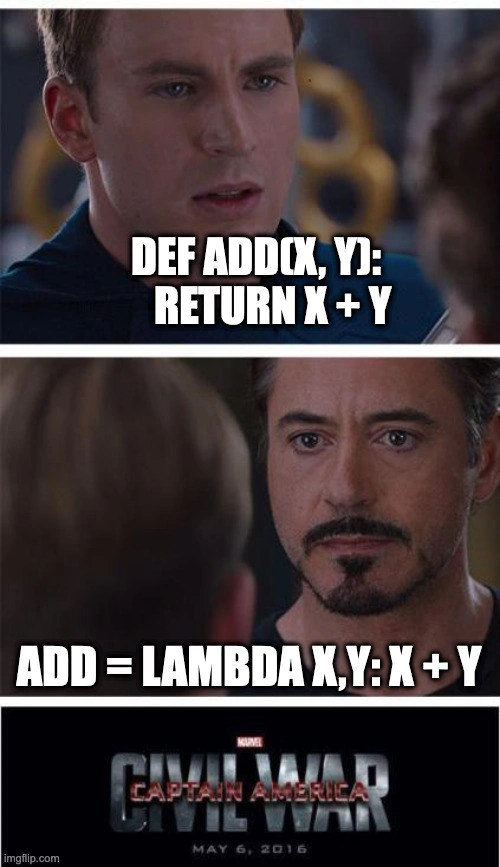
This meme draws battle lines around a very Python-specific code style debate, dramatizing it as a Marvel-esque showdown. In the first panel, Captain America is essentially championing the classic approach:
def add(x, y):
return x + y
Meanwhile, Iron Man retorts with the sleek one-liner:
add = lambda x, y: x + y
They’re both defining a function to add two numbers, but each side believes their method is superior. It’s portrayed as an epic Civil War of coding styles, poking fun at how developers sometimes treat minor stylistic preferences like a clash of superheroes.
Team def (Captain America’s side) stands for explicitness and clarity. Using the def keyword to define a function is the traditional, explicit way in Python. It gives the function a name (add), a clear structure (with an indented block and a return statement), and allows for extras like docstrings or type hints. This approach is often favored in the name of Clean Code principles and readability – code reviewers often nod approvingly when they see well-named functions defined with def. It’s the “old-school” straightforward method: easy to read, maintain, and extend. In Python culture, one of the guiding mottos (from the Zen of Python) is “Explicit is better than implicit.” Team def lives by that creed, insisting that writing out the function in full makes the code more understandable for everyone. Just like Captain America values clear principles and a structured plan, proponents of def value the clearly defined function.
Team lambda (Iron Man’s side) represents the concise and modern approach. A lambda in Python creates an anonymous function on the fly – it’s basically an expression that returns a function object. Iron Man’s add = lambda x, y: x + y is doing the same addition, but in one quick line. This appeals to developers who like brevity or come from more functional programming backgrounds. It feels sleek and high-tech (fitting for Iron Man’s style): no need for the ceremony of a full function definition when all you want is a quick operation. Lambdas are often used for one-off purposes, like sorting keys or small callbacks, where defining a whole function with a name might feel like overkill. Team lambda might argue, “Why write five lines for a trivial operation when one line will do?” It’s the flashy shortcut, analogous to Iron Man improvising with a gizmo to solve a problem in one swift move.
Experienced Python developers reading this meme are chuckling because they’ve seen this lambda vs def argument play out in real life. The humor comes from inflating a tiny disagreement into an Avengers-level conflict. In reality, both code snippets do the exact same thing – they create a function that adds two numbers – but developers can get surprisingly passionate about the “right” way to do it. This mirrors other infamous developer feuds (think tabs vs spaces or brace style wars), where something seemingly small in syntax or formatting becomes an ideological battlefield. The meme’s Captain America: Civil War format is perfect here, as it famously depicted friends turned rivals over a philosophical divide. Likewise, in many teams, you might find one group firmly on “Team def” citing CodeStyleGuides like PEP 8 (“write code that’s readable and obvious”) and another group on “Team lambda” enjoying clever one-liners and functional flair.
From a senior engineer’s perspective, there are concrete reasons behind the preferences:
- Readability: Using
defto name a function can make code more readable and self-documenting. For example, a function namedadddefined withdefis immediately clear to new readers. Lambdas can be less obvious at a glance, especially if they get more complex than a simplex + y. Many linters and style guides will even flag an assigned lambda, hinting that you should just usedeffor clarity. - Capabilities: A
deffunction can have a multi-line body, include comments, and handle more logic. Lambdas in Python are limited to a single expression – you can’t put multiple statements or complex control flow inside alambda. If requirements grow (say you need to add logging or error handling), the one-liner lambda becomes insufficient, whereas thedefapproach can easily accommodate changes. - Intent: There’s an ironic twist in the meme’s example – doing
add = lambda x, y: x + yactually gives the function a name (add) anyway! Essentially, Iron Man’s line defines an anonymous function and immediately names it. Seasoned devs often joke that if you find yourself assigning a lambda to a variable, you should have just useddefin the first place. Lambdas shine when you truly need a throwaway function (like an inline callback), not when you plan to reuse a function and give it a lasting name.
Despite these reasoning points, the truth is that in practice either approach will work for a simple addition. That’s why the meme is funny: it exaggerates the situation to Marvel movie proportions. We see a worried Captain America and a determined Iron Man ready to duke it out over something as mundane as how to write a tiny function. It highlights the almost comical intensity with which developers can defend their preferred coding style. Both sides ultimately want the same end result (just like the Avengers all wanted to protect people, even if they disagreed how). The meme playfully asks the viewer to pick a side in this “civil war” of coding: Are you Team def or Team lambda? – a tongue-in-cheek reference to the film’s marketing. In the end, it’s a reminder that even the most well-versed developers can get into friendly battles over CodeQuality and style. And of course, it invites us to laugh at ourselves, because we’ve all seen a code review comment that felt like an ideological stance. So, choose your side (wisely or not), and remember that this war is all in good humor – after all, both approaches will happily return x + y without complaint.
Description
A meme showing a person following a map, but the map is leading them into a wall. The person is looking at the map with a confused and frustrated expression on their face. The caption reads 'When you follow the documentation, but it's outdated.' This is a common and frustrating experience for developers. Documentation is often an afterthought, and it can quickly become outdated as the code changes. This can lead to a lot of wasted time and effort, as developers struggle to figure out how to use a library or an API. Senior developers have learned to be skeptical of documentation, and to always verify it with their own experiments

Comments
7Comment deleted
The only thing worse than no documentation is outdated documentation
While they’re busy reenacting Civil War over def vs lambda, the seniors are diff-ing the disassembly, noticing it’s the same bytecode, and quietly wondering who’s going to fix the helper that still mutates globals in prod
The real civil war starts when someone puts that lambda in a list comprehension inside a map() call and asks the junior dev to add logging to it
The real civil war isn't about whether to use lambdas or named functions - it's the moment your team lead sees your one-liner lambda chain that's 47 operations deep and asks 'but can you debug it?' Spoiler: you can't, and now you're rewriting it as a proper function with a docstring while muttering about how Haskell developers would understand
Python Civil War: def buys you names, docstrings, and readable tracebacks; lambda buys you E731 and a pre-commit fight in Slack
Def gives you docstrings, a sensible __name__, and happy linters; lambda saves five keystrokes and starts a three‑week code‑review war
Lambdas: elegant one-liners today, def rewrite fodder for the next maintainer tomorrow