Skip to content
DevMeme
5177 of 7435
AI Perfectly Scales the Process of Creative Failure
AI ML Post #5670, on Nov 17, 2023 in TG

AI Perfectly Scales the Process of Creative Failure

Why is this AI ML meme funny?

Level 1: Overexcited Helper

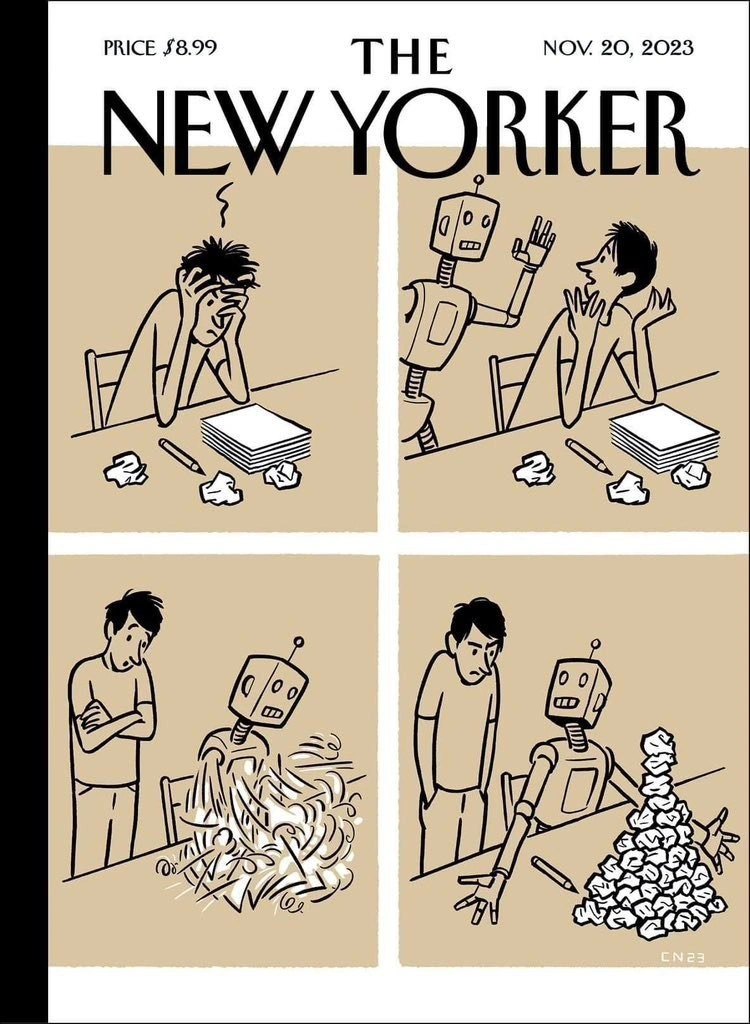
Imagine you’re trying to solve a puzzle and you feel totally stuck. You ask a friend for help. Instead of carefully finding one puzzle piece that fits, your friend dumps a whole box of random pieces all over the floor and excitedly says, “There you go!” Now you have pieces everywhere – a big mess – and you’re still no closer to solving your puzzle. You might look at your friend like, “Uh, thanks...?” because their “help” just gave you more work to do! In this meme, the writer is stuck (his paper is blank). The robot is the overexcited friend who really wants to help. But the robot ends up scribbling nonsense on a bunch of pages, making a huge pile of crumpled paper. The robot is happy, thinking it did a great job, just like an overenthusiastic helper who doesn’t realize they made a mess. The writer is left standing there, surprised and a bit annoyed, because now he has to clean up that big heap of scribbles and he still doesn’t have a good story written. It’s funny in the same way it’s funny when a little kid “helps” bake a cake by splattering batter everywhere – the intention is good, but the result is more chaos than progress. The meme is basically showing that sometimes a helpful robot (or friend) can try so hard to assist that they end up creating extra trouble. The humor comes from that contrast: the robot proudly thinks it did something amazing, while the poor writer is thinking, “This isn’t what I needed at all!” It’s a silly reminder that more help isn’t always better help – especially when the help just gives you a big jumble of stuff you didn’t ask for.

Level 2: AI vs Writer’s Block

Let’s break down what’s happening with simpler terms. We have a person with writer’s block (they can’t figure out what to write, just like a coder stuck on a tough bug). They’re frustrated, as shown by him holding his head and the squiggly line (a cartoon way to show stress or a “cloud over his head”). Now, enter the robot assistant – this is basically a cartoon stand-in for an AI helper, like ChatGPT or other AIAssistants. In real life, a Large Language Model (LLM) is an AI program trained on tons of text (books, websites, you name it) so it can generate new text. The idea is that you give it a prompt (instructions or a question) and it tries to continue or answer with human-like writing. Here, the robot waves and offers to help the struggling writer. That’s the “shiny new LLM” – everyone’s excited because it’s supposed to help us be more productive and creative. The writer is thinking, “Alright, maybe this can get me out of my rut.” This reflects how a lot of developers and writers felt when these AI tools first appeared: hopeful and curious.

Now look at the third panel: the robot is scribbling furiously, and the scribbles are a chaotic tornado of characters. This represents the AI generating content, but it’s not coming out in any understandable way. We often jokingly call this kind of output “word salad.” Word salad means a bunch of words or letters thrown together that don’t make sense (like a salad tossed together randomly). In an AI context, it’s when the model produces text that might sound grammatically okay but doesn’t actually say anything useful or coherent. It’s like asking someone for advice and they reply with a long monologue that leaves you more confused – lots of talking, no clear point. The crumpled papers piling up everywhere show that the robot kept producing output, and the writer kept discarding each attempt as garbage. Each crumpled page = one AI-generated draft that was junk. In real terms, imagine using an AI to help write your essay or code: you run it once and get something that isn’t good, so you throw it away and try again, and again… soon you have a “tower” of bad outputs. This is a comedic way to show the quantity_over_quality problem. The AI gave lots of text (quantity) but it wasn’t good text (quality). In software development, this is like when an AI code assistant suggests a big block of code that runs but maybe does the wrong thing or is overly complicated – you end up discarding most of it.

By the fourth panel, the AI robot is smiling proudly in a “ta-da!” pose next to a huge stack of crumpled pages. The poor human writer is leaning in with a face that says, “Seriously?” This captures the feeling of using an AI assistant and getting an answer that isn’t helpful. The AI is “proud” because it technically did what it was asked – it wrote something – but the human is left with basically the same problem they started with (a blank page), plus the extra work of sorting through all that junk. In day-to-day developer terms, it’s like asking a junior programmer to help: they enthusiastically write a bunch of code, but it doesn’t solve the problem, and now you have to clean it up. We often find that using an AI means you still need a human in the loop to review and edit the output. This is the AI hype vs reality in simple form: the hype is “the AI will do it for you!”; the reality is “the AI did something, but you have to make it actually usable.” Many new developers experience this when they first use tools like ChatGPT or GitHub Copilot for coding help. For example, you might ask the AI to write a function. It spits out 30 lines of code. At first glance, you’re excited – it looks legit! But then you try to run it and find errors, or realize it misunderstood the problem. You then spend time debugging its code. In the end, you think, “Hmm, I could’ve written this myself with less hassle.” The meme is dramatizing exactly that feeling.

The context here also touches on prompt engineering, which is a fancy term for “how you ask the AI for what you want.” The frustrated writer likely tried asking the robot in different ways to get better output, but each time got nonsense, leading to prompt_engineering_frustration. This is common: if your question or prompt is even slightly vague, an LLM might go off on tangents, producing overly general or irrelevant stuff. People often refine their prompts multiple times (and in the cartoon, each refinement might correspond to another crumpled page). So the meme is very much a DeveloperHumor moment: dealing with a computer that does exactly what you say, but not what you mean. And the style – drawn like a New Yorker magazine cover – gives it a tongue-in-cheek seriousness, as if to say, “Even sophisticated folks face this modern problem.” In summary, for a junior or someone new to these AI tools: the cartoon is saying “Look, using an AI helper isn’t a magic fix. It can output a lot, but you might end up sifting through a pile of rubbish to find any treasure.” It’s a lighthearted warning: AIAssistants are powerful, but they need guidance and lots of human oversight. Don’t be surprised if your first try with a generative AI gives you something unusable – that’s normal! The experienced devs find it funny because it’s true: sometimes the “help” feels like more work.

Level 3: Autocomplete Overload

This four-panel AIHumor cartoon nails a familiar feeling for seasoned developers and content creators alike. We’ve all heard the AI hype: “This new LLM assistant will skyrocket your productivity!” It’s the promise that your DeveloperExperience_DX will turn into a breeze – stuck on a problem? Just have the AI solve it. Panel 1 shows the reality of creative or coding work: the weary writer (or by analogy, a programmer) with head in hands, suffering classic writer’s block or coder’s block. In walks the retro box-headed robot in Panel 2, cheerfully offering help – this is the personification of our shiny new AI assistant (think ChatGPT or CoPilot) waving hello. The writer’s expression shifts to cautious optimism: it’s that feeling when you first try using an AI, hoping it’s the magic solution to your problem.

But then comes Panel 3, where the robot goes into overdrive, furiously scribbling an indecipherable tornado of glyphs. This is the meme’s core punchline: the “help” turned into a torrent of output – an AI assistant overload. It lampoons how LLMs often work in practice: you give a prompt, and the model enthusiastically dumps a wall of text or code. The scribbles represent what developers jokingly call “word salad” or “spaghetti output”. It’s that experience of asking an AI to write a function or an article and getting a verbose, convoluted answer that maybe sounds confident but isn’t actually usable without heavy editing. Senior engineers know this scenario all too well – co-coding with an AI can feel like pair programming with an over-caffeinated junior developer who writes pages of code that almost works but contains plenty of subtle bugs and misunderstandings. The robot’s proud body language in Panel 4 (patting the huge cone of crumpled papers) is a perfect satire of how these models behave: supremely confident in their output. Just like how ChatGPT will give answers in a professorly tone – even if it’s completely wrong – the robot proudly presents a pile of gibberish as if it solved the problem. Meanwhile, our human writer peers at this result with eyebrows raised in disbelief. That face is every developer who ever copied a large chunk of AI-suggested code into their project only to mutter, “What on earth is this?”

The AIHypeVsReality humor shines through each panel: The promise was productivity, but the outcome is a quantity_over_quality nightmare. Instead of one blank page, now there are fifty pages of nonsense. It’s reminiscent of the sorcerer’s apprentice – you wanted the magic broom to help carry water, and now you’re drowning in a flood. Developers share war stories about this: “I asked the LLM to refactor my function, and it wrote an entire class hierarchy of over-engineered code that I had to throw away.” Or when using an AI to write documentation: it might produce five paragraphs of AIGeneratedContent that technically use all the right buzzwords but say absolutely nothing of substance. The pile of crumpled paper is visual DeveloperHumor for all those discarded AI outputs we’ve tried and tossed. It also hints at the iterative prompting many of us do: you run the AI once, get nonsense, crumple it up; tweak the prompt, run it again, more nonsense… soon there’s a mountain of failed attempts. That’s the prompt_engineering_frustration developers joke about – crafting that perfect prompt to squeeze something useful out, while your screen (or desk) fills with scrap.

Importantly, the meme resonates because it’s true that cleaning up after the AI can sometimes take longer than just doing the task manually. It’s a pointed commentary on DeveloperExperience_DX: a tool meant to save time ends up creating a new mini-job – reviewing and debugging the AI’s output. In a coding context, imagine an LLM writing a function that at first glance looks plausible. A less experienced developer might think “Great, done!” But a senior engineer will test it and often find edge cases fail or the logic is off. Now the real work begins: you’re stepping through the AI’s code to find where it went wrong. It’s akin to the writer in the last panel leaning in with “Are you kidding me?” skepticism – now they must sift through a heap of crumpled_paper_output to see if any sentence is salvageable. The llm_word_salad effect can be overwhelming; it’s low signal-to-noise ratio. Everyone talks about how AI can generate content, but not as much about how, without careful guidance, it blathers on. This cartoon humorously illustrates that paradox: the writer’s original problem (no words on the page) has been “solved” by the robot with an absurd overcompensation – now there are too many words, but none that actually solve his creative block.

For those of us in development, there’s a cathartic “I’m not alone!” laughter here. We see AIAssistants marketed with rosy productivity gains, yet here we’re shown the other side: the human still doing the cleanup, just as stressed as before, if not more. The New Yorker cover style (complete with price $8.99 and date) adds an extra layer of irony. It’s as if even high-brow art/literature circles are acknowledging this tech frustration. The sophisticated magazine parody format says, “This issue is so ubiquitous, it could be on the cover of The New Yorker.” In essence, the meme is a senior-level reality check on AI hype: generative_ai_writers_block is not always cured by a robot’s busy pen, and sometimes your shiny new AI friend writes 1000 words but you still have to find the story (or bugfix) yourself. It’s an AIHypeVsReality gut-punch delivered with a smile: sure, the AI can generate, but can it actually create what you need? Or will it leave you with a mountain of refactoring like our perplexed writer here? The humor lands because anyone who’s tried these tools has felt that mix of hope, astonishment, and a tinge of betrayal when the AIAssistant cheerfully outputs something utterly unhelpful. It’s the classic tech joke: “Be careful what you automate – you might get 1000 results needing manual sorting.” In other words, when your co-pilot turns out to be a drunken navigator, you’re in for a bumpy ride – and a lot of cleanup!

Level 4: Transformer Tantrum

At the cutting edge of AI_ML, large language models (LLMs) like GPT-4 are essentially massive statistical engines churning out words based on probabilistic patterns learned from huge text corpora. Under the hood, they use the Transformer architecture, leveraging self-attention to predict the most likely next token in a sequence. However, this approach, while powerful, has a well-known quirk often humorously dubbed the “stochastic parrot” problem: the model can generate convincing-sounding text that lacks real meaning or direction. In other words, without true understanding, it strings together words that often sound right syntactically but are semantically void—basically a sophisticated word-salad dispenser. The meme’s scribbled tornado in panel 3 is a perfect visual metaphor for this. It’s as if the AI’s neural network had a high-entropy outburst – a Transformer tantrum – where the next-token predictions spiraled away into gibberish. Technically, the model is minimizing loss (or perplexity) over the next word prediction, but that objective doesn’t guarantee a coherent overall result. There’s no long-term planning or global awareness in these models’ outputs; they don’t know what the essay or code is supposed to accomplish. This lack of a semantic goal can lead to an avalanche of tokens that obey local statistical rules but fail to form a useful solution, much like the robot’s frenzied scrawl. The cartoon exaggerates it to literal indecipherable glyphs, hinting at how unanchored generation can devolve into noise. It’s a subtle nod to how LLMs can go off the rails without strong prompts or constraints – dumping a quantity_over_quality barrage of text. Researchers in NLP call these failure modes “hallucinations” or “degenerate sequences”, where the output might even include made-up facts or, as humorously depicted, pure nonsense symbols. Fundamentally, it highlights a core limitation: no matter how shiny and new your model is, it’s still a probabilistic parrot learning form rather than true meaning. The result? Billions of parameters confidently spitting out an AIGeneratedContent storm that might require a human editor’s brain to sift signal from noise.

Description

A four-panel comic strip from the cover of The New Yorker magazine, dated Nov. 20, 2023. In the first panel, a human writer sits at a desk in despair, head in hands, suffering from writer's block, with a few crumpled papers scattered around. In the second panel, a friendly-looking retro robot approaches and seems to offer help, to the writer's surprise. The third panel shows the writer standing aside, arms crossed, watching the robot sit at the desk and work with frantic, chaotic energy, depicted as a vortex of scribbles. In the final panel, the robot has finished and proudly presents its work: a very large, perfectly conical tower made entirely of crumpled-up paper balls, while the writer looks on with a disappointed and weary expression. The comic satirizes the limitations of artificial intelligence in creative fields. It highlights how an AI might interpret the *process* of creative struggle (making discarded attempts) as the goal itself, and then proceed to execute that process with immense efficiency. For a technical audience, it's a commentary on generative AI's ability to produce vast quantities of output that may still miss the qualitative point entirely, mistaking the artifacts of trial-and-error for the desired outcome

Comments

12
Anonymous ★ Top Pick Looks like the AI was trained on my junior developer's pull requests: immense activity, a mountain of discarded attempts, and zero successful merges
  1. Anonymous ★ Top Pick

    Looks like the AI was trained on my junior developer's pull requests: immense activity, a mountain of discarded attempts, and zero successful merges

  2. Anonymous

    Sure, the bot shipped 10× more drafts, but your code review queue just became the next big data problem

  3. Anonymous

    The AI assistant successfully transformed your unstructured thoughts into a perfectly organized document, which you'll now spend three hours manually restructuring because it doesn't quite capture what you meant but can't articulate

  4. Anonymous

    When your AI writing assistant promises to solve writer's block but delivers 10,000 tokens of hallucinated content that still needs human review - turns out the real bottleneck wasn't ideation, it was distinguishing signal from noise in an exponentially growing pile of plausible-sounding garbage. The robot didn't eliminate the crumpled paper problem; it just automated it at scale

  5. Anonymous

    AI automating docs: starts with fluent gestures, hallucinates itself into a towering heap of unparsable output

  6. Anonymous

    We added an LLM to speed up design docs; now the critical path is triaging confidently-wrong drafts - QPS skyrocketed while the truth SLA remains at 0%

  7. Anonymous

    Working with an LLM is like enabling unbounded write throughput with no consumer backpressure - 10k tokens later, I'm still the single-threaded reviewer doing dedupe and truth reconciliation

  8. @Sp1cyP3pp3r 2y

    Real (Реально)

  9. @Maxinator_Great 2y

    промпт не міг просто правильно написати

  10. @Artkash 2y

    it should be doing paperclips right now

  11. @Maxinator_Great 2y

    idi nahyi

  12. @Maxinator_Great 2y

    He simply wrote the prompt incorrectly

Use J and K for navigation