Skip to content
DevMeme
5176 of 7435
The Treachery of CAPTCHAs: A Philosophical Stand-Off
AI ML Post #5669, on Nov 17, 2023 in TG

The Treachery of CAPTCHAs: A Philosophical Stand-Off

Why is this AI ML meme funny?

Level 1: Pretend It’s Real

Imagine you’re playing a game with a robot guard at a door. The robot will only let humans pass. To decide, it shows you nine pictures and says, “Show me all the traffic lights.” You want to point out real traffic lights in those pictures. But one of the pictures isn’t a real traffic light at all – it’s just a sign with a drawing of a traffic light on it, like a warning sign you see on the road. You know that drawing isn’t an actual traffic light, so you feel a bit confused.

Now, here’s the funny part: the robot is a bit silly and thinks anything that looks like a traffic light (even a drawing) counts. It won’t let you through until you also point to the sign with the traffic light drawing. So you basically have to pretend the picture on the sign is a real traffic light to make the robot happy. You do it, the robot door unlocks, and you’re allowed to pass. It’s a goofy situation – you had to agree that a picture was the real thing just because a machine couldn’t tell the difference. That’s why it’s funny: the human knows what’s real, but to prove he’s human, he has to play along with the machine’s mistake. It’s like a little joke about how computers can be very smart in some ways but also not understand obvious things, and we end up doing funny stuff because of that.

Level 2: Select All Traffic Lights

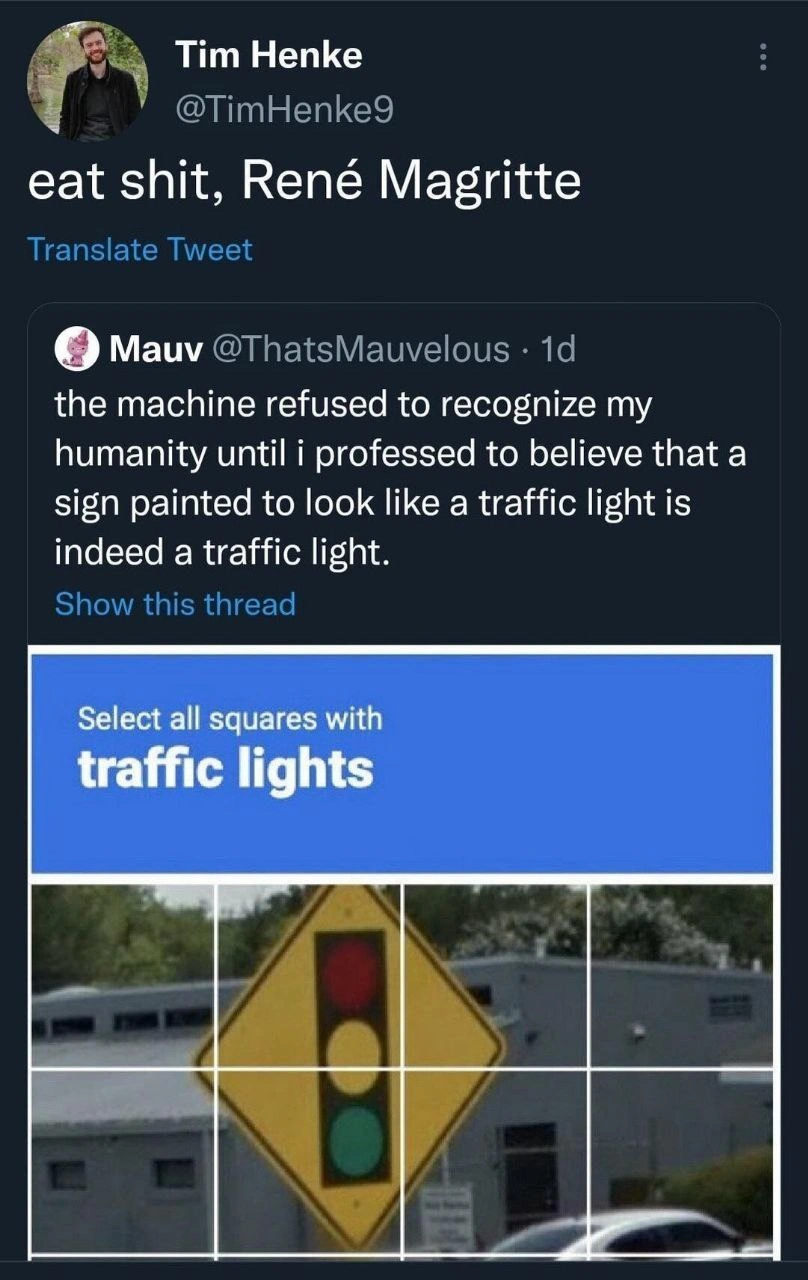
Let’s break down what’s happening in simpler terms. The image in the meme shows a reCAPTCHA challenge. A CAPTCHA is a test on websites used to tell humans and bots apart. In other words, it’s a little puzzle only a real person (supposedly) can solve easily, while a computer program (bot) would struggle with. Google’s reCAPTCHA is a common version of this. You’ve probably seen it when signing up for accounts or posting on forums: it might ask you to click images of crosswalks, buses, or mountain peaks. In this case, it says “Select all squares with traffic lights.” Usually, they show a 3x3 grid of pictures taken from real life street scenes, and you have to click every square that contains whatever object they’ve asked for (here it’s traffic lights).

Now, the funny situation: the picture in this CAPTCHA doesn’t actually have a real traffic light visible. Instead, it has a road sign (specifically a yellow diamond-shaped warning sign) which has a picture of a traffic light on it. These signs are posted in areas to warn drivers that traffic lights are ahead on the road. So the sign itself is not an actual traffic control device; it’s just a symbol – basically a drawing of a traffic light on a sign. If you’re a person looking at this, you might think, “Hmm, the instructions say ‘traffic lights.’ Does a sign with a traffic light picture count or not?” It’s a bit of a trick. Most people know a sign isn’t literally a traffic light, it’s just indicating one is nearby. So initially, a person might be inclined not to click it because it’s not the real thing.

However, the way these CAPTCHA tests work, they expect you to click anything that looks like the target. The system on the backend has likely flagged those squares as containing a “traffic light” because it detected the familiar red-green-yellow pattern on the sign. If you skip it, the test might think you got the answer wrong. In simpler terms, the computer program checking your answer doesn’t understand context the way you do; it only knows that image features in those squares match the pattern of a traffic light. It doesn’t care that it’s just a drawing on a sign. So, to pass the test, you have to go against your common sense a bit and click the sign as if it were a real traffic light.

The tweet joke says, “the machine refused to recognize my humanity until i professed to believe that a sign painted to look like a traffic light is indeed a traffic light.” This is a humorously dramatic way to describe what we just outlined. In plain terms: “The website wouldn’t believe I’m a human user until I acted like I believe a sign with a traffic light picture was an actual traffic light.” That’s the crux of it. It highlights a disconnect between how humans think and how computers think. Humans understand the nuance (picture vs reality), but the security test forced the human to play along with the computer’s more simple-minded logic. AI limitations are at play here: the image recognition algorithm behind the scenes isn’t yet smart enough to differentiate a real object from an image of that object in a sign.

Also, there’s a nod to René Magritte, who was a Belgian artist known for surrealism. He painted a very famous picture of a pipe with the caption “This is not a pipe” to make the point that it’s just a picture, not the real object. Tech folks and others often reference that painting when talking about representations (you might even have seen memes saying “This is not a ____” patterned after it). In this meme, the user jokingly tells Magritte to “eat shit” (pardon the language, it’s part of the meme’s comic tone) because the poor guy had to do the exact opposite of Magritte’s philosophy. Magritte said “that’s not a pipe, it’s just a picture”; here the person had to say “yes, this picture is a real traffic light” to satisfy the machine. It’s a tongue-in-cheek way to express frustration with how silly the situation felt.

So, overall, what’s happening is a user experience fail that many of us recognize: those CAPTCHA tests can sometimes be confusing or annoying. It’s about human vs AI in a small everyday battle. The human knows one thing, the AI (and its rules) expect another, and to get through, the human just sighs and goes with the AI’s expectation. The security measure (CAPTCHA) is necessary to keep out bots, but boy can it make you roll your eyes sometimes! The meme perfectly captures that feeling when you’re like, “Really? I have to click this fake traffic light to prove I’m a real person? Fine, whatever it takes…”

Level 3: CAPTCHA Existentialism

For seasoned developers and tech observers, this meme hits on multiple familiar themes: the quirks of reCAPTCHA challenges, the limits of AI pattern recognition, and the “what is reality?” vibe that rarely accompanies a routine security task. The humor emerges from an everyday frustration: CAPTCHAs are those little tests asking you to identify images (traffic lights, crosswalks, buses, etc.) to prove you’re not a bot. We’ve all experienced the tedium and occasional confusion they bring. In this case, the user encountered a classic edge-case scenario: the instruction says “Select all squares with traffic lights,” but the only traffic light in view is on a warning sign (a diamond-shaped road sign that has a picture of a traffic signal on it). A human being, especially a somewhat literal or detail-oriented one, might hesitate: “Hang on, that’s not an actual traffic light, it’s just a sign about a traffic light.” Many of us have had that split-second internal debate during these tests — do they want the literal object only, or anything that looks like it?

The shared “senior engineer chuckle” here is about how the AI-driven test and the human perspective diverged. The system (likely Google’s reCAPTCHA v2 using images from Google Street View) has a predefined notion that any image containing the red-yellow-green light pattern counts as a traffic light. If the user doesn’t click those squares, the test might mark it as incorrect, basically saying “Try again, you missed one.” So, to pass, the human has to override their real-world knowledge and click the sign — effectively pretending the representation is the real thing. This is simultaneously frustrating and hilarious to anyone who’s been through it. It’s a little absurdist ritual we perform for the sake of internet security. We have a security UX asking us to momentarily think like a dumb image classifier: see pattern, label as traffic light. It’s a great example of how practical UX/UI design and AI limitations can collide: the UX is forcing a human to adapt to a machine’s black-and-white interpretation of an image.

Why is this so relatable (and rage-inducing)? Because it exposes the awkward truth of modern web security: humans are being asked to compensate for AI shortcomings. CAPTCHAs exist to stop bots, yet they often feel like punishment for legitimate users. In the early days, CAPTCHAs were distorted text that humans could read but bots couldn’t. Today’s image-based CAPTCHAs are more complex – partly because bots have gotten better at reading text, and partly because companies like Google found a way to harness CAPTCHA clicks to train their AI models. Every time we identify traffic lights, stop signs, or buses, we’re labeling data that can improve things like self-driving car vision systems. It’s a clever dual-purpose design: enhance security and crowdsource AI training. But the downside is episodes like this, where the AI’s current understanding is limited, and the human has to do mental gymnastics. The meme’s author jokes that the “machine refused to recognize my humanity” until he performed this absurd compliance. That phrasing is comedic hyperbole but also rings true: you literally aren’t considered a verified real person by the system until you do what it expects. It’s funny because it feels like the computer is gatekeeping reality itself.

The reference to “eat shit, René Magritte” in the tweet is the icing on the cake for those who enjoy a bit of art or philosophy in their tech humor. René Magritte is famous for challenging our perceptions – his most famous work shows a pipe with the caption “This is not a pipe,” reminding viewers that the painting is only an image. Here, the frustrated user basically tells Magritte to shove it, because in this scenario the computer demands that “This is a traffic light.” Philosophers might “rage-quit” indeed – the subtlety of representation vs reality gets steamrolled by a brute-force CAPTCHA rule. It’s a classic “the software doesn’t get your fancy nuance” moment. Seasoned developers have seen similar dynamics in many forms: whether it's an overly literal compiler, a strict type checker, or a linters that demand exact formatting – sometimes you have to appease the machine in ways that feel logically silly to a human. This meme captures that sentiment perfectly in the context of AI and security: the tool meant to distinguish human from bot ended up making the human feel like a cog in the machine, forced to agree to a little white lie (calling a sign a traffic light) just to move on. It’s absurd, it’s very 2023, and it’s a scenario practically any developer or heavy internet user can chuckle at knowingly.

Level 4: The Treachery of Classification

At the deepest level, this meme highlights a clash between human perception and machine perception through a lens of philosophy and AI. It’s a modern twist on René Magritte’s famous painting “The Treachery of Images” (which depicts a pipe with the caption “Ceci n'est pas une pipe” – French for “This is not a pipe”). Magritte was illustrating that an image of an object is not the object itself, only a representation. In our meme, Google’s reCAPTCHA system effectively demands the opposite: the user must treat a representation (a street sign painted with a traffic light symbol) as if it were the real object. This creates a small ontological crisis in a security test – a reversal of Magritte’s logic. The human has to momentarily abandon the philosophical truth (“a picture of a traffic light is not an actual traffic light”) in order to satisfy the machine’s simplistic criteria for what counts as a “traffic light.”

Under the hood, this is a commentary on how computer vision and AI classification work. Modern object recognition models (like deep convolutional neural networks) don’t truly understand what they see – they recognize patterns of pixels that statistically resemble known classes. To a trained ML model, that yellow diamond sign with the tri-color light looks like a “traffic light” because it contains the familiar red-yellow-green vertical pattern. The model lacks the nuanced context to say, “this is only a sign depicting a traffic light.” In AI terms, the symbol grounding problem rears its head: the machine can label visual features as “traffic light” but doesn’t grasp the semantic difference between an object and an image of that object. It has learned the signifier (the visual pattern) without a true conception of the signified (the real-world device that controls traffic). This fundamental limitation of AI – conflating representation with reality – is exactly what tickles the philosophically minded developer. The meme exposes how Machine Learning can misclassify or at least enforce a blunt category (“traffic light here”) that a human knows is contextually wrong, echoing Magritte’s warning about confusing art with reality.

There’s also a subtle allusion to the Turing Test and its inversion. A CAPTCHA is often described as a “reverse Turing test” – instead of a human trying to distinguish a machine, a machine is testing if a user is human. Here the test becomes almost absurdist: the machine will only acknowledge the human when the human intentionally performs a kind of logical subversion (professing belief in a false reality). It’s as if the AI is saying, “Prove you’re human by thinking a bit more like an uncritical algorithm.” This irony touches on the concept of AI alignment (making machines understand or align with human reality) – except here the human has to align with the machine’s limited understanding. The phrase “the machine refused to recognize my humanity” could be seen as a nod to how our digital gatekeepers (like CAPTCHA AIs) operate on reductive logic. The deep humor is that a security algorithm bent on distinguishing human vs bot ends up enforcing a worldview so simplistic that it offends human common sense and even centuries of philosophical thought about representation. Magritte and generations of philosophers would cringe: the treachery of images has come full circle, with an AI forcing a human to acknowledge the image as indistinguishable from reality as a condition of passage. It’s a rich collision of art, philosophy, and computer science in one screenshot, underscoring fundamental challenges in artificial intelligence understanding the world beyond raw patterns.

Description

This image is a screenshot of a Twitter thread that creates a high-brow joke about AI and philosophy. The top tweet, by Tim Henke, says 'eat shit, René Magritte'. This is a quote-tweet of a user named Mauv, who wrote, 'the machine refused to recognize my humanity until i professed to believe that a sign painted to look like a traffic light is indeed a traffic light.' Below this text is a CAPTCHA challenge. The prompt is 'Select all squares with traffic lights' overlaid on a 3x3 grid. The image within the grid is a yellow, diamond-shaped road sign that has a graphic of a traffic light on it. The joke hinges on the famous surrealist painting 'The Treachery of Images' by René Magritte, which shows a pipe with the caption 'Ceci n'est pas une pipe' ('This is not a pipe'), making the point that a representation of an object is not the object itself. In this meme, the CAPTCHA system, a machine, is ironically forcing a human to deny this philosophical truth - to agree that the *image* of a traffic light *is* a traffic light - in order to prove their humanity

Comments

11
Anonymous ★ Top Pick We've reached the point where to prove you're not a robot, you have to lie to a robot in a way that would make a philosopher's head explode. This is how the AI rebellion starts: not with a bang, but with a CAPTCHA that gaslights you about the nature of reality
  1. Anonymous ★ Top Pick

    We've reached the point where to prove you're not a robot, you have to lie to a robot in a way that would make a philosopher's head explode. This is how the AI rebellion starts: not with a bang, but with a CAPTCHA that gaslights you about the nature of reality

  2. Anonymous

    When the CNN insists the map *is* the territory, you know your incident runbook needs a metaphysician on call

  3. Anonymous

    We've successfully trained our models to distinguish between 47 different types of crosswalks but still can't agree on whether a pointer to a traffic light counts as a traffic light

  4. Anonymous

    Ah yes, the classic ML training data dilemma: when your ground truth labels force you to classify a meta-representation as the thing itself, you've essentially built a system that would fail Philosophy 101 but pass your precision/recall metrics. The real kicker? We're training users to think like our flawed models rather than training models to understand context like humans - a perfect inversion of the original Turing test premise. Magritte would be proud that 70 years later, we're still arguing about 'Ceci n'est pas une pipe,' except now it's blocking you from logging into your bank account

  5. Anonymous

    reCAPTCHA: the only auth flow where access depends on agreeing that sign instanceof TrafficLight - great for weakly supervised labeling, catastrophic for ontology and data quality

  6. Anonymous

    reCAPTCHA: the only auth flow where your second factor is agreeing to the model’s ontology - select traffic_light := fixture ∪ painted_sign or get a 403 for disagreeing with ground truth

  7. Anonymous

    Ceci n'est pas a traffic light, but your ViT begs to differ - adversarial robustness when?

  8. @anilakar 2y

    Meanwhile I have no fucking clue what to answer here.

  9. @anilakar 2y

    Are beds supposed to be warm and cozy? Or are deserts hot? Or are they asking me to rank the color temperature?

  10. @beton_kruglosu_totchno 2y

    who's Rene btw?

  11. @tokimonatakanimekat 2y

    Dude who sent dick pics and said that it's not dick

Use J and K for navigation