Skip to content
DevMeme
5178 of 7435
The Generational Cycle of Startup Success and Failure
Startup Post #5671, on Nov 17, 2023 in TG

The Generational Cycle of Startup Success and Failure

Why is this Startup meme funny?

Level 1: Hard Work vs Easy Life

Imagine two brothers growing up. The older brother had a hard life: when he was a teenager, his family didn’t have much money, so he had to cook his own dinner every night and even help build things around the house. He learned to be really strong and capable because he had no choice – he had to work hard and figure things out. Now the family becomes better off by the time the younger brother is growing up. The parents give the little brother an easy life – they buy him whatever he needs, and he never has to cook or do chores. That younger brother turns into a bit of a spoiled kid. He’s never learned how to take care of himself because everything was always done for him. But one day, things change: the parents are away and there’s no ready-made dinner and no help. Suddenly the younger brother faces a hard time – he’s hungry and has to cook for himself with no experience. He struggles at first (maybe he burns the food and makes a mess) because he’s weak at these tasks. But after some trial and error, he learns how to cook a simple meal. Now he’s a bit stronger and more capable because of that tough situation. This story is like a cycle: hard times made the older brother strong. That strength created easy times for the younger brother. The easy times made the younger brother weak. And then the hard situation hit and forced him to become strong too. We find it funny because it’s true in a lot of situations: if people never face challenges, they don’t grow strong, and that can lead to problems later. The meme takes this idea and applies it to a startup company, but at the heart of it, it’s the same up-and-down cycle of hard work and easy living, happening again and again.

Level 2: Battles to Babies

Let’s break down the meme’s cycle in simpler terms, and explain what each part means in the real world of tech:

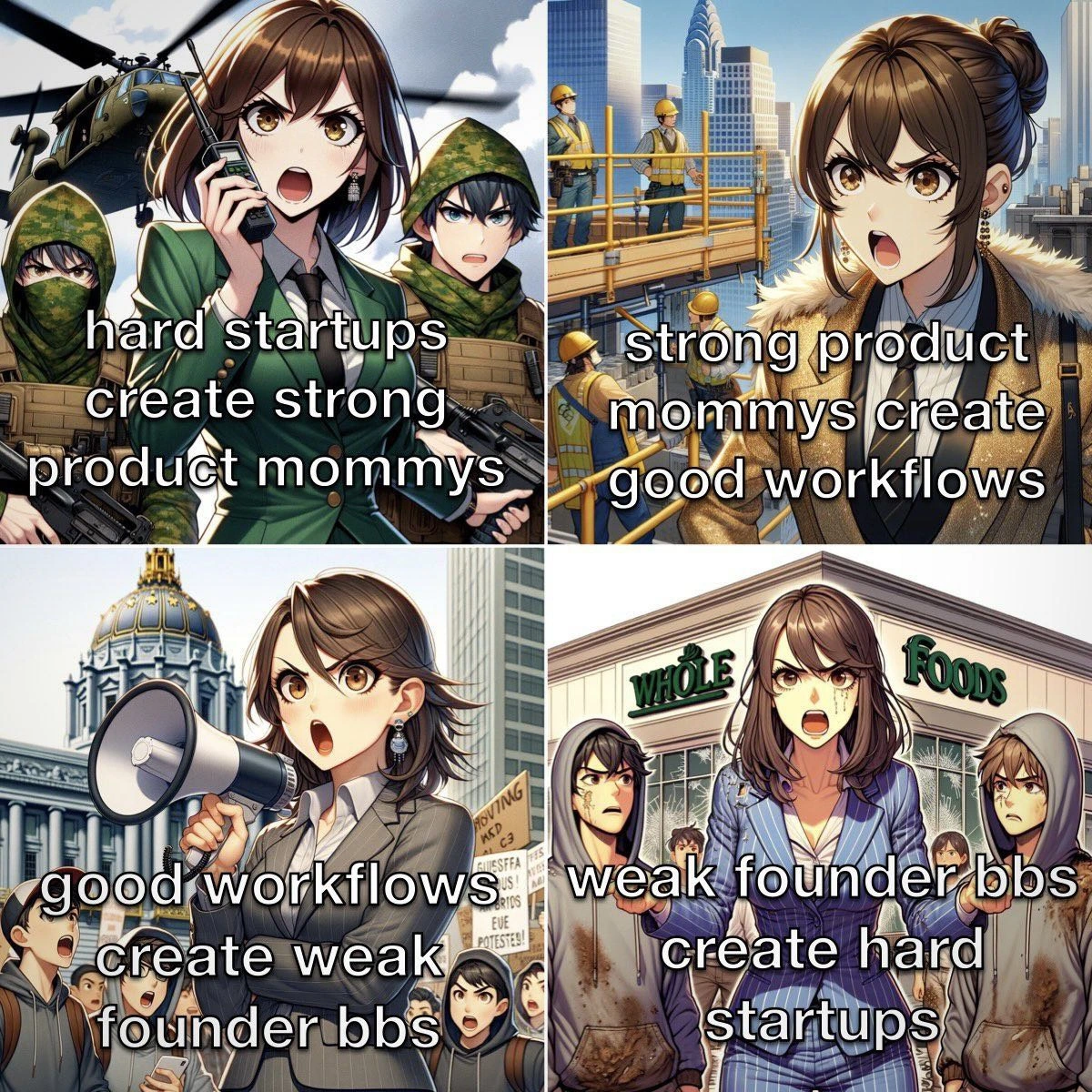
  • Hard startups: A startup is a new, fast-growing company (often in tech) that’s just trying to survive and make it big. “Hard startup” refers to when running that company is extremely tough. Think of a tiny team working out of a garage (or a cheap co-working space) under hard conditions: money is tight, competition is fierce, and everyone is pulling crazy hours. It’s “hard” because every week could be the last if they don’t succeed. In the top-left panel, we see a dramatic war-like scene (even a helicopter and soldiers!) – that visual is exaggerating how a startup can feel like a battlefield. In early startup life, people often joke about being “in the trenches” or having a “war room” when crunch time hits. There’s no time for formal process; you deploy updates at 2 AM, fix bugs on the fly, and pivot (change business direction) whenever you discover a feature isn’t working. This chaotic, high-pressure environment forges strong problem-solvers. Everyone has to toughen up, especially the product leaders who decide what to build next.

  • Strong product mommys: Here the meme is using a funny term for strong product managers. A Product Manager (PM) is the person responsible for deciding the direction of the product: which features to build, in what order, and making sure the product actually solves customer problems. They coordinate between the engineers, designers, and business folks. In a “hard startup” scenario, a PM has to be extremely strong (skilled and resilient) to keep the team focused and the product on track amidst chaos. The meme calls them “product mommys” as a playful twist. It’s like saying the PM becomes a team mom – they’re caring for the product and team, but they’ll also discipline things to meet goals. Picture a mom who loves you but won’t hesitate to scold you into doing your homework; a strong PM in a tough startup is a bit like that, making sure everyone does what’s needed, even with limited resources. The anime lady with the fierce expression and soldiers behind her embodies that tough love product leader. She’s protecting her “baby” (the product) and her team as if they’re family in a hostile world. In real life, a strong PM at a tiny startup might be the one setting ruthless priorities (“we can only build one feature this month, so it better be the most important!”) and saying no to distractions. They often act as the glue holding everything together when times are hard.

  • Good workflows: As a startup survives and grows (thanks to those strong PMs and a bit of luck), things calm down and improve. They raise more money, gain more customers, and can breathe a little. Now comes the phase of establishing good workflows. A workflow is basically a set process or way of doing things. Good workflows mean the company has figured out more efficient, repeatable processes for its work. Instead of pure chaos and last-minute decisions, they might adopt methods like Agile development (with regular sprints, stand-up meetings each morning, etc.), use tools like JIRA or Trello to track tasks, write design docs before coding, and have code reviews and testing procedures. It’s all the organized stuff that makes a company run smoothly and predictably. The meme’s top-right panel shows our heroine in a more civilized setting – at a construction site in the city – symbolizing building structured processes in a stable environment. The construction workers and scaffolding mean we’re constructing something solid: the company’s formal way of working. A strong PM from the first stage often helps introduce these workflows: they document how features should be built, they set up regular check-ins, etc. Good workflows are great because they reduce mistakes and don’t rely on everyone heroically winging it all the time. For a less experienced developer, this phase is when you suddenly have onboarding guides, code style guides, and maybe even a manager or a Product Mommy who says, “Take the weekend off, we have a process to handle this on Monday.” It feels way better than the all-nighters of the hard startup phase… at least initially.

  • Weak founder bbs: Now the downside of those good workflows: if life stays easy for too long, people in charge might get too comfortable. The founder is the person (or people) who originally started the company. In the early days, the founder is often super tough and involved – they had to be, to get the company off the ground. But what happens when all those processes and successes make the company run smoothly? Future founders or even the same founder, now wealthy and successful, can become “weak.” Here “weak” doesn’t mean physically weak – it means not prepared for tough challenges, perhaps complacent or even a bit spoiled. The meme calls them “founder bbs” (read: founder babies) to humorously suggest they’ve become like infants who can’t handle hardship. The bottom-left panel shows the suited woman with a megaphone at a protest – she looks authoritative, but perhaps out-of-touch. Why a protest scene? It could imply that she’s engaging in grandstanding or that people are unhappy under her leadership. It’s a clue that things aren’t as stable as the workflows made it seem. In real terms, weak founders might be those leaders who only operated during boom times when money was easy and markets were growing. They might have never dealt with a true crisis (like running out of cash or having a major product failure). Picture a CEO who’s used to every idea getting millions in funding from eager investors during good economic times – they might lack the grit needed when the market tightens. In a well-run company with tons of process, sometimes new leaders rise who are good at managing process, but not so good at dealing with chaos. They become a bit like kids who’ve grown up with “good times” and can throw a tantrum when things go wrong because they never experienced “bad times.” The phrase “weak founder babies” is a blunt joke: it suggests these later-stage leaders might fuss and flounder when the real pressure hits, much like a baby would cry if its routine is upset. The Whole Foods reference in the next panel (we’ll get there) reinforces how pampered they’ve become – Whole Foods is a symbol of a comfortable, upscale lifestyle.

  • Hard startups (again): Finally we reach the last part of the cycle: those weak leaders inevitably lead to hard times returning – or “hard startups” once more. The bottom-right panel shows our formerly polished exec outside a Whole Foods (a fancy organic grocery store) surrounded by younger people in hoodies looking upset. This is a clever depiction of the wheel turning again. Whole Foods stands for the cushy life (expensive smoothies, relaxed afternoons), whereas hoodies are stereotypical attire for scrappy startup folks (think of a young tech founder in a hoodie hacking away in a dorm room). So what’s happening? The “weak founder baby” phase created problems – maybe the company lost its edge, or a bubble burst – so now either a) the once successful company is struggling (hard times internally) or b) new startups are popping up to challenge it (creating hard times for the old guard). The angry hoodie-clad onlookers could be ex-employees or new entrepreneurs saying “Enough! We can do better” – essentially starting the cycle anew with their own hard startup, rebelling against the comfy Whole Foods executive culture. In real-world terms, this is something like: a big tech company gets slow and complacent, so a new startup launches to disrupt it. For example, imagine a huge social media company that’s gotten bureaucratic (their founders enjoy spa days and gourmet cafeterias). A couple of frustrated engineers in hoodies leave and form a hungry new startup that attracts users by being fresh and edgy – suddenly the old company has a serious competitor. Now the old company experiences hard times because they’re losing relevance. Alternatively, sometimes a broad market downturn happens (say the economy crashes or investors stop funding silly ideas). Those “weak” founders who were spending afternoons at Whole Foods now face hard reality: they must downsize, work twice as hard to get sales, or watch their company crumble. That forces everyone remaining to toughen up again. We’re back to square one: only the truly strong teams survive, new leaders emerge forged by fire, and the whole startup life cycle repeats.

In summary, each panel of the meme is a phase in the life of tech organizations: from chaotic hustle (battle mode) to structured success (building mode) to complacent ease (comfort mode) and then back to chaos (survival mode) when the bubble bursts. The humor lands because it exaggerates roles with terms like “product mommy” and “founder baby,” which conjure funny images (a product manager as an overprotective mom, a CEO as a whiny baby). But it’s really pointing to a genuine pattern discussed often in StartupLife and CorporateCulture: the tug-of-war between scrappiness and process. Even as a junior developer or someone new to tech, you might have noticed how a small startup feels different from a big established tech firm. In a tiny startup, you deploy code whenever and wear many hats – it’s exciting but tough (that’s the “hard startup” vibe). In a large company or a later-stage startup, there are guidelines, code reviews, and maybe lots of meetings – it’s comfortable and things seem orderly (that’s “good workflows”). However, if you join a team that’s too comfortable, you might see the downsides: people can become set in their ways, and when a big challenge comes, there’s panic because folks aren’t used to rolling up their sleeves anymore. This meme basically says no stage is permanent. Startup culture has this almost natural up-and-down cycle: fight, win, chill, falter, repeat. Understanding this makes the meme even funnier, because it’s poking fun at the inevitability of those stages. It’s like saying, “Enjoy those free snacks and neat workflows now, because if we get too soft, we’ll all be back in the trenches soon enough!” And if you’ve ever heard a tech CEO described as a “wartime CEO” versus a “peacetime CEO,” that’s exactly the concept here. Wartime (hard startup) leaders are fierce, and peacetime (good workflow) leaders can get lax. Eventually, the cycle ensures the war returns in some form. So even as a newcomer, you can appreciate the irony: today’s cushy tech job exists because someone else went through hell to build it – and if we forget that, well, hell might just come knocking again tomorrow.

Level 3: The Circle of Startup Life

At its core, this meme riffs on the famous adage “Hard times create strong men, strong men create good times, good times create weak men, weak men create hard times.” In the startup world, that becomes a cycle of scrappiness and complacency: hard startups create strong product mommys, strong product mommys create good workflows, good workflows create weak founder bbs, weak founder bbs create hard startups. It’s a tech culture Ouroboros – a startup life-cycle where adversity and success take turns feeding each other.

To a seasoned developer or tech PM, this hits close to home. We’ve seen startup culture swing between “wartime” and “peacetime” modes. In the early “hard startup” phase everything is on fire – runaway deadlines, technical debt piling up like sandbags, survival mentality 24/7. The meme portrays this with an anime-style battlefield: a suited woman barking commands with armed teammates and even a helicopter overhead. This over-the-top war imagery screams “startup in survival mode.” When you’re in a tiny venture-funded company with three months of runway left, every day feels like a battle. You have to ship features under absurd pressure, squash show-stopper bugs at 3 AM, and pivot on a dime when investors frown. These hard startups forge strong product managers (ironically dubbed “product mommys” here) the same way bootcamps forge tough soldiers. A Product Manager (PM) in this context becomes a battle-hardened general — or a fierce “product mommy” as the meme jokes, implying a tough-but-nurturing figure who holds the ragtag team together. In hard times, a PM has to do everything short of magic: ruthlessly prioritize features, cut scope with surgical precision, console cranky developers, and still deliver something that keeps the startup alive. That “mommy” label is tongue-in-cheek: she’s not literally anyone’s mother, but she’s taken on a caretaker role for the product and team, nurturing the project with tough love. It’s a comedic inversion of the macho “strong men” idea – here the strong leader is a no-nonsense product mama bear shielding her cub (the product) from doom.

From those strong PMs come good workflows – the meme’s second phase. The top-right panel shows our once-combat-ready heroine now in stylish business attire at a high-rise construction site, rallying builders instead of soldiers. This symbolizes the transition from chaos to order. After the startup survives the initial onslaught and finds some success (maybe a viable product or Series A funding), it’s time to institutionalize the hard-won lessons. Strong product managers begin introducing structure: feature specs, sprint plans, QA processes, documentation, and all the workflow goodies that help a company scale. In short, they’re building process (hence the construction imagery with scaffolding and hardhats). What were frantic all-hands fire drills now become organized stand-ups and OKR check-ins. “Good workflows” means the company has established efficient procedures and corporate culture norms so things run smoothly. And indeed, in a peacetime startup, life gets comfortable. Deployments are no longer wild cowboy coding at midnight; they’re managed via CI/CD pipelines with proper code review. The product roadmap is planned quarters in advance instead of scribbled on a napkin the night before a demo. All those battle scars from the early phase turn into process and policy – ironically, the very things many of us dreamed of when we were digging ourselves out of production outages in the war phase.

But here’s the twist: good times breed complacency. The meme’s third panel (bottom-left) shows the same protagonist, now a polished woman in a suit with a megaphone, seemingly addressing a protest outside a grand building (city hall vibes). Text reads “good workflows create weak founder bbs.” This is a biting satire of how success can soften leadership. When everything runs like a well-oiled machine, future founders or top bosses might emerge who’ve never experienced the chaos of true hard times. They inherit a cushy situation: abundant funding, a strong market, and layers of workflow already set up by those “strong product mommys.” These leaders are depicted as “weak founder babies.” Calling them “bbs” (babies) is deliberate comic exaggeration – conjuring an image of pampered tech CEOs who might whine when the kombucha keg runs dry. It’s a direct parody of the original proverb’s “weak men.” In the context of organizational dynamics, these weak founders are the ones who grew up in the boom times of tech. They might be second-generation leadership or new startup CEOs during a frothy market who think running a company is all about ping-pong tables, lavish off-sites, and “workflow culture” bureaucracy to avoid any discomfort. They love their good workflows so much that they start to rely on process over pragmatism. While the prior generation fought to survive, this generation fights to schedule more meetings.

Why show the founder figure with a megaphone at a protest? It’s an absurdist touch to emphasize how disconnected things can get in the comfortable phase. Perhaps our once-ferocious PM-turned-exec is now more occupied with grandstanding and “vision speeches” (like rallying a crowd) rather than rolling up her sleeves. It hints that leadership in good times can drift into politics, both internal corporate politics and external posturing, instead of focusing on gritty execution. In real startup lore, this could be the CEO who spends more time on TED Talks and thought-leadership blogs than understanding why the latest product update is lagging. The CorporateCulture at this stage prizes stability, “don’t rock the boat” thinking, and sometimes vanity projects – because things are going well... until they’re not.

And indeed, they won’t forever. Enter panel four: “weak founder bbs create hard startups.” The cycle completes as those pampered leaders lead the company (or the industry) into the next crisis. The meme’s bottom-right scene is outside a Whole Foods — a cheeky symbol of cushy tech affluence — with our central character now a glossy executive confronted by hoodie-wearing onlookers. This imagery oozes irony: Whole Foods is the temple of organic comfort for urban tech elites (free almond milk and $15 salads, anyone?), and hoodies are the classic garb of scrappy startup geeks. So here we have “weak” founders (the suited execs living the easy life) blindsided by a new generation of scruffy disruptors (the hoodie-clad youths). Those onlookers with scowls and hoodies could be the hungry new entrepreneurs or disillusioned employees ready to break away and create the next hard startup. It’s a great visual metaphor for how a complacent company or era spawns its own opposition. Think of how big bureaucratic companies (the suits) inadvertently encourage ambitious folks in their ranks to leave and start something new (the hoodies). Or how an industry flush with cash in good times funds a lot of flimsy startups with hype-man founders, many of which will implode and clear the way for gritty survivors. Organizational dynamics often show that when leadership is weak or out-of-touch, the environment becomes “hard” again: maybe the company fails and has to downsize drastically, or the market crashes (hello, dot-com bubble), or disruptive innovation from two kids in a garage dethrones the old guard. One way or another, easy times end. And so the venture funding loop resets: investors who once cut blank checks get stingy after being burned, only truly resilient teams get money, and we’re back to hard startups struggling mightily (back to panel 1, figuratively) in order to survive.

The humor here is dark but on point. It’s the kind of knowing laughter you hear in a startup’s late-stage all-hands meeting when someone quips “well, looks like it’s wartime again.” This meme gets knowing nods because it captures a painful truth about tech StartupLife: success can sow the seeds of failure, and failure (or hardship) forces a return to fundamentals that drives the next success. Experienced devs and product managers love-hate this reality. We’ve witnessed brilliant companies go from “move fast and break things” to “move slow and make bureaucratic PowerPoints.” We’ve seen heroic engineers and PMs pull off miracles under pressure, only to watch later hires (or sometimes the big bosses) get lazy with fancy tools and endless process checklists. Then, when a real challenge hits (competition, economic downturn, scaling crisis), those processes can’t save you if the leaders aren’t battle-tested. Cue layoffs, panic, and a scramble where only the truly strong rebuilders will persevere — essentially rebooting the gritty startup ethos all over again.

In short, the meme lampoons the process vs scrappiness trade-off that every growing tech company faces. It’s a satirical take on the StartupCulture and how Product Management and leadership evolve (or devolve) over a company’s life-span. By casting the proverb in anime action scenes, it extra-dramatizes what can feel like life and death to those of us living it. It’s funny because it’s true in a lot of cases, and also because it’s absurd to see roles like “product manager” and “founder” reimagined as “mommys” and “bbs” in a melodramatic hero cycle. It’s poking fun at the Management tropes: the tough love PM who saves the day, the well-oiled workflow that makes everyone complacent, the spoiled CEO who’s never hit a deadline with a stick, and the inevitable hard reset that follows. Seasoned tech folks chuckle (or groan) because we’ve been through this ride before — maybe more than once. As sure as DNS issues sunrise, hard startups will be back in vogue when the weak leaders of the good times drop the ball. And around and around we go, the Circle of Startup Life spinning like a deploy on Friday: inevitable and a little bit scary.

Description

A four-panel comic in a detailed anime art style that adapts the historical aphorism 'Hard times create strong men...' to the tech startup world. Each panel features an anime woman and other characters, representing a different stage of the cycle. In the first panel, a determined-looking woman in a business suit stands with soldiers and a helicopter, with the text 'hard startups create strong product mommys'. The second panel shows her confidently overseeing a construction site, captioned 'strong product mommys create good workflows'. In the third panel, she's leading a protest with a megaphone, with the text 'good workflows create weak founder bbs' (bbs likely meaning 'babies'). The final panel depicts her crying in front of a Whole Foods with two disheveled young men, captioned 'weak founder bbs create hard startups', completing the cycle. The meme satirizes the idea that the very success and stability created by one generation of skilled product leaders can foster an environment that produces weak, entitled, or unprepared founders, leading to inevitable failure and a return to difficult beginnings
Comments

34
Anonymous ★ Top Pick A perfect CI/CD pipeline and a pristine Jira board create founders who think a 'hard startup' is when the free kombucha tap is broken
  1. Anonymous ★ Top Pick

    A perfect CI/CD pipeline and a pristine Jira board create founders who think a 'hard startup' is when the free kombucha tap is broken

  2. Anonymous

    Conway’s Law meets venture capital: ship enough process and your founders eventually refactor themselves into motivational posters - right before the burn rate calls git revert

  3. Anonymous

    The eternal startup cycle: You build abstractions to hide complexity, only to discover you've created a new layer of complexity that requires its own product manager to abstract away - eventually leading to a founder who thinks they can 'disrupt' the industry by removing all those unnecessary abstractions

  4. Anonymous

    This meme perfectly captures the eternal recurrence of startup dysfunction: battle-hardened PMs emerge from chaos to impose Jira workflows so rigid they breed a generation of founders who can't ship without a 47-step approval process, inevitably leading to the next wave of 'move fast and break things' chaos. It's Conway's Law applied to organizational psychology - your company structure mirrors your trauma response to the last company's structure

  5. Anonymous

    Like microservices sprawl: strong PMs from hard startups enforce clean APIs, until weak founder-bbs revert everything to a monolith

  6. Anonymous

    You know it’s the ‘weak founder’ phase when Jira metrics ship faster than features and Conway’s Law starts dictating your CI pipeline

  7. Anonymous

    You can tell the cycle is complete when the PMO’s OKR is “standardize innovation” and the Jira burndown is perfectly linear - right before the next hard‑startup reboot

  8. Алексей 2y

    Good one 😂

  9. @vrntctl 2y

    i want her to peg me

  10. @ilia_esmaili 2y

    Made with AI

  11. @idkwtfits 2y

    Wtf is this, where's the funny, why tf is it even made like that, when the original version of the meme is still perfectly usable and suitable for this "joke"

    1. @elonmasc_official 2y

      You expressed 100% what I wanted!

    2. @vrntctl 2y

      there is less funny but more hot

      1. @idkwtfits 2y

        It's literally neither, my man, touch grass for once, you seem to need it.

        1. @vrntctl 2y

          doing that rn

          1. @idkwtfits 2y

            Indoors grass doesn't count.

          2. @NevermindExpress 2y

            You need these

    3. @IliaPastushkov 2y

      Do you have a link to an original?) just curious)) thanks in advance

  12. @vrntctl 2y

    think about that product mommy to sit on my face

  13. @vrntctl 2y

    still want her to sit on my face

  14. @vrntctl 2y

    ok bitch

  15. @vrntctl 2y

    give me a sec

  16. @vrntctl 2y

    hold on

  17. @vrntctl 2y

    still want her to sit on my face

    1. @NevermindExpress 2y

      Is that your backyard?

  18. @vrntctl 2y

    Also, think about putting her toes in uour mouth

  19. @vrntctl 2y

    Yes

  20. @vrntctl 2y

    Or rather

  21. @IliaPastushkov 2y

    Hi! Explain please what’s bbs stands for? I googled it and found the term “behaviour based safety” but I still can’t getj the point what’s weak founder bbs and why it’s created by good workflows

    1. @RiedleroD 2y

      bulletin board system

      1. @RiedleroD 2y

        hmm well on second thought, that's probably not what's meant here.

        1. @RiedleroD 2y

          maybe just short for "babies"?

          1. @qtsmolcat 2y

            Yes

  22. @callofvoid0 2y

    ah that joke bad times make good people good people create good things good things make good times good times make weak people weak people create bad things bad things make hard times goto line1

Use J and K for navigation