RIP Robinhood's reputation: January 28, 2021
Why is this FinTech meme funny?
Level 1: The Broken Promise
Imagine you have a friend who always helps you trade your toys or candies with other kids. This friend promised to let you trade freely so everyone gets a fair chance at the best goodies. One day, there’s a super exciting trade – everyone is trying to get a special shiny card, and you have a great opportunity to win big. But suddenly your friend stops you and says, “No, you can’t trade right now. I’m not letting you do it.” You’d feel shocked and upset. It’s like your friend broke a big promise. You might even say, “You’re not my friend anymore!” as an angry way of saying you can’t trust them now. You and your classmates might jokingly draw a tombstone on the chalkboard that says “RIP Friendship” with the dates of your friendship, to show that the friendship died that day.
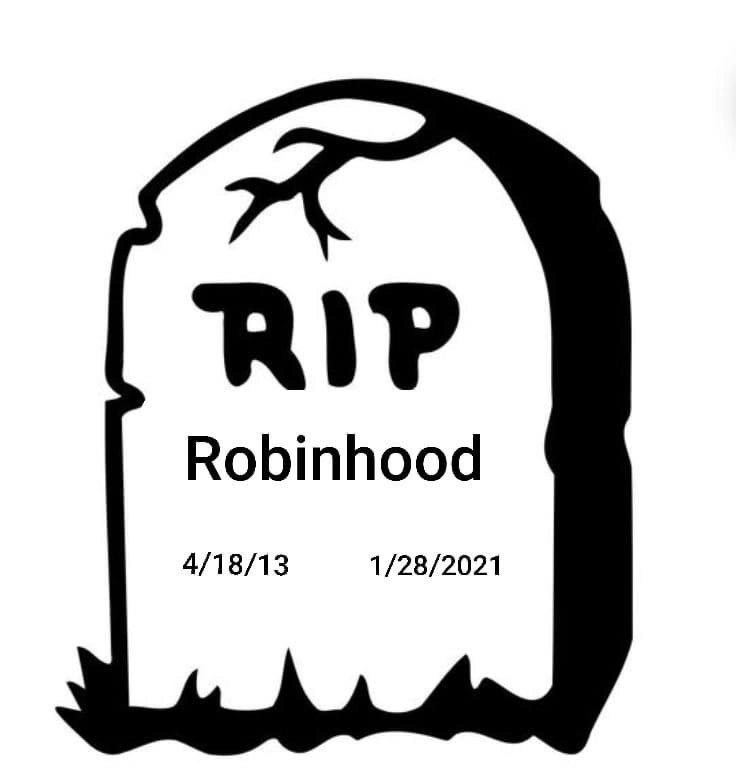
This meme is doing the same kind of thing, but with a company (Robinhood) instead of a friend. Robinhood was like a friend to many new stock traders — it helped them trade easily. But when it suddenly stopped them during the most important moment, those traders felt betrayed. They joked that Robinhood was “dead” to them by drawing a pretend tombstone image with the company’s name and the date of the incident. Of course, Robinhood didn’t literally die like a person, but the trust people had in it did. The tombstone picture is a funny way to show a sad feeling: that a promise was broken so badly it felt like a little funeral for the trust they had. It’s exaggerated and cartoonish, which is why it’s humorous, but it also tells you how hurt and angry people were when their helper suddenly refused to help at the crucial moment.
Level 2: Funeral for a Trading App
The image is a black-and-white tombstone cartoon that says "RIP Robinhood" with the dates 4/18/13 (Robinhood’s founding in 2013) and 1/28/2021 (the day of the GameStop trading halt). In internet culture, an "RIP [thing]" picture is a way to declare that thing effectively dead. Here it’s not a person but a company’s reputation being buried. So why would people say Robinhood "died" on January 28, 2021? That was the day Robinhood, a popular FinTech startup for stock trading, suddenly stopped users from buying certain stocks like GameStop. They did this because of an extreme event known as the GameStop short squeeze, which caused crazy trading volume and big stress on the financial system.
Let’s break down the terms:
- FinTech (Financial Technology): an industry where tech startups build software for financial services (trading, banking, payments). Robinhood is a FinTech company because it uses a smartphone app and modern tech to let people trade stocks easily (often with a slick user experience and no commissions).
- GameStop short squeeze: GameStop, a video game retail company, saw its stock price skyrocket in January 2021. Many small investors (often from Reddit’s WallStreetBets forum) kept buying the stock, which squeezed big hedge funds that had bet against it. A short squeeze happens when those big players who shorted (bet the price will fall) are forced to buy the stock to cover their positions as the price jumps, pushing the price even higher. It was a wild, once-in-a-decade market event, and it put huge strain on anyone facilitating those trades.
- Trading halt on Robinhood: Robinhood temporarily disallowed buying of GameStop and a few other hot stocks. Users could only sell their shares, not buy more. This is unusual because it wasn’t the stock market exchange stopping trades (exchanges sometimes halt trading for everyone during extreme volatility); it was the app itself imposing a limit on its users. Robinhood said they had to do it because of regulatory requirements and because they didn’t have enough cash on hand to cover the risks of all those volatile trades. In simpler terms, the rules of the financial system required Robinhood to have a lot of money reserved when trades are this risky, and they were running low, so they hit pause.
- User trust erosion: This phrase means the users’ trust in Robinhood was severely damaged. Robinhood built its brand on empowering small investors, so its users felt betrayed and angry when they were suddenly restricted from trading at the crucial moment. It’s like the platform broke a promise. Many users publicly said they’d quit the app and never come back. On social media, people expressed this anger through jokes and memes – essentially saying “Robinhood as we knew it is dead to us now.”
- Production incident: In software terms, this means some unexpected problem or emergency change in the live system (the production environment) that affects users. For Robinhood’s engineers, this trading halt was a massive production incident – whether it was triggered by technical overload or by a business decision due to compliance. It happened suddenly, had huge user impact, and everyone from developers to CEO was likely scrambling to handle it in real-time. The whole world saw it unfold. It wasn’t a planned maintenance or a tiny glitch; it was a very public crisis for the platform.
- Regulatory pressure: FinTech companies are tightly regulated by financial authorities and partner organizations. Robinhood can’t just allow unlimited trading if the underlying rules (from regulators or the clearinghouses that actually settle the trades) say they need certain safety nets (like big cash deposits) for that trading. On Jan 28, those rules essentially forced Robinhood’s hand – they had to slow things down or else risk breaking the law or failing to meet requirements. That’s what we mean by regulatory pressure: external rules pushed them to act even if they didn’t want to.
- Reputational risk: This is the risk of losing your good reputation. For a startup – especially one dealing with people’s money – reputation is everything. If users think your platform is unfair or unreliable, they will leave and tell others to avoid you. Robinhood’s decision led to a huge reputational risk: people started to see the company as untrustworthy or not truly “for the little guy.” It sparked outrage, bad press, and even attention from lawmakers. This kind of damage to trust can take years to fix, if ever.
In StartupCulture, a company’s reaction to a crisis can define its future. Robinhood’s reaction (halting trades) became infamous. The tombstone meme is the tech community’s wry way to say “Robinhood messed up so badly that they might as well be dead to us now.” It shows how the Startup “died” in the hearts of its users, even though the company itself is still operating. It’s tech humor mixed with genuine frustration.
So, this meme presents a gravestone for Robinhood, which symbolizes a final farewell to the company’s good image. It’s like saying, “Here lies the idea of Robinhood we believed in.” If you’re new to tech or finance, imagine a big online game you love suddenly stops you from playing the most exciting level, right when it matters most. You’d be upset and feel let down. That’s how Robinhood’s users felt. The dates on the tombstone (2013–2021) mark Robinhood’s birth and then the “death” of its trust on that 2021 date. It’s an exaggeration – Robinhood the company didn’t actually shut down – but it captures the emotion of the moment. The humor comes from using something as serious as a grave marker to dramatize a company’s mistake. It’s a bit dark, but it gets the point across: in the world of FinTech, one bad move can make your loyal users jokingly write your obituary.
Level 3: The Day Trust Died
At the height of the GameStop short squeeze frenzy on January 28, 2021, the Robinhood trading platform faced a perfect storm of technical load and regulatory pressure. In a move that stunned its users, Robinhood halted buying of certain red-hot stocks (like GME) right when excitement was at its peak. This one production incident turned into an overnight legend in FinTech circles – for all the wrong reasons. The meme’s tombstone graphic (showing "RIP Robinhood" with 2013–2021) declares the brand’s death not literally, but in reputation. It’s a darkly humorous take on how a single decision in a live system can kill user trust in an instant.
For seasoned developers, the humor here is bitterly familiar. We’ve all seen startups touting "disrupt the industry" one day, then scrambling to keep the lights on the next. Robinhood’s trading halt is basically a case study in StartupLife resilience (or lack thereof). The company's very name evokes a folk hero who steals from the rich to give to the poor, but on that day the FinTech world watched Robinhood seemingly do the opposite. Many furious retail traders felt the app had sided with big hedge funds – turning into the Sheriff of Nottingham, not the hero – and they responded with a cascade of memes and outrage. It’s funny in that too real way: the platform that promised financial freedom ended up locking the doors precisely when users wanted it most.
The tombstone meme format itself is a staple of TechHumor and internet culture. Developers often pronounce something "dead" with an "RIP X" image when a tool or idea falls out of favor. Here, it was deployed at ludicrous speed: mere hours after the trading halt, the RIP meme format was plastered all over social media, marking the death of Robinhood’s goodwill. This dramatic headstone with dates (4/18/13–1/28/2021) is exaggeration as protest. It’s the community’s way of delivering a snarky eulogy for the app’s credibility. User trust had been so deeply damaged that it felt like an outage of confidence – and indeed, trust in a trading platform is as vital as uptime.
Behind the scenes, the reality was that Robinhood had encountered a classic FinTech nightmare: they had to choose between two disasters. On one side, there were strict financial rules (and partners like clearinghouses) creating a regulatory compliance crisis that demanded the app slow down risk. On the other side, there were millions of users expecting the app to work no matter what. Regulatory pressure in a finance environment often forces immediate action – even if that means pulling the plug on a core feature. In a veteran engineer’s eyes, this was like a system failure where the "fix" is to turn off a major functionality. It’s the stuff of on-call nightmares. IndustryTrends have shown that online communities will quickly bury a platform that breaks its promises, especially when it involves people’s money. So the meme’s tombstone doubles as a caution sign: in FinTech, betraying the trust of passionate users can bury your brand overnight. One chaotic morning, and a billion-dollar startup found itself attending its own online funeral. It’s dark humor, yes – but for developers who’ve been through 3 AM firefights, it’s also a rueful acknowledgment of just how fragile user trust can be, even for a star startup.
Description
A simple meme depicting a black-and-white cartoon tombstone. The text on the gravestone reads 'RIP Robinhood' with a 'birth' date of 4/18/13 and a 'death' date of 1/28/2021. This image was created and circulated on January 28, 2021, the exact day that the stock trading app Robinhood controversially restricted the buying of GameStop ($GME) and other 'meme stocks' during a massive short squeeze event. The meme declares the 'death' of the company's brand and user trust, as many retail investors felt betrayed by a platform that claimed to 'democratize finance for all' but appeared to be protecting hedge funds. For the tech community, this was a major event highlighting the power and potential pitfalls of FinTech platforms, and the massive social and financial impact that platform-level decisions (and the infrastructure to execute them) can have
Comments
12Comment deleted
Turns out the 'free' in their API was just a read-only token for the buy endpoint that day
Turns out you can autoscale pods, but you can’t autoscale user trust - one “if (ticker == GME) return 403;” hotfix and your uptime becomes an epitaph
They claimed to 'democratize finance for all' but apparently forgot to implement proper liquidity management and clearinghouse deposit calculations in their risk models - turns out their system architecture couldn't handle actual democracy when millions of users tried to exercise it simultaneously
Robinhood's tombstone perfectly captures the irony of a platform named after someone who 'stole from the rich to give to the poor' ultimately restricting the poor from buying while allowing the rich to sell. The dates tell the whole story: born promising to democratize finance, died the moment they had to choose between their users and their clearing house margin requirements. It's the ultimate product-market fit failure - turns out your market wasn't retail traders, it was Citadel's order flow all along. At least they're consistent: they took from the rich (VCs) and gave to the poor (their reputation)
RIP Robinhood: when your risk engine doubles as a feature flag named disable_buy=true - great for clearinghouses, fatal for trust
99.99% uptime, 0% buy time - turns out SLOs don’t cover collateral requirements
Robinhood's autoscaler vs. WallStreetBets surge: the outage that proved retail FOMO > any cloud budget
I don't get it. Comment deleted
r/WallStreetBets drama just google "rip robinhood" Comment deleted
We need to support them Comment deleted
Wait, what for? Comment deleted
I mean guys from rabbit and game stop lol Comment deleted