Skip to content
DevMeme
2428 of 7435
Hiring Funnel: From Kaiju Battles to Shoveling Snow
Career HR Post #2699, on Jan 28, 2021 in TG

Hiring Funnel: From Kaiju Battles to Shoveling Snow

Why is this Career HR meme funny?

Level 1: Big Fight, Small Job

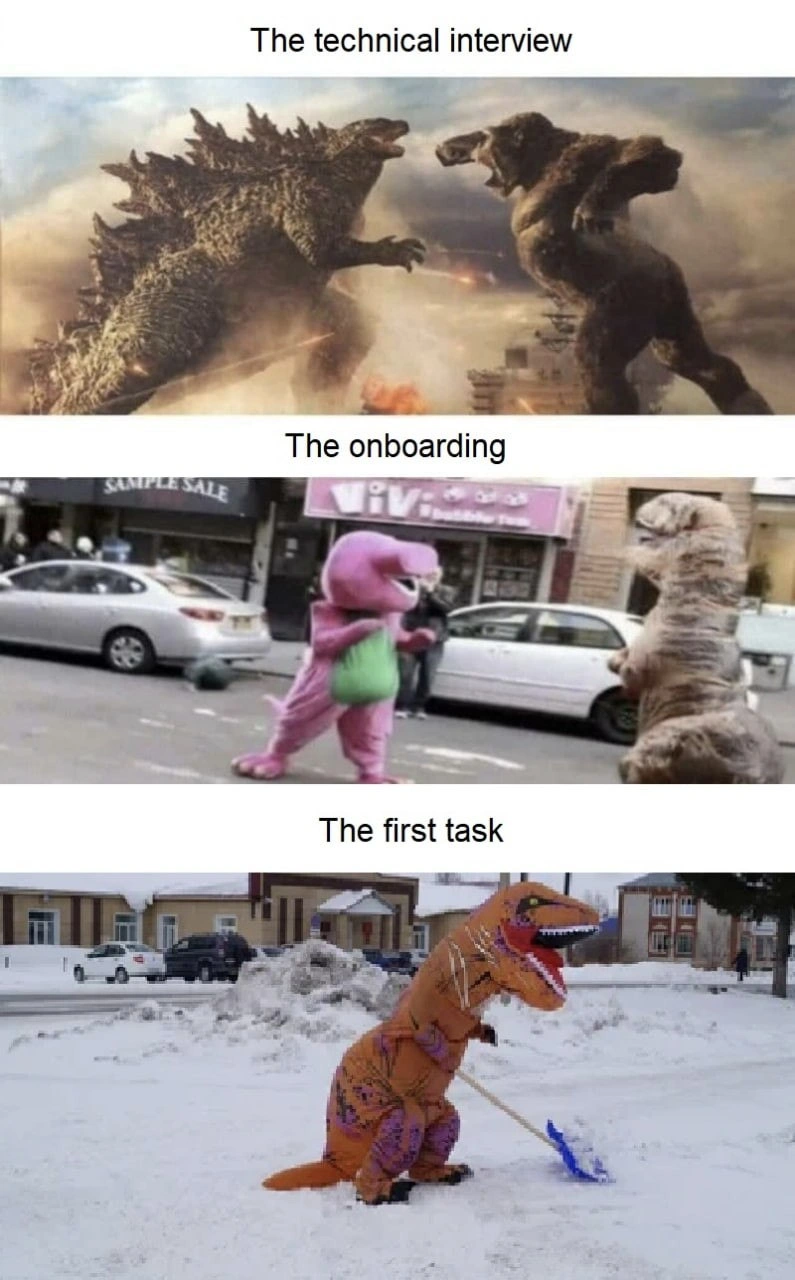
Imagine you trained really hard to do something super challenging – like you thought on your first day you’d be fighting a dragon to save a city. But instead, after all that training, you show up and they just ask you to clean your room. That’s what this meme is joking about. The “big fight” is like the super hard test (the technical interview) you take to get a coding job. It’s huge and scary, like two giant monsters fighting. Then the “small job” is what you actually do when you start the job: something simple and boring, like shoveling snow off a driveway. It’s funny because it’s not what you expected. You expected an exciting adventure, but you got a normal chore. In other words, the meme is saying getting a programming job can feel like a big epic battle at first, but once you start, the work can seem easy or ordinary – even silly – compared to that. The dinosaur costumes and snow shoveling make it extra silly so we can laugh at how different the reality is from what we imagined.

Level 2: Epic vs Everyday

For a less seasoned developer or someone new to the field, let’s decode the joke in simpler terms. This meme is an expectations vs. reality story about starting a new developer job. In the beginning (the top panel labeled “The technical interview”), you see a scene from a Godzilla vs. Kong battle. That’s a metaphor for how technical interviews in software can feel: huge, intense, and high-stakes. When you interview for a coding job, companies often ask you to solve tricky programming puzzles or algorithm problems on the spot. It’s like a big exam where you might have to write code on a whiteboard or in a timed online test. Many candidates prepare by practicing lots of problems (on sites like LeetCode or HackerRank) so they can defeat whatever coding monster is thrown at them. The meme uses the giant monsters fight to exaggerate this feeling – as if you’re wrestling a giant gorilla and a radioactive lizard just to get the job. It’s InterviewHumor because in reality, while interviews are tough, they’re obviously not life-or-death. But subjectively, especially for newbies, it feels like a battle where only the strongest coder survives.

Now, the second panel is captioned “The onboarding” and shows two people dressed in inflatable dinosaur costumes (one even looks like Barney the dinosaur, bright pinkish-purple!). They are sort of play-fighting or flailing at each other on a city street. This silly, low-budget scene represents onboarding, which is the process of joining a company and getting set up to work on your team. Why this image? Because onboarding is usually less glamorous and more clumsy than people expect. After the serious interview process, you might expect your first day at work (your first_day_at_work) to be structured and grand. You imagine the company will have a clear plan for you: a computer ready, accounts set up, a training schedule, maybe a mentor to show you the ropes. But reality often falls short. Perhaps your manager is too busy to properly welcome you, or the team forgot you were starting that day. Maybe your computer isn’t ready, so you spend hours installing software and hunting down passwords. It can feel a bit chaotic and even comical – kind of like two clumsy dinosaurs trying to coordinate a dance in the street. The OnboardingProcess is depicted as messy and underwhelming. It’s the meme’s way of saying, “Remember that big fancy battle (interview) you went through? Well, now things are suddenly goofy and confusing.” For a junior developer, this highlights the surprise: the company put you through a rigorous filter, but once you’re in, they might not have a solid plan to integrate you. This part of the meme gets a laugh because it’s relatable: nearly every developer remembers their first day not going exactly as expected, whether it was waiting for IT to give you access or reading documentation that nobody updated since last year.

Finally, the third panel, “The first task,” shows an orange T-Rex costume person kneeling down and shoveling snow in a quiet neighborhood. This represents the very first real work assignment you get as a new developer. Shoveling snow is a mundane, laborious chore – something simple, even boring. So the meme is saying: your first task at the job might feel ridiculously simple or menial compared to what you thought you’d be doing. It’s a common joke in developer circles that after all the fancy coding you did to pass the interviews, your first JIRA ticket (tasks are often tracked in a system called JIRA) could be something like “fix a typo in the code” or “change the color of a button on the website.” In other words, something so basic that you wonder, “I studied all those algorithms for this?” Here, the person in the dinosaur suit shoveling snow is a perfect metaphor: they look silly and a little sad doing a very plain task. It’s as if the company said, “Congratulations on slaying the coding dragon! Now please put on this embarrassing costume and do this trivial errand.” Of course, in real life they don’t make you wear a costume, but as a new hire you might still feel out of place or overqualified when tackling that first tiny assignment. This is classic DeveloperHumor and CareerHumor – nearly every programmer can smile (or groan) remembering their first day tasks, which often were much simpler than the interview prep. It underscores an expectations vs reality moment: you expected to dive into important, challenging projects, but initially you’re doing something very basic.

So why is the whole meme funny? It exaggerates a truth that people in tech talk about a lot. There’s a saying that tech interviews often test things you rarely use on the job. This meme takes that idea and makes it visual and absurd for comedic effect. It’s showing a new hire’s journey:

  • Expectation: The hiring process made you prove yourself in an epic way (fighting the Godzilla of coding challenges).
  • Reality of Onboarding: You arrive and things are clunky and awkward (like a cheap dinosaur costume skit, not the polished intro you imagined).
  • Reality of First Task: The work you initially get is trivial (shoveling snow, a chore, nothing like the epic stuff you prepped for).

Each step is a step down in intensity and glamour. That contrast is where the humor lies. It’s relatable developer experience because so many in the industry have lived through exactly this sequence. Even if you’re a junior developer just starting out, you might have heard mentors or online communities joke about whiteboard interviews and then the dull first tasks. The meme basically says, “Yup, it’s true, and here it is in a nutshell.” By using funny images (big CGI monsters vs goofy costumes vs a dinosaur doing yard work), it drives the point home in a way that makes you chuckle and nod. It’s a lighthearted way to cope with the fact that the tech industry can be a bit absurd in how it hires versus how it works day-to-day.

In summary, at this level we understand the meme as a commentary on the gap between how developers are evaluated and what they actually do starting out. You don’t need to be an expert to get it: it’s a simple joke about expectations vs. reality. The tags like TechnicalInterviewProcess, OnboardingPain, and RelatableDeveloperExperience all point to this common knowledge among developers. If you’ve gone through a tough interview, an unorganized onboarding, and an easy first task, this meme probably makes you laugh and think “Oh, I know this feeling!” Even if you haven’t experienced it yet, now you’ll be in on the joke – you’ll see why a picture of Godzilla and a picture of a snow-shoveling dinosaur together tell a funny story about life as a developer.

Level 3: Clash of the Code Titans

In the first panel, the meme invokes an epic monster battle – the famous Godzilla vs. Kong showdown – to represent the technical interview. This isn’t just cinematic flair; it’s poking fun at how intense and exaggerated technical interviews can feel. Many developers preparing for a coding interview feel like they’re gearing up to fight a colossal beast. Instead of giant lizards, the “monsters” are tough algorithmic challenges: think implementing a complex sorting algorithm or solving a tricky dynamic programming puzzle on a whiteboard while someone times you. The stakes are high, adrenaline is pumping – it’s a make-or-break InterviewHumor moment. Everyone’s watching if you’ll conquer the challenge or get crushed. The meme captions this as “The technical interview,” highlighting how the technical interview process often turns into a dramatic showdown of wits and code, much like a Hollywood battle scene.

Fast forward to the second panel: the grandeur disappears. Now we see two people in goofy inflatable dinosaur suits (one looks like a pink Barney, the other a budget T-Rex) clumsily bumping into each other on a city street. This is labeled “The onboarding.” It’s a brilliant contrast: after the high-stakes interview duel, the onboarding process at a real job can feel shockingly low-budget and chaotic. In developer terms, onboarding is supposed to be the structured introduction to your new role – setting up your dev environment, meeting your team, learning the codebase. But here it’s portrayed as two faux dinosaurs awkwardly sparring, which is exactly how disorganized or lackluster onboarding can feel. Instead of the sleek orientation you expected, you might get outdated documentation (a 404 on the wiki, anyone?), a bewildered manager who’s double-booked, or a “mentor” who’s as lost as you are. This OnboardingPain resonates with developers because so many have experienced an orientation that’s more confusion than preparation – essentially a mascot suit melee when you were promised a professional battle plan. The meme’s expectations_vs_reality humor shines here: you anticipated something grand (maybe a structured training or at least a proper introduction), but you find yourself stumbling around, much like two dinos with limited vision trying not to fall over. It’s chaotic, slightly comical, and definitely not what you imagined while signing the offer letter.

Then we hit the third panel, labeled “The first task.” Here, the lone inflatable T-Rex is kneeling in a snowy suburban driveway, shoveling snow — a hilariously mundane chore. This visual is a huge comedown from Godzilla’s fiery battle. It perfectly captures that moment every new developer experiences on their first day or first week: after all those brain-bending interview questions, your new_hire_first_task ends up being something like fixing a one-line bug or formatting a document. In the meme, shoveling snow in a dinosaur suit is a metaphor for any trivial, tedious task a developer might get right out of the gate. It’s unglamorous work. Maybe your first JIRA ticket is to rename variables to meet the style guide, or you spend a day just trying to get the ancient build system to compile the project. Shoveling snow is cold, repetitive labor — and doing it in an orange T-Rex costume is equal parts absurd and pathetic. Likewise, the first task assigned to a new dev is often embarrassingly simple or completely unrelated to all those algorithms you studied. It might even feel like janitorial work on the codebase: cleaning up someone else’s messy legacy code or writing unit tests for an already solved problem. The meme nails this relatable developer experience: the company grilled you like a legendary coder in interviews, but now they have you on “dino duty,” performing what feels like menial work that a junior high kid could do. It’s the ultimate CareerHumor: a punchline many of us live through.

Why is this progression so funny and painfully on point? It highlights the misaligned expectations in tech hiring. Companies often conduct interviews as if they’re selecting people for an elite special-ops mission – algorithms, data structures, maybe even design a system that handles a billion requests (cue the Godzilla-sized scale). But once hired, developers frequently face a reality filled with mundane tasks and organizational chaos. The DeveloperExperience_DX at many places doesn’t match the heroics promised. This disconnect is a well-known industry joke: “I studied NP-hard problems to fiddle with CSS tweaks as my first job.” The grandiosity of the interview (Godzilla vs Kong) versus the anticlimax of real work (snow shoveling in a T-Rex suit) rings true because the technical interview process often emphasizes computer science theory and puzzle-solving under high pressure, while the actual job might demand patience, reading existing code, and navigating office bureaucracy – skills tested nowhere in the interview. The meme is essentially a visual expectations vs. reality check for anyone in software engineering.

Let’s break down the contrast in each stage for clarity:

Stage Meme Depiction Reality for Developers
Technical Interview Godzilla vs. Kong epic battle scene High-stakes algorithm puzzles, whiteboard coding duels under pressure
Onboarding Two people in silly inflatable dino suits flailing around Disorganized orientation, confusing setup, feeling lost like "what do I do now?"
First Task T-Rex in a costume shoveling a snowy driveway Trivial initial assignment (e.g. small bug fix or mundane chore) that feels anticlimactic

Notice the downward spiral: from fighting giant monsters to floundering in costumes, to doing a lone, boring chore. It’s a developer humor rollercoaster because each step is a sharp overturn of expectations. Experienced engineers (the battle-scarred pros) nod and smirk at this, because they’ve seen it so often. They know that hiring can be a Godzilla-sized ordeal, while day-one tasks are often as humbling as cleaning up the codebase’s snow pile. The meme resonates as CareerHumor because it exposes a truth in an exaggerated, comical way: the tech industry sometimes turns trivial work into an unintentionally grand comedy, with the new hire wondering why they needed to know about Big O notation to operate a metaphorical snow shovel.

Finally, it’s worth noting that beyond the humor, there’s a subtle critique here. The meme suggests that our hiring processes might be a bit out-of-touch. Why are we staging Godzilla interviews to hire someone who will end up doing ordinary development tasks at first? It hints at the idea that maybe the process should focus more on real-world skills (like reading existing code, using frameworks, debugging, collaborating) – not just on conquering algorithmic monsters. So when you laugh at the inflatable dinosaur shoveling snow, there’s a part of you that’s also shaking your head, knowing how accurately this depicts the gap between interview expectations and on-the-job reality. The RelatableDeveloperExperience captured here is equal parts funny and frustrating, a wink and nudge that almost every programmer understands.

# Metaphorical pseudocode contrasting the interview vs the job:
def technical_interview():
    # Complex monster battle: solve a tough algorithm under pressure
    try:
        solve_hard_problem()  # e.g., invert a binary tree or optimize an NP-hard problem
        return "Victory against Godzilla-level question!"
    except TimeUpError:
        return "Defeated in the interview arena."

def first_week_on_job():
    # Mundane task: shovel the snow (trivial fix) in a dinosaur suit
    setup_dev_environment()  # might take a day, with many hiccups
    ticket = get_first_jira_ticket()  # e.g., "Update README.md" or "Change button color"
    complete(ticket)
    return "Task done, feeling a bit overqualified... :)"  # ironic satisfaction

print(technical_interview())  # Expected: Victory against Godzilla-level question!
print(first_week_on_job())   # Expected: Task done, feeling a bit overqualified... :)

This code snippet whimsically contrasts the two experiences. In technical_interview(), you’re up against a “Godzilla-level” coding question – something formidable that you either conquer or get defeated by if time runs out. In first_week_on_job(), instead of glory, you’re wrestling with setting up your environment (ever spent a whole day installing dependencies? 🐢), then pulling a trivial first JIRA ticket like “update the README”. The return strings even joke about the emotional outcome: “feeling a bit overqualified...” – because after slaying algorithms, updating documentation feels like using a bazooka to kill a mosquito.

All in all, at this senior level of understanding, the meme is a wry commentary on tech industry culture. It uses exaggerated imagery (giant monsters vs. a dinosaur doing chores) to highlight a real disconnect. We find it funny because it’s true: the InterviewHumor hits home, and the sequence from cinematic battle to menial task is an hyperbole that exposes how absurd this all can be. The seasoned developer in us laughs, perhaps a tad bitterly, because we’ve lived through that “Godzilla interview, Barney onboarding, trivial first task” sequence and thought, “Really? All that for this?”.

Description

A three-panel vertical meme format illustrating the comical disparity between different stages of the hiring and onboarding process in a tech company. The first panel, labeled 'The technical interview,' depicts a dramatic, city-destroying battle between Godzilla and King Kong, symbolizing a grueling and high-stakes interview process. The second panel, 'The onboarding,' shows two people in cartoonish dinosaur costumes (one resembling Barney, the other a T-Rex) casually interacting on a city street, representing a silly, perhaps disorganized, and less intense onboarding experience. The final panel, 'The first task,' features a person in an inflatable orange T-Rex costume struggling to shovel a massive amount of snow with a small blue shovel, humorously portraying the first assignment as mundane, absurdly difficult due to lack of proper tooling, or completely unrelated to the skills tested in the interview. This meme resonates with experienced developers who have often endured intense, algorithm-focused interviews only to be assigned trivial or poorly defined tasks upon starting, highlighting the frequent disconnect between a company's hiring process and the reality of the daily job
Comments

10
Anonymous ★ Top Pick The interview is to see if you can reverse a linked list on a whiteboard. The first task is to figure out why the CI/CD pipeline fails because someone used a different version of Node.js
  1. Anonymous ★ Top Pick

    The interview is to see if you can reverse a linked list on a whiteboard. The first task is to figure out why the CI/CD pipeline fails because someone used a different version of Node.js

  2. Anonymous

    I aced the interview by white-boarding Paxos from memory; day one they hand me an inflatable T-rex suit to “shovel” 12 years of cron-driven Snowflake dumps nobody owns

  3. Anonymous

    They made me implement a distributed consensus algorithm on a whiteboard, but my first PR was updating copyright years in 47 README files

  4. Anonymous

    After grinding LeetCode for months, acing the system design round where you architected a globally distributed real-time data pipeline with sub-millisecond latency, and whiteboarding a red-black tree implementation from memory, your first sprint ticket is literally 'Update copyright year in footer to 2024.' The technical interview process: where we ask candidates to invert binary trees so they can spend their first month updating Jira ticket statuses and fixing CSS padding issues

  5. Anonymous

    Interview: Godzilla-scale system design. First task: Shovel T-Rex snow off the legacy monolith

  6. Anonymous

    We whiteboard Raft to death in the interview, then hand you a plastic shovel and no IAM role to rename a feature flag across 12 repos

  7. Anonymous

    Interview: planet-scale distributed systems. Onboarding: inflatable dinos. First task: grab the blue shovel and clear the glacier of tech debt off the monolith because our “snowplow” cron died in 2015

  8. @bladefistx2 5y

    Repost

  9. @bladefistx2 5y

    Jan 26

  10. Deleted Account 5y

    Literally naruto

Use J and K for navigation