Skip to content
DevMeme
7344 of 7435
Childhood Dream: Becoming Exit Liquidity for AI Company Shareholders
IndustryTrends Hype Post #8048, on Jun 2, 2026 in TG

Childhood Dream: Becoming Exit Liquidity for AI Company Shareholders

Why is this IndustryTrends Hype meme funny?

Level 1: Buying the Lemonade Stand at Closing Time

Imagine kids ran a lemonade stand all summer, made all the money there was to make, and — just as the weather turns cold — put up a sign: "Once-in-a-lifetime chance to OWN this amazing stand!" Someone pays top dollar for it right before the first snow, and the original kids skip away rich. Now imagine that buyer announcing, with a straight face, "Ever since I was little, I dreamed of buying a lemonade stand at the exact wrong moment." That's the joke: nobody wants to be the person holding the empty pitcher when the music stops — so pretending it was your life's ambition is the funniest possible way to admit it keeps happening to people anyway.

Level 2: Vocabulary for the Cap Table

Shareholders own pieces (shares) of a company; early ones — founders, employees, venture capitalists (VCs, professional startup investors) — get shares cheap. They only turn paper wealth into money at an exit: an IPO (the company lists on a public stock exchange) or an acquisition. To sell shares, someone must buy them — that buyer is the liquidity ("liquidity" just means how easily an asset converts to cash). "Exit liquidity" is the derisive label for late buyers whose main function, in hindsight, was letting insiders cash out before the price fell. Retail investors are ordinary individuals (versus institutions) — historically the last to arrive in any mania.

The pattern the joke compresses: hype inflates a sector's valuations → insiders sell into the enthusiasm → latecomers buy the peak → the correction arrives and the latecomers "hold the bags." It happened with dot-coms in 2000 and with crypto repeatedly; the post simply assumes AI follows the template. The career-relevant translation for developers: startup equity in an offer letter makes you a shareholder too — understanding where you sit in that food chain (and when you're the one being sold to) is as much a job skill as any framework.

Level 3: Greater Fool as a Service

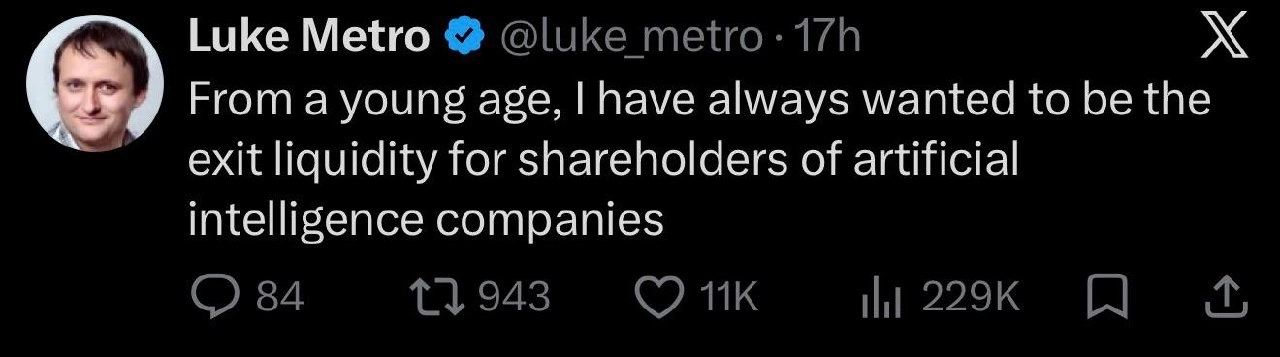
The artifact is a dark-mode X post from Luke Metro (@luke_metro, verified, posted 17h before the screenshot; 943 retweets, 11K likes, 229K views):

From a young age, I have always wanted to be the exit liquidity for shareholders of artificial intelligence companies

The engine is the "from a young age, I have always dreamed of..." template — the cadence of a college admissions essay or an astronaut's memoir — welded to the single most undignified role in market microstructure. "Exit liquidity" is trading slang with a precise meaning: for an early shareholder to sell at the top, someone must buy at the top. That buyer provides the liquidity for the exit. They are not a participant in the upside; they are the upside's off-ramp. Crypto culture minted the phrase ("you're not early, you're exit liquidity"), and this post ports it to the AI capital cycle: foundation-model startups raising at extreme revenue multiples, secondaries letting employees and VCs de-risk pre-IPO, retail finally invited in exactly when insiders want out. The venture model is built around the exit — IPO or acquisition is the success condition — which means someone structurally must hold the bag, and it is reliably whoever bought access last and latest.

The aspiration framing is what elevates it from finance grumbling to craft. Declaring bagholding a childhood dream does two things: it satirizes the inevitability (you'll be exit liquidity whether you dream it or not — via your index fund, your 401(k), your employer's equity comp), and it parodies the sincere LinkedIn-brained vocational destiny posts that the AI gold rush produces daily ("I've always been passionate about transforming enterprise workflows"). There's also a darker resonance for the developer audience sharing it: engineers are double-exposed, holding equity in AI companies while their own labor market gets repriced by the very products those valuations rest on. Whether this proves to be the bubble-top tweet or just hype-cycle gallows humor is the part nobody can know from inside the chart — which is precisely why the deadpan works. Every bubble's participants joked about the bubble; the jokes age into either prophecy or pessimism, and the meme commits to neither.

Description

A dark-mode X (Twitter) screenshot. Luke Metro (verified, @luke_metro, posted 17h ago) writes: 'From a young age, I have always wanted to be the exit liquidity for shareholders of artificial intelligence companies.' Engagement shows 84 replies, 943 retweets, 11K likes, 229K views. The deadpan 'childhood dream' framing skewers the AI investment frenzy: retail investors and late-stage buyers piling into AI IPOs and secondaries are, in trading parlance, the 'exit liquidity' that lets early shareholders and VCs cash out at peak hype before valuations correct

Comments

1
Anonymous ★ Top Pick The AI gold rush business model, clarified: the model weights are open, the losses are distributed, and the exit is the only thing that scales
  1. Anonymous ★ Top Pick

    The AI gold rush business model, clarified: the model weights are open, the losses are distributed, and the exit is the only thing that scales

Use J and K for navigation