Code Comments: For Clarity vs. For Absolution
Why is this CodeQuality meme funny?
Level 1: Cleanup vs Coverup
Imagine two kids told to clean up a messy room. The first kid actually tidies everything: he puts toys back on the shelf and books in the drawer, maybe even labels the boxes so everyone knows what’s inside. The second kid, on the other hand, looks at the mess he made and decides not to clean at all – instead, he writes a note that says, “I made this mess because I was busy with something else. I’ll fix it later, promise!” and sticks that note on the door. One child solved the problem (and even helped others understand the new order of things), while the other child just gave a reason for why the mess is still there. It’s funny because the second kid acts proud of his note, as if that’s just as good as actually cleaning up – but of course, it isn’t. One is fixing and explaining, the other is just excusing. They are not the same.
Level 2: Explaining vs Excusing
Let’s break down the joke in simpler terms. In programming, code comments are text notes you put in your source code that the computer ignores when running the program. They’re there only for humans to read – usually to clarify what the code is doing or why something was done a certain way. For example, if you wrote a really tricky algorithm or some complex logic, you might add a comment like // Using a special formula here to handle edge cases to help the next person (or your future self) understand it. That’s the first part of the meme: “You write comments to explain complex code.” It describes a developer who is using comments in the traditional, helpful way – to make a complicated piece of code more understandable. This is generally considered good practice when the code itself can’t be easily simplified or when the reasoning isn’t obvious just from reading it.
Now, the second part: “I write comments to justify the use of anti-patterns.” Here’s what that means. An anti-pattern is basically a fancy term for a bad solution or a poor coding practice that people recognize as problematic. It’s the opposite of a design pattern (which is a recommended, proven solution). Think of an anti-pattern as a common mistake or a “how not to do it” example in software design. For instance, a classic anti-pattern is copy-pasting code everywhere instead of creating a reusable function – it might work at first, but it makes things hard to update and debug later. Another would be using one giant “God object” that tries to do everything, instead of splitting the tasks into smaller, focused modules. Seasoned developers consider these approaches code smells (signs that something is off in the code’s design). Ideally, when you spot a code smell, you should fix it by refactoring (rewriting the code in a cleaner way).
However, fixing things properly isn’t always easy or fast – maybe there’s a looming deadline or the code is so fragile that touching it could break something else. This is where the concept of technical debt comes in. Technical debt means you’ve taken a shortcut or implemented a quick-and-dirty solution now, knowing that you’ll have to pay the price later by cleaning it up. It’s like skipping your chores today and having twice as much to do tomorrow. Writing a comment to justify an anti-pattern is basically like leaving an IOU note attached to the messy code: “I know this code isn’t great, but I had a reason to write it that way, and I (or someone) will fix it in the future.”
So the meme’s second developer isn’t using comments to explain a hard-to-understand but well-intentioned piece of code. Instead, he’s using comments as a defense, essentially saying, “Yes, I did something against the recommended rules, but let me explain why.” For example, in real life you might see a comment like:
# NOTE: Using a global variable here to avoid a bigger refactor.
# (I know global variables are bad, but there’s a deadline.)
This person is excusing a known bad practice (using a global variable) by documenting their reasoning. They’re not exactly proud of the messy code, but they’re hoping that having a justification written down will make it more acceptable. It’s like they’re preemptively arguing with any future maintainer who might stumble upon that code. Instead of cleaning up the “mess,” they carefully explain why the mess was made.
Finally, the bottom caption, “WE ARE NOT THE SAME,” drives home the contrast as a punchline. It’s a popular meme catchphrase used to compare two behaviors or mindsets in a cheeky way. Here, it highlights the difference between two programmer attitudes:
- Developer A writes comments to help others understand complex but well-crafted code.
- Developer B writes comments to rationalize or defend bad code (shortcuts and anti-patterns) so that it sounds justified.
It’s funny to people who write code because both kinds of commenting happen in real projects, and the second kind is a bit backwards. Normally, if code is bad, you’re supposed to improve it, not just explain it away. Relying on a comment to justify a poor decision is like saying, “I broke the rules, but it’s okay because I left a note.” It’s using documentation in a sneaky way – not to illuminate the code, but to excuse its flaws. Seeing someone almost brag about that is the tongue-in-cheek humor here. In plain terms: one developer uses comments to make tough code clearer, the other uses comments to make bad code sound better. We are not the same.
Level 3: Comment-Driven Development
In the real world of software projects, experienced developers have seen this pattern play out countless times. Instead of refactoring a messy solution or addressing a code smell, someone will leave a verbose comment rationalizing why the code is the way it is. It’s essentially comment-driven development – using a comment as a shield to deflect criticism from an obvious anti-pattern. The meme captures this with its two voices: one developer diligently writes comments to explain legitimately complex code, while the other proudly proclaims, “I write comments to justify the use of anti-patterns.” The suited man confidently adjusting his tie in the image exudes a smug pride, as if to say: “Yes, I implemented a questionable solution, but look, I wrote a thorough note to defend it. I’m not like those other devs.” It’s a tongue-in-cheek take on developer culture and the bravado of bending rules.
If you’ve ever inherited a legacy codebase, you’ve likely encountered sections that read like a diary of technical debt. For example, imagine opening a source file and finding at the top:
// HACK: Using a global cache here as a quick fix due to deadline pressure.
// TODO: Replace with proper dependency injection in future release (if we ever get to it).
window.__cache = {}; // Anti-pattern in action: global state as a singleton
Coming across this, a seasoned engineer will smirk and sigh at the same time. The comment basically says, “We know this is bad, but we did it anyway.” It acknowledges the poor practice (global state, in this case) and even promises to make it right later. But as any battle-scarred developer knows, “later” can turn into “never.” That TODO might as well be writing on the wall of a forgotten cave. The code runs, the comment justifies it, and life moves on... until an on-call pager goes off at 3 AM because the “quick fix” wasn’t so quick to crumble.
This scenario is funny to those of us with experience because it’s so real. We’ve all sat in code reviews or stand-up meetings where someone admits, “I know this approach violates best practices, but we’re short on time – I left a comment explaining it.” It’s practically a rite of passage in teams dealing with crunch deadlines and ever-shifting requirements. Over time, entire systems accrue these little comment excuses, each one a sticky note over a growing crack in the foundation. The meme exaggerates the attitude: the second developer doesn’t just quietly confess the hack; he brags about his anti-pattern defense strategy as if it’s a mark of sophistication. It’s the same energy as saying, “I don’t always write bad code, but when I do, I document the heck out of it – we are not the same.”
Within engineering circles, this touches on an ongoing debate (the "developer comment wars," if you will): Should code be self-explanatory, or is it acceptable to lean on comments as crutches? One camp strives for clear, well-structured code where comments are minimal and strictly used for clarification. The other camp… well, they might crank out a tangled implementation and slap on a comment explaining why it had to be that way. The meme takes a jab at the latter approach. It highlights an uncomfortable truth: writing a detailed justification in the comments is often easier than addressing the root cause. Why spend an extra day untangling some spaghetti code logic when you can add a paragraph of explanation and call it a day? From an architecture standpoint, it’s misguided – you’re supposed to fix the anti-pattern, not just write a manual for it inline. But from a boots-on-the-ground standpoint, we all know the pressures that lead to this behavior (brutal deadlines, legacy systems that might collapse if you touch them, management prioritizing new features over refactoring).
The humor hits home because it’s both absurd and relatable. The idea that two developers might both take pride in their comments, yet for utterly opposite reasons, is a perfect punchline for anyone who’s been in the trenches of a gnarly codebase. It’s a nod of commiseration among senior devs: we grin because we’ve been there, and we groan because we know CodeQuality shouldn’t be treated this way. In the end, the meme’s message resonates as a sarcastic caution: don’t be the one in the blue suit proudly defending a bad practice with fancy words – it’s better to fix the code than to pen the wittiest excuse.
Level 4: Deodorant for Code Smells
Software architecture literature draws a clear line between elegant design patterns and their evil twins, anti-patterns. A design pattern (popularized by the Gang of Four’s 1994 book) is a proven, reusable solution to a common problem – think of the Strategy or Observer patterns that cleanly separate concerns. In contrast, an anti-pattern is a notorious cul-de-sac solution that seems handy at first but leads to technical dead-ends. Classic examples include the Singleton obsession (overusing global state under a respectable name) or the infamous Big Ball of Mud architecture (where a system’s structure degenerates into a tangled mess). These patterns-gone-wrong come with tell-tale code smells – symptoms in the code (like dangerously long functions, duplicated logic, or mysterious side effects) that signal deeper design problems. The term code smell itself was popularized by Kent Beck and Martin Fowler as a sniff test for code quality issues that likely need refactoring.
Enter the concept of technical debt, coined by Ward Cunningham as a metaphor in the early 1990s. This “debt” accrues when developers choose an expedient but sub-optimal solution (often an anti-pattern) to meet immediate goals, planning to “pay it back with interest” by fixing it later. In theory, prudent engineers try to minimize such debt: ideally, refactor away the anti-pattern or avoid introducing it in the first place. There’s a classic maxim in clean coding circles:
“Don’t comment bad code – rewrite it.”
In other words, if a section of code is confusing or flawed, you should improve the code itself rather than paste an explanatory bandage over it. Comments in source code are meant for documentation, but using them to excuse poor choices is like spraying air freshener in a moldy room – it might mask the stink briefly, but the rot remains underneath. In fact, seasoned reviewers view excessive justifications in comments as a red flag: the more a snippet is defended in prose, the more you suspect it violates fundamental architecture or SOLID principles.
Interestingly, research and tooling have evolved to sniff out these apology-laden notes. Static analysis tools and code searches look for comments containing TODO, FIXME, or even cheeky markers like HACK. Each is the developer’s equivalent of a sticky note saying, “We know this is bad, but…” – essentially a confession of a code smell or technical debt item. Such a comment is a deodorant for code smells: it attempts to cover the odor of an ugly hack without actually cleaning it up. The humor in the meme arises from this very disconnect. A developer who writes “I know this is an anti-pattern, but here’s why I did it…” is openly acknowledging the rules of good design, only to flaunt them. It’s a paradox of software maintenance – knowing the right pattern yet choosing the wrong one, and believing a detailed comment will make it palatable. The meme’s bold punchline “I write comments to justify the use of anti-patterns” is a tongue-in-cheek denunciation of this practice. It exaggerates the stance that a sufficiently wordy comment can absolve a coding sin – a notion no serious DesignPatterns textbook would endorse, yet one that plays out in real codebases all the time.
Description
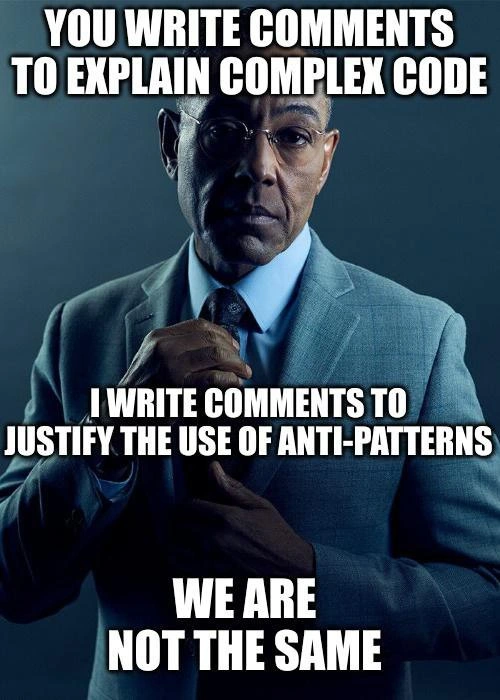
This meme utilizes the popular 'We Are Not the Same' format, which features a stern, well-dressed Giancarlo Esposito as the character Gus Fring from the 'Breaking Bad' series. The image is split into three parts with large, white, impactful text. The top text reads, 'YOU WRITE COMMENTS TO EXPLAIN COMPLEX CODE'. The middle text contrasts this with, 'I WRITE COMMENTS TO JUSTIFY THE USE OF ANTI-PATTERNS'. The punchline at the bottom declares, 'WE ARE NOT THE SAME'. The humor is rooted in the stark difference between two developer mindsets. The first is the idealistic, by-the-book developer who uses comments to aid understanding, adhering to clean code principles. The second represents the battle-hardened, pragmatic senior developer who has been forced by deadlines, legacy systems, or other constraints to implement a solution they know is flawed (an anti-pattern) and uses comments as a form of self-defense or a warning to future developers. It's a cynical but highly relatable take on the realities of software development

Comments
14Comment deleted
Some comments are for future developers. My comments are for my future self during the post-mortem, serving as a formal apology to the SRE team and a justification for my continued employment
My favorite design pattern is the comment that begins, “Due to business constraints…”, instantly upgrading any God Object into a strategic monolith
The best code comments are the ones that start with "Yes, I know this violates SOLID principles, but the deadline was yesterday and the PM promised the client we'd have real-time updates without mentioning we're still on a shared hosting plan from 2009."
The difference between a senior engineer and a principal engineer: one writes comments explaining *why* the code is complex, the other writes comments explaining why the anti-pattern was the *least worst* option given the constraints of a legacy monolith, tight deadlines, and that one critical dependency that hasn't been updated since 2014. Both know the code smells - only one has accepted that sometimes you're just documenting the crime scene for the next archaeologist
My comments aren’t documentation; they’re plea bargains with future me for why we shipped a global Service Locator wrapped in a Singleton
Comments: because deleting spaghetti code would be admitting defeat
When your ADR is just // eslint-disable-next-line legacy_global_required_for_deadline, you didn't document intent - you minted a permanent waiver and called it architecture
I write comments to commit same code Comment deleted
You can --allow-empty though Comment deleted
i write comments to good memes Comment deleted
I write comments to remember wtf I've written the other day Comment deleted
i write comments so my coworkers wont die from depression Comment deleted
complex code kinda is antipattern Comment deleted
idk, sometimes the code has to be complex Comment deleted