Rickroll Masterclass: Phishing Awareness Training the Developer Community Actually Paid Attention To
Why is this Security meme funny?
Level 1: Funny Trick, Real Lesson
Imagine your friend loves to play little pranks on you. One day, they hand you a chocolate box saying, “Here’s a treat!” But when you open it, pop! – a silly springy snake jumps out instead of candy. You both laugh (maybe you roll your eyes), but guess what? Next time that friend says “Hey, open this box,” you’re going to be a bit more careful, right? You might peek first to make sure it’s not another joke. You learned to be cautious in a fun way.
That’s exactly what happened with this Rickrolling joke. People on the internet kept sharing a link that looked interesting, but it was actually a surprise music video from the 1980s. It became a big funny gotcha! moment in the online world. After falling for the trick once or twice, everyone started checking links twice before clicking them – just like you’d check a box from your prankster friend. A formal lesson or class telling you “be careful with links from strangers” might be easy to forget. But a funny trick that actually happens to you is a real lesson you remember. In the end, that goofy Rick Astley video taught a lot of us to think before we click, in a way that was far more memorable (and entertaining) than any boring class on internet safety.
Level 2: Check Before You Click
At its core, this meme is contrasting a fun internet prank with serious cybersecurity lessons. Let’s break down the pieces. Rickrolling is an old-school internet joke: someone sends you a link that you think will be something interesting or important, but instead it opens the music video for Rick Astley’s 1987 song “Never Gonna Give You Up.” It’s a harmless prank – you’re expecting, say, a programming tutorial or a funny cat GIF, but you get a retro pop song surprise instead. If you’ve ever seen that meme where suddenly a video of a red-headed 80s singer starts dancing and singing, you’ve been “rickrolled.”
Now, on the other side, we have phishing and security awareness training. Phishing is a technique bad guys use to trick people into clicking bad links or giving away passwords. For example, you might get an email that looks like it’s from your bank, asking you to click a link to “verify your account,” but the link actually goes to a fake site that steals your login info. Companies consider phishing a big threat, so they make employees take security awareness classes. These classes (or online modules) basically teach you how to not get tricked – they say things like “Don’t click on suspicious links or unexpected attachments,” “Always check the sender’s email address,” and “Hover over a link to see where it really goes before you click.” They might even run fake phishing tests by sending out dummy emails to see if you’ll click a sketchy link. It’s all to train you to be careful on the internet, especially with things like random links.
The funny claim in the meme is that Rickrolling taught developers caution better than those official classes did. Why would that be? Think about the developer community and meme culture: devs are often sharing links and jokes on platforms like Reddit, Stack Overflow, Slack, or Discord. Rickrolling became an inside joke among tech folks. If you were the newbie in a chat room and someone said “Oh, you have to check out this amazing debugging trick, here’s the link,” chances are someone might slip in the Astley video to playfully tease you. After falling for that once or twice – getting the “Gotcha!” moment with Rick Astley singing – you start becoming wary of unexpected links. It’s not that Rick’s video is harmful; it’s just embarrassing (and then humorous) to be fooled. No one likes to be the person who loudly says “Guys, check out this link!” and then it’s the Rickroll and everyone laughs. So, developers naturally began to check before they click anything that looked a little off or came without much context. They might hover their mouse over the hyperlink to see the actual URL, or notice if the link uses a weird short URL (like bit.ly/xyz) and maybe think twice. In effect, this prank trained people to have a healthy skepticism of links.
Meanwhile, those cybersecurity classes are trying to teach the exact same habit! Every security training or phishing awareness slideshow says, “Don’t trust links, even if they seem friendly. Verify first.” But let’s be honest: many developers find those official trainings boring or easy to ignore. You might just click through the slides quickly or pass the end-of-lesson quiz without truly changing your behavior. The Rickroll, however, was memorable. It’s part of InternetCulture – people joked about it so much that it kind of stuck in your brain. In fact, in many dev teams, if someone posts a link, you’ll often see a half-joking warning like, “This isn’t a Rickroll, I promise,” because being cautious about links became second nature.
The meme uses this cultural reference to make a point: sometimes a funny meme can be a more effective teacher than a formal lesson. The “Phishing Awareness Training the developer community actually paid attention to” (as the title says) was not a stuffy classroom or an online course, but an organic prank that spread peer-to-peer. Social engineering (tricking people as a hacker would) was demonstrated by friends as a joke, and developers ended up learning from each other. It highlights a gap in cybersecurity education: you can give people rules, but often real experiences (even silly ones) stick better. After being tricked a few times, developers essentially developed a mild “link click phobia” – not an actual fear, but a habit of being extra careful – which is exactly what security experts want everyone to have.
So in simpler terms: Devs became more careful about clicking strange links thanks to a funny pop culture prank. They paid attention to Rick Astley popping up on their screen in a way they might not have paid attention to a dry security lecture. The meme humorously nods to this reality, making those in tech chuckle and say, “It’s true – getting rickrolled taught me my lesson!”
Level 3: Click at Your Own Rick
If you’ve been around developer circles long enough, you’ve probably been rickrolled at least once. You click an innocent-looking link a colleague shares – maybe claiming to show a cool new framework or a hilarious bug report – and suddenly you’re greeted by the upbeat 80s synth of Rick Astley’s “Never Gonna Give You Up.” The meme’s punchline here is that this goofy internet prank did more to ingrain safe browsing habits in engineers than any formal security awareness seminar ever managed. It’s a tongue-in-cheek nod to how internet culture can unintentionally school us in phishing defense.
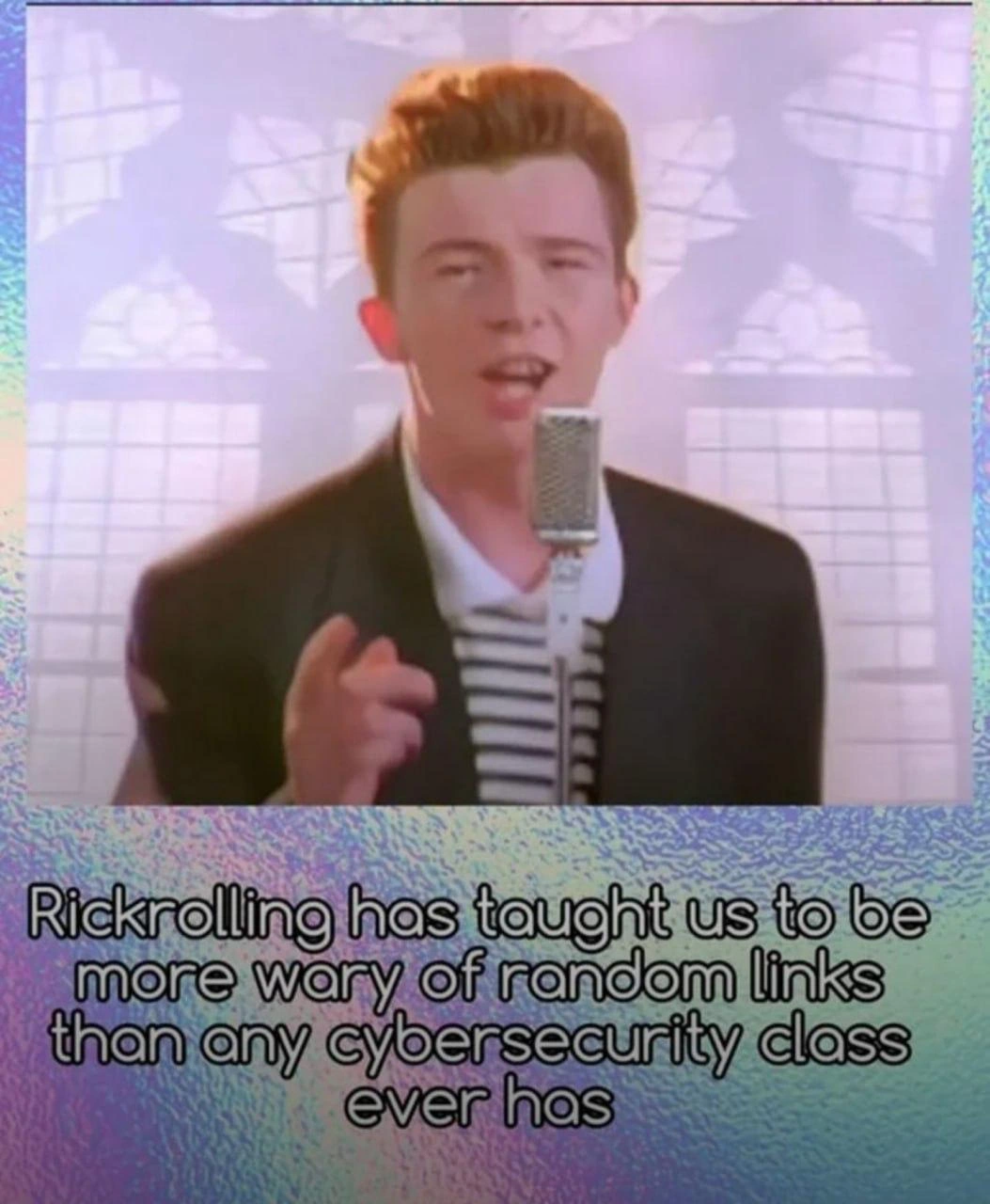
On a technical level, Rickrolling is a classic bait-and-switch: the link’s label or context promises one thing, but the actual target is an unexpected YouTube video (usually Rick Astley’s smiling face belting out lyrics). This is fundamentally the same tactic used in malicious phishing attacks and other social engineering exploits – only Rick’s intentions were far more benign (and musical!). Experienced developers see the parallel: whether it’s a prank or a real attack, the lesson is “don’t trust random links at face value.” The meme text – “Rickrolling has taught us to be more wary of random links than any cybersecurity class ever has” – resonates because half the battle in corporate security training is getting people to actually internalize habits like hovering to preview a URL or scrutinizing suspicious link domains. And guess what? After falling victim to a dozen surprise renditions of “Never Gonna Give You Up,” most of us learned to double-check links out of sheer self-preservation (and maybe a bit of pride).
From a senior developer’s perspective, it’s hilariously true. Companies spend thousands on formal Phishing Awareness Training, sending out fake phishing emails or making employees sit through annual InfoSec courses. But many coders will admit that the fear of getting rickrolled by their buddies in a Slack channel taught them to hover-check every hyperlink long before the IT department’s official training kicked in. It’s the difference between a dry lecture saying “be cautious with unknown URLs” and a visceral I-do-NOT-want-to-get-caught-again reaction you develop after your team laughs at you for falling for a disguised Rick Astley video for the third time. In developer communities, inside jokes often carry real wisdom. Here, the PopCulture prank of Rickrolling essentially became a grass-roots meme security training program. Seasoned engineers joke that Rick Astley was an unwitting cybersecurity instructor — he “never gave us up” until we learned our lesson.
To put it in perspective: the original Rickroll phenomenon (dating back to around 2007) was an InternetCulture sensation, essentially a friendly troll that spread through forums and chatrooms. Over years of repeated exposure, it conditioned a generation of web users to distrust unexpected links. It’s a bit of Pavlovian conditioning via meme: get burned (or rather, serenaded) a few times by surprise Astley, and you start treating every unsolicited URL with caution. In contrast, formal classes and PowerPoints about SocialEngineering and phishing often struggle to achieve that same gut-level wariness. The irony isn’t lost on anyone: a viral joke did what corporate policies couldn’t.
Developers even developed “immune responses” to Rickrolling. For instance, many learned to spot the telltale YouTube ID of the Rickroll video (dQw4w9WgXcQ) in a URL, or they’d use preview features and URL expanders to dodge the prank. Some would jokingly add code to their browsers or scripts:
RICKROLL_ID = "dQw4w9WgXcQ"
def open_link(url):
if RICKROLL_ID in url:
raise Exception("Rickroll detected! Never gonna click it!")
# ...otherwise, proceed normally
// A tongue-in-cheek safeguard: if a link points to Rick Astley, we bail out.
Of course, this is just for laughs – but it shows how deeply the lesson sank in. The meme strikes a chord with developers because it acknowledges a security education gap: traditional training can be forgettable, but a prank sticks with you. The next time an unfamiliar Bit.ly link or suspicious “must-see” video shows up, seasoned devs smirk and think, “Not today, phisher – and not today, Rick Astley.” In summary, Rickrolling turned out to be the phishing awareness training the dev community actually paid attention to, forging cautious clicking habits through shared laughter and a bit of embarrassment.
Description
The meme shows a still frame from the famous 1980s music video often used for “rickrolling.” The singer’s face is intentionally blurred for anonymity, but the retro microphone, striped shirt, and back-lit stained-glass windows are clearly visible. Below the image, bold black text on a pastel, oily-iridescent background reads: “Rickrolling has taught us to be more wary of random links than any cybersecurity class ever has.” The visual joke contrasts a light-hearted internet prank with the serious discipline of infosec, highlighting how repeated unexpected YouTube redirects conditioned seasoned engineers to hover-preview every URL long before formal phishing-simulation platforms existed
Comments
19Comment deleted
If compliance swapped the yearly 45-minute CBT for one disguised Rick Astley link, we’d hit zero-click phishing faster than you can say “never gonna give you up.”
After 15 years in tech, I've seen million-dollar security awareness programs fail where a simple Rick Astley video succeeded - turns out the best penetration testing is when users actually remember to check URLs because they're terrified of hearing that drum intro at full volume during a screen share
Rickrolling inadvertently became the most effective zero-cost security awareness training program in history - teaching an entire generation to hover over links, inspect URLs, and maintain a healthy paranoia about shortened links. No SANS course, no expensive security certification, just Rick Astley's dulcet tones conditioning us to treat every suspicious link like a potential XSS payload. The irony? A 1987 pop song did more for phishing prevention than decades of corporate security training videos. Now every engineer instinctively checks for 'dQw4w9WgXcQ' in YouTube URLs before clicking, a Pavlovian response that's probably prevented more credential theft than two-factor authentication
Rickrolls turned me into a human IDS: hover‑inspect every a[href], URL‑decode the bit.ly chain with curl -I, then maybe click
Rickrolling: the zero-day social engineering exploit that patched more clickbait vulns than a decade of phishing sims
Zero‑trust in our org started the day every “design doc” link resolved to dQw4w9WgXcQ - now we hover to inspect the href and curl -I the redirect chain before clicking
XcQ Comment deleted
Here should be a link with a research that proves this statement Comment deleted
here's a really good study on it: https://arxiv.org/abs/2204.06826 Comment deleted
Telegram spoils it :( Comment deleted
i tried my best 🥲 Comment deleted
you need redirect link Comment deleted
the joke writes itself Comment deleted
oh yeah, I wrote a blog post on that actually: https://riedler.wien/!/Blog/20240328/ Comment deleted
This girl is hot 🥵 Just look! Comment deleted
We're no strangers to love Comment deleted
You know the rules, and so do I Comment deleted
Jokes on you, I actually click every link hoping to get rickrolled because the song is fire Comment deleted
🔥 Comment deleted