Skip to content
DevMeme
6239 of 7435
ML lecture secretly turns students into unpaid RLHF labelers via “Battle Mode”
AI ML Post #6841, on Jun 3, 2025 in TG

ML lecture secretly turns students into unpaid RLHF labelers via “Battle Mode”

Why is this AI ML meme funny?

Level 1: Candy-Coated Chores

Imagine your teacher says, “Let’s play a game: we’ll have a race to see who can clean up the classroom the fastest! Ready, set, go!” All the kids start playing, rushing to pick up books and papers, excited to win the game. In the end, the classroom is tidy. The teacher is happy because the cleaning got done, and the kids feel like they just had fun. But what really happened? The teacher cleverly turned a boring chore into a game so that the students would do the work without realizing it was work.

That’s exactly what’s going on in this meme, but with college students and an AI program. The students were told to try out a cool “Battle Mode” where two answers from a computer compete, and they choose the better one. It sounded like a fun challenge, like a little contest. They’re doing it, thinking it’s just a neat way to learn about AI. But in reality, they’re helping the company by providing free feedback on the AI’s answers – basically doing the AI’s homework for it. The students are laughing and crying (in the text message, they used crying emojis) because they realized they were tricked a bit, just like the kids who thought cleaning was a race. It’s funny because it’s a cheeky trick: make something boring seem fun, so people do it happily. The meme is pointing out this sneaky move in a simple way: call work a “game” and people will do your work for free! Here, the “game” was picking the best AI answer, and the prize was just the feeling of playing – no actual reward, except maybe learning a lesson about how clever (or sneaky) the tech world can be.

Level 2: Learning vs Labeling

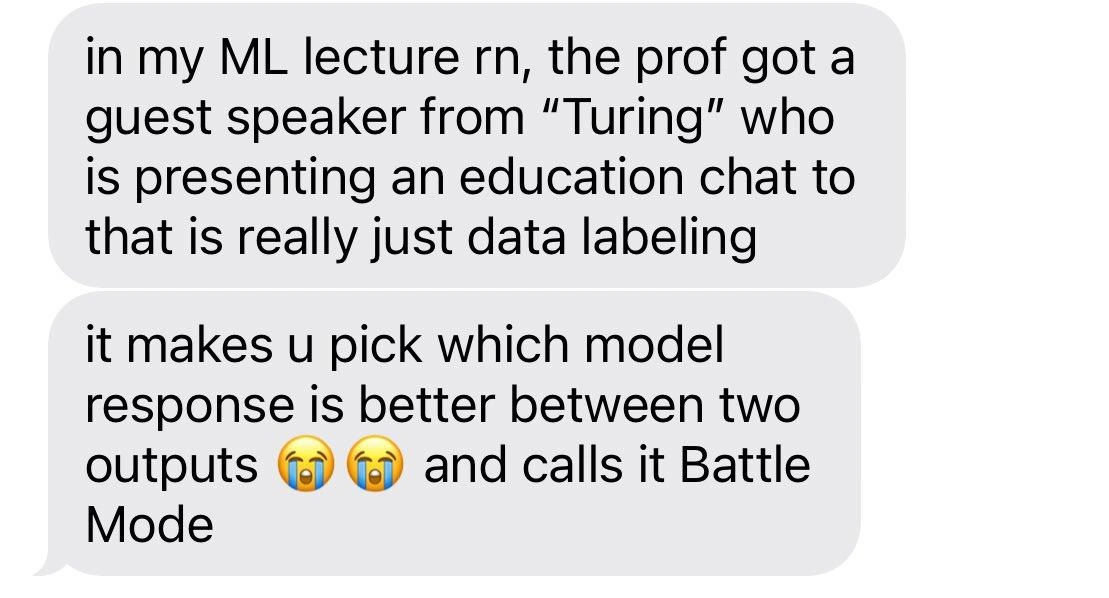
Let’s break down what’s happening in this meme in plain terms. A student in a machine learning class is texting that their professor brought in a guest speaker from a company (called “Turing”) to show an educational chat tool. This tool has a feature dubbed “Battle Mode.” In this mode, the students are shown two answers from an AI for the same question, and they have to pick which answer is better. The student quickly realizes: wait a minute, this isn’t just a fun quiz – it’s basically data labeling work. In other words, the company is having the class act like human reviewers, deciding which AI response is good and which isn’t. And they’re doing it for free, under the pretense of a cool demo. The student is half-laughing and half-crying about this (hence the 😭 emojis) because it’s a sneaky move.

Now, what is data labeling and why does it matter? In Machine Learning, especially with things like chatbots or LLMs (Large Language Models), humans need to teach the AI what a “good” answer looks like. One common way to do this is by preference labeling: you give the AI some question or prompt, have it produce two different answers, and then a person selects which answer is better. That choice is a valuable label. It tells the AI, “Answer A was preferred over Answer B for this question.” Imagine training a dog with treats – except here the “treat” is telling the AI which answer was the good one. After collecting a bunch of these comparisons, the AI model can be tuned (through a process called Reinforcement Learning from Human Feedback (RLHF)) to prefer the kind of answers people like more. In simpler terms, the AI updates itself so that next time, it tries to produce answers closer to those that humans gave a thumbs-up.

Why would an AI company want college students to do this? Because getting these preference labels is super important but usually costs time and money. Companies often hire annotators or use crowd-sourcing platforms (like Amazon’s Mechanical Turk) to gather thousands of judgments on AI outputs. Here, the company “Turing” found a clever shortcut: turn it into a classroom exercise. The students get to “learn about AI” by playing around with the chatbot and comparing answers, and the company quietly collects tons of feedback data. It’s presented as a win-win: students see cool tech in action, and the AI gets better from their input. But the cheeky part (and why it’s a joke) is that the students are essentially acting like unpaid labellers. It’s as if a teacher gave a “fun assignment” that just so happens to help a company improve its product.

The term “Battle Mode” is pure marketing sugar-coating. By calling it a battle, they frame it like a game – two answers enter, one answer leaves victorious! That makes it sound engaging, like the students are contestants or judges in a game show. If they called it “Rating Mode” or “Comparison Task,” let’s be honest, it would sound boring and the students might realize they’re doing grunt work. So instead, it’s branded as an exciting feature. The meme points out the silliness of this: beneath the flashy name, the task is the same old routine of telling an AI which answer is better.

For someone new to these concepts, here’s why this is significant: In the AI/ML (Artificial Intelligence/Machine Learning) industry, improving an AI’s responses often requires lots of human examples of what’s good or bad. This meme is highlighting a trend (with humor) where companies try creative ways to get those examples. Sometimes they make apps where users give feedback for fun, or they integrate the process into learning tools, like here. It’s funny in a kind of “I see what you did there” way. The student’s reaction (“😭😭”) shows they feel a bit used but can’t help but laugh at how brazen it is. They went to a lecture to learn, and suddenly they became volunteer data workers.

In summary, at this level: the meme is about a class of students unknowingly doing a job that helps train an AI. The company dressed up the job as a “Battle Mode” game in an educational chat app. The student who texted about it is amused and exasperated, realizing they’re effectively unpaid helpers for the AI. This resonates in the tech world because it’s a peek behind the curtain – showing how sometimes the Learning experience for people is conveniently combined with gathering Data needed for AI. It’s both an educational tool and a bit of an exploitation tool, and that contrast is the punchline of the joke.

Level 3: Gamified Gruntwork

What makes this meme hilariously on point for seasoned developers and data scientists is the blatant repackaging of tedious data labeling work as a shiny “educational” feature. The student texting from class has basically pulled back the curtain: “the prof invited a guest from ‘Turing’ who showed us an ‘education chat tool’ that is really just data labeling... it makes you pick which model response is better between two outputs 😭😭 and calls it Battle Mode.” If you’ve been around the AI block a few times, you can practically hear the collective groan-laughter. We recognize this pattern immediately: when someone gives a fancy name to a boring (but necessary) task to make it sound exciting. Battle Mode – because calling it “Please Help Us Rank These Responses Mode” wouldn’t fly on a PowerPoint slide.

From the senior perspective, this scenario is rich with industry satire. In the world of AIIndustryTrends, companies are desperate for high-quality labeled data to train and refine their models. Especially for conversational AI and LLM fine-tuning, one of the bottlenecks is getting lots of human feedback (that RLHF we explained above). It’s expensive and slow to pay professionals for preference labelling, so why not kill two birds with one stone: turn it into a “learning opportunity” for students! Here, the guest speaker basically tapped into a free labor force by marketing the drudgery as a cool classroom activity. It’s a classic example of battle_mode_marketing – slap a edgy name and some gamification on the task, and suddenly it feels like a fun challenge rather than unpaid work. The meme nails this with the absurdity of calling a simple A/B comparison a “Battle.” You can almost imagine the UI with fiery versus graphics: Model A vs. Model B – FIGHT! 🥊. But behind that spectacle, every student click is an unpaid data annotation feeding the company’s AI model.

The humor has a bit of a dark edge because it’s too real. There’s a long tradition of tech companies disguising work as play. Remember those CAPTCHAs that ask you to identify street signs or storefronts? While you proved you’re not a robot, you were also meticulously labeling images to help train self-driving car vision systems. (Congrats, you were an unpaid intern for Google’s AI, one stoplight at a time!). Or consider those “image labeling games” from the early days of Data ScienceHumor: people would tag images or transcribe snippets of text in what felt like a game or community contribution. This meme is the MachineLearning version: edu_tech_exploitation 101. The students think they’re participating in a fun new learning tool called an “education chat,” but in reality they have been recruited into a mini Mechanical Turk assembly line. The two crying emojis the student uses perfectly capture the mood: it’s the crying-with-laughter mixed with please-someone-save-me face. We’re laughing because we’ve seen this trick before, and we’re crying (inside) because it keeps happening.

Real-world scenarios in tech echo this: beta testers for apps effectively doing free QA, “gamified” apps that crowdsource translations or OCR, and hackathon participants generating ideas and prototypes that companies might profit from – all under the banner of “learning and community.” In this case, the professor either knowingly or unwittingly allowed a company rep to turn the lecture hall into a cheap data factory. A senior dev or researcher can’t help but smirk at the audacity. It’s AIHumor with a bite: on one hand, students get a hands-on demo of how AI models are evaluated; on the other, the company gets a pile of labeled comparisons without cutting a single check. The phrase “Battle Mode” itself is a comedic masterstroke of marketing – conjuring images of epic duels – when in fact it’s as mundane as asking “Which of these two paragraphs looks better to you?”. The meme hits home because it spotlights the gap between the LearningCurve idealism and industry reality: Sure, you’re learning… but the house always wins (and by house, we mean the company training their model on your responses).

To illustrate how simple this “Battle” really is, here’s essentially what’s happening behind the scenes in code form:

# Pseudo-code for the "Battle Mode" data labeling process
prompt = "Explain the law of thermodynamics in simple terms."
answer_A = model_version_1.generate(prompt)
answer_B = model_version_2.generate(prompt)

# Display two model outputs to the user (student)
print("Model A says:\n", answer_A)
print("Model B says:\n", answer_B)

# Student picks which answer is better
user_choice = select_preferred(answer_A, answer_B)  # e.g. returns "A" or "B"

# Record the preference for training data
preferences_dataset.append((prompt, answer_A, answer_B, user_choice))

Battle Mode, as epic as it sounds, is basically this: present two answers and ask “Which one do you like more?” The code above is a simplified peek – two model versions answer the same question, a student chooses the preferred response, and that choice gets logged. That’s it. The grand AI duel is just a fancy UI on top of a select_preferred() function. And each recorded choice in preferences_dataset becomes one more training example to refine the model later. Think of the students as gladiator judges in an arena where the gladiators are AI responses – but the judges are the ones doing the work so the emperor’s champion (the AI) can be crowned later.

In a veteran engineer’s cynic tone: “Battle Mode? More like Intern Mode.” This meme resonates because it exposes how something high-minded (an education chat tool) can double as a low-key data grab. It’s equal parts funny and eyebrow-raising. The next time someone comes to a university class touting a “fun new interactive learning platform,” the savvy students will be asking: Are we learning, or labeling? At least throw in some pizza or extra credit if you’re going to have the class do your AI’s homework!

Level 4: The RLHF Ruse

Under the hood, this “Battle Mode” classroom demo is a textbook example of Reinforcement Learning from Human Feedback (RLHF) in action. In RLHF, a Large Language Model (LLM) (think of the brains behind a chatbot) is fine-tuned by using human preferences as a learning signal. Here’s how it works at a theoretical level: the model generates two different answers to the same prompt, and a human evaluator (in this case, unsuspecting students) chooses which answer is better. Formally, the AI system treats that choice as a reward signal – the preferred answer is like the “winning move” in a game. The model then adjusts its parameters to make outputs more like the chosen one in the future. Essentially, the human is defining an implicit reward function: “answer A is better than answer B” becomes data the AI uses to learn how to please human judges.

Why do we need this? Modern AI models are trained on huge amounts of text and learn to imitate language patterns, but they don’t innately know what we consider a good answer versus a bad one. The base training objective (predicting the next word) can produce correct sentences that are irrelevant or oddly phrased. RLHF fixes that by introducing a second training phase: the model’s goal shifts to producing responses that humans prefer. In mathematical terms, if a human consistently ranks output A higher than output B, the training process tweaks the model so that the score ( r_\theta(A) ) from an internal reward model becomes higher than ( r_\theta(B) ). The reward model ( r_\theta ) itself is trained on many such human comparisons to predict a “preference score” for any given output. The AI then undergoes a reinforcement learning step (often using an algorithm like Proximal Policy Optimization) to maximize this learned reward. In plainer terms: the AI tries an answer, the human’s choice teaches it “this was good” or “that was bad,” and the AI updates itself to get more “good” feedback next time.

Collecting these preference labels is crucial but labor-intensive. High-quality preference data doesn’t fall from the sky – it usually comes from armies of paid annotators carefully comparing outputs. OpenAI’s famous GPT models, for example, were fine-tuned with thousands of such comparisons, where humans ranked outputs to align the AI with human values and expectations. The hilarious (and slightly devious) twist in this meme is how that data-gathering step is being accomplished. Rather than hiring a team of annotators, the guest lecturer’s company found a captive audience of ML students to do it for free, under the guise of an educational game. From a pure engineering standpoint, it’s clever: you turn a necessary RLHF data collection process into an interactive demo, tapping into student engagement to harvest labels. But it’s also a bit of a ruse – reframing grunt work as a fun challenge. It blurs the line between a learning exercise and a data annotation pipeline.

It’s worth noting the irony of the company name “Turing” here. Alan Turing famously proposed the Turing Test, where a human judge has to decide which conversational partner is the machine. In this “Battle Mode,” students are similarly judging AI outputs – not to tell if they’re human, but to say which machine response is better. The roles are flipped (the machine isn’t trying to fool them, it’s trying to improve from them), yet the students have essentially become Turing-testers for hire (except there’s no hiring, just volunteering!). This full-circle nod to AI history – using human judgment as the ultimate test – underpins the entire exercise. It’s a sophisticated feedback loop: human intuition gets fed into a training algorithm aiming to make the AI more aligned with human preferences. In theory, everyone wins – the students learn about AI evaluation, and the model gets smarter. But as we’ll see next, the humor (and cynicism) comes from how this theory meets reality in a classroom setting.

Description

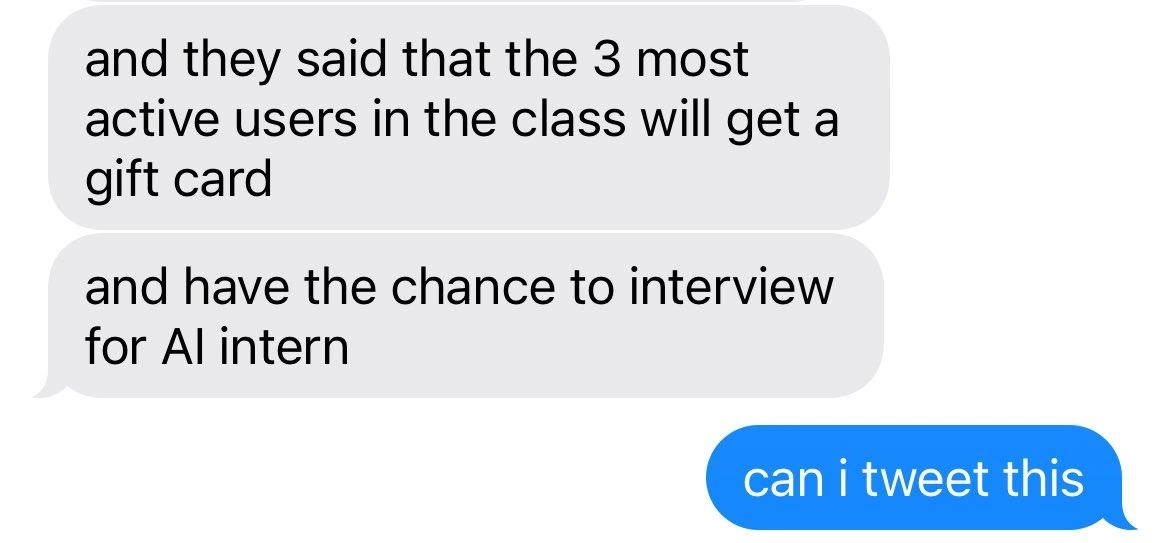
The image is a grey iMessage-style chat bubble containing two paragraphs of text. It reads: “in my ML lecture rn, the prof got a guest speaker from ‘Turing’ who is presenting an education chat to that is really just data labeling it makes u pick which model response is better between two outputs 😭😭 and calls it Battle Mode”. Two loudly-crying-face emojis follow the second sentence. Visually, the bubble has rounded corners and light grey background typical of iOS SMS, with black sans-serif text. Technically, the message calls out a guest lecture that rebrands reinforcement-learning-by-human-feedback (RLHF) preference labeling as an “educational chat”, effectively crowdsourcing model ranking from students under the flashy name “Battle Mode”. Experienced ML practitioners will recognise this as a common tactic to gather high-quality comparison data for fine-tuning large language models while disguising it as gamified learning

Comments

6
Anonymous ★ Top Pick Nothing like repackaging a comparison-ranking endpoint as a pedagogy hack - next semester they’ll call gradient descent "Hero’s Journey" and bill it as narrative design
  1. Anonymous ★ Top Pick

    Nothing like repackaging a comparison-ranking endpoint as a pedagogy hack - next semester they’ll call gradient descent "Hero’s Journey" and bill it as narrative design

  2. Anonymous

    Ah yes, 'Battle Mode' - where two LLMs enter, one leaves with slightly better RLHF scores, and the student leaves wondering why they're paying tuition to do Amazon Mechanical Turk's job. Next week's lecture: 'Interactive Learning Experience' where you debug production code for a Y Combinator startup

  3. Anonymous

    Ah yes, the classic 'educational tool' that's really just RLHF with extra steps. Nothing says 'learning experience' quite like being an unpaid data annotator for someone's production model training pipeline. At least when we used to grade each other's code in CS101, we weren't secretly fine-tuning a startup's Series B pitch deck. Props to Turing for discovering that college students are cheaper than Mechanical Turk - just wrap it in pedagogical theater and call it 'Battle Mode.' Next week's guest lecture: 'Interactive Cloud Architecture Exercise' (actually: debugging their Kubernetes cluster for free)

  4. Anonymous

    Rediscover Mechanical Turk: harvest Bradley-Terry pairs for your RLHF reward model, slap 'Battle Mode' on the UI, and call the free annotations 'student engagement'

  5. Anonymous

    Turing's 'Battle Mode': RLHF where students are the unwitting oracles, bootstrapping alignment faster than any paid Turk

  6. Anonymous

    Calling pairwise RLHF annotation “Battle Mode” is just Elo ratings for LLMs with a marketing layer - AKA turning your lecture into free reward-model training

Use J and K for navigation