Skip to content
DevMeme
6237 of 7435
2025 Forecast: Recycle Bin Evolves Into Microsoft Teams, According to Windows Meme Timeline
Microsoft Post #6839, on Jun 3, 2025 in TG

2025 Forecast: Recycle Bin Evolves Into Microsoft Teams, According to Windows Meme Timeline

Why is this Microsoft meme funny?

Level 1: When Help Becomes Hassle

Imagine you have a fancy new walkie-talkie that all your friends at school use to stay in touch about homework. Sounds useful, right? 😅 But now imagine this walkie-talkie beeps all the time. Every few minutes it’s someone asking a question, reminding you about a group project, or even just telling silly jokes. It even starts heating up and slowing down your other gadgets because it’s so busy. You can’t focus on your actual homework because this thing keeps demanding your attention. Pretty soon, you’d get annoyed and might joke, “Ugh, this walkie-talkie is garbage! I just want to throw it in the trash can so I can get some peace.”

That’s exactly the feeling this meme is poking fun at. Microsoft Teams was supposed to be a helpful tool so people working on computers can talk and work together, especially when they’re not in the same office. But when it constantly interrupts you and makes your computer tired, it starts to feel more like a nuisance than a help. The meme shows the little trash can picture on the computer turning into the Teams logo because a lot of folks feel like Microsoft Teams has basically become the “trash can” of their workday – where all the unwanted stuff (like extra messages and meetings that wear you out) seems to collect. It’s a funny way of saying “This thing that was meant to help us has gotten so annoying that we see it as junk!”

Level 2: The Purple Trashcan

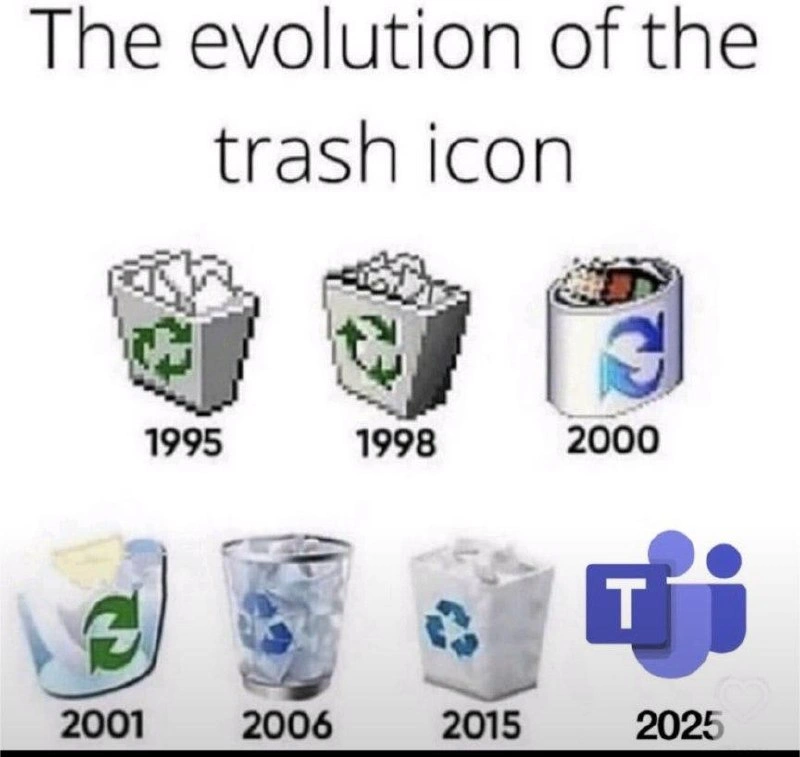
Let’s break down the joke in simpler terms. The Recycle Bin in Windows is the place you put files when you want to delete them – basically a trash can on your screen. Over the years, each version of Windows changed how that icon looks (usually to match the newer style of the system). For example, in 1995 the trash icon was pixelated and grey; by 2001 (Windows XP era) it looked more 3D and colorful; in 2006 (Windows Vista) it became a shiny transparent glass bin; in 2015 (Windows 10) it turned into a flatter, modern icon. These icons always clearly meant “trash/recycling.”

Now, Microsoft Teams is a completely different thing – it’s a program for communication, like Slack or Zoom, that companies use for chat and video meetings. Its icon is purple with a T on it. People use Teams to send messages, share files, and hop on video calls, especially in office settings or when working from home. It’s a key part of modern CorporateCulture and RemoteWorkCulture – if you start a job at a big company today, there’s a good chance your team talks and meets on Teams every day.

The meme joke is that in “2025”, instead of another new trash can picture, the Teams logo is shown as the trash bin. In other words, it’s saying “Teams has become the new trash.” Why would anyone call Teams trash? Well, consider a few things many users (even younger devs) notice:

  • Too Many Pings and Meetings: Imagine you’re coding or focusing on a task, and ding! a Teams message pops up. Then another. Then someone schedules a meeting about something that could’ve been a message. A lot of people experience MeetingOverload on Teams – an endless chain of video calls and chats. It starts to feel like a time sink. When we say “communication overhead,” we mean you spend so much time communicating about work that it eats into the time to actually do the work. This can make Teams feel like a bucket where hours of productivity get tossed away.
  • Performance and Bloat: Teams can be slow or use a lot of your computer’s memory. It’s built on Electron, which basically means it’s running a mini web-browser behind the scenes for the user interface. That convenience comes at a cost: your laptop might get hot or laggy just because Teams is open. Ever notice how your laptop’s fan kicks on during a big group call? Yup, that’s Teams using resources. For a junior developer, it’s eye-opening when you see that a simple chat app can use hundreds of megabytes of RAM. It feels wasteful, like having a huge trash can that’s mostly empty but still taking up space.
  • Corporate Mandate: In many companies, you don’t get to choose the chat app – it’s decided by corporate IT. Microsoft Teams is often bundled with Office 365, so management says “we’ll use Teams for everything.” Even if you personally prefer emailing or another app, you’re stuck with the company standard. This is part of modern CorporateCulture: using the tools the business has chosen, even if they’re not perfect. When a tool is forced on everyone, people love to gripe about it together. Teams has become that common gripe, much like coworkers might joke about the printer always jamming.

So putting the Teams icon as the 2025 trash can is a bit of sarcastic humor. It suggests that after all these years of refining software, we ended up turning our main communication tool into a sort of digital garbage bin – a place where trivial information, distractions, and wasted time accumulates. Essentially, the meme is saying: “By 2025, the real garbage on our computers isn’t the files we delete, it’s Teams meetings and chats!” For anyone overwhelmed by constant notifications or suffering “meeting fatigue,” that joke hits home. It’s a playful way to vent about how a tool meant to help us sometimes ends up feeling like a hindrance.

Level 3: From Bin to Bloatware

The meme presents a timeline of the Windows Recycle Bin icon from 1995 through various redesigns, then lands on the Microsoft Teams logo as the 2025 version of the “trash can.” It’s a tongue-in-cheek dig that senior engineers immediately get. Over the decades, we’ve watched Windows UI evolve: the trash icon went from a blocky 16-color bin in Windows 95, to a shaded 3D basket by Windows 2000, to a translucent glass can in Vista (2006), and a minimalist bin by Windows 10 (2015). Each update made the icon prettier and our desktops more polished. Then 2025 rolls around and – surprise! – the trash can itself “evolves” into the purple Teams logo. 😈 What gives? It’s a cynical punchline: after years of UI improvements, the thing clogging up our desktop (and our patience) isn’t even a trash bin anymore, it’s Microsoft’s flagship chat app. This lands as tech humor because so many devs feel that Teams has effectively become the place where digital junk lives.

Why is this funny to seasoned developers? Because it rings painfully true. Microsoft Teams is often the butt of jokes in corporate IT and developer circles for being that piece of productivity software bloatware everyone is forced to use. By calling it the new “trash icon,” the meme combines two gripes:

  • The burden of CommunicationOverhead: In today’s remote-work culture, Teams is always open, pinging you with “urgent” messages, flashing pop-up alerts about yet another meeting. It becomes the dumping ground for office chatter and random FYIs. In a veteran dev’s eyes, it’s where productivity goes to die – a digital landfill of unread messages and missed calls. That’s the CommunicationOverhead talking: too many pings, not enough coding.
  • MeetingOverload and corporate fatigue: Remember when a meeting was something you physically went to? Now your calendar is a mosaic of back-to-back Teams calls. Daily stand-up at 9:00, project sync at 10:00, “quick” design review at 11:00 – all on Teams. It’s exhausting. This meme winks at the burnout: after years of optimizing software workflows, we’re ironically stuck spending half our day clicking the purple “Join Meeting” button. The MeetingOverload is so real that seeing the Teams icon literally become the trash bin feels apt.
  • Software bloat and ms_teams_memory_usage: Those early Windows trash icons were a few kilobytes of bitmap. They used negligible resources on a 90s PC. Fast-forward to now: Teams is an Electron-based behemoth. It’s effectively a Chromium browser instance running a chat app, notorious for chewing through CPU and RAM (developers swap horror stories of Teams consuming a gigabyte of memory just to show a couple of messages). The meme’s implication is clear – Teams is as bloated as today’s “Trash”. It’s the unwieldy app you want to shut down whenever your laptop’s fans start blasting. (Plenty of us have jokingly run taskkill /IM Teams.exe /F just to take out the “trash” and get some peace.)

In short, the sarcastic UI timeline paints Teams as the end-state of the recycle bin’s evolution because many devs see it as digital refuse. It’s where our focus, RAM, and time get thrown away. This joke hits a nerve in corporate culture: we’ve come to accept that every few years Microsoft will refresh its icons and push a new “solution” on us. And yet, despite the modern look and cloud integration, some of these solutions (hello, Teams) feel as clunky and obtrusive as a trash can sitting in the middle of your desk. The meme exaggerates to make a point: after all this time, the pinnacle of our desktop evolution is a purple notification monster that we can’t escape. That’s a TechHumor cocktail of nostalgia, frustration, and dark sarcasm which veteran engineers find both hilarious and a little too relatable.

Description

Meme with the headline text "The evolution of the trash icon" displayed in large black font. Below it are seven side-by-side images, each labeled with a year: 1995, 1998, 2000, 2001, 2006, 2015, and 2025. The first six images show progressively higher-resolution versions of the classic Windows Recycle Bin, complete with crumpled paper and green/blue recycling arrows. The seventh "2025" slot humorously replaces the bin with the purple Microsoft Teams logo, implying the chat/meeting app has become synonymous with digital refuse. The joke lands for seasoned engineers who have survived decades of Microsoft UI makeovers and now endure constant Teams pop-ups, memory spikes, and meeting fatigue - turning today’s collaboration tool into tomorrow’s trashcan icon

Comments

12
Anonymous ★ Top Pick Funny how Teams went from ‘replace Skype’ to ‘replace the delete key’ - finally a feature we can all close without reopening
  1. Anonymous ★ Top Pick

    Funny how Teams went from ‘replace Skype’ to ‘replace the delete key’ - finally a feature we can all close without reopening

  2. Anonymous

    After 30 years of UI evolution, we finally achieved the perfect trash icon: one that actively generates garbage during meetings while consuming 2GB of RAM to display a blinking cursor

  3. Anonymous

    The trash icon evolution perfectly captures Microsoft's product strategy: start with something functional, iterate through increasingly realistic renderings, then replace it entirely with a communication platform that generates more notifications than a misconfigured Kubernetes cluster. By 2025, the trash icon doesn't delete files - it schedules a meeting to discuss whether the file should be deleted, creates a Teams channel about it, and sends you three reminder notifications before the file finally expires from neglect in someone's OneDrive

  4. Anonymous

    Trash icons sleekened over decades, but Teams proves UI evolution recycles the same enterprise bloat - now with mandatory tabs

  5. Anonymous

    2025: the recycle bin became a distributed monolith - called Teams - where every message has eventual consistency, a retention policy, and zero chance of being taken out

  6. Anonymous

    By 2025 the Recycle Bin is called “Teams” - everything you drop in is write-only, search is eventually consistent, and the client uses more RAM than your IDE

  7. @Artkash 1y

    I refuse to put my files there.

  8. @Broken_Cloud_1 1y

    the better

  9. @kitbot256 1y

    Compared to Slack, Teams is not even awful

    1. dev_meme 1y

      Slack got custom stikrs though

      1. @kitbot256 1y

        exactly what I need for my business communications.

        1. dev_meme 1y

          Gotta stay joky

Use J and K for navigation