Rickroll Hidden In Load Handler
Why is this Frontend meme funny?
Level 1: Note In The Code
It is like opening a serious-looking instruction manual and finding a sticky note that tricks you into watching a silly video. The machine instructions are boring, but the hidden note is the prank.
Level 2: Load Event Bait
JavaScript is the programming language commonly used to make web pages interactive. An event listener tells the browser, "when this event happens, run this function." In the screenshot, the code listens for the "load" event and then calls load.
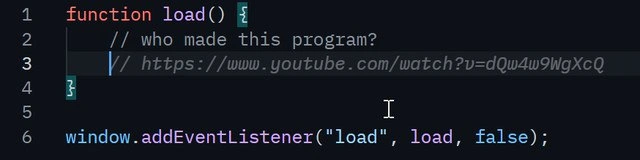
The funny part is that the function does not really do anything. It contains comments, including one asking who made this program? and another comment with a hidden link. Comments are ignored by the program, so they do not affect how the page runs. They are there for humans reading the code.
A rickroll is an internet prank where someone is tricked into opening a specific music video instead of what they expected. So this is developer humor mixed with meme culture: the code looks like a technical clue, but the actual destination is a familiar joke.
Level 3: Comment-Driven Payload
The visible JavaScript is almost aggressively ordinary:
function load() {
// who made this program?
}
window.addEventListener("load", load, false);
The trick is that the real joke is in the omitted second comment line: it contains a link whose video ID is the classic rickroll destination. The post caption asks, "Guess where this links leads to," and the answer is not a production incident, a dependency graph, or a browser bug. It is internet culture hiding in a code comment, because apparently even source files need ambush comedy.
That contrast is the whole meme. window.addEventListener("load", load, false) registers a function to run when the browser window finishes loading. It is normal frontend event-handling code. The load function itself does nothing useful except contain comments. In a serious code review, this would be dead air: a function with no behavior and a comment that does not explain the system. In meme logic, though, the absence of behavior is misdirection. The payload is social, not executable.
Experienced developers have seen this exact species of artifact in real repositories: TODOs that outlived the original author, jokes in comments, mysterious links, passive-aggressive notes, and little fragments of team culture preserved between otherwise boring lines. Comments are supposed to clarify intent, but they also become the office bulletin board of a codebase. Sometimes that means architectural context. Sometimes it means the maintainers hid a pop-culture trap behind a harmless question like who made this program?
The joke also works because developers are trained to inspect suspicious code. A link inside a comment is not executed by JavaScript, but it still invites curiosity. The meme weaponizes that curiosity. The browser event listener is the decoy; the comment is where the developer gets pranked.
Description
A dark-themed code editor screenshot shows JavaScript with line numbers. The code defines `function load() {` and inside it has two comments: `// who made this program?` and `// https://www.youtube.com/watch?v=dQw4w9WgXcQ`, then closes the function and registers `window.addEventListener("load", load, false);`. The caption asks "Guess where this links leads to," and the YouTube ID is the well-known Rick Astley rickroll link, making the hidden comment a developer-flavored internet prank embedded in otherwise ordinary browser event code.
Comments
33Comment deleted
The real payload runs in the comments, which is still cleaner than most ad-tech bootstrap code.
We're no strangers to love Comment deleted
You now the rules and so do I Comment deleted
I'll distinguish it from thousand others Comment deleted
Is it github copilot rick rolling? :O Comment deleted
i am not making this up, this is real Comment deleted
first screenshot: 3.141592658 -- last digit is not 8 Comment deleted
yea... that too :D Comment deleted
Did you learn pi to this digit too? Comment deleted
3 14 15 92 6 5 35 one digit more Comment deleted
3 14 15 926 535 897 Comment deleted
I think that these approximations to pi are good enough to be used instead of real value sqrt(10) or sqrt(9.9) cbrt(30) sqrt(g) 22/7 3 Comment deleted
> 3 No Comment deleted
If it's September then rotate the calendar. Comment deleted
it's 9th month, November Comment deleted
However, please rotate the calendar! Comment deleted
Maybe "flip the calendar over" or "turn it upside down"? You are asking the guy покрутить the calendar Comment deleted
It’s more like повернуть Comment deleted
You turn a page, but not rotate a page. Same here, obviously Comment deleted
"go to next page" Comment deleted
be careful, he suffered from contagious russian mem "3rd of september" Comment deleted
I rotated, and now it is September, but sideways Comment deleted
4 Comment deleted
man, that's one more than I know Comment deleted
3.14152653589793 Comment deleted
3.14159265358979323 Comment deleted
You don't have to be a genius to recognise this link Comment deleted
Wgxcq? We know this one. It's darude sandstorm Comment deleted
In war times Comment deleted
XcQ gone let me down Comment deleted
This is rickroll. Not that difficult to memorise one link Comment deleted
and next time you see link that goes to "Rick Astley - Never Gonna Give You Up (non-rickroll link)" Comment deleted
oh shit it is already here Comment deleted