Skip to content
DevMeme
2928 of 7435
The Unspoken Truth About 'Final' Requirements
Stakeholders Clients Post #3234, on Jun 13, 2021 in TG

The Unspoken Truth About 'Final' Requirements

Why is this Stakeholders Clients meme funny?

Level 1: Promises Written in Sand

Imagine you’re building a big sandcastle at the beach with your friend. 🏰 Your friend told you exactly what kind of castle they want – with two tall towers and a moat – and you start working happily. You ask, “You’re not going to change your mind while I’m building, right?” and your friend says, “No, no, I promise, that’s exactly what I want.” So you keep building the castle just as planned. But then halfway through, your friend suddenly says, “Actually, can you turn it into a giant sand spaceship instead?” 🚀 You look up, surprised and a bit upset, because you’ve already put in so much effort making a castle. First they said castle, and now they want a spaceship! In our story, you stare at your friend silently for a moment (maybe with a Are you kidding me? face). Then you ask again, a lot more nervously, “You really aren’t going to change it again, right?!”

This is exactly what the meme is joking about, but with software. The promise of “stable requirements” is like your friend promising they won’t change their mind about the sandcastle. But in reality, people do change their minds – just like your friend did. It can feel frustrating and a little funny at the same time, because you realize that promise wasn’t very solid. The meme shows a developer (like the sandcastle builder) realizing the client’s requirements (the castle plan) might not stay the same. It’s humorous because the developer kind of knew the truth: just like building in sand, the plans can easily shift. In simple terms, the joke says: sometimes people promise not to change what they want, but then they do – and everyone working on it just has to sigh and start shaping that sand spaceship.

Level 2: Scope Creep 101

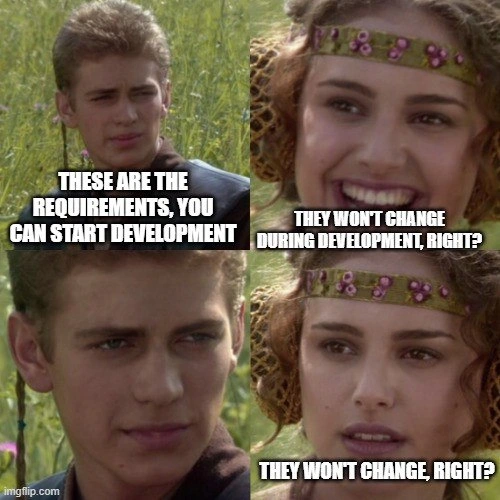
Let’s break down what’s happening in this meme in simpler terms. We have a four-panel image taken from a Star Wars movie scene (Episode II, where Anakin and Padmé are talking in a meadow). This scene has become a popular meme template – people use it to create their own dialogues by adding text. In this version, it’s used to joke about changing_requirements in software projects. In the first panel, the young man (Anakin, representing a stakeholder or client) confidently says: “THESE ARE THE REQUIREMENTS, YOU CAN START DEVELOPMENT.” That means the client or project manager is giving the developer a list of things the software should do (the requirements) and claiming that list is complete and final. The second panel shows the young woman (Padmé, representing the developer) asking: “THEY WON’T CHANGE DURING DEVELOPMENT, RIGHT?” She’s basically double-checking, “Are you sure these requirements will stay the same while I’m working? You’re not going to ask for new things in the middle, right?” This question is crucial because developers plan their work around these requirements.

Now, the third panel is just Anakin’s face silently staring back. There’s no caption here – and that silence is intentional and funny. In conversations, especially in memes, silence can mean someone doesn’t have a good answer or is caught off guard. Here it suggests that the stakeholder is either unwilling or unable to promise that requirements won’t change. It’s an awkward pause. You can almost hear crickets chirping in that meadow! This silence basically screams, “Well… about that…” without him actually saying a word. Finally, the fourth panel returns to Padmé. This time she repeats her question louder: “THEY WON’T CHANGE, RIGHT?” Now the text is larger, emphasizing her alarm. Her expression has gone from hopeful to concerned. This mirrors a developer’s growing worry when they realize the stakeholder’s silence is a bad sign. She’s asking again because she suspects the first answer wasn’t truthful. In plain terms, she’s panicking: “Wait, you did mean it when you said they won’t change… right?! Please tell me you mean it!”

The humor here comes from the relatable situation: the developer really wants a guarantee that the work she’s about to do won’t be undone or redirected by sudden changes. The stakeholder’s nervous silence is basically an admission that such a guarantee is shaky. This scenario is extremely common in real software projects. Requirements are the specific needs or features the software must have – like a blueprint for what to build. When those needs keep changing after development has started, we call it scope creep. Scope means the overall boundaries or extent of the project (what’s included to do), and creep means it slowly grows beyond what was agreed. Think of it like a creeping vine that spreads and spreads. ScopeCreep often happens when clients keep adding “just one more thing” or when they change their minds about what they want. It’s a major topic in ProjectManagement and a running joke in software engineering circles.

Why do developers care so much about avoiding changes during development? For a junior developer or someone new to real-world projects, imagine you’ve planned out how to build a feature based on a certain specification. You might have written some code assuming those specs are correct. If the spec changes suddenly, it can mean some of your work was wasted or needs re-writing. It can also introduce bugs because changes might not fit neatly into what’s already built. Managing changes is actually a whole process, often called change management or RequirementsChangeManagement. Agile software development processes (like Scrum) accept that change will happen – in fact, one of the Agile principles is to “welcome changing requirements, even late in development.” This is because Agile methodologies emerged as a response to the old way (called Waterfall) where you tried to lock in all requirements at the start. In Waterfall, if requirements changed late, it was seen as a failure of planning. Agile, on the other hand, expects some change and tries to accommodate it in short cycles (sprints). But even with Agile, the understanding is that changes should be managed in an organized way – for example, put new requests into the next sprint’s planning. When a client comes in and disrupts the current sprint with new demands, the team can handle it, but it often means re-prioritizing tasks and possibly not finishing something they planned. That can be stressful and is definitely an AgilePainPoint (pain point meaning a real challenge people feel).

The tags like ClientExpectations and MisalignedExpectations point to the core issue: the client (or stakeholder) might expect that changing their mind is easy or think “It’s just a small change, what’s the big deal?” while the developer expects the client to stick to the plan that was agreed upon. When those expectations don’t line up, frustration occurs on both sides. The developer might feel, “They promised me no changes! How can I build anything if the target keeps moving?” and the client might feel, “Aren’t good developers supposed to be flexible? Why are they so upset about a tiny change?” This misalignment is exactly what the meme jokes about. It highlights the AgileHumor aspect: yes, Agile teams are supposed to welcome change, but inside, developers often still groan and find it humorous in a cynical way when someone says “Don’t worry, nothing will change.” It’s like a running gag.

Also, notice the meme uses bold white text in Impact font with a black outline. That’s the standard style for many Internet memes, because it’s highly readable on top of images. All the text is in uppercase, which is a meme convention to make the dialogue loud and clear (and sometimes to indicate shouting or emphasis). In this particular meme format (often called the Anakin-Padmé or “Padme Amidala Questions” meme), the structure is always: Person A says something, Person B asks a question in response, then Person A is shown silent or making a face, and Person B repeats the question more anxiously. People have used this format for various jokes where someone assumes they’re getting a good deal or a stable situation, and then realizes they aren’t. Here it’s applied to software requirements. The third panel’s silent_stare_panel is the punchline setup – the lack of answer is the answer. And Padmé’s repeated question is the final punchline delivery: she now knows the truth (things will change) but is almost in denial, hoping for a different answer.

In summary, for a newer developer or someone not yet in the industry, this meme is saying: Clients or bosses might assure you that everything they want is fixed and won’t change – but in reality, things almost always change. It’s highlighting that Requirements vs Reality gap in a humorous way. The developer’s experience, especially in Agile projects, is that you should be ready for the unexpected. So it’s a form of DeveloperHumor where we laugh at a situation that might otherwise make us want to pull our hair out. When you encounter this in your career (and you will, sooner or later), you’ll remember this meme and think, “Ah, so this is what they were joking about. They warned me!”

Level 3: Scope Creep Strikes Back

At a senior engineering level, this meme hits home because stable requirements in software projects are about as real as unicorns. The scene is a classic Anakin and Padme template from Star Wars, repurposed to lampoon the false promise of unchanging specs. In the first panel, the stakeholder confidently declares, “These are the requirements, you can start development.” Any veteran developer reading that line instantly raises an eyebrow. Why? Because we’ve all heard some version of “the specs are final” only to watch those requirements shape-shift mid-project. The developer (Padmé) in the meme asks the hopeful question, “They won’t change during development, right?” This is the moment every engineer secretly dreads: we’re basically asking, “You’re sure nothing will change? You’re really, really sure?” And then comes the telltale silence in panel 3 – Anakin’s uneasy blank stare – which speaks louder than any words. It’s the awkward pause every developer recognizes when a client or product manager can’t quite back up the promise. That silence is a red flag, a comedic beat that signals: “Uh oh… they will change, and we both know it.” By the final panel, Padmé repeats the question with even greater emphasis – “They won’t change, right?!” – highlighting her dawning panic as she realizes the stable requirements were a lie all along. The humor here cuts deep because it’s Requirements vs. Reality: the initial confidence versus the inevitable truth.

This meme is funny to us because it dramatises a ritual we know too well. It’s practically a rite of passage in software development: the Stakeholder_Promises at project kickoff, followed by the inevitable ScopeCreep sneaking in later. The term scope creep refers to exactly this phenomenon – the project’s scope (what needs to be done) creeps wider and wider over time. One day it’s “just build what’s in the spec,” the next day there’s a “small change” or five, and suddenly you’re living in an Agile nightmare sprint. Even though Agile methodology encourages “embracing change,” in reality those mid-sprint changes still cause heartburn. (As a cynical veteran might quip, Agile says “respond to change,” but it feels more like “brace for impact.”) The meme’s situation is a textbook AgilePainPoint: stakeholders assure you of stability at sprint planning, but halfway through the sprint they drop a “priority shift” bomb. It’s DeveloperHumor because every dev team has experienced that meeting where the client’s expectations and the dev team’s plans suddenly diverge. You can almost hear the collective groan and see the team scratching their heads, muttering “Didn’t they say no changes?!”

Why does this keep happening? Often, stakeholders genuinely believe the requirements are final – until reality intervenes. Market conditions change, competitors launch new features, the client thinks of a “brilliant idea” after seeing the first demo, or an executive simply changes their mind. Other times, the promise was just wishful thinking or a tactic to get developers moving. From a seasoned project management perspective, initial requirements are rarely set in stone; they’re written on water. In rigid Waterfall days, teams tried to “freeze” specs upfront and treat any change as a costly exception. But experienced devs knew even back then that unstable_specs were inevitable – so-called “frozen” requirements had a habit of melting as soon as coding started. That disconnect leads to MisalignedExpectations: the developer expects a clear target to build toward, but the stakeholder is expecting to tweak that target on the fly. The meme nails this misalignment with that silent side-eye from Anakin. It’s the look of “Here we go again…” when the dev realizes the client’s expectations (“requirements won’t change”) were unrealistic from the start.

In practice, managing these changes is an art. RequirementsChangeManagement is the polite term for “figuring out how to deal with all the new ideas popping up.” Senior engineers and project managers will maintain a change log or a backlog in JIRA for new requests, and prioritize them for future sprints. But when changes come mid-sprint (like suddenly switching the castle to a spaceship halfway through building, as any Lego-loving dev would groan about), it throws off the team’s flow and threatens to derail the timeline. The meme’s impact text and the character’s expressions perfectly capture that “you’ve got to be kidding me” moment. We laugh (maybe a bit bitterly) because we’ve been Padmé, asking in vain for reassurance that never really comes. It’s a shared understanding in dev culture: RequirementsVsReality is always a battle, and reality usually wins. In fact, the only truly stable requirement is that things will change.

To put it another way, here’s how the typical promise vs. outcome plays out:

What Stakeholder Promises What Actually Happens
“The requirements are final.” New features or changes creep in gradually.
“No changes during development.” “One small tweak…” turns into multiple tweaks.
“Scope is fixed, guaranteed.” Scope creep expands project boundaries.
“We have stable requirements.” Requirements evolve as reality kicks in.

Every veteran developer can swap war stories of “final” specs that weren’t final. We’ve learned (the hard way) to expect the unexpected. This meme resonates because it’s a form of group therapy: it pokes fun at the universal Agile humor of planning one thing and delivering another after all the last-minute changes. It’s the dark comedy of software engineering – we laugh so we don’t cry. The next time someone says “they won’t change, trust me,” you might just remember Anakin’s blank stare and Padmé’s worried face, and make sure your project plan has a little wiggle room…

Description

This meme uses the four-panel 'Anakin and Padmé' format from the Star Wars prequels to satirize the universally understood volatility of software requirements. In the first panel, Anakin Skywalker, representing a project manager or client, confidently states, 'THESE ARE THE REQUIREMENTS, YOU CAN START DEVELOPMENT.' The second panel shows a cheerful and naive Padmé Amidala, representing the developer, asking, 'THEY WON'T CHANGE DURING DEVELOPMENT, RIGHT?' The third panel cuts back to Anakin, who offers only a deadpan, knowing stare in response. In the final panel, Padmé's smile has vanished, replaced by a look of dawning horror and concern as she repeats, 'THEY WON'T CHANGE, RIGHT?' The humor lies in the silent confirmation of a painful truth in software development: requirements are almost never final. The developer's initial optimism quickly turns to dread, a feeling every experienced engineer recognizes as the inevitable precursor to scope creep and mid-sprint changes
Comments

8
Anonymous ★ Top Pick A junior dev takes the requirements literally. A senior dev hears 'the requirements are final' and immediately starts abstracting everything for the inevitable 180-degree pivot next sprint
  1. Anonymous ★ Top Pick

    A junior dev takes the requirements literally. A senior dev hears 'the requirements are final' and immediately starts abstracting everything for the inevitable 180-degree pivot next sprint

  2. Anonymous

    Calling requirements “final” is just product’s version of eventual consistency - eventually they align with whatever the CEO thought of this morning

  3. Anonymous

    After 20 years in the industry, I've learned that 'requirements freeze' is just a theoretical concept they teach in CS programs, like frictionless surfaces in physics or rational actors in economics - useful for modeling, but never actually observed in nature

  4. Anonymous

    The requirements are frozen in carbonite - until the stakeholder meeting next Tuesday when they'll be thawed, modified, and re-frozen three times before lunch. Senior engineers know that 'final requirements' is an oxymoron, like 'production-ready prototype' or 'quick meeting.' The real skill isn't coding to spec; it's architecting systems flexible enough to survive the inevitable requirements churn while maintaining the poker face that suggests you totally believed them when they said nothing would change

  5. Anonymous

    Requirements won't change? That's like deploying to prod without a rollback plan - optimistic until the force of business needs awakens

  6. Anonymous

    We architected assuming linearizable requirements; stakeholders implement eventual consistency with unbounded write throughput via Slack

  7. Anonymous

    “Final requirements” are just a read from an eventually consistent cache - the moment you start coding, the invalidation event fires

  8. Deleted Account 5y

    Don't post a meme twice

Use J and K for navigation