Skip to content
DevMeme
2929 of 7435
The Existential Struggle of Software Testing
Testing Post #3235, on Jun 13, 2021 in TG

The Existential Struggle of Software Testing

Why is this Testing meme funny?

Level 1: Tables Turned

Imagine you’re playing a game or solving a puzzle, and suddenly it feels like the puzzle is solving you instead. 😄 This meme is funny because it’s like saying, “I tried to check my work, but my work started checking on me!” Think of it like this: you ask your friend to quiz you on your homework to see if you know the material, but the questions end up being so hard you feel like the quiz is testing how smart you are instead of how good your homework is. It’s a silly role reversal.

Another way to picture it: you’re trying to teach your dog a trick, but your dog just tilts its head and somehow you end up fetching the ball. Who’s training who here? 🤷‍♂️ In the same way, when a programmer’s tests keep failing, it feels like the computer is the one giving the programmer a test. It’s a funny feeling because normally people are in charge of computers, but sometimes it seems like the computer is saying “Nope, try again!”

So the core of the joke is about feeling frustrated but in a playful way. We usually test our code to make sure it’s correct, but when things go wrong, it feels like the code is testing our patience and knowledge. It’s like the tables have turned – the tester becomes the one being tested. Anyone who’s struggled with a tricky problem can relate to that feeling. You plan to beat the challenge, but for a moment it feels like the challenge is beating you. And that’s why this line makes programmers chuckle: it’s a lighthearted way of saying “wow, this problem is really giving me a workout!”

Level 2: Testing Your Patience

Let’s break down the basics for those newer to the craft. Unit testing is a practice where developers write small pieces of code to check (“test”) that individual functions or modules of their application work correctly. Think of each unit test as a yes/no question you ask your code: “If I give you X, do I get the expected Y?” For example, if you have a function add(a, b) that should return the sum of two numbers, a unit test might call add(2, 2) and expect the result to be 4. If the function returns something else (like 5 due to a bug), the test will fail and alert you. Normally, we are in control, writing tests to make sure our program behaves.

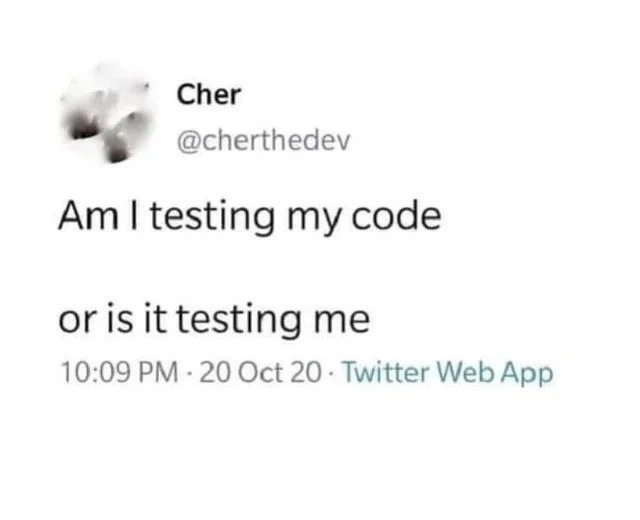
Now, this meme jokes that sometimes it feels the other way around. When the tweet asks, “Am I testing my code or is it testing me?”, it’s expressing DeveloperFrustration in a humorous way. Why might a newcomer find their code “testing” them? Imagine you wrote a bunch of tests, hit run, and a ton of them failed. Red error messages scroll by, and you’re left scratching your head. Each failing test is essentially telling you, “I expected this function to do something else – something’s wrong!” If you’re new, it can feel like the computer is grilling you about every little mistake. This is what the meme is capturing: the almost psychological battle of debugging and troubleshooting your own tests. It’s DebuggingFrustration for beginners – you thought you were just checking your work, but suddenly you’re in a confrontation with it.

Let’s connect this to common experiences. Perhaps it’s your first week on a job, and you’re asked to add a small feature. You write some code, run the test suite, and boom – 5 tests unrelated to your change are now failing. What just happened? 😨 Now you have to figure out if your change broke something or if those tests were flaky (flaky tests are tests that sometimes fail for unrelated reasons, a huge source of DeveloperPainPoints). As a junior developer, this feels overwhelming. It’s like setting up a domino and unexpectedly knocking down a whole line you didn’t even see. Each failing test presents a puzzle: is the code wrong, or is the test itself written with assumptions that no longer hold? You might find yourself asking the codebase, “Okay, what do you want from me to pass these tests?” It really can feel like the code is demanding answers from you – hence the joke that the code is testing the developer.

Key term check: UnitTesting (as mentioned) means focusing on one “unit” of code at a time. Debugging is the process of finding out why something went wrong and fixing it. In testing, debugging often means reading error messages, digging into why the expected output didn’t match actual output, and correcting either the code or the test. The categories listed, Testing and Debugging_Troubleshooting, point out exactly what’s happening in this scenario. Testing is supposed to catch mistakes, and troubleshooting is what you do when a test catches one. The meme simply adds a human twist: it acknowledges that this process can mess with your head a bit.

There’s also a hint of something every programmer learns: good tests not only check the code, they also document what the code should do. So when a test fails, sometimes it’s telling you that either your code’s behavior or your understanding of the requirements is wrong. For a newcomer, that moment can feel humbling. For example, if a test is named test_user_age_cannot_be_negative() and your code fails it, it’s effectively the code asking you, “Hey, did you consider that age could be -5? Should that be allowed?” Suddenly, the test isn’t just a passive check; it’s actively teaching (or questioning) you. That’s why the tweet uses the phrase “is it testing me” – because a smart test suite will reveal gaps in your thinking. It’s almost like a mentor pointing out “Gotcha!” cases, except in text form on your screen.

Let’s not forget the emotional side: RelatablePain means this is a common pain that many can relate to. When you run a test suite and see a wall of red F’s or big "FAIL" messages, your heart sinks. You might groan, facepalm, or even start doubting, “Am I cut out for this?” Don’t worry – every developer has been there. We’ve all felt personally attacked by error messages at some point! That’s why this meme resonates and circulates in DeveloperHumor circles. It’s a way of saying “Haha, yep, I’ve felt that!” to your peers.

Also, note the format: it’s a screenshot of a tweet (a tweet_screenshot_meme). Tweets are a popular way devs share quick humorous thoughts. The text “Am I testing my code or is it testing me” is short, sweet, and perfectly captures the feeling. No wonder people in the comments might respond with “Story of my life” or “Every time I run npm test… 😅”. The tags like #TestingHumor or #DeveloperFrustration often accompany such posts to signal the topic and tone. So even without deep technical knowledge, you get that it’s about the trials of writing/tests and the stress that comes with it.

In essence, for a junior engineer or someone learning programming, the meme is a lighthearted introduction to the idea that writing tests (and debugging them) can be surprisingly challenging. It’s not just you – even experienced devs feel like the code is kicking their butt sometimes. So when your tests fail and you feel frustrated, know that it’s a universal developer experience. The code isn’t literally testing you, but it can sure feel that way on a tough day! Keep at it, learn from the failures (both yours and the code’s), and soon enough you’ll be laughing at memes like this, knowing you’ve survived those interrogations-by-test.

Level 3: When Mocks Mock You

Unit tests are supposed to be your tool for validating code, but this meme flips the script with a classic code_testing_paradox. In a well-lit corner of Twitter humor, a developer quips: "Am I testing my code or is it testing me?" — an almost existential sigh that every seasoned engineer recognizes. Why is this so funny and painfully true? Because we've all been there: late night, green test suite turning red, and suddenly those tests you wrote feel less like simple checks and more like an interrogation lamp shining on your face.

In the ideal world of Test-Driven Development (TDD), you write tests to assert your code’s correctness. Red means fail, green means pass – simple, right? But reality is messier. Often, writing tests uncovers that you misunderstood the requirements or your code’s behavior. Each failing test is essentially your code saying, "Nope, not gonna work. Think again." Over time, this can start to feel personal. It’s as if the unit testing process reverse-engineers into test_driven_burnout, where you, the developer, feel like the one under examination. DeveloperFrustration sets in when a test case keeps failing no matter how confidently you refactor – a known DeveloperPainPoint. You begin to anthropomorphize the test suite: "What does it want from me? Why is it punishing me?"

This tweet-style meme nails that feeling with minimal words. The text “Am I testing my code or is it testing me” is a perfect encapsulation of RelatablePain and classic TestingHumor. The humor works on multiple levels. On the surface, it’s just a witty reversal of roles. But dig deeper and it touches on an impostor syndrome many developers have: when your tests keep failing, you start questioning your own abilities. It’s like the code is challenging your understanding, almost asking debugging questions back at you. After your code throws its tenth assertion failure, you’re left thinking: who’s really in charge here?

Why is this combination of elements so humorous? First, it references the common experience of tests exposing bugs (or flawed assumptions) in front of your eyes. That’s the DeveloperHumor aspect – we laugh because it’s true. Second, it anthropomorphizes software testing, drawing a parallel to a Turing test in reverse. Normally, we test software to see if it behaves correctly. Here, it’s as if the software (via the tests) is giving us a Turing test of our competence, and often we feel like we’re failing. It’s a cheeky nod to the notion that sufficiently tricky code can make a developer feel like the one being evaluated.

Let’s talk real-world scenarios. Imagine you wrote a seemingly simple function, and you’re confident it works. You run your test suite:

$ npm test
FAIL  ./mathUtils.test.js
✕ should return the correct result (5ms)

  ● mathUtils › should return the correct result

    expect(received).toBe(expected) // Expected: 42, Received: 43

  at Object.<anonymous> (mathUtils.test.js:12:16)

Boom – AssertionError. The test expected 42 but got 43. A one-off error, perhaps just a tiny detail. But in that moment, seeing that bright red FAIL, it feels like the test is saying: "You didn't think of something, did you?" The cold, indifferent output might as well be a stern teacher’s red pen marking your work. You end up debugging not just the code but also questioning your approach: Did I implement the formula wrong? Did I misunderstand the problem? The test isn’t just validating your code; it’s forcing you to re-evaluate your understanding. It’s DebuggingFrustration 101 – the code was almost right, but almost doesn’t count in test-land. Each failure is a mini interrogation: Why did you assume that? What about the edge cases?

This tweet_screenshot_meme strikes a chord because it’s an exaggerated truth. After wrestling with brittle tests or puzzling failures, a developer might mutter, "What is this, a pop quiz?" The phrase "testing me" is apt – a failing test often feels like a judgment on the developer. Are you patient enough to find the bug? Did you write the test correctly, or is your code the culprit? Sometimes the UnitTesting process turns into an introspective review of your decisions. In complex codebases, tests can break because of things outside your control (flaky tests due to timing, environment issues, or mock objects that weren't set up right). If a test fails due to a misconfigured mock, it’s almost poetic: your mock is literally mocking you by not behaving as expected. When mocks mock you, indeed.

Another layer is the culture around testing. Modern development workflows (continuous integration, code reviews) put a lot of emphasis on tests. Ever had a pull request blocked because some arcane unit test failed? It’s not even about your feature anymore – now you’re digging into someone else’s test that started failing "mysteriously". You feel like the codebase is initiation-ritual testing you, seeing if you’re worthy to deploy. This is a shared trauma: you see a failing test and sigh, "Alright, what do you want from me this time?" The DeveloperHumor arises from acknowledging that shared pain with a smirk. We make memes to cope with that feeling of being one assert.equal away from a mental breakdown.

Historically, programmers didn’t always write extensive automated tests. There was a time of "just run it and see if it works". But as software engineering matured, we realized the importance of catching bugs early. Enter unit tests, and later the TDD movement: write the test, watch it fail, then make it pass. It’s a fantastic approach in theory — ensuring robust, bug-resistant code. But the joke here hints at the psychological side-effect: constantly seeing red failing tests can be demoralizing. It’s as if we’ve built a machine to relentlessly point out our mistakes. The meme’s timestamp “10:09 PM · 20 Oct 20” even adds flavor – late-night coding with tests failing can lead to exactly this tired, half-joking thought. (Is the code testing me? Because I feel thoroughly examined!).

In summary, the humor emerges from RelatablePain. It satirizes the reality that while tests are tools we create to verify our programs, they often end up testing our patience, confidence, and sanity. The tweet’s phrasing is simple but deep: a perfect DeveloperFrustration haiku. We laugh because it validates our experience – everyone who’s slogged through DebuggingTroubleshooting at midnight knows that feeling. The roles of tester and tested have blurred, and the TestingHumor of that role reversal is both cathartic and a little cathode-ray (like the red FAIL text on your screen) for our souls.

Description

This image is a screenshot of a tweet from a user named Cher (@cherthedev). The tweet, posted on October 20, 2020, poses a poignant and philosophical question in two short lines: 'Am I testing my code or is it testing me'. This simple phrase perfectly encapsulates the intense frustration and mental challenge that often accompanies the process of testing and debugging software. For experienced developers, it's a deeply relatable sentiment. Writing and passing tests can sometimes feel like a grueling battle against an obstinate system, pushing one's patience, problem-solving abilities, and even sanity to their limits. The joke is that the code, with its complex bugs and unexpected behaviors, becomes an adversary that tests the developer's own resilience and competence
Comments

10
Anonymous ★ Top Pick My code has two states: 'not tested' and 'testing my sanity'
  1. Anonymous ★ Top Pick

    My code has two states: 'not tested' and 'testing my sanity'

  2. Anonymous

    My unit tests no longer assert values - they schedule 2 a.m. reviews of my dependency graph and ask, “Are you comfortable with the architectural choices that led you here?”

  3. Anonymous

    After 15 years in the industry, I've learned that test coverage metrics are just a number, but the psychological coverage of your test suite writing back 'Expected undefined to deeply equal [object Object]' at 2 AM is what truly measures your architectural decisions from six months ago

  4. Anonymous

    After 15 years in the industry, you realize that comprehensive test suites don't just validate your code - they validate your architectural decisions, your understanding of edge cases, and occasionally, your entire career trajectory. When your integration tests start failing in ways that seem physically impossible, you're not debugging anymore; you're having a philosophical debate with the universe about determinism, and the universe is winning with a stack trace 47 levels deep

  5. Anonymous

    When your test suite flakes harder than a distributed transaction in prod, it's not testing code - it's benchmarking your zen

  6. Anonymous

    With eventual consistency and 30s sleeps in E2E, we’re not testing the system - we’re load-testing the on-call’s patience

  7. Anonymous

    Our test suite is so flaky the only SLO it enforces is my heart rate - pretty sure the runner’s doing chaos engineering on the developer, not the code

  8. @SuperiorProgramming 5y

    The other way around.

  9. @ZgGPuo8dZef58K6hxxGVj3Z2 5y

    Lol

  10. @sylfn 4y

    (will be deleted)

Use J and K for navigation