Skip to content
DevMeme
3729 of 7435
Regex Fashion: The Universal Match
Languages Post #4068, on Dec 24, 2021 in TG

Regex Fashion: The Universal Match

Why is this Languages meme funny?

Level 1: One Shirt Fits All

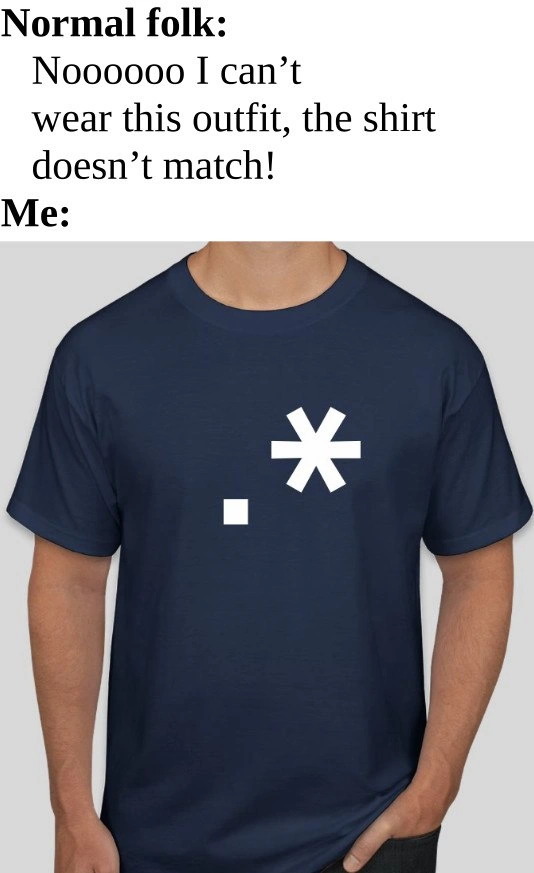
Imagine you have a magical shirt that goes with absolutely anything. No matter what pants or shoes you put on, this special shirt will always look like it matches perfectly. Pretty cool, right? That’s essentially the joke here, but with a programmer twist. The top of the meme shows a regular person whining, “Oh no! I can’t wear this outfit because the shirt doesn’t match!” They’re upset because in normal life, you have to pick clothes that look good together, like matching colors or styles. Now along comes the programmer (the “Me:” in the meme) who isn’t worried at all. Why? Because on their shirt they’ve printed a tiny piece of computer code that means “match anything.” It’s like having a wildcard or a joker card for clothing. In the world of programming, .* is a symbol that basically says “I’ll fit with whatever.” So the programmer’s joke is that by wearing a shirt with this .* symbol, they’ve made a shirt that literally matches every outfit. It’s as if their shirt can magically change or just universally count as a match with any pants, any jacket, any hat – you name it.

Why is this funny? It’s because it shows how a programmer thinks differently about a simple problem. A non-programmer worries about style and matching colors, but the programmer thinks, “Hey, I know a cheat code for this!” It’s a playful way of using computer language in real life. Even though in reality a shirt with a dot and star on it doesn’t truly change color, the idea makes us laugh. It’s like saying, “I solved my fashion problems with programming.” For someone who doesn’t know coding, the shirt might just look like a weird star symbol. But for those who do know, it’s like a little secret message saying “I’m not concerned, my shirt matches by definition!” It brings the serious, logical world of coding into something as everyday as getting dressed, and that surprise mix-up is what makes it silly and fun. Essentially, the programmer turned a fashion problem into a simple yes/no rule – and in their rule, the answer is always “Yes, this shirt will go with that!” So it’s a joke about being smart (or cheeky) enough to have one shirt that fits all occasions, told in the language of computers.

Level 2: Match Anything Pattern

Let’s break down the joke for someone newer to coding. The shirt has two special symbols on it: a period (.) followed by an asterisk (*). In programming, specifically in Regular Expressions (regex), . and * are powerful little characters. Regular expressions are patterns used to match text. Think of them as super-smart search strings that can flexibly find what you’re looking for. For example, a regex can check if a string looks like an email address or extract all words starting with “cat”. They’re part of the core toolkit in many programming tasks (hence being a CS_Fundamentals topic). But they often look cryptic, because symbols like . * ^ $ \ have special meanings.

Here’s what these symbols mean in regex:

  • . (dot) – This means "match any single character." It’s like a wildcard for one slot. It doesn’t matter if it’s a letter, number, or punctuation – . will match it.
  • * (star) – This is a quantifier meaning "repeat the previous element zero or more times." In other words, the thing right before the * can occur any number of times (it could be absent, or present once, or many times over). This * symbol is actually called the Kleene star in computer science, and it basically means "you can have as many of this thing as you want."

Now, when you put them together as .*, you create a pattern that means "zero or more of any character." Essentially, .* will match anything you throw at it:

  • It can match an empty string (zero characters).
  • It can match a single character like "A" or "z".
  • It can match a word like "Hello".
  • It can match an entire sentence, or a paragraph, or theoretically an entire book of text.

In regex terms, .* is like a match-all cheat code. It doesn’t filter or restrict what you match; it says “whatever text is there, I’ll match it.” That’s why we call .* the "match anything" pattern.

So what does this have to do with a shirt and outfits? When people talk about clothing, saying a shirt “matches” your pants means the colors or styles look good together. It’s about coordination: you wouldn’t wear plaid with polka dots because those clash, for example. Non-tech folks might agonize, “Oh no, this shirt doesn’t match these pants!” They’re using "match" in the style sense. But the meme’s author is a developer, and they can’t help but hear the word "match" and think about regex pattern matching. The top text says “Normal folk: Nooo I can’t wear this outfit, the shirt doesn’t match!”. The implication is a normal person is upset because, say, the shirt is red and the pants are green and that combo looks odd. Then comes the developer’s turn: “Me:” followed by a picture of a shirt with .* on it. The developer’s joke solution is, “I have a shirt that matches literally anything – because .* matches any pattern you can imagine.” It’s a pun and a nerdy solution rolled into one. Instead of worrying about fashion rules, the programmer applies a regex rule. We’ve basically turned a wardrobe problem into a software problem: the shirt is acting like a regex that will always succeed in matching whatever outfit it’s part of.

For a new programmer or someone not yet familiar with regex, it might help to see how .* works in a tiny code example. Imagine we want to test this regex on various strings (as an analogy, think of each string as representing an “outfit description” and our shirt pattern should match all of them):

import re

pattern = re.compile(".*")           # This compiles a regex pattern that matches anything.
tests = ["jeans and t-shirt", "suit and tie", "sport shorts", ""]  # various "outfits", even an empty one
for outfit in tests:
    if pattern.fullmatch(outfit):
        print(f"'{outfit}' matches the pattern .*")

If you run this code, it will print that every single one of those test strings matches .*. No matter if the string is "jeans and t-shirt", "suit and tie", "sport shorts", or even an empty string (representing perhaps wearing nothing at all!), the regex returns a match. Why? Because .* doesn’t care what’s inside the string. It’s happy with any characters, any length. In terms of outfits, it’s like the shirt says: “Got stripes? Cool. Plain pants? Fine. Crazy rainbow jacket? No problem!” There’s no combination that the pattern would reject.

Now, beyond the regex itself, there’s another layer to the humor: developer culture. This meme is a form of CodingHumor that shows how developers sometimes inject programming into daily life. Inside jokes like this are common in developer communities. If you’ve ever browsed forums or social media for programmers (like certain subreddits or Stack Overflow anecdotes), you’ll find people joking about writing pseudocode for their grocery list or treating everyday issues like they’re debugging code. It’s a way for programmers to bond over the unique (and sometimes silly) way they see the world. Wearing a regex on a shirt is part of that tradition. It’s saying “I’m a proud coding nerd, and I find this funny.” Other developers who see it will likely chuckle and think, “Ha! . * — I see what they did there.” It immediately tells you something about the wearer: they know regex, and they have a sense of humor about it. It’s a developer meme come to life on fabric.

The categories listed (like DevCommunities) underline that aspect: this kind of humor thrives in groups of programmers. If you’re new to coding, you might not get all these jokes yet, but over time you’ll learn the lingo and then they’ll suddenly click. The first time you learn about regex and spend an afternoon wrestling with .* and other tokens, you’ll forever remember “dot star = match everything.” After that, seeing .* on a shirt will likely make you grin. It’s also relatable humor: a lot of devs actually do try to simplify decisions (like what to wear) by using logic or even by minimizing choices. Some programmers really have a closet full of identical black t-shirts to avoid matching issues entirely! This meme just takes it to a geeky extreme by literally printing the solution on the shirt. In short, to understand the meme you need to know what .* means in coding, and why applying that to clothing is both clever and absurd. Once you know those, the joke lands perfectly.

Level 3: Wardrobe Wildcard

For seasoned developers, the humor here comes from the collision of two worlds: everyday fashion rules versus programmer logic. In normal life, saying a shirt doesn’t "match" an outfit refers to clashing colors or styles. But mention "matches" to a developer and our brains jump straight to pattern matching and regular expressions. This meme plays on that dual meaning. The top text shows a “Normal folk” worrying about wardrobe coordination (“Noooooo I can’t wear this outfit, the shirt doesn’t match!”). The punchline is the “Me:” part: a developer confidently wearing a shirt printed with .*. In programming, .* is the ultimate wildcard pattern — it matches anything. So the developer’s joke is, "If my shirt is .*, it will literally match every outfit." It’s a geeky literalism: solving a fashion matching problem by applying a computing concept quite literally onto clothing.

This combination is funny to those in the know because it’s an inside joke on multiple levels. First, you have to recognize that .* is a regex pattern (not just a random asterisk). Among developers, seeing .* immediately screams “match-all pattern.” It’s akin to a secret handshake in the DevCommunities: if you smirk at the .* shirt, you’ve just identified yourself as a techie. Non-developers might just see a dot and a star and be puzzled (“Is that an Asterisk? What does your shirt mean?”), but developers instantly get the reference. This is classic developer humor – it takes a mundane scenario (picking an outfit) and delivers a punchline in the language of code. It’s the same flavor of humor as a shirt that says There’s no place like 127.0.0.1 for home: if you know, you know. The .* shirt is a developer fashion statement announcing one’s coder credentials through a clever pun.

There’s also a relatable truth here about how programmers approach problems. Many of us can’t help but apply logic or algorithms to everyday life. Choosing matching clothes can feel like a combinatorial challenge (you might jokingly call it the closet_matching_problem). How do you decide which shirt goes with which pants? It’s almost like solving a small constraint satisfaction problem each morning. Some developers actually respond by simplifying their wardrobe to a formula (think of the stereotypical tech CEO wardrobe of all-gray shirts to avoid decision fatigue). This meme cranks that idea up a notch: rather than just picking neutral colors, the developer literally encodes a solution. The .* pattern on the shirt is like an algorithmic shortcut—a single rule that says "I match with everything." In essence, the meme’s “Me:” character has devised a wardrobe algorithm: take one regex_tshirt that matches anything, pair with any outfit, and you’re done. No need to consult fashion guides or color wheels; the shirt itself guarantees a match by definition! It’s a playful jab at how programmers often favor general-purpose solutions. Why manually match each outfit piece-by-piece when you can create a universal solution that covers all cases? This is the ultimate general solution to style coordination, delivered with nerdy bravado.

The humor also pokes gently at the stereotype that engineers might lack fashion sense or over-index on logic. The normal person is fretting about style, and the developer bypasses the entire concern by treating it as a literal pattern-matching problem. It’s TechHumor 101: translating a real-world worry into code. There’s irony in that approach — obviously in real life, just wearing a shirt with .* doesn’t actually ensure your plaid pants and polka-dot tie will look good together. But to a programmer, the idea of a match_anything_pattern is irresistibly elegant, even for clothes. It’s like saying, “I solved fashion with one regex.” The absurdity is what makes it funny. It resonates with the relatable dev experience of seeing the world through a coder lens. We’ve all had moments where a friend says something ordinary and our brain throws a regex or a snippet of pseudocode at it before we even realize. This meme captures that instinct perfectly.

What really sells the joke is the visual of the shirt itself. It’s a simple navy T-shirt with a white print of a dot and an asterisk — minimalistic, yet loaded with meaning. In a way, it does look like a generic shirt that could go with almost anything (navy is a pretty neutral color). But the real punch is that the print explicitly spells out “match everything.” It’s self-referential humor: the dot-star pattern on the shirt claims universality, and wearing it is a cheeky way of saying “My outfit is always logically correct.” If you’re a coder, you might even be tempted to get this shirt made for real, just to wear it at a hackathon or the next casual Friday as an inside joke that your programmer colleagues will appreciate. They’ll see you in the hallway and grin because they immediately parse the regex. It’s a fun way of finding your tribe—much like a band t-shirt signals music tastes, a regex t-shirt signals geeky humor tastes.

Finally, consider the contrast in emotional tone: the “Normal folk” in the meme is wailing “Noooooo!” over an outfit mismatch, a very dramatized frustration. The “Me:” (the developer) is completely chill, offering an almost smug solution. This mirrors workplace dynamics we’ve seen in dev teams: one person sees chaos, the engineer sees a solvable problem (perhaps solved in an unorthodox way). The meme exaggerates it to great effect. It implies a certain confidence: Me, a developer, unbothered by problems that scare others, because I have regex. It’s both a celebration of regex’s power and a lighthearted roast of our tendency to use overly technical tools to address simple life problems. In summary, it’s CodingHumor gold: a perfect dot-star mashup of fashion and computation that only a programmer would dream up.

Level 4: Kleene Star Chic

In the realm of formal language theory, the .* on that shirt is not just a random design—it’s a direct reference to the Kleene star operator, a foundational concept in computer science. In regex syntax, the dot . represents "any single character," and the star * (named after mathematician Stephen Kleene) means "repeat the previous element zero or more times." Put together, .* denotes “any sequence of characters of any length.” In formal terms, the pattern matches the universal set of strings. If we imagine the alphabet of all possible outfit styles as Σ, then this shirt’s pattern is essentially declaring:

$$ L(\mathtt{.}) = \Sigma^ $$

In other words, the language recognized by the regex .* is all possible strings. It’s the maximal language in the hierarchy of regular languages, a regex that accepts absolutely everything. This makes the shirt a tongue-in-cheek formal proof by wardrobe: no input (outfit) exists that doesn’t satisfy the pattern on the shirt. From a theoretical perspective, it’s amusing because .* is the ultimate match-anything pattern—the regex analog of a universal truth. It’s as if the wearer encoded the universal matching function into their clothing.

This humorous fashion statement also highlights the elegant minimalism of regex syntax. A mere two-character pattern encapsulates an infinitely large set of possibilities. In automata theory, .* corresponds to a state machine that trivially accepts any input string (basically a start state that is also an accepting state with a self-loop on every character). The shirt is effectively advertising that automaton in the real world. For the subset of us who revel in CS fundamentals, there’s delight in recognizing such an academic concept put to playful use. It demonstrates the gap (or perhaps the bridge) between abstract computer science and everyday life: a bit of formal wardrobe theory if you will. We’ve taken an idea from the theory of computation and literally worn it on our sleeve (or chest) to solve a sartorial problem.

On a more practical advanced note, .* is known among developers as a very greedy token – it will gulp up as much text as possible in a match. In complex patterns, an ill-placed .* can lead to unintended matches or even catastrophic backtracking in regex engines. But on this t-shirt, that raw matching power is harnessed harmlessly. There are no performance issues or edge cases to worry about in cotton fabric. The only backtracking happening might be a passerby doing a double-take to re-read the shirt. It’s a brilliant, physically wearable illustration of how a simple theoretical construct (the Kleene star) can have a fun, intuitive meaning outside of code. Regular expressions originated in 1950s mathematics and later became a key tool in text processing (thanks to implementations by programmers like Ken Thompson in early Unix). Now, decades later, that same concept pops up as regex couture: a fashion statement that proudly says "I know how patterns work... even in my closet."

Description

A two-part meme. The top section has text: "Normal folk: Noooooo I can't wear this outfit, the shirt doesn't match!". The bottom section, labeled "Me:", shows a person wearing a navy blue t-shirt. The shirt has a large white graphic on it: a dot followed by an asterisk (`.*`). This is the regular expression pattern for "match any character (`.`) zero or more times (`*`)". The technical joke is that in the world of regular expressions, `.*` is a wildcard that matches literally anything. The meme humorously contrasts a common social concern (mismatched clothes) with a developer's mindset, where a universal "matcher" is the perfect, logical solution, demonstrating a practical but nerdy approach to fashion. It’s a classic developer pun that finds humor in applying programming concepts to everyday life


Comments

30
Anonymous ★ Top Pick My wardrobe's matching algorithm is simple: `if (shirt.matches('.*')) { return true; }`. It has 100% test coverage and has never failed in production
  1. Anonymous ★ Top Pick

    My wardrobe's matching algorithm is simple: `if (shirt.matches('.*')) { return true; }`. It has 100% test coverage and has never failed in production

  2. Anonymous

    I finally reduced wardrobe compatibility checks from quadratic colour comparisons to a single pre-compiled ‘.*’ - production-ready cotton with zero merge conflicts

  3. Anonymous

    Wearing .* in production: matches everything perfectly until someone realizes it's also matching the 500MB log entries you forgot existed

  4. Anonymous

    A '.*' shirt matches everything - greedily. Pair it with lazy pants ('.*?') if you only want to commit to the minimum outfit necessary

  5. Anonymous

    The shirt matches everything because it's '.*' - though in production, you'd want to be more specific with your patterns to avoid catastrophic backtracking. But hey, at least it's not '/.*/' without the multiline flag, or you'd only match the first line of your outfit

  6. Anonymous

    My dress code is just /.*/ - passes every review until SRE flags it as an unanchored, greedy rule with catastrophic backtracking in the laundry pipeline

  7. Anonymous

    \s*: the only regex that scales horizontally to any pair of pants without N+1 wardrobe queries

  8. Anonymous

    Our office dress code is validated by ^.*$ - HR calls it inclusive, Security calls it a P1. Classic dot‑star tradeoff

  9. @asuender 4y

    I think this is one of the best memes I’ve ever seen honestly

    1. @gotboredanyway 4y

      Noooo cmon man

  10. @mnik01 4y

    .+

    1. @f3rr0us 4y

      Well, do you want for the shirt to match when you have no underwear at all, that's the question

  11. @average_meni_na_drugu_enjoyer 4y

    thats regex that match everything?

    1. @dsmagikswsa 4y

      Yes

  12. @xgoader 4y

    what about newline symbol?

    1. dev_meme 4y

      did you mean CR LF sequence?

    2. @Araalith 4y

      Depends on flags.

  13. @xgoader 4y

    yep, in python dot matches everything except '\n', not sure about other languages

    1. dev_meme 4y

      "Other way impossible, because of shitty python"

    2. @affirvega 4y

      In regex101.com you can specify, so that dot matches \n, idk if it can be done in python

      1. @xgoader 4y

        yep, there is a flag to make dot match everything

    3. @CcxCZ 4y

      Many RE engines operate line-wise, especially the classic unix tools. This is not specific to Python by far.

    4. @a_desant 4y

      It also can be made matching \n, youjust have to specify regex flag

  14. @Rumbatutumba 4y

    why period? wouldn’t a single asterisk match more cases?

  15. @Rumbatutumba 4y

    oh, it’s python

    1. dev_meme 4y

      it should not

    2. @affirvega 4y

      It's regex. Dot matches any character, star specifies that there can be 0 or more of any character So it matches 0 characters or any sequence of characters

  16. @picolino 4y

    Thx for stickerpack dude

    1. dev_meme 4y

      I rarely use my stickers here, because they are mostly russian

  17. Deleted Account 4y

    Now i want it on XMas :D

Use J and K for navigation