Regex Explained Recursively
Why is this Languages meme funny?
Level 1: The Confusing Answer
This is like asking someone to explain a secret code, and they answer using an even bigger secret code. The funny part is that the answer is technically related, but it makes the original problem feel harder instead of easier.
Level 2: Symbols With Jobs
A regular expression, often called regex, is a pattern used to search or match text. For example, a simple regex can find numbers, check whether a string looks like a date, or extract a value from a log line.
Regex syntax uses many symbols. A dot can mean “any character.” Square brackets can define a set of allowed characters. Parentheses can group parts of a pattern. A question mark, plus sign, or star can control how many times something may appear. Backslashes are often used to escape symbols so they are treated literally.
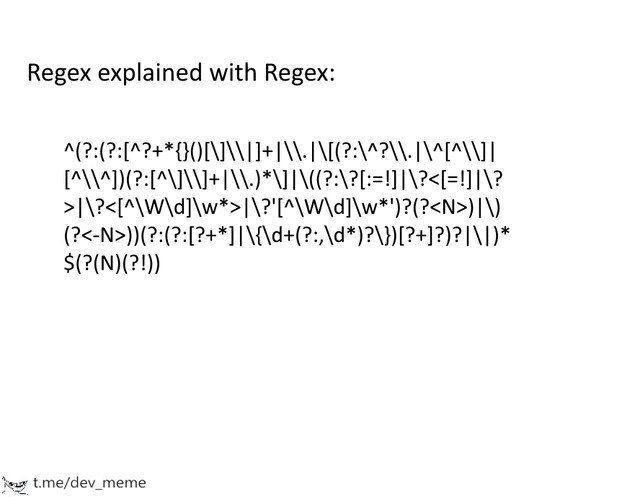
The image is funny because it promises to explain regex, but the explanation is itself a very complicated regex. That is like asking for directions and receiving a map folded into the shape of another map. It may contain the answer, but first you need to survive the format.
For newer developers, this is a useful warning about code readability. Regex is not bad. It is a powerful tool. But as patterns get longer, they become harder to debug and easier to misunderstand. Good projects often add tests, comments, named helper functions, or a real parser when the pattern starts looking like the one in the image.
Level 3: Maintainability Nightmare Fuel
The humor lands because regular expressions have a strange social status among developers. They are indispensable for text processing, validation, extraction, search, syntax highlighting, log parsing, and quick data cleanup. They are also notorious for becoming write-only code. The image captures that contradiction by using regex to explain regex, producing something that is technically related to the topic and almost maximally hostile to human understanding.
The visible expression contains anchors like ^ and $, escaped brackets, character classes, groups, alternation, quantifiers, and named-group-looking constructs. Each piece has a purpose, but the whole thing reads like a keyboard had a production incident. That is the senior-developer pain point: a regex can be correct, tested, and still be a maintainability hazard. Six months later, the person who wrote it may approach it with the same caution as everyone else, because past-you rarely leaves a runbook.
This meme also satirizes the temptation to solve parsing problems with one heroic pattern. Regex is excellent when the target language is simple and local: find an email-ish token, split a log line, validate a small format, extract a version number. Trouble starts when the input has nested structure, escaping rules, comments, multiple dialects, or helpful users who paste the one case nobody considered. At that point, the regex grows defensive armor: more groups, more alternation, more escaping, more conditional logic, and fewer surviving friendships.
There is a real trade-off here. A short regex can replace dozens of lines of manual string handling. A monstrous regex can replace dozens of lines of readable parser code and then charge interest forever. The joke is that the “explanation” demonstrates the problem more effectively than any documentation could. It is a tutorial that teaches exactly one lesson: yes, regex can do that; no, this does not mean you should ship it without tests and a comment.
Level 4: Automata Eating Syntax
The image says:
Regex explained with Regex:
and then presents a dense multi-line expression starting with ^(?: and ending with $(?(N)(?!)). That ending is especially telling: it resembles a conditional check used with named or balancing groups, a feature from practical regex engines rather than the clean mathematical definition from an automata textbook. The meme is not just “regex is hard.” It is showing a regex-like machine attempting to describe regex syntax, which is roughly where the mirror starts screaming.
In formal language theory, a regular expression describes a regular language, and every regular language can be recognized by a finite automaton. Classical regex operators include concatenation, alternation, and repetition. Those are powerful, but bounded in an important way: a finite automaton has no unbounded memory stack. That means pure regular expressions cannot naturally count arbitrarily nested parentheses, because balanced nesting is the kind of structure associated with context-free languages.
Real-world regex engines complicate this tidy story. Many modern flavors add lookarounds, backreferences, named groups, conditionals, recursion, or balancing groups. Some of those features move beyond regular languages and into more expressive, less predictable territory. The visible pattern contains pieces like (?<N>), (?<-N>), and (?(N)(?!)), which suggest it is tracking group nesting so it can reject an expression with unmatched parentheses. That is clever, but it is also the kind of clever that turns code review into archaeology with syntax highlighting.
The theoretical joke is that explaining regex with regex collapses specification, parser, and validator into one line-noise artifact. A proper parser would usually tokenize the input, build structure, and report meaningful errors. This expression tries to encode a grammar-like check directly inside the matching engine. It is concise in the way a compressed crash dump is concise: information-dense, technically impressive, and absolutely not what you want as onboarding material.
Description
A mostly blank white meme image has the heading "Regex explained with Regex:" near the upper left. Under it is a dense five-line regular expression full of anchors, nested groups, character classes, escaped brackets, lookaround-like constructs, named group syntax, and the final visible ending "$(?(N)(?!))"; the bottom-left watermark reads "t.me/dev_meme." The joke is that explaining regular expressions with another regular expression makes the subject maximally self-referential and unreadable. It captures the familiar senior-engineer tradeoff where regex can be concise, correct, and still hostile to future maintainers.
Comments
5Comment deleted
Regex is the only documentation format where adding more explanation can increase the cyclomatic complexity of your eyebrows.
I can`t read it even with my mangekyou Comment deleted
use xxx (replace x with `) to post code blocks Comment deleted
Its kinda easy. Comment deleted
butt whatt itt means? Comment deleted