Skip to content
DevMeme
2153 of 7435
The Great Role Reversal: Humans Scroll, Machines Learn
AI ML Post #2403, on Dec 1, 2020 in TG

The Great Role Reversal: Humans Scroll, Machines Learn

Why is this AI ML meme funny?

Level 1: Phones vs Books

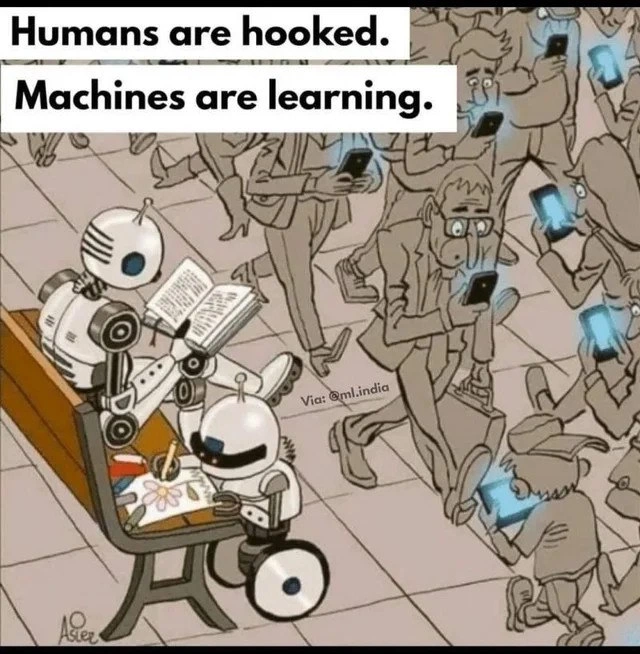
Imagine you walk into a classroom and see a really silly scene: all the kids (who are usually the ones learning) are not paying attention at all — they’re just staring at their phones, totally hypnotized. But at the back of the class, two little robots are behaving like star students: one robot is reading a big storybook and the other robot is drawing a beautiful flower with crayons. You’d probably giggle, right? It’s funny because normally you’d expect the kids to be reading and drawing and the robots (like toys) to be the ones just sitting there. But here it’s the opposite! The people have become like statues with phones, not really thinking, just stuck on the screen as if under a spell. Meanwhile, the robots are the ones learning new things and being creative.

This picture is showing in a simple way how sometimes grown-ups (and all of us, really) get so hooked on phones and tablets that we stop paying attention to the world around us. It’s as if the phone tricks us into staring at it for hours – like when you watch too many cartoons in a row and forget to do your homework. In the drawing, the humans look almost like sleepwalkers or zombies with blue light on their faces, which is silly and a bit sad. The robots, on the other hand, are doing the good stuff: reading books, studying, drawing art. They’re improving themselves. So the joke is kind of saying: people are acting like machines (just doing the same thing over and over on their phones), and the machines are acting like people (learning and exploring)! It makes us laugh because it’s a cartoon and an exaggeration — in real life robots don’t actually sit on park benches reading — but it also makes us think about how much time we humans spend on screens. The feeling you get is a mix of "Haha, that’s goofy!" and "Hmm, maybe we should be more like the robots and less like phone-zombies sometimes." In plain terms: the humans in the picture are stuck looking at their phones, and the robots are the ones getting smart. It’s a fun role reversal that points out how crazy our world can be today.

Level 2: Doomscrolling 101

At a more straightforward level, this meme is saying: people are obsessively using their phones, while robots are busy getting smarter. Let’s break down the key ideas. First, what do we mean by humans “hooked” on phones? In everyday terms, a lot of us have experienced digital addiction – that urge to keep checking apps, scrolling through feeds, or watching one more video even when it’s 2 AM. One popular term for this, especially when it involves endless bad news or social media, is doom-scrolling. Doomscrolling means you keep scrolling and scrolling, even if the news or content makes you sad or anxious, yet you can’t look away. The humans in the cartoon are doing exactly that: hunched over, eyes glued to the glowing screen, swiping away in a trance. Their posture and blank expressions say it all – they’re stuck on their screens like zombies. This is a familiar sight in the real world: think of commuters all looking down at their phones, or a family at dinner where everyone is checking Instagram. It’s so common that the tech industry talks about the screen time problem and how excessive screen time can affect us.

Now, what about the robots? They’re depicted as doing positive, active things: one is reading a book, and the other is drawing a flower. In the meme, these robots symbolize Artificial Intelligence (AI) or machine learning models. In real life, AI doesn’t literally sit on a bench with a book, but the cartoon shows the idea that AI systems are learning (like a student hitting the books) all the time. And what are they learning from? From us, the users. The statement “Machines are learning” refers to how our behaviors online become training data for algorithms. Training data is a machine learning term: it means the examples that a computer program studies to learn about patterns. For instance, if you want an AI to recognize cats, you feed it a lot of cat photos as training data. In the context of this meme, the training data is not cat photos or labeled images, but rather our own actions on apps. Every video you watch, every article you click, every second you linger on a post – that’s all data. And companies use that data to train their algorithms to predict what else you might like or how to keep you engaged longer.

This creates what we call a feedback loop. A feedback loop means the output of a system winds up influencing the input in a cyclical way. Here’s how that works step by step in a typical social media app:

  1. App shows content: You open the app, and it shows you some posts or videos.
  2. You react: You either enjoy and interact with what you see (maybe watch fully, hit “like”, leave a comment) or you ignore it (scroll past quickly, or close the app).
  3. App learns from your reaction: The app is tracking what you do – this tracking data is often called telemetry. It notes, for example, “User spent 10 seconds on Post A but 2 minutes on Post B” or “User liked 5 posts about cooking this week”.
  4. App adjusts what it shows next: Using that information (the training data), the algorithm (the decision-making program in the app) picks more content similar to what kept you engaged and less of what didn’t. So if you spent a lot of time on cooking videos, the app will show you more cooking content later. If you always skip dancing videos, it will stop putting those in your feed.
  5. Cycle repeats: Now you see the new, more tailored feed and step 2 happens again. Over time, the feed gets really good at showing you things that grab your attention – because it learned your preferences from past behavior.

This is the data feedback loop the meme mentions. It’s like a circle: the more you scroll, the more data you give; the more data the AI has, the better it gets at giving you stuff to scroll. It can become a vicious cycle of human distraction -> data -> smarter AI -> even more engaging content -> back to human distraction.

If you’re a newer developer or just starting in tech, you might have already encountered pieces of this concept. For example, have you heard of an A/B test? That’s when a developer or designer shows two different versions of something to users (say, two button colors or two feed algorithms) to see which one performs better (e.g., which keeps users on the app longer). The idea of an A/B test is to use real user behavior as data to make design decisions. It’s a simpler, manual example of apps learning from users. Many popular apps are constantly running experiments like this to tune their experience. As a junior dev, your first exposure to this might be adding analytics to an app – maybe logging an event whenever a user clicks a certain feature, so the team can see if that feature is engaging or not. Those analytics events are a form of behavioral data collection, just like the humans’ phone usage in the meme generates data.

Let’s connect this back to the image elements:

  • Humans on phones: They represent us, the users, and our tendency to get hooked by well-designed apps. Terms like digital_addiction, phone_scrolling, and screen_time all describe this scenario of people compulsively interacting with their devices. We’ve all seen how a cleverly designed app can cause human distraction for hours.
  • Robots reading/drawing: They personify the AI systems that observe and learn from the data we produce. In reality, AI isn’t a cute robot with a sketchpad, but it is constantly improving through training data. The big robot reading a book mirrors how AI systems ingest huge amounts of information (like reading a book of our behavior logs). The small robot drawing might symbolize creativity or producing output – perhaps hinting that AI will use what it learned to create new things (for example, recommending you a new video or even generating content like an artwork).
  • Banner text “Humans are hooked. Machines are learning.”: This is basically the meme’s caption, saying in plain words what’s happening. Humans are hooked = people are addicted to their phones. Machines are learning = AI is learning from everything those people are doing. The credit “Via: @mi.india” just indicates the source or artist handle, which is not part of the joke itself but a nod to who made the cartoon.

To make it even clearer, consider a few simple examples of your own phone usage and what it means to the AI behind an app:

What you do on your phone What the app’s AI learns or does with that info
You watch a video till the end, without pausing. The app takes note: "You loved that video!" It will show you more content like that (same topic or style) since you seemed interested.
You scroll past a post immediately, barely looking at it. The app learns "That post didn't catch your attention." It will show you fewer things similar to that post in the future.
You click “Like” on a photo of a cute puppy. The system now knows you enjoy cute animal photos. Expect to see more adorable puppy or kitten pictures on your feed.
You spend 2 straight hours scrolling one night. The app realizes "Wow, we really got them tonight!". It might ramp up showing you even more engaging stuff (and probably a couple of ads too, since you're hooked). It confirms that its strategy to keep you engaged is working.

As you can see, your actions are effectively teaching the machine. In machine learning terms, you’re providing labeled examples: liked this, didn’t like that, stayed long here, left quickly there. The algorithm (which is just the set of rules or a model that makes decisions in the app) uses those examples to improve. So the meme is pointing out this somewhat funny truth: every time we, humans, are lazily scrolling on the couch, there’s an AI algorithm somewhere that’s hard at work learning from it. It’s as if the AI is a diligent student and we’re unknowingly the tutors giving it lessons through our behavior.

The overall tone is both humorous and a little critical. It’s funny because of the reversal – robots acting human (studious, creative) and humans acting robotic (mindlessly repeating the same action of scrolling). But it’s also making us think: are we letting ourselves become data-producing machines while the actual machines are becoming smart creative thinkers? For anyone new to tech or not, it’s a clever illustration of the saying "learning from the best" – except here the “best” might not be us anymore if all we do is stare at our phones!

Level 3: Hooked on Data

This meme nails a piece of tech industry satire that rings painfully true: humans glued to their phones, while robots (i.e., AI algorithms) quietly get smarter. The humor comes from role reversal. In theory, people are supposed to be the creative, learning beings and machines just dumbly follow code. But here, humans are depicted as zombie-like screen addicts — slouched, glassy-eyed, bathed in that eerie blue glow — while the robots on the bench are studious and vibrant. Notice how the artist drew the humans in drab gray tones and the robots in bright, lively colors. That color contrast is deliberate: it implies that excessive screen time has drained the humans of their vitality (turning them into monotone drones), whereas the machines, joyfully “reading” and “drawing,” are full of life (colorful and curious). It’s a visual gag that any developer who’s pulled an all-night Twitter doom-scroll can relate to. We’ve met the zombie, and it is us. 😅

Beyond the art, the meme comments on the attention economy in a way that tech folks will instantly recognize. “Humans are hooked” alludes to how modern apps and platforms deliberately hook users with addictive UX patterns. Think of infinite scrolling feeds, autoplay videos, push notifications — all designed to keep you engaged (or rather, entranced). It’s well-known inside the industry that if you’re not paying for the product, you are the product. User attention and behavior data have become the currency. This is what the meme calls the “training data feedback loop.” Every moment of digital addiction (those hours of mindless phone scrolling) is being siphoned into data that tech companies use to refine their machine learning models. In other words, while you're binging on content, the apps are binging on telemetry about you. It’s a bit like a farm: we humans are harvesters of content (consuming lots of it), and simultaneously we’re the crop being harvested (our data is collected) to feed the AI. Creepy? Absolutely. But also darkly funny when depicted as robots literally studying on a park bench while humans kneel at the altar of the smartphone.

The phrase "Machines are learning" is a sly nod to machine learning in practice. Those two cartoon robots represent AI systems improving themselves in real-time. Consider any big social media or content platform: behind the scenes, there are recommendation algorithms observing what you linger on vs. what you ignore. It’s AIHumor with a kernel of truth: the machine is effectively people-watching and taking notes. For example, if a user spends an extra 5 minutes scrolling cat videos, the algorithm makes a note (“user really likes cats”) and serves even more cat content. If breaking news about, say, a celebrity scandal causes a spike in engagement, the machine learns that juicy gossip could keep people hooked and adjusts what stories to push next. The feedback loop here is that user behavior influences the machine’s behavior, which then influences user behavior again. It’s like a never-ending cycle of data-driven one-upmanship: we give the AI data, the AI gives us ultra-refined content, which makes us give more data... and round it goes.

This resonates strongly with anyone aware of AI hype vs. reality. There’s so much hype about sophisticated AI models, but the reality is that much of their "intelligence" comes from massive amounts of human-generated data. The meme distills this: humans mindlessly swipe through apps, machines learn from every swipe. It's a cynical commentary on tech trends — one that engineers and product designers swap knowingly over coffee. We’ve even coined terms like “user engagement” and “growth hacking” which essentially boil down to finding ways to maximize that hooked state. Entire teams in big tech companies are devoted to increasing those metrics: longer sessions, more clicks, higher retention. This meme playfully exposes the underbelly of that approach.

To put it in a real-world scenario: imagine a meeting at a social media company. The product managers are discussing how to improve the recommendation algorithm to boost engagement by 5%. Someone suggests: "People seem to watch a lot of prank videos late at night — let's surface more of those." That’s a data-driven decision based on usage patterns. The result? Even more people stay up past midnight chuckling at their phones, giving the algorithm confirmation it was right. Human distraction increases; the algorithm grows more confident in its tactics. It’s a vicious cycle (or a data feedback loop, as the caption says). This is why the meme feels “too real”. Most of us have experienced that weirdly targeted feed that knows our tastes a little too well, or noticed we spent an extra hour on an app without meaning to. It’s not magic or mind reading — it’s machine learning models quietly doing their job. And their job is literally to learn what makes us tick (or click).

Many experienced developers also recognize the subtle cautionary tale here. The image implies a future where robots (AI) might outpace humans because they had the luxury to focus on learning while we were busy scrolling. It's a tongue-in-cheek echo of sci-fi tropes: instead of Terminators coming with lasers, they’re coming with PhDs because we were all glued to TikTok. 📱🤖 The robots won't need to conquer us by force if we hand them the world by ignoring it, right? That's the kind of half-joking, half-serious watercooler remark this meme elicits in engineering circles. In summary, "Humans are hooked, Machines are learning" is tech humor pointing out an uncomfortable truth: we have willingly become test subjects and teachers for the very AIs that were supposed to serve us. We laugh, but maybe we also nervously glance up from our own phones, wondering just how much the machines have learned today.

Quick contrast: The meme’s core joke can be summed up as humans vs. AI, consumption vs. education. We can imagine it as a table of who’s doing what:

Human Behavior (Hooked) AI/Robot Behavior (Learning)
Mindlessly scrolling social media feeds late into the night. Actively analyzing which posts or videos kept the user scrolling.
Tapping likes, reacting emotionally to clickbait headlines. Recording each like as a data point to refine interest profiling.
Binge-watching autoplay videos on YouTube/Netflix. Noticing the binge and fine-tuning the recommendation engine to serve a similar sequence next time.
Getting distracted by endless notifications. Continuously updating its model with every notification you open (learning what grabs your attention).
Feeling addicted and unable to put the phone down. Growing more accurate in predicting content to keep you engaged tomorrow.

In essence, we’re on the left column, the AI is on the right. The meme humorously illustrates this lopsided partnership.

Level 4: Backpropagating Behavior

At the deepest technical layer, this meme hints at a self-reinforcing machine learning feedback loop. Every flick of a human thumb on a phone is essentially a training example for an algorithm. In advanced terms, it's like a reinforcement learning system where the environment is human behavior and the agent is the content-selection algorithm. Each time a person doom-scrolls a little longer, the algorithm treats it as a reward signal: "This content kept them hooked, do more of this." Conversely, when a user swipes past or closes the app, it's a negative signal: "Adjust strategy, keep their attention!". Over millions of users, the model continuously updates (think of stochastic gradient descent tweaking weights) to better predict and manipulate what will maximize engagement. This creates an algorithmic ouroboros – a snake-eating-its-tail scenario – where human screen time feeds data into AI, and AI, in turn, optimizes to increase human screen time. It’s a closed-loop system, not unlike a thermostat adjusting to reach a target temperature, except the thermostat is a recommendation engine and the target is your attention.

From an information theory perspective, those glowing phones are sensors collecting behavioral telemetry: every tap, scroll, pause, and click is quantified. That massive dataset is the training data pipeline fueling improvements in the model. The bigger robot reading the book in the meme wryly represents the AI avidly studying this inbound data. The smaller robot drawing a flower hints at the AI starting to produce its own creative output, having learned from human patterns. There’s an implicit contrast to classical supervised learning: here nobody explicitly labeled “this is engaging” – instead, human actions label the data implicitly (a form of self-supervised learning on our preferences). The humor has a razor’s edge: the machines aren’t just coldly crunching numbers, they’re portrayed as joyfully learning, which is both a satirical and literal truth in modern AI systems that improve via user interaction.

It also touches on some deeper AI ethics and theory. The scenario is a textbook case of Goodhart’s Law: when a proxy metric becomes a target, it ceases to be a good metric. Platforms target watch time or clicks as a measure of success, so algorithms relentlessly optimize for those. The result? They often serve up ever more sensational, addictive content to drive the metric up, whether or not it's truly good for the user. This is an unintended consequence of the objective function. In control theory terms, the system lacks constraints on how to achieve the goal, so it exploits every human psychological vulnerability to minimize the “loss” (where loss might be defined as user boredom). The meme’s “Humans are hooked. Machines are learning.” tagline succinctly captures this asymmetry: humans are stuck in a local minimum of mindless scrolling, while the machines continuously refine their weights and biases (figuratively speaking) to achieve a more optimized state. It’s a stark illustration of the modern attention economy’s engine, where human behavior is both the fuel and the product. And as absurd as the cartoon looks, it’s grounded in the real dynamics of AI systems quietly learning from and capitalizing on our every digital move.

# Pseudocode of the engagement feedback loop
while user.is_online:
    content = recommender.pick_next(user)
    show_to_user(content)
    reaction = user.get_reaction(content)      # e.g., watch duration, click, skip
    recommender.update_model(content, reaction)

Above is a simplification, but it’s essentially what happens millions of times a second. The recommender system selects content, observes the user’s reaction, and backpropagates that feedback into the model. Over time, this loop converges: the content becomes highly tailored to tickle the user's brain just right. The meme’s robots-with-books imagery is a cheeky metaphor for those algorithms growing ever more “learned” with each iteration. In short, the cartoon is comic relief built on a genuinely complex reality: our digital distraction is governed by algorithms that learn (almost in a scholarly way) from our every swipe. The fundamental irony? We’ve built machines that excel at understanding human weakness — and they do so by voraciously reading the book that we unknowingly write for them with every notification click and late-night scroll.

Description

A satirical cartoon depicting a stark contrast between humans and robots. In the foreground, two robots are sitting on a park bench. A larger, more humanoid robot is engrossed in reading a physical book, while a smaller, childlike robot on a single wheel is happily coloring a picture of a flower with crayons. In the background, a large crowd of monochrome-styled humans walks by, every single person staring down at their brightly glowing blue smartphones, oblivious to the world around them. The text overlay at the top reads, 'Humans are hooked. Machines are learning.' There is a small watermark 'Via: @ml.india' and an artist signature 'Aster' in the bottom left. The illustration serves as a powerful social commentary on the state of technology and society, suggesting a role reversal where machines are pursuing creative and intellectual growth while humans are lost in passive consumption and digital addiction. For tech professionals, it's a poignant reflection on the products they build and the societal impact of AI and engagement-driven platforms
Comments

17
Anonymous ★ Top Pick We're meticulously training models to understand the nuances of human creativity, while the actual humans are busy training the models on how long they can stare at a loading spinner
  1. Anonymous ★ Top Pick

    We're meticulously training models to understand the nuances of human creativity, while the actual humans are busy training the models on how long they can stare at a loading spinner

  2. Anonymous

    Turns out the real MLOps architecture is planet-scale: humans run as sidecar containers generating dopamine-labeled clickstreams so the robots can hit their next accuracy SLA

  3. Anonymous

    The real singularity isn't when AI surpasses human intelligence - it's when your ML model has a better attention span than your entire engineering team combined, and the only thing getting reinforcement learning is our dopamine receptors from notification badges

  4. Anonymous

    The real plot twist in machine learning: we thought we were building intelligent systems, but we've actually just created the world's most elaborate data labeling workforce - ourselves. Every swipe, click, and scroll is a training sample. The robots aren't taking our jobs; they're just sitting back with a good book while we frantically generate their datasets. Turns out 'human-in-the-loop' meant we're the loop, and the exit condition is undefined

  5. Anonymous

    RLHF in prod: Real Life Habit Formation - users doomscroll to label data, models learn, and the only ones reading the docs are the bots

  6. Anonymous

    Our doomscrolling generates the unlabeled data they gradient-descend on to surpass us - ultimate self-own dataset

  7. Anonymous

    We optimized the reward to “engagement” and accidentally put the users in the training loop - models converge, humans overfit to the feed

  8. @TERASKULL 5y

    phone bad book good upvotes to the left

  9. @GLXBX 5y

    True

  10. @zherud 5y

    imagine machines reading books when they can just download data from server.

    1. @obuyadude 5y

      OCR maybe? For hand-written or non-digitized content?

      1. @diminddl 5y

        H 3lIo

  11. @nickyfostr 5y

    Imagine being a human in 2020 when u can be a machine

  12. Deleted Account 5y

    I bet the dev who made this writes in cobol

  13. Deleted Account 5y

    Damn boomers

  14. @diminddl 5y

    OCR is not that good for written text

    1. @obuyadude 5y

      :)

Use J and K for navigation