Architectural Vision vs. The Delivered Feature
Why is this DesignPatterns Architecture meme funny?
Level 1: Dreams vs Duct Tape
Imagine you have a picture in your head of building the most amazing treehouse ever – with painted walls and cool horse decorations. But then you actually try to build it over a weekend. You run out of time and materials, so instead of a carved wooden horse like you dreamed, you just take a cheap toy horse and tape it to a post. It’s not pretty, but it kind of looks like what you wanted if you don’t stare too closely. This is exactly what the meme is joking about. In our imagination, things are perfect, like a beautiful work of art. In reality, we do whatever it takes to get it done, even if that means using tape to hold things together. It’s funny and relatable because everyone knows the feeling of expecting something grand and ending up with something a bit silly. The fancy horse vs. taped toy horse makes us laugh because it’s a goofy way to show the difference between what we hope for and what we actually get.
Level 2: Tape It and Ship It
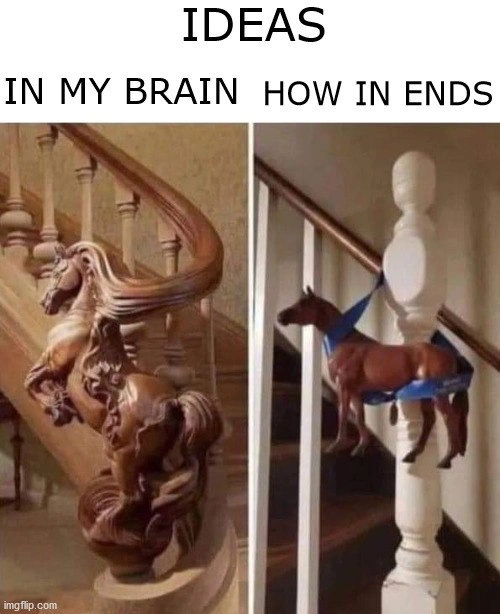
The meme shows two stairway banisters, each with a horse figure, but one is a grand masterpiece and the other is an obvious quick fix. On the left, “IN MY BRAIN” sits atop a picture of a beautifully carved wooden horse worked seamlessly into the stair railing. This represents a developer’s ideal design vision – the kind of perfectly crafted solution you plan at the start of a project. On the right, labeled with the humorously misspelled “HOW IN ENDS” (meant to be “how it ends”), we see a cheap plastic toy horse literally taped to a plain post. This comically represents what actually gets delivered to production after the project encounters reality (tight deadlines, bugs, and changing requirements).
In software development, it’s common to start with big ideas of writing clean, elegant code using all the right patterns. You might think about applying solid architecture, maybe using well-known design patterns (like the SOLID principles for maintainable code). That’s the left image: everything polished. But as you start coding, unexpected challenges pop up. Perhaps a library doesn’t do exactly what you expected, or an urgent feature request forces you to change course. You begin adding quick fixes: a hardcoded value here, a copy-pasted function there – just to make things work. Over time, those fixes accumulate into what we call technical debt. Technical debt is like taking coding shortcuts that you promise to clean up later (but “later” often never comes). The right image with the horse strapped by tape is basically one giant shortcut on display. It’s held together, not elegantly, but hey, it works!
Spaghetti code is a term newbies learn to dread – it means code that’s tangled and messy, like a bowl of spaghetti. Instead of well-structured modules (the nice carved banister), you get a tangle of interdependent code where nothing is clearly organized (the toy horse just taped on randomly). New developers often experience this gap firsthand: you set out to write something perfectly, but by the time you finish your first big feature, the code looks nothing like the neat plan you had. Maybe you skipped proper refactoring (the process of cleaning and improving code) because the deadline was looming. Refactoring is like carving that block of wood carefully to get the horse shape; skipping it is like saying “forget carving, just tape a toy on it, we gotta deliver now.” In the real world (RealWorldVsIdeal scenario), developers often have to balance ideal solutions with practical constraints. This meme humorously highlights that balancing act by exaggerating the difference — turning a beautiful idea into a ridiculous taped-up reality.
The phrase “Tape It and Ship It” is essentially what happens in crunch time: instead of building the perfect horse, you duct-tape whatever you have and ship the product out the door. It’s funny in a bittersweet way because every coder has been there. You know the code or design isn’t pretty, but it’s what you’ve got working before the deadline, so out it goes. The hope is that later you can go back and fix it (pay off that technical debt), carving that messy plastic horse into the elegant sculpture it was meant to be. But until then, the production version might be a bit of a taped-together hack. This meme uses an everyday object lesson to make that software engineering truth crystal clear — and that’s why it resonates with developers at all levels.
Level 3: From SOLID to Spaghetti
At the architecture whiteboard stage, everything is pristine. In our heads we’re galloping freely with SOLID design principles – classes perfectly separated, neat interfaces, and zero redundancy. That left image of the elaborately carved horse banister is basically your mental UML diagram: ornate, over-engineered perhaps, but undeniably elegant. Fast forward to real life coding under a brutal deadline, and the result often looks like the right image – a crude toy horse strapped on with blue tape. In software terms, that’s a bunch of quick hacks and workarounds holding the product together. The meme hits hard because every senior developer has witnessed beautiful plans disintegrate into spaghetti code once the heat is on.
Why does this transformation happen? Scope creep, last-minute changes, and “just make it work” pressure are the usual suspects. You start building with noble intentions of high CodeQuality and robust design, but then the database returns weird nulls, an urgent feature request pops up, and suddenly you’re bolting on fixes at 2 AM. It’s a classic case of TechnicalDebt accumulation: each shortcut (a quick tape here, a zip-tie there) lets you ship on time, but leaves the codebase held together by proverbial duct tape. The elegant galloping horses of your initial vision turn into a limp plastic horse you pray doesn’t fall off during a demo.
This meme also satirizes the painful gap between developer expectations vs. reality. We joke about it because it’s an industry rite of passage. Remember that time you imagined writing a modular microservice masterpiece, but the deployed app became a monolithic ball of mud? Yeah, that. The left panel’s magnificent woodwork is the over-ambitious spec document, while the right panel’s taped toy is the actual commit tagged v1.0.0. From afar it might technically resemble what was promised (“hey, it’s a horse, right?”), but up close it’s absurd. Stakeholders see something delivered; developers see the ugly compromises behind the scenes.
Architect (then): “We’ll craft a flawless, scalable solution with beautiful code!”
Developer (now): “Just strap this on and deploy… we’ll fix it in post.”
The humor cuts deep because we’ve all been that developer. High-minded designs often meet messy reality, especially when refactoring gets skipped. The “IN MY BRAIN” side is how you’d build it with unlimited time and no pesky constraints. The “HOW IT ENDS” side is what you release after fighting through integration hell and JIRA scope changes. It’s a banister horse all right – just not quite the majestic stallion you envisioned. In the end, we ship the duct-taped pony and tell ourselves it’s temporary, even as it gallops into production and haunts our on-calls. This meme nails that implementation_gap with darkly comic precision: the difference between dreaming in architecture astronaut land and delivering under real-world constraints is literally night and day (or in this case, carved wood vs. taped toy).
Description
A two-panel meme contrasting a grand idea with its poor execution. The left panel, labeled 'IDEAS IN MY BRAIN', shows a magnificent, intricately carved wooden horse seamlessly integrated into the newel post of a grand staircase. The right panel, labeled 'HOW IN ENDS', displays a cheap, plastic toy horse crudely attached to a simple white newel post with blue painter's tape. The text, though grammatically awkward ('HOW IN ENDS' instead of 'HOW IT ENDS'), effectively communicates the core message. This meme resonates deeply with experienced developers who have seen brilliant, elegant architectural designs and project visions devolve into clumsy, hacky implementations due to deadlines, budget constraints, or shifting requirements. The beautiful carved horse represents the perfect 'greenfield' plan, while the taped-up toy represents the technical debt-ridden reality of the final product
Comments
12Comment deleted
The first image is the system diagram shown to the stakeholders. The second image is the 'temporary' fix from three years ago that's now a load-bearing part of the infrastructure
Design doc: stateless CQRS stallion galloping through event streams. Production: a singleton God class blue-taped to the monolith, neighing 500s every deploy
After 15 years of architecting distributed systems, I've learned that the gap between my whiteboard diagrams and what actually ships is roughly the same as the gap between a Bernini sculpture and whatever that horse thing is supposed to be
Every architect's journey: You start designing a microservices mesh with event sourcing, CQRS, and saga patterns documented in beautiful C4 diagrams. Six sprints later, you're duct-taping a monolith to a cron job and calling it 'pragmatic engineering.' The dragon became a plastic horse, but hey - it ships on Friday and the stakeholders can't tell the difference from their Jira dashboard
Brain: Distributed consensus via Raft. Prod: Shared Excel on NFS with manual merges
On the whiteboard it’s an elegant, event‑driven stallion; in prod it’s a plastic pony zip‑tied to the legacy banister, hidden behind a feature flag and two cron jobs - because “MVP by Friday” beat “architecture that lasts.”
The architecture doc promised a hand-carved domain model; after pivots, vendor SDK quirks, and a Friday demo, we shipped the MVP - a toy horse duct-taped to prod behind a feature flag, with NFRs deferred to “phase two.”
Juan Comment deleted
you guys finishing your ideas? Comment deleted
Juan Comment deleted
man Comment deleted