Skip to content
DevMeme
1936 of 7435
The Great Refactoring Effort: From Caterpillar to Caterpillar with Wings
Refactoring Post #2151, on Oct 15, 2020 in TG

The Great Refactoring Effort: From Caterpillar to Caterpillar with Wings

Why is this Refactoring meme funny?

Level 1: Hiding the Mess

Imagine you have a super messy bedroom: toys all over the floor, clothes piled on the chair, crayons scattered everywhere. Your parent asks you to clean it up so it can be neat and nice (like turning that messy caterpillar into a beautiful butterfly 🦋). You spend some time “cleaning,” but what you actually do is shove all the toys under your bed, push the clothes into the closet, and maybe dust off the top of your dresser. Now the room looks a little better at first glance — there are no toys on the floor now, hooray! But when you really look or try to find something, you realize the room is still a big mess, just a hidden mess. The toys and clothes are all still there, just out of sight. You didn’t truly organize or fix anything; you just moved the mess around.

That’s exactly what happened in the funny picture with the caterpillar. We thought we were going to fix the code and make it as awesome as a butterfly. But after all the “cleaning up,” the code was basically the same as before, just with a tiny change (like the caterpillar got two tiny wings that don’t even work). It’s like our room: we expected it to be sparkling clean, but it’s really still messy under the bed. The joke is that sometimes we put in a lot of effort to improve something and it ends up almost the same as when we started, just slightly dressed up. It’s funny in a “oh no, I’ve done that!” kind of way. Even though the caterpillar tried to become a butterfly, it’s still a caterpillar at heart — and even though we tried to tidy the room by hiding stuff, it’s still messy at its core. So the lesson? Real change is hard, and just hiding the mess (or giving a caterpillar tiny wings) doesn’t really fix the problem, but it sure makes for a good laugh when we realize what we did!

Level 2: When Code Won’t Fly

Let’s break down what’s happening in this meme for a less experienced developer. The comic shows a caterpillar turning into a butterfly as an analogy for code refactoring. Normally, in nature, a caterpillar goes into a cocoon (also called a chrysalis) and comes out completely transformed — it can fly, it’s beautiful, it’s totally different. Many developers expect refactoring to do the same for code: take a clunky, ugly program (caterpillar code) and turn it into something elegant and efficient (butterfly code). Refactoring means changing a code’s internal structure to improve it (make it cleaner, more readable, easier to maintain) without changing what it actually does. It’s like cleaning up the mess in the code’s room. Ideally, after refactoring, the code’s behavior is the same for users, but inside it’s much nicer and more organized for developers. This often involves removing code smells (common signs of bad design, such as super long functions or duplicate code) and paying down Technical Debt (things the team knows are quick-and-dirty solutions that should be improved when there’s time). When you tackle technical debt, you’re basically doing the cleanup or “paying back” the debt by refactoring messy parts of the code that were left in a hurry.

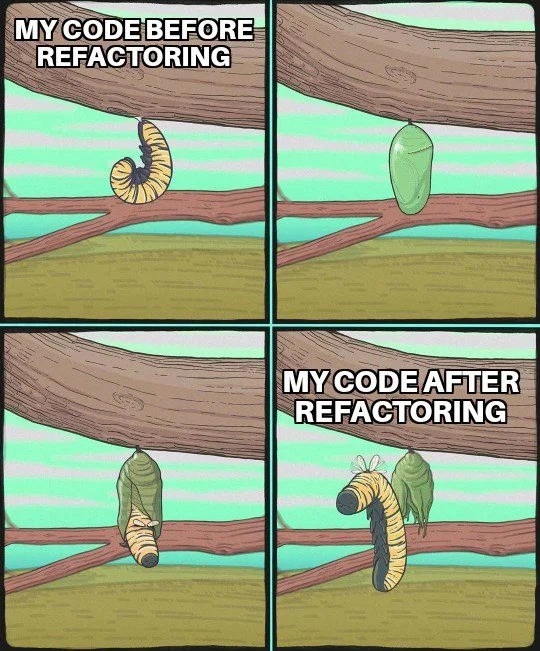
Now, in the first panel titled "MY CODE BEFORE REFACTORING," we see a plump, yellow-and-black caterpillar hanging from a branch. That represents the original code — maybe it’s not pretty or optimal, but it’s alive (it works). It likely has issues: for example, perhaps it’s a single 1000-line function, or variables with meaningless names like data1, data2, and lots of repetitive logic. These are the kinds of code quality problems that make developers cringe and say, “We really should refactor this.” The idea is that by refactoring, we could turn this ugly caterpillar code into a well-structured butterfly.

The second panel shows the caterpillar encased in a green cocoon. This is like the refactoring process itself. The developer is hard at work here, wrapping the code in changes. Maybe they’re breaking that giant function into smaller functions, renaming those data1 and data2 variables to something clearer like customerList and orderList. They might be moving some classes into new files or introducing a new interface to improve modularity. In a real scenario, a junior dev might excitedly do these tasks thinking, “Just wait, this code is going to be so clean!” The cocoon stage is all the effort and time spent on the cleanup.

In the third panel, the cocoon is opening... but uh-oh! We can see the same caterpillar body inside. The refactoring process is nearing its end, and it’s becoming clear that things haven’t fundamentally changed. Maybe those improvements were only skin-deep. For example, yes, the function has been split into two, but those two functions are each 500 lines long and still hard to understand. Or you introduced a new class for a part of the code, but that class is now tightly coupled to the old ones — the design didn’t really improve, it just moved around. If this were code review time, you’d realize you didn’t actually eliminate any real complexity; you just shuffled it. The expectation vs reality is sinking in.

Finally, the fourth panel says “MY CODE AFTER REFACTORING,” and we see the caterpillar out of the cocoon, looking almost the same as it did before, except now it has two puny wings. This is the punchline: after all that refactoring, the code is still a caterpillar. It might have some appearances of improvement — like those tiny wings, maybe the code has slightly better naming or a bit more structure — but it’s not a butterfly. It can’t “fly.” In coding terms, maybe it doesn’t run much faster, it isn’t much easier to add new features to, or the messy logic is still largely there. The changes didn’t deliver the dramatic improvement everyone hoped for.

This resonates with developers because it’s common to feel this refactoring pain. You set out thinking, “I’m going to refactor this messy system and make it awesome.” You spend hours or days on it. Then you run the tests (hopefully you have tests!) and everything still works — which is good — but when you step back and look at the code, you realize it’s… well… different, but not really better. The same confusing flow might exist, just split into more files. The same global variables might exist, just renamed. The code’s core structure (its “caterpillar body”) didn’t truly change, so it’s still awkward. That can be frustrating: the technical debt hasn’t gone away. You basically gave the caterpillar a makeover, but it’s no butterfly.

For example, imagine you have a program that calculates something but the code is all in one place and very tangled. You decide to refactor. You break the code into three modules, you rename some functions, and you remove a few duplicate lines. When you’re done, those are nice improvements, yet you discover the program’s design is still hard to follow. It still has the same weird dependencies between modules, and adding a new feature is just as confusing as before. That’s like those tiny wings — yes, they’re an addition, but the caterpillar code can’t actually take off. The overall improvement to code quality is minimal.

So, the humor here is a bit self-deprecating for developers: we laugh (maybe a bit sadly) because we’ve all done a “refactor” that changed lots of lines, but in retrospect, didn’t really solve the big issues. It’s a classic case of refactoring expectations vs reality. We expected a glorious butterfly (an elegantly refactored codebase) and ended up with basically the same clunky system, just wearing two green wings that don’t work. The meme uses the failed metamorphosis analogy to highlight how sometimes our big code clean-up efforts result in only superficial changes. It’s a lighthearted reminder that effective refactoring is hard — you can’t just wrap the code in a cocoon and hope; you need time, good design, and often tests to ensure you can truly change its form. Without those, you risk ending up in the situation shown here: caterpillar code before, caterpillar code after.

Level 3: Cocoon of Debt

Picture a developer embarking on a grand refactoring mission: the codebase is the caterpillar, full of stripes (read: code smells and kludges) crawling along and barely doing its job. The plan? Wrap this ungainly creature in a shiny green chrysalis of refactoring efforts and watch a beautiful, elegant butterfly emerge (the kind of pristine architecture you read about in Clean Code). But in this meme’s hilariously honest outcome, what wriggles out is still basically a caterpillar – now sporting two comically tiny wings. In other words, after all that work, the code still can’t fly.

This hits home for any senior engineer who’s survived a “refactor all the things” sprint, only to realize the system’s fundamental design hasn’t changed one bit. We’ve all seen it: you check in a massive refactoring PR, thousands of lines diffed, hoping to reduce complexity or pay down Technical Debt. Yet, when the dust settles, the core structure is strikingly unchanged – the big ball of mud is still a big ball of mud, maybe with a fresh coat of paint. The meme exaggerates this with the caterpillar life cycle: we expected a miraculous metamorphosis, but got a slightly different caterpillar. It’s the Non-Butterfly Effect, if you will. 🐛✨ (Chaotic systems theory pun fully intended). The code went through the motions of change (much like our larva snug in a cocoon), but it emerged with the same old problems, just reorganized.

Why is this funny to experienced devs? Because it’s painfully relatable. We know true refactoring is supposed to improve CodeQuality and maintain behavior while cleaning internals. But often, due to tight deadlines, fear of breaking legacy logic, or sheer scope creep, the refactor only addresses superficial issues: maybe splitting one giant function into two slightly less giant functions, or renaming FooManager to BetterFooManager (yeah, that’ll save us 🙄). The result: TechnicalDebt remains alive and well, like a caterpillar’s heavy body dragging down those tiny new wings. The codebase might have a new folder structure or a few new interfaces, but the tangled dependencies and weird edge-case logic are all still there, just shuffled around.

This scenario is a classic case of “refactoring in name only.” It’s reminiscent of rearranging deck chairs on the Titanic (or should we say, rearranging leaves in the caterpillar’s terrarium). Everyone hoped for a soaring butterfly of a program — faster, cleaner, easier to extend — but what they got was basically the same critter with decorative additions. Those little wings in the last panel? Think of them as token improvements: maybe a couple of new unit tests, some variables renamed from temp to customerCount, or a new class extracted that still calls all the same old procedures. These changes are not useless (just like wings aren’t totally pointless), but they’re far from transformative. The code still crawls under the weight of outdated design decisions.

There’s an implicit “expectation vs reality” joke here that seasoned devs know too well. Management or a gung-ho team lead might have promised that a refactoring sprint would solve our problems: “We’ll turn this legacy monolith into a sleek microservices architecture!” — the butterfly dream. Weeks later, the system is still a monolith (just split into microservices that are tightly coupled 😅). The developer humor comes from that letdown. It’s a coping laugh at countless real-world attempts where refactoring didn’t slay the dragon of complexity, it merely taught it to wear a bowtie. The RefactoringPain is real: you spend late nights untangling code, expecting catharsis when it finally compiles… only to find that the new version is just as confusing, albeit differently organized.

A senior perspective also catches the dark irony: the meme’s title “The metamorphosis” echoes Kafka’s novella where the protagonist turns into a giant bug. Here, our code was supposed to undergo a positive metamorphosis, but ironically it stays an overgrown bug (caterpillar). It’s a wink to the literary reference — a failed metamorphosis analogy that every overworked developer can appreciate. In the end, the humor is equal parts sigh and snicker: yes, we’ve been there. The code before vs after refactor looks shockingly similar, and we’re left holding a caterpillar wondering where our butterfly went.

Description

A four-panel comic strip that humorously depicts a failed software refactoring effort using the metaphor of a caterpillar's metamorphosis. In the first panel, a caterpillar is shown on a branch with the label 'MY CODE BEFORE REFACTORING.' The second panel shows the caterpillar having formed a chrysalis, representing the process of refactoring. The third panel shows the chrysalis breaking open, with the unchanged caterpillar emerging. The final panel, labeled 'MY CODE AFTER REFACTORING,' reveals the result: the same caterpillar, but now with a tiny, useless pair of wings and a small halo. The joke is a cynical take on refactoring projects that consume time and effort but fail to produce a fundamental improvement (a butterfly), resulting only in superficial or cosmetic changes. It's a deeply relatable scenario for experienced developers who have witnessed large-scale refactors that don't address the core architectural problems
Comments

8
Anonymous ★ Top Pick We were promised a migration from a monolith to microservices. After a year of refactoring, what we got was a monolith that now makes an API call to itself
  1. Anonymous ★ Top Pick

    We were promised a migration from a monolith to microservices. After a year of refactoring, what we got was a monolith that now makes an API call to itself

  2. Anonymous

    Three sprints of “strategic refactoring” later: the 10k-line God class now lives in butterfly.v2, has a WingsFactory, and still crawls in prod - but the slide deck swears we’re microservices-ready

  3. Anonymous

    After 15 years in the industry, I've learned that refactoring legacy code is like evolution - sometimes you get elegant butterflies, but more often you get the Cambrian explosion's rejected prototypes still dragging their old dependencies behind them like vestigial organs

  4. Anonymous

    Every senior engineer knows the painful truth: sometimes your 'refactoring sprint' is just an expensive way to rediscover why the original developer wrote it that way in the first place. You start with working spaghetti code, spend two weeks applying SOLID principles and design patterns, and emerge with... well-documented spaghetti code that now requires a PhD to modify. The caterpillar had it right all along - at least it could still move forward

  5. Anonymous

    Refactoring: rigorously preserving external behavior while rotating your internal screams 180 degrees

  6. Anonymous

    Refactoring promised a butterfly; I shipped the same caterpillar hidden behind three interfaces and a factory - 95% coverage says it flies, prod says it crawls

  7. Anonymous

    Two sprints of refactoring later: cyclomatic complexity +/- 0, +1 interface, +2 adapters, +3 DI bindings - the God object just grew wings

  8. @zherud 5y

    Looks much more dangerous than the normal code. I bet its c++

Use J and K for navigation