The Original Python Whisperer
Why is this Languages meme funny?
Level 1: He Speaks Snake
Imagine a boy who can talk to a snake – literally have a chat with it. That’s what happens in the Harry Potter story: Harry finds out he can understand a snake hissing, almost like they have their own secret words. Now, there’s also something called Python which is not a snake at all but a language people use to talk to computers (through coding). The funny part of this meme is mixing those two ideas up. It’s as if we’re saying, “Wow, Harry is basically the first kid to learn the Python language!” It sounds like we mean the coding language (which is a popular computer language named after a snake), but we’re really joking about him talking to an actual python snake.
So why is it funny? It’s like a play on words: the word “Python” can mean a snake or a computer language. The meme makes you think of both at the same time. Picture someone saying, “I learned to speak Python,” and you wonder – do they mean hissing like a snake or writing code on a computer? Here, little Harry is doing the snake-talking thing, and we pretend that’s him mastering the computer language. It’s silly because in real life, nobody “speaks” computer languages to snakes! But combining a magic moment (talking to animals) with a tech idea (programming language) makes a goofy crossover that fans of both find clever. In simple terms, the meme joke is: Harry talks to a snake, which is a python, and Python is also a coding language, haha! It’s just a fun way to connect a pop culture magical ability to a nerdy computer pun, making people who know about both grin in surprise.
Level 2: Snake Language 101
Let’s break down the joke for those newer to either coding or Harry Potter. In the Harry Potter series, Parseltongue is the secret snake language. Only a rare few (like Harry and Voldemort) can speak or understand it. In a famous scene from the first movie/book, young Harry discovers this talent at a zoo – he chat-chats with a python snake, much to everyone’s surprise. Now, separate from wizarding fiction, Python (capital P) is a very popular programming language that developers use to write software. It’s known for being easy to read and learn, and it’s named after Monty Python, a comedy group (though its icon is a snake, because “python” is also a snake species). When programmers say “I know Python,” they mean they can write code in the Python language to make computers do things. We sometimes even say we “speak” a programming language as a fun metaphor, even though we usually write or code it rather than speak it out loud.
Now, the meme’s caption – “Harry Potter is the first one to understand the python language.” – is a play on words, a classic language pun. Here’s why it’s funny: the phrase could mean two things:
- Literally understanding a python’s language – Harry comprehending what a snake says (thanks to Parseltongue magic).
- Figuratively understanding the Python programming language – as if Harry is a coder who already knows Python (the coding language) before anyone else.
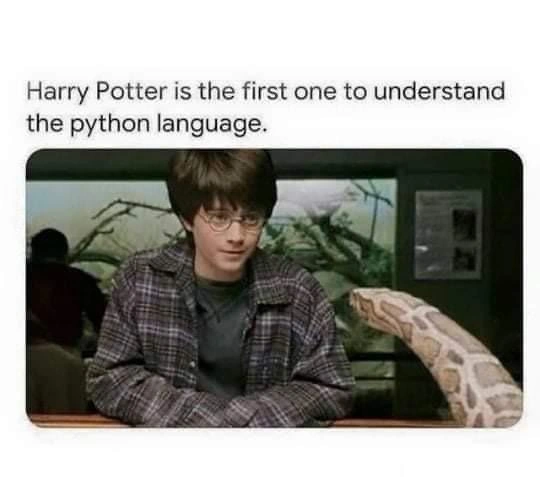
In the image, we see Harry at the snake’s enclosure, looking like he’s in a conversation with the snake. So visually, it reinforces the first meaning (he’s talking to an actual python snake). But because many of us associate “Python” with the coding language, our developer brains instantly jump to the second meaning. The humor comes from that mental double-take: Wait, “Python language” as in coding or snake tongue? Ohhh, they meant the snake but joked it’s the coding language! 😅 It’s TechHumor 101 – using a PopCultureReference (Harry Potter) and a TechPun (Python the language vs python the animal) to create a crossover joke.
For a junior developer or someone new to this, it helps to know that Python (the coding language) is often personified in memes by snake images or references (since the word itself originally describes a snake). And Harry Potter is huge in pop culture, so scenes from it get meme-ified a lot. Here the meme-maker picked the perfect Harry Potter scene where a snake is present. The caption intentionally phrases it like Harry was a programmer: “understand the Python language” sounds like he figured out the Python coding syntax. But in context, we know it’s just that he magically understood a snake’s hissing. The joke clicks when you realize Python = snake = coding language. Essentially, Harry’s rare magical ability is being humorously equated to having early proficiency in a programming language that shares the snake’s name.
This kind of relatable humor sticks because many of us in tech also love fantasy or sci-fi. The HarryPotter scene is familiar to a broad audience, and so is Python as a coding language (even newbies have heard of it or started learning it). By combining them, the meme speaks to both interests at once. It’s saying, “Hey, Harry could talk to this snake – haha, that means he was basically coding in Python before it was cool!” It’s a light-hearted joke without any negativity, relying purely on wordplay. Once you understand the two meanings of Python, the meme’s punchline is pretty straightforward. And if you ever hear a dev joke about “speaking code” or “understanding X language,” now you’ll know they might be punning about programming languages vs. plain English (or in this case, vs. snake language!). In summary: Harry’s parselmouth abilities let him chat with a snake, and we’re just cheekily rebranding that as if he were fluent in the Python programming language. It’s a simple pun that brings a nerdy smile. 🐍🖥️
Level 3: The Original Python Interpreter
At first glance, this meme mashes up Harry Potter lore with programming humor, and it’s delightfully nerdy. The caption proclaims “Harry Potter is the first one to understand the python language.” On a literal level, in the movie scene Harry speaks Parseltongue (the magical snake language) to a real python snake. On a tech level, developers joke that “understanding a language” means being fluent in a programming language like Python. The humor sparks from that double meaning. Essentially, young Harry is portrayed as an early adopter of Python – not the snake this time, but the coding language that shares its name. This playful crossover tickles experienced devs because it links two very different knowledge domains with a single witty phrase.
What makes this particularly funny to developers is the layered wordplay. Python is of course one of the most popular programming languages today, but it’s also the kind of snake Harry is chatting up in the image (a Burmese python from the zoo scene in Harry Potter and the Sorcerer’s Stone). By saying Harry “understands the Python language,” the meme implies he’s literally conversing with a snake and metaphorically fluent in the Python programming language. It’s a classic tech pun: one term, two contexts. This sort of humor hits home for coders because we often talk about “speaking” or “writing” in programming languages as if they were natural languages. For instance, a developer might proudly say “I speak Java and JavaScript” (meaning they can code in those), so hearing “he understands Python” creates a sly crossover between magical linguistics and software skills.
From a senior developer’s perspective, there’s also a tongue-in-cheek historical twist. The timeline of the joke almost fits: Harry unwittingly speaks to that python around 1991 (in the book’s timeline) – around the exact time Guido van Rossum first released the Python programming language to the world. 😁 So in a cheeky sense, Harry beat the rest of us to the punch! Of course, in reality Python is named after the British comedy group Monty Python, not directly after the snake. But over the years the snake iconography became synonymous with the language (just look at Python’s two-snake logo). That’s why this pun works so well: the cultural association between Python (code) and pythons (serpents) is already ingrained in developer culture. Pop culture references like Harry Potter are common in developer humor because they create an instant bond – if you get the reference and the tech context, you feel like part of an in-joke. Here the joke leans on our shared knowledge: we know Harry Potter is a “Parselmouth” (a person who can speak to snakes), and we know Python is a coding language with a snake theme. Put them together, and we have a magical mashup where Harry is essentially a wizard coder.
In true enthusiastic fashion, let’s geek out a bit further: One could say Harry acts as a Python interpreter in that scene. Just as the Python runtime translates your code for the machine, Harry translates snake-speak for humans (and vice versa). He’s a walking, talking API between serpent and student! For veteran developers, this jest also nods to how effortlessly younger generations pick up high-level languages today – almost like magic. Seasoned coders who slogged through more arcane languages might chuckle (or groan) at the idea that an 11-year-old wizard intuitively “speaks” a modern, powerful language like Python without a single lesson. It’s a humorous exaggeration of Python’s famed readability and gentle learning curve – as if even a kid discovering his wizard powers could accidentally code in Python. The meme blends the Harry Potter universe with programming culture, showing how relatable humor can arise from simply noticing a word like “Python” straddling two worlds. And admit it, the notion of Harry Potter being the original Python developer in some alternate universe is a fun little thought exercise that can make any senior dev smirk between debugging sessions.
Description
This meme presents a clever pun combining the worlds of programming and popular culture. It features a well-known screenshot from the movie 'Harry Potter and the Sorcerer's Stone,' where the young protagonist, Harry Potter, is at a zoo communicating with a large snake. Above this image is the caption: 'Harry Potter is the first one to understand the python language.' The humor is derived from a double meaning: in the Harry Potter universe, Harry is a 'Parselmouth,' meaning he can speak the language of snakes (Parseltongue). The meme playfully equates this magical ability with understanding the Python programming language. For developers, it's a lighthearted joke that merges a widely recognized piece of nerd culture with one of the most popular programming languages

Comments
21Comment deleted
The first Python interpreter was a magical ability, the second was written in C. Both are still considered black magic by anyone trying to debug GIL issues
Harry isn’t hissing Parseltongue - he’s walking the snake through Python’s MRO. Next scene, the basilisk files a Jira about diamond inheritance
After 20 years in tech, I've finally realized why Python became so popular - it's the only language where talking to rubber ducks evolved into talking to actual snakes, and somehow the snake's implicit typing and lack of semicolons made more sense than the duck's silence
Ah yes, the original Python developer - mastered object-oriented programming by talking to objects that were literally snakes, debugged in production at age 12, and his entire codebase was written in a language only he could parse. No wonder Python became so popular for data science - Harry was already extracting insights from basilisks and handling exceptions that could literally petrify you. Though I hear his deployment strategy of 'just destroy all the Horcruxes' never quite caught on in modern DevOps circles
Harry spoke Python fluently pre-PEP 8; we've been hissing over 2-to-3 migrations ever since
Parseltongue is basically a zero‑overhead FFI for Python - great throughput, but the GIL still hisses at threads
Harry understood Python first - it’s just Parseltongue: significant hiss-space, and the GIL means only one snake talks at a time
No, Mowgli was the first Comment deleted
bruh Comment deleted
:)) Comment deleted
No, Salazar Slytherin is the first then Comment deleted
True Comment deleted
not false Comment deleted
!!true Comment deleted
1 Comment deleted
NaN == NaN Comment deleted
false Comment deleted
just ieee754 Comment deleted
fuck float all my homies use haskell Rational Comment deleted
Both 'a' and 'b' is NaN, so why they should be equal? Comment deleted
They both are not a number Comment deleted