Skip to content
DevMeme
1790 of 7435
Red Team Aspirations vs. Blue Team Reality
Security Post #1997, on Sep 2, 2020 in TG

Red Team Aspirations vs. Blue Team Reality

Why is this Security meme funny?

Level 1: Cops and Robbers

Imagine you’re playing a game of Cops and Robbers with your friends. You really, really want to play as the robber – you know, the “bad guy” who gets to run around sneaking and pretending to steal treasure. That sounds exciting and fun, right? But then the teacher or your friend in charge says, “Hmm, you should be a police officer instead. You’ll be better at catching the robber.” Suddenly, you’re not the sneaky bandit; you’re the good guy guarding the bank. You might feel disappointed and protest, “Aw, but I wanted to be the villain!” because, let’s face it, playing the bad guy can feel more adventurous in a make-believe game.

This meme is just like that. The person wanted a job where they could pretend to be the “bad guy” hacker (breaking into systems to test them, like a robber in the game). But the company said, “No, you’ll do better as the good guy defending us” (like making them be the cop). Skeletor, the cartoon character in the picture, is basically stomping his foot saying “I want to be evil, not good!” – which is a silly way of expressing the same feeling. It’s funny because usually being the good guy is supposed to be a good thing. But here the person is comically upset about having to be the hero instead of the villain. It’s a big kiddie playtime twist: they got cast as the sheriff when they had their heart set on being the outlaw, and their over-the-top tantrum makes us laugh.

Level 2: Blue Team Blues

Let’s break down the basic joke: in cybersecurity, “red team” refers to the offensive security folks – the ones who simulate attacks, try to hack systems (legally!), and find vulnerabilities. Think of them as professional “pretend bad guys” hired to test a company’s defenses. On the other side, the “blue team” is the defensive security crew – they monitor for intrusions, respond to attacks, and generally protect and guard the systems. They’re like the “good guys” who set up shields, check logs, and fix the weaknesses the red team (or real attackers) might exploit.

Now, the meme text says: “when you apply for a cybersecurity position in a red team but they say you’d be more suitable in the blue team.” This sets up a scenario many early-career security enthusiasts dread: you wanted the penetration testing job (that’s the red team role where you get to do the hacking), but the interviewers or hiring managers decide you should do a blue_team job (defense, like working in a Security Operations Center monitoring alerts). It’s basically being told, “We think you should play defense, not offense.” If you were dreaming of being the hacker character, that’s a bummer!

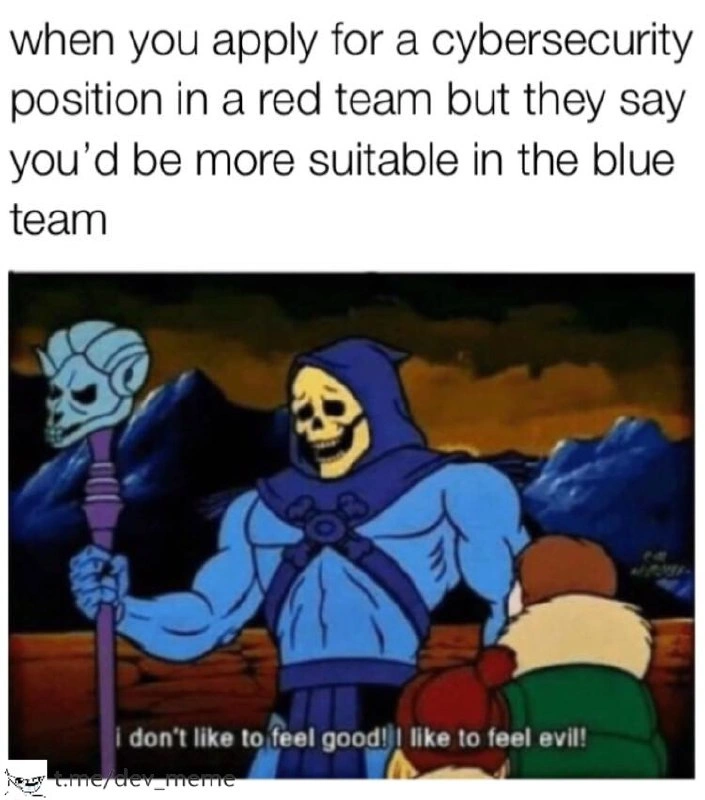
Enter Skeletor – a cartoon villain from the classic show He-Man. In the image, Skeletor is raising his staff and yelling with a subtitle: “I don’t like to feel good! I like to feel evil!” Why Skeletor? Well, he’s an iconic villain (literally loves evil scheming), and funnily enough he’s colored blue. The meme uses this skeletor_meme scene because it perfectly exaggerates how the disappointed applicant feels. The applicant is essentially saying: “I don’t want to be the good guy (blue team defender) making things feel safe. I want to be the bad guy (red team attacker) causing chaos – that’s what I enjoy!” It’s a dramatic, humorous way to express their frustration. Skeletor’s over-the-top evil line is obviously a joke – in real life, even red teamers are not actually evil, they’re helping the company by finding holes. But InterviewHumor often uses extremes to make a point. The candidate imagined themselves as a cool hacker infiltrating systems (perhaps picturing Hollywood-style hacking scenes), and now they’re basically being asked to feel good by protecting systems instead.

This is a common theme in CareerHumor for security folks. Many people get into cybersecurity thinking they’ll be the one doing ninja-like exploits and yelling “pwned!” after bypassing some firewall. Those roles exist (that’s penetration testing/red teaming), but there are fewer of them and they often require a certain mindset and experience. On the flip side, almost every company needs a strong blue team: analysts to review security alerts, incident responders to handle breaches, engineers to configure security tools, etc. So during interviews, hiring managers often try to figure out where you’d fit best. They might ask questions like, “How would you approach securing a system?” versus “How would you try to break into a system?” If your answers show more enthusiasm for locking things down and monitoring, they might steer you toward a blue team role. If you’re more excited about the breaking-in part, maybe you’re a red team fit. In the meme’s scenario, the interviewers essentially said, “We think you have a defender’s mindset.” For someone who really wanted an attacker’s job, that can feel like a letdown – hence the joking cry of liking to “feel evil.”

Let’s decode Skeletor’s line in simple terms. “I don’t like to feel good, I like to feel evil!” – here “feel good” could represent doing the morally “good” job of defending (which might be satisfying, but in a righteous, responsible way). “Feel evil” represents doing the mischievous stuff – not actually being a criminal, but having the thrill of the “bad guy” role in a controlled environment. The meme humorously suggests the candidate has that villainous enthusiasm: they find the idea of hacking (even as an ethical hacker) more fun than the idea of protecting. It’s poking fun at how an offensive security enthusiast might react if you tell them to join the boring ol’ defense team. In reality, blue team work isn’t about “feeling good” in a simplistic way – blue teamers get adrenaline rushes too (like catching an intruder in action), but the meme exaggerates it as good vs evil for comedic effect.

For context, the terms red team and blue team actually come from military war-game exercises and are widely used in cybersecurity. Red teamers will conduct simulated attacks (for example, they might run a phishing campaign against their own company or attempt to exploit a server vulnerability). Blue teamers are the ones who set up defenses against those attacks (like spam filters for phishing emails, or intrusion detection systems that catch exploit attempts) and who investigate whenever something suspicious happens. In some companies, if you interviewed for a Security position, they might consider you for either team depending on your skills. It’s not uncommon for someone to apply for a penetration tester job and instead get offered a role as, say, a SOC Analyst (watching for threats) or a security engineer (implementing defenses). That’s exactly the situation this meme describes. And among security professionals, it’s a well-known irony – everyone wants a turn playing the “attacker”, but most end up doing time as a “defender.” The phrase blue team blues is even jokingly used to describe the feeling of being stuck in a defensive security job longing for more excitement.

So, the meme is both CyberSecurityMemes comedy and a bit of reality: Skeletor’s dramatic evil-loving persona represents the candidate’s thwarted penetrationTesting ambitions. The hiring team essentially said, “We think you’ll do better protecting Castle Grayskull than trying to storm it.” And the candidate (channeling Skeletor) hilariously protests because, come on, who wouldn’t want to have the fun of being the “bad guy” once in a while? It’s a playful jab at how companies steer careers and how, in the end, somebody’s got to guard the castle – even if they applied to be the dragon.

Level 3: Offense-Defense Dichotomy

In the world of cybersecurity roles, this meme hits on the classic Red Team vs Blue Team dichotomy that seasoned security folks know all too well. The image’s caption sets the stage: “when you apply for a cybersecurity position in a red team but they say you’d be more suitable in the blue team.” Translation for the initiated: you showed up to the interview eager to be an offensive security expert (the one hacking into systems as an ethical attacker), but the hiring panel sized you up and basically said, “Actually, we need you on defense.” It’s a plot twist many in the industry recognize with a smirk.

What makes this particularly hilarious to experienced engineers is the dramatic Skeletor reference. Skeletor – the blue-skinned, skull-faced villain from He-Man – is pictured declaring, “I don’t like to feel good! I like to feel evil!” This cartoon villain quote is a tongue-in-cheek stand-in for the applicant’s inner monologue. In security parlance, the person would rather embrace their evil side (simulated evil, of course – the kind of creative mischief a penetration tester gets paid to do) than be stuck doing the good guy work of guarding and defending. The humor is doubled by Skeletor literally being blue: he’s a villain who is blue in color, which slyly mirrors the fate of being assigned to the blue team. It’s as if the universe itself is saying, “Nope, you’re blue like Skeletor, whether you like it or not.”

From a senior perspective, there’s an industry truth here: offense is glamorous, defense is necessary. Everyone and their cousin who’s into cybersecurity dreams of joining the Red Team – popping shells, breaking into networks with creative hacks, wielding tools like Metasploit or writing zero-days. It’s the fun side of feeling “evil” for a good cause. But companies have a limited number of those castle-smashing roles. Meanwhile, the Blue Team (the defenders in the Security Operations Center, or SOC) is where the trenches truly are: monitoring endless logs, responding to incidents at 3 AM, configuring firewalls, and patching vulnerabilities on repeat. It’s less glamorous and more grind. So what happens in real life? You guessed it – many eager “wannabe hackers” get hired into blue team positions. Partly because that’s where the headcount is needed (you might have 2 red teamers vs 20 blue teamers on a security team), and partly because good defensive folks are worth their weight in gold. As the cynical saying in security goes, “Attackers get the headlines, but defenders keep the lights on.”

The meme is winking at how hiring managers assess mindset during interviews. A candidate might be gung-ho about breaking things, but the interviewers are secretly scoring: Is this person’s mentality better for defense or offense? They might throw scenario questions to see if you think like a clever thief or a careful guard. If you approach every problem with structured, protective thinking, they might decide you’re a born blue teamer – even if you applied to be an ethical hacker. It’s like a career HR sorting hat: “Better fit for the defense against the dark arts, than the dark arts themselves.” For an applicant dead-set on being the next penetration testing superstar, hearing “we see you more in a blue role” is crushing. It feels like being told you’re too nice or not “evil” enough to play with the red team rebels. The meme nails this ironic disappointment with Skeletor’s over-the-top villainous angst.

To a veteran security engineer, the scene is both funny and painfully relatable. We’ve all seen the eager junior with an OSCP cert and a toolkit of exploits get rerouted into maintaining the SIEM alerts console instead. It’s a rite of passage in many security careers: cutting your teeth in defense before you can pivot into offense. The joke’s dark edge – “I like to feel evil!” – echoes how a red teamer finds joy in outsmarting systems (it’s a CyberSecurityMemes staple that hacking-loving geeks tongue-in-cheek call themselves “evil” while actually working for good). Meanwhile, “feeling good” (protecting, complying with policies, cleaning up malware messes) is cast as the boring fate of the blue team. Seasoned folks chuckle because they know two truths: 1) the blue team is absolutely crucial (and can be exciting in its own way, chasing real bad guys), and 2) many of us have worn both hats eventually. The meme cleverly expresses the security career plot twist when one’s red team ambitions meet corporate reality, with a dash of 80s cartoon flair. It’s funny because it’s true – the red_team vs blue_team saga is a defining tension in security careers, and here it’s distilled into one Skeletor tantrum we can all laugh at.

Description

This is a two-part meme. The top section contains black text on a white background that reads: 'when you apply for a cybersecurity position in a red team but they say you'd be more suitable in the blue team'. The bottom image is a still from the classic cartoon 'He-Man and the Masters of the Universe', featuring the main villain, Skeletor. He is depicted with a sad, downturned expression, holding his signature ram skull staff. Subtitles at the bottom of the image read, 'i don't like to feel good! I like to feel evil!'. The joke is a commentary on cybersecurity culture. Red teams are offensive security professionals who simulate attacks (the 'bad guys'), while blue teams are defensive specialists who protect against them (the 'good guys'). The humor lies in equating the desire to be on a red team with a villain's love for being evil, perfectly captured by Skeletor's lament at being forced into a 'good' role

Comments

7
Anonymous ★ Top Pick The difference between a red teamer and a blue teamer? A red teamer sees a vulnerability and writes a proof-of-concept. A blue teamer sees a vulnerability and writes a Jira ticket that gets de-prioritized until the next quarter
  1. Anonymous ★ Top Pick

    The difference between a red teamer and a blue teamer? A red teamer sees a vulnerability and writes a proof-of-concept. A blue teamer sees a vulnerability and writes a Jira ticket that gets de-prioritized until the next quarter

  2. Anonymous

    Bragged about chaining 0-days to pop shells; HR heard “great, you’ll chain SIEM rules to pop PagerDuty at 3 a.m.”

  3. Anonymous

    After 20 years of writing WAF rules and SIEM correlations, you realize the real vulnerability was believing HR understands the difference between someone who breaks things elegantly and someone who just knows how to read Splunk dashboards

  4. Anonymous

    The eternal cybersecurity identity crisis: you spend years mastering exploit development, reverse engineering, and social engineering tactics, only to be told your 'attention to detail' makes you perfect for writing SIEM rules and triaging alerts at 3 AM. It's like training to be a lockpick artist and being assigned to watch security camera footage instead - technically both are security, but one definitely feels more like the villain origin story you signed up for

  5. Anonymous

    Red team: crafting zero-days. Blue team: drowning in false positives. HR's plot armor strikes again

  6. Anonymous

    They saw 'built custom C2' on my resume and decided I should write the Sigma rules and ATT&CK mappings to catch it

  7. Anonymous

    Applied for red team; they put me on blue after seeing my exploit POCs ship with unit tests, a MITRE ATT&CK mapping, and a Splunk detection - apparently I hack like an SRE

Use J and K for navigation