Skip to content
DevMeme
1791 of 7435
A CS student's desperate dating life
CS Fundamentals Post #1998, on Sep 2, 2020 in TG

A CS student's desperate dating life

Why is this CS Fundamentals meme funny?

Level 1: When a Tree Gets a Text

Imagine a big friendly tree could join a dating app and chat with people. 😄 Now, instead of a person asking the tree for a normal photo, they make a silly request using tree language. They say, “send nodes,” because a “node” is like a little part of a tree diagram (kind of like a branch or twig in computer-talk). It sounds almost like something else people sometimes joke about asking for (there’s a phrase “send nudes,” which means send me naked pictures, but here we changed one letter). So this person is basically making a pun — they’re playing with words. It’s as if they meant to say the naughty thing, but because the match is literally a tree (a binary search tree, which is like a special kind of pretend tree in computers), they replace it with a tree term to be funny. Then they add “Or at least a root,” which is like saying, “okay, maybe not all the tree’s parts, just the main part?” A root is the first part of a real tree that’s in the ground, and in a computer tree it’s the top piece. So the person is teasing, asking this tree for a peek at its “root”! It’s completely goofy because, of course, trees don’t use phones and send pictures. The joke makes us laugh because it mixes something totally nerdy (tree nodes and roots from computer science) with the idea of flirting on a phone app. In simple terms, it’s funny for the same reason a knock-knock joke with a pun is funny – it surprises you by taking a familiar phrase and giving it a clever twist. Even if you don’t know much about computers, you can giggle at the idea of someone trying to flirt with a tree using tree words. It’s just a playful, nerdy way to be silly!

Level 2: Nerdy Tinder 101

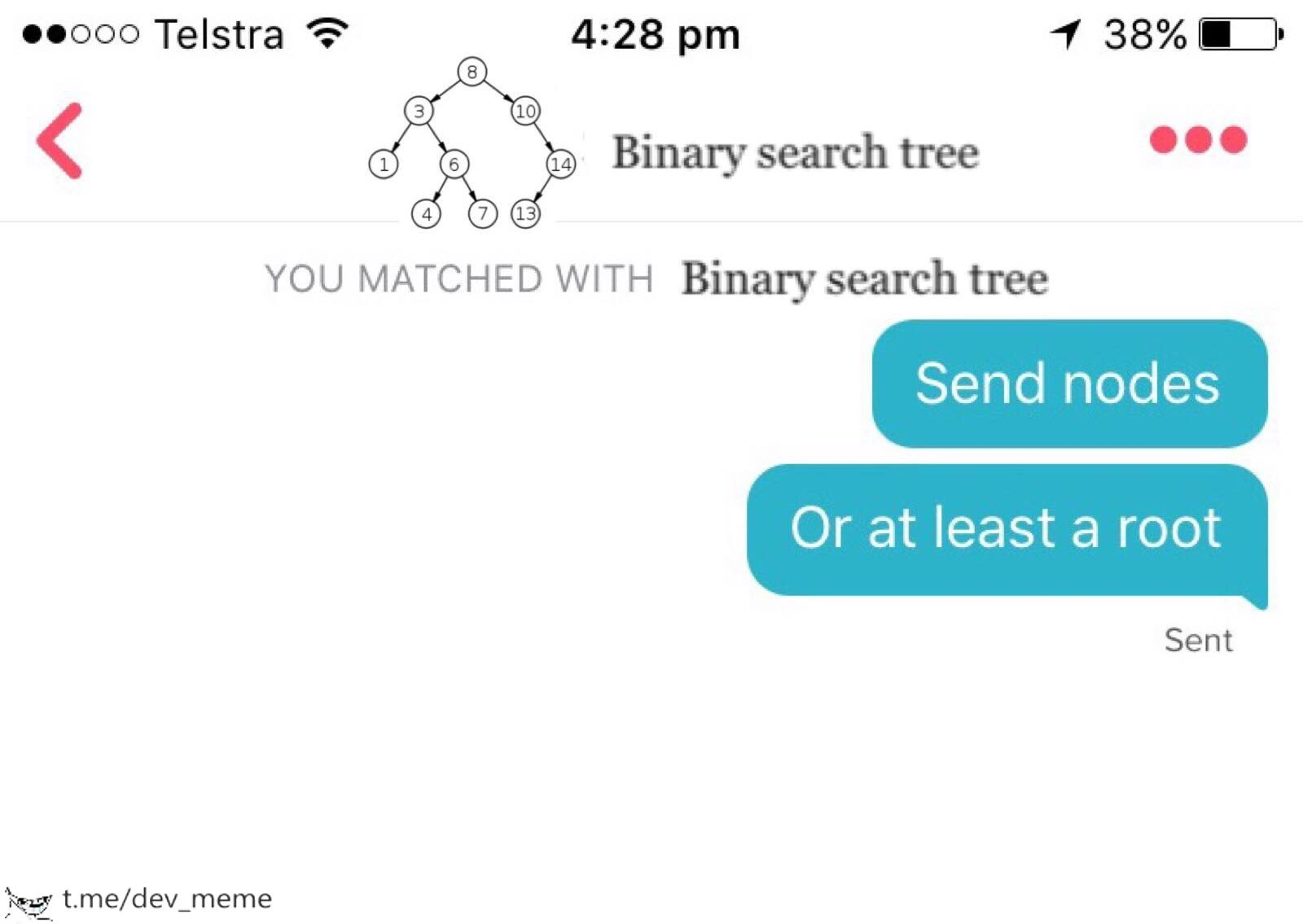
If you’re newer to coding or not up on internet lingo, let’s break down the joke. The meme is framed like a dating app chat (imagine the Tinder app interface). It says “YOU MATCHED WITH Binary search tree” at the top, which is already silly – normally you match with a person, not a binary search tree! A binary search tree is a fundamental data structure you learn in computer science. It’s basically a way to organize numbers or data in a binary tree shape so you can search very efficiently. In a binary tree, each element is called a node, and each node can connect to up to two other nodes (often called its left child and right child). The very first node at the top of the tree is special – we call it the root of the tree (like the root of a real tree, except here it’s drawn at the top). In the little profile picture, you can actually see a tiny diagram of such a binary search tree: the number 8 is at the top (that’s the root node), then it branches to 3 on the left and 10 on the right, and so on. This structure isn’t random; it follows the binary search rule: everything left of a node is smaller than it, everything right is larger. It’s a classic topic in CS_Fundamentals and DataStructures courses, so much so that even seeing that diagram of circles and numbers will ring a bell if you’ve taken an algorithms class or done coding interviews.

Now, the humor comes from the messages the user sends: “Send nodes” and “Or at least a root”. These messages mimic a well-known phrase in texting culture: “send nudes.” If you haven’t heard that phrase, “send nudes” is basically a (not-so-polite) way someone might ask for naked pictures in a private chat. It’s become a bit of a meme phrase on the internet — people joke about it a lot. Here, our developer changed nudes to nodes – notice it’s just one letter different. By doing that, a spicy request turns into a geeky request for parts of a tree data structure. It’s a classic form of wordplay pun in the tech world. The follow-up line “Or at least a root” continues the joke: if the “Binary search tree” won’t send its nodes, maybe it can send just one node – the root node. In normal flirty terms, it’s like saying “Ok, maybe not the whole nude photo, but how about just a little peek?” But here that idea is translated into tree terms. It’s a goofy cs_pickup_line — basically a nerdy way to flirt or be funny with someone who understands computer science.

Let’s clarify the terms to ensure the pun lands:

  • Node: In a tree structure (like a binary tree), a node is one point of data. Think of it like a little box that holds a number or value and can link to other boxes. In the context of this meme, the tree’s “profile” would have a bunch of these nodes (the circles in the diagram are nodes). The phrase “send nodes” imagines someone asking the tree to send pictures of its nodes (maybe like a human sending pics of body parts, but here it’s tree parts!). It’s absurd, which is why it’s funny.
  • Root: This is the top node of the tree. It’s the origin from which the rest of the tree “grows”. In the meme, when the person says “Or at least a root,” they’re punning on “at least a root node” of the tree. It’s like saying, “okay, if you won’t send all your nodes, send me the most important one – the root.” In a flirty non-technical chat, someone might say “well, at least send me something.” Here that something is humorously the root of the tree.

By combining a tinder_ui_parody (the fake dating app screenshot) with straight-up computer science lingo, the meme creates a jarring but humorous contrast. If you’re a junior dev or a student, once you recognize the terms, you can appreciate how corny this is – and that’s the point! It’s making light of the serious stuff you learn in class by tossing it into a totally unrelated context (online dating). Also, it’s a bit of a nod to how developers might jokingly communicate. We often throw technical references into everyday jokes. For example, a programmer might jokingly say “I’ll DNS you” instead of “I’ll text you,” or call a romantic mismatch a “type error.” Here, asking a binary tree for “nodes” is that same kind of DeveloperInJokes vibe. It’s the kind of thing you’d laugh at with classmates after a data structures lecture: you’ve just learned what nodes and roots are, and suddenly you realize “hey, nodes sounds like nudes – that’s hilarious!” You feel kind of clever for getting the joke, because it means you understand the computer science part and the pop culture part. In summary, the meme is a fun blend of ComputerScienceHumor with everyday texting slang. It’s essentially saying: “I’m a proud nerd, and I’ll even flirt like one.” And if you understood all that, congrats – you’re in on the joke! 🎉

Level 3: Binary Searching for Love

At first glance, this meme mashes up a Tinder-style dating app chat with hardcore CS fundamentals. The profile name is Binary search tree, and the dev’s pickup line is a cheeky pun: “Send nodes” (followed by “Or at least a root”). This is a tongue-in-cheek play on the infamous texting phrase “send nudes.” For seasoned developers, the humor clicks on multiple levels. We’ve got a data structure (a binary tree) personified as a dating match, and a classic developer in-joke that replaces one letter to turn a risqué request into pure ComputerScienceHumor. It’s the kind of wordplay pun you groan at and laugh because it’s so nerdy. The joke leans on your knowledge that a node is a fundamental part of a tree, and a root is the top node – so “send nodes” sounds almost like some code-guy’s flirty request to this “tree” match. The phrase is so close to “send nudes” that it catches you off guard, delivering that aha! moment of recognizing both the tech term and the naughty original.

For experienced devs, there’s extra hilarity in how unabashedly technical this cs_pickup_line is. It’s a perfect collision of communication norms (a flirty message on a dating app) with CS_Fundamentals (binary tree lingo). The status bar details (Telstra, 4:28 pm, 38% battery) mimic a real iPhone screenshot, making the parody feel authentic – like some coder actually swiped right on a data structure. This witty scenario plays on the trope that developers sometimes mix work and life in absurd ways – here a dev “matching” with a code concept and then dropping a one-liner that only a fellow geek would find romantic. It’s essentially tech humor about falling in love with your code (or at least your favorite algorithm)! Seasoned engineers might even recall that “send nodes” is a bit of a classic in the developer in-jokes arsenal – a meme phrase that’s popped up on T-shirts, forums, and cheat sheets as a nerdy spin on internet slang. We can’t help but appreciate how it roots the humor in a fundamental data structure we all had to learn, whether in college or those dreaded coding interviews. In fact, many of us have sweated over binary tree problems, so seeing a BST pop up on a dating app of all places is ridiculously out of context and that’s why it’s funny. It’s the relief of seeing a once serious, academic concept become the punchline of a joke.

There’s also a wink at efficiency and structure that senior devs might chuckle at. A binary search tree (BST) is prized for its O(log n) search efficiency when balanced – it’s all about finding things fast by splitting the data in half at each node. The idea of “matching” with a BST hints that maybe finding love could be as efficient as a binary search: cut the dating pool in half each time with a clever algorithm until you find the one. (If only romance had such elegant logarithmic time complexity!) The line “Or at least a root” adds a second layer: in tree terms, the root node is the origin of the whole structure. But read aloud, it sounds like “or at least a root” – which, knowingly or not, doubles as cheeky slang in some locales (in Australian English, “a root” can mean a casual hookup). So, this single phrase manages to be a triple entendre: a technical term, a play on a lewd request, and even a regional pun. Talk about overloading a variable! 😄 All these subtle references give seasoned techies that little dopamine hit of “I see what you did there.” It exemplifies how ComputerScienceHumor often works: by layering multiple meanings – technical, literal, and cultural – into a single, seemingly simple line. And ultimately, it’s poking fun at ourselves as developers: who else would flirt by asking for data structure diagrams? It’s a gentle roast of our tendency to be hopelessly hopefully romantic about the things we spend all day with – in this case, our beloved binary trees.

Description

The image is a screenshot of a mobile phone screen, mimicking a dating app interface like Tinder. At the top, it says 'YOU MATCHED WITH Binary search tree'. Below this, there's a diagram of a binary search tree with the root node 8 and subsequent child nodes. In the chat section, two messages sent by the user are visible. The first one says 'Send nodes', and the second one, 'Or at least a root'. This is a multi-layered pun playing on dating app culture. 'Send nodes' is a deliberate homophone for 'send nudes,' a common, risqué request in online dating. The follow-up 'Or at least a root' continues the joke, as 'root' is the top-level node in a tree data structure, but it can also be interpreted with a vulgar anatomical slang meaning. The humor comes from the absurd application of flirtatious, slang-filled dating conversation to a fundamental computer science data structure
Comments

7
Anonymous ★ Top Pick I matched with an API once. It had a great interface, but I got a 401 Unauthorized when I tried to get more personal
  1. Anonymous ★ Top Pick

    I matched with an API once. It had a great interface, but I got a 401 Unauthorized when I tried to get more personal

  2. Anonymous

    Pro tip: if a Binary Search Tree offers to “send nodes,” insist on level-order - you don’t want to unpack emotional baggage in post-order

  3. Anonymous

    After 20 years of optimizing search algorithms, you realize the real O(log n) complexity was finding someone who appreciates your perfectly balanced personality and doesn't mind when you occasionally need to rebalance after a particularly stressful insertion

  4. Anonymous

    When your dating profile says you're looking for someone balanced but you match with a binary search tree that's clearly skewed right. At least they're offering O(log n) commitment instead of the usual O(n²) drama - though let's be honest, without proper balancing guarantees, this relationship could degenerate into a linked list real quick

  5. Anonymous

    BST pickup line gold: 'Send nodes or at least a root' - beats swiping through O(n) singletons any day

  6. Anonymous

    Matched with a binary search tree: “send nodes.” Me: “root access first.” Dating, like data structures, goes from O(log n) to O(n) the moment it stops being balanced

  7. Anonymous

    Finally, a match that respects O(log n) reply times - if it gets awkward, we just rotate and rebalance

Use J and K for navigation