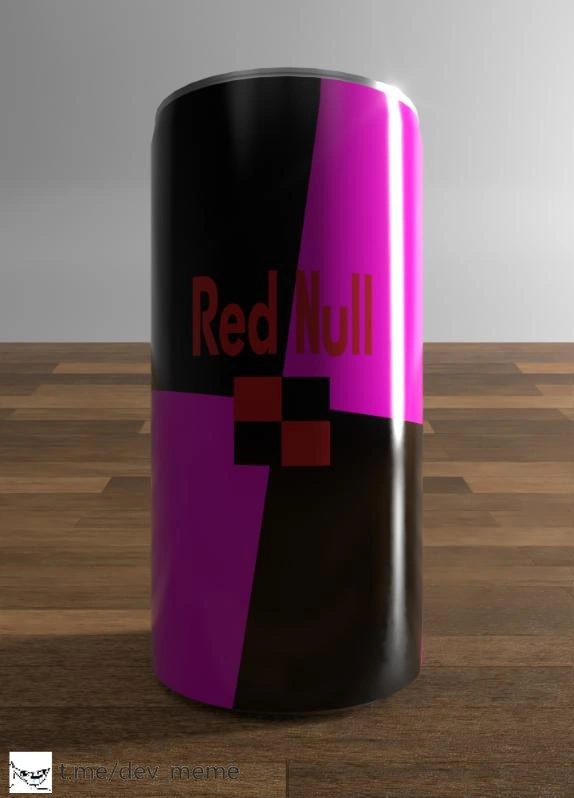
Red Null: The Official Energy Drink for Missing Textures
Why is this GameDev meme funny?
Level 1: The Missing Picture
Imagine you’re reading a comic book, and on one page there’s supposed to be a big colorful picture. But the artist forgot to put the picture in. Instead, you see a blank square with a bright, goofy pattern or an “image not found” symbol. It looks totally wrong and out of place, right? This is like a giant red flag telling everyone “oops, something is missing here!” In our everyday life, it’s as obvious as printing a family photo album and finding one photo is just an empty frame with a neon placeholder. You’d instantly know: the real picture didn’t get included.
Now, if that mistake happens at the last minute, the person who made the book might stay up all night fixing it. How do they stay awake? Maybe by drinking a lot of soda or a big cup of coffee. In this story, instead of a normal drink like Red Bull (a famous energy drink), we jokingly imagine a special drink called Red Null made just for these moments. It’s like saying, “Oops, I made a mistake that’s super obvious, time to drink this magic can of energy and pull an all-nighter to fix it!”
So, the meme is funny because it shows a pretend energy drink can covered in that crazy bright checkerboard pattern – the kind of “error sticker” you’d see when a picture is missing in a game or a comic. It’s a silly way of showing how a developer might feel when they realize they forgot something important: wide awake and in need of caffeine, all because one picture (texture) was missing. In simple terms, it’s like forgetting a puzzle piece and then needing a big sugary drink to help you concentrate while you find and place that missing piece back where it belongs.
Level 2: Null Reference Nuisance
Let’s break down the technical references for a newer developer or someone outside the field. In programming (especially in game development or graphics coding), a null reference is basically a variable that is supposed to link to something (like a texture/image) but currently points to nothing. You’re supposed to set that reference to an actual object (for example, load an image file and assign it to a texture variable). If you forget to set the reference for the texture, the game doesn’t have the image data it needs. The result? The game engine says, “I have no idea what picture to draw here,” and usually it visibly complains.
How does it complain? Many game engines use a missing texture checkerboard – those magenta and black squares – as a loud placeholder. It’s the engine’s way of flagging “Hey developer, something’s wrong with your asset!” Magenta (a vivid pink/purple) is chosen because it’s very unlikely to appear in a normal game texture by accident, so it immediately stands out. If you see a character or object covered in that black-and-bright-pink checker pattern, you know some texture file is missing or not assigned. For example, in the Unity game engine, if a 3D model’s material has no texture or a shader fails to compile (a shader_loading_error), the object might show up as pure bright pink. In other engines like Valve’s Source, missing textures appear as a black/magenta checkerboard. It’s practically a universal “error skin.”
Now, what’s with the Red Null can? It’s a parody of Red Bull, a famous energy drink. Developers are jokingly imagining an energy drink specialized for these debugging emergencies. The tagline even says it’s “powering late-night null reference debugging marathons.” That’s a humorous way to say, “We’re up all night fixing null reference bugs, and we sure need energy drinks to stay awake!” The Red Null name swaps “Bull” with Null, directly referencing the dreaded NullReferenceException (in languages like C# or Java, that’s the error you get when you try to use an object that isn’t set). If you’ve ever seen a program crash and print something like NullReferenceException or NullPointerException, it means the code tried to access a reference that was null (no object). In plain terms, the code expected a thing but found nothing – like an empty box when you expected a toy inside.
When the meme text says “When you forget to set a reference for the texture,” it describes exactly the mistake: the developer didn’t assign the texture image to its place in the code or editor. So during the game, the code goes looking for the texture and finds null instead of a valid image. Cue the bright magenta error pattern plastered on the 3D model, effectively yelling “Missing texture here!” This is a common bug in game development – maybe you removed or renamed an image file, or simply forgot to hook it up. It’s both frustrating and embarrassingly obvious when it happens. The combination of the garish graphics glitch and the late-night hour leads to a very real scene: the developer sighs, cracks open an energy drink (maybe a real Red Bull or coffee), and starts a debugging session to hunt down where that reference got lost.
This meme falls under Developer Humor and Debugging Troubleshooting because it dramatizes that exact situation with a bit of sarcasm. It’s poking fun at how often programmers rely on caffeine when facing bugs in software. The categories GameDev and Graphics are highlighted here: it’s specifically referencing game graphics programming. We’ve got a graphics_and_multimedia_processing issue (missing texture) caused by a simple coding slip-up. The can’s design – with the missing texture art – is something any game artist or programmer immediately recognizes. It’s the kind of inside joke you smile at once you’ve experienced the pain behind it. A junior dev might learn from this: always double-check your references and assets, or you’ll meet the magenta checkerboard of shame! And if you do meet it, well, stock up on those energy drinks for a long night of debugging.
Level 3: Billion-Dollar Brew
At the highest level, this meme blends game dev horror with caffeine-fueled survival in a way seasoned developers know all too well. The tall can labeled Red Null is a tongue-in-cheek knockoff of Red Bull, and it sports the garish magenta-and-black checkerboard – the infamous missing texture pattern that haunts every graphics programmer’s nightmares. This is a potent cocktail of inside jokes: forgetting to assign a texture reference, triggering a NullReferenceException, and pulling an all-nighter with an energy drink to fix it.
In Game Development, a null reference bug is as energizing (and terrifying) as any energy drink. It’s midnight, your game build is running, and suddenly your 3D model appears covered in eye-searing magenta blocks instead of the intended artwork. Experienced devs instantly recognize this neon checkerboard as the engine’s “texture not found” flag. It’s the engine screaming “I got null instead of a texture, so here’s some nightmare fuel!” The meme’s text, “When you forget to set a reference for the texture,” nails this scenario. A senior developer has likely been there: a missing asset or an uninitialized pointer leading to a visual bug so bright and ugly you can’t possibly ignore it.
Why magenta and black? It’s not just aesthetic torture – it’s deliberate. Engine creators choose violent magenta because it’s a color rarely used in normal art, so a missing asset shouts at you from the screen. It’s a built-in debugging signal. The 2×2 block on the can is a miniature of that default checkerboard, a subtle nod that says “Here's your bug, front and center.” In graphics APIs or game engines, if a texture reference is null or a file is missing, the renderer often falls back to this pattern rather than crashing outright. For example, older versions of the Source engine or rendering frameworks might do something like:
Texture* tex = loadTexture("player_skin.png");
if (tex == nullptr) {
tex = defaultMissingTexture; // use the magenta-black checkerboard as a fallback
}
renderModel(playerModel, tex); // draw model with either real or placeholder texture
The placeholder ensures the game keeps running, but bugs are glaringly obvious. Seasoned devs joke that these bugs in software are so common, they deserve sponsorship: hence Red Null, the developer’s choice! It’s a riff on the real crunch-time companion, Red Bull, which “gives you wings” – except Red Null gives you null pointer exceptions (and maybe heartburn). We’ve all sipped a late-night cola or coffee debugging some impossible issue; this meme imagines an energy drink made of pure null to “power” those bleary-eyed debugging marathons. It’s hilariously meta: the drink’s brand itself is an error state.
The humor works on multiple levels of insider knowledge. Null references are notorious – Tony Hoare (who introduced null pointers) even called them his “billion-dollar mistake.” A senior dev sees “Red Null” and chuckles, recalling how much time and money null bugs have devoured in projects. The can’s broken-asset aesthetic is a love letter to every graphics programmer who’s shipped a game only to see characters strutting around in checkerboard suits because a texture path was wrong. It’s funny because it’s true: real engineers have fixed exactly this at 3 AM, running on caffeine fumes. The Debugging_Frustration tag is spot on – nothing bonds developers more than war stories of catastrophic failures caused by one forgotten line of code. This meme playfully says “Here’s to that absolute panic and the caffeine that gets us through it.” 🍻 (or rather, an energy drink toast).
Description
The image displays a 3D rendering of a beverage can sitting on a wooden-textured surface. The can is designed as a parody of a Red Bull can, but with the brand name 'Red Null' in bold red font. The can's texture is the iconic magenta (or bright purple) and black checkerboard pattern, which is widely recognized in the game development and 3D graphics communities as the default texture used by rendering engines when an asset or texture file is missing or its path is incorrect. A small logo composed of four squares in the same checkerboard pattern sits below the text. The caption 'When you forget to set a reference for the texture' directly explains the joke. This visual pun is highly relatable to developers and artists who have experienced this common graphical bug, where the engine substitutes the 'null' texture placeholder, turning their 3D models into this distinct pattern
Comments
7Comment deleted
I'm not saying our asset pipeline is broken, but our game's protagonist is currently powered by Red Null and has a magenta checkerboard personality
Red Null: for that 2 a.m. moment when the asset GUID registry hands you null, the CI pipeline says “✅”, and you realise the magenta-black checkerboard is now a shipping feature
When you're debugging production at 3am and realize the only thing keeping your microservices alive is the same thing keeping you alive - copious amounts of caffeine and the split personality between 'everything is fine' and 'everything is on fire'
When your junior 3D artist marks the UV unwrapping task as 'done' but clearly just hit 'Auto UV Project' and called it a day. This is what happens when you skip the seam placement step and wonder why the client's energy drink can looks like it went through a dimensional rift. Pro tip: cylindrical projection works great until you realize the texture needs to actually align at the seam - a lesson every graphics programmer learns exactly once, usually at 2 AM before a milestone delivery
Red Null: bypasses strictNullChecks, ships fine in staging, and delivers a production-only NPE right before your SLO rolls over
Red Null: Rust refuses to compile it; Java drinks it and throws by 2pm
Red Bull: The only dependency that scales alertness without Kubernetes drama during 3AM outages