The Strategic Complexity of My Pull Request
Why is this CodeReviews meme funny?
Level 1: Nervous Puppy
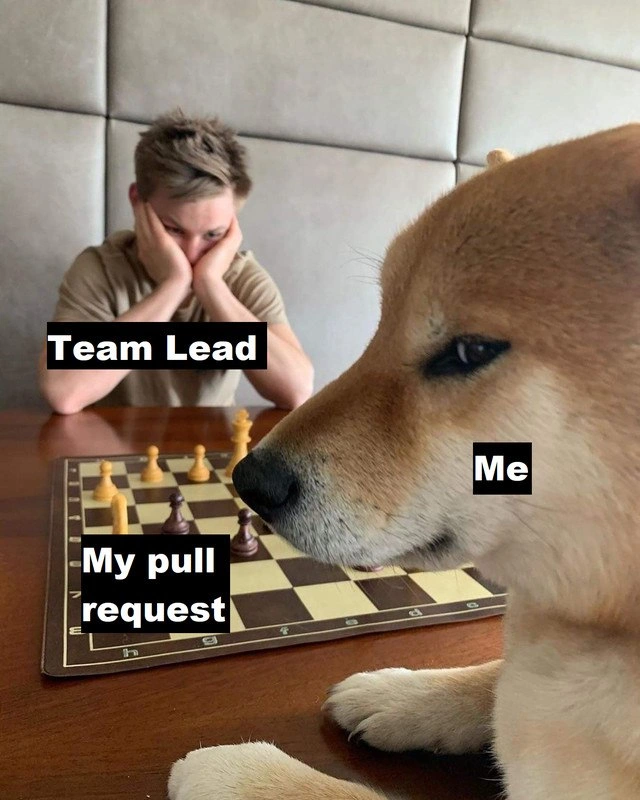
Imagine you just finished a big homework project and you give it to your teacher. Now your teacher is checking it very slowly and carefully, thinking hard about each part. You sit there waiting quietly, hoping you did everything right. You feel a bit like a nervous puppy watching for your owner’s reaction. In the picture, the dog with the label "Me" is in that exact situation, and the "Team Lead" (like the teacher or parent) is the person looking carefully at the work (the chessboard labeled "My pull request"). It’s funny because the dog looks super serious and worried, almost like it understands the chess game. This is just like how we feel sometimes when someone important reviews what we did – we watch them, hoping for a thumbs up. The joke is showing that waiting-for-approval moment in a silly way: a dog and a human playing chess, where the dog is actually us developers waiting for our work to be approved. Even if you don’t know about coding or pull requests, you know the feeling of waiting for feedback. It’s as if you played a game and now it’s the other person’s turn, and you really want to win. In simple terms, the meme is funny because it’s a big goofy way to say: waiting for someone to judge my work feels like an intense game, and I’m just sitting here with big puppy eyes, hoping I did well.
Level 2: Pull Request Duel
This meme is comparing a pull request review to a duel on a chessboard. Let’s break that down. In software development, when you finish working on some code changes, you don't usually put them directly into the main application right away. Instead, you create a Pull Request (PR) – essentially a request asking, "Can we pull my changes into the main code?" It's a feature of version control platforms like GitHub, GitLab, or Bitbucket that manage code using Git. With a PR, your teammates (often a senior dev or the Team Lead, who is like the captain of the dev team) will look over the changes before they become part of the official codebase. This process is known as a code review.
In a code review, the reviewer examines the modified code line by line, much like someone examining a chessboard for the best move. They’re looking for any mistakes, improvements, or effects the change might have:
- Bugs or Errors: e.g. checking that you didn't introduce a bug (maybe a typo in a calculation or a missing check for a null value).
- Coding Style and Standards: ensuring the code follows the team's conventions (like using consistent naming and spacing – the little things that keep code neat and uniform).
- Design and Logic: making sure the solution makes sense and fits well with the rest of the project (is it the simplest approach? did we duplicate code unnecessarily?).
- Tests: verifying that there are unit tests or that the change was tested, so we know it actually works as intended and won’t break existing features.
The Team Lead, being experienced, often leads these reviews. They might leave comments on the PR for the author (the person who wrote the code) to address. For example, they might say, "Hey, I think you should handle the case where user is null here," or "Could we rename this variable to make it clearer?". Sometimes they will request changes formally, meaning the pull request can’t be merged until you fix those points. Other times, if everything looks good (or after you make the suggested tweaks), they approve the PR, allowing it to be merged into the main code.
Now, the meme uses a chessboard analogy to inject humor into this scenario. The chessboard in the picture is labeled "My pull request", and the two players are "Team Lead" (the human, deep in thought) and "Me" (the Shiba Inu dog). Chess is a game of strategy and patience, which is a funny but fitting comparison for a code review:
- In chess, each player carefully considers their next move. In a code review, the author and reviewer consider their next steps too. The author might respond to feedback by changing the code (their move), and the reviewer might come back with more comments or eventually say "all good" (their move).
- The Team Lead in the meme is posed like a serious chess player, hands on chin, intently studying the board. This corresponds to a team lead studying the code changes intensely, looking for any potential issue as if it were a game-winning or game-losing move.
- The dog labeled “Me” represents the developer who made the PR. Using a Shiba Inu dog is a nod to internet culture (the doge_meme – Shiba Inus are famously used in memes for their funny, wise-looking expressions). The dog’s face is close to the camera with a somewhat concerned or anticipatory look, which perfectly captures how a developer might feel waiting for review feedback: a bit anxious, trying to read the reviewer’s face for clues, eagerly awaiting the verdict.
The phrase "studies my pull request like a chess grandmaster" is playfully exaggerating how meticulous code reviews can be. It might sometimes feel like the reviewer is trying to outsmart your code or catch you in a mistake, the way an opponent in chess tries to predict and counter your every strategy. In reality, both the reviewer and developer are on the same side – both want the code to be good – but the meme highlights that nervous feeling of team_lead_vs_dev. Especially for a newer developer, having a senior person intensely examine your work can feel intimidating, almost adversarial, even though it’s normally done to help you and maintain quality. This is where the humor comes in: deep down we know a code review isn’t literally a battle, but it feels like a duel when you’re the one under the microscope!
Many developers find this meme highly relatable. That tense moment of waiting for a code review outcome is almost universal in the programmer’s journey. Will the comment be “Looks good, ship it”? Or will it be a long list of change requests? The meme visualizes that suspense in a lighthearted way. It’s showing a common developer experience: sitting there (perhaps with your fingers crossed) while your team lead methodically goes through your code. If you’ve ever shared your code for review, you might recognize yourself in that Shiba Inu – trying to appear calm and confident, but internally thinking “Please find it okay… please don’t spot that one doubtful bit of logic…”. It’s developer humor making light of what can be a stressful moment.
It’s worth noting that a good team lead or reviewer isn’t actually trying to defeat the developer (and a healthy code review doesn’t feel like a fight!). Ideally, code reviews are a constructive conversation. But the meme jokes that sometimes it can feel like a battle of intellect, almost as if the reviewer is saying “I’ll find the flaw in this plan!” and the coder is countering “I bet you won’t!”. The chess imagery emphasizes strategy: a team lead might indeed think strategically about code quality – for example, noticing that today’s small hack could cause technical debt down the road, and suggesting a more robust approach now (sacrificing a quick win for a long-term victory, like a chess sacrifice for future advantage). Meanwhile, the developer might have their own strategy: maybe they implemented something in a certain way to meet a deadline or because of some constraint, and now they need to justify that decision move by move.
All the elements (doge face, chessboard, intense thinking) come together to portray pull_request_review in an entertaining way. It says: “Hey, we’ve all been here — submitting code and feeling like it’s being analyzed under a microscope by the team’s resident grandmaster.” The code_review_anxiety is real, but laughing about it reminds us that even senior devs have been that nervous coder once. And who knows? Perhaps the team lead in the meme is also enjoying the challenge, much like a true chess match, thinking “Let’s see what clever move this dev made, and if I can find a better one or learn something new.” In the end, when the review is done, both sides hopefully high-five (or virtually approve/merge) and continue building the project — until the next “duel” on the next pull request 😉.
Level 3: Checkmate or Approve
In this meme, a routine code review is dramatized as a high-stakes chess match. The developer (the Shiba Inu labeled "Me") has opened a pull request on Git, and the Team Lead (the human opponent) is scrutinizing it like a grandmaster analyzing a chessboard. This senior-perspective humor hits home because seasoned devs know that a really thorough code review can feel like a mental showdown. Every code change on the PR (the pieces on the board) might have hidden consequences, and the team lead is planning several moves ahead – anticipating bugs, design issues, or maintenance headaches that could arise if the code is merged. The image exaggerates this dynamic: the Team Lead’s pose (hands on chin in deep concentration) and the dog’s intense sidelong stare comically portray the pull_request_review process as an epic battle of wits rather than a friendly collaboration. It’s funny precisely because it is a bit true – experienced leads do often parse through code methodically, almost strategizing how to respond (approve, comment, or request changes) like a chess pro deciding on the next move.
Behind the humor, there’s an industry truth: good code reviews require strategic thinking. A team lead might mentally simulate different execution paths of the new code, much like a chess player imagines future moves. They’re checking if this PR will checkmate the codebase with a nasty bug or performance regression later. The developer, on the other hand, often sits nervously (like our Shiba Inu) awaiting feedback. That anxious waiting feeling is real – it's a form of code review anxiety. Will the lead find a flaw in logic (equivalent to a vulnerability in your defense)? Are there style inconsistencies or architecture concerns (like weak pawns or an exposed king in chess terms)? Every experienced dev has lived this relatable scenario: you submit what you think is a decent solution and then watch the project lead comb through it line by line, half expecting a "Gotcha!" moment. The meme nails this relatable developer experience by showing the dev as a wide-eyed pupper facing the seasoned reviewer – a power dynamic every programmer recognizes with a chuckle.
The labels in the image turn a normal GitHub interaction into a comedic metaphor. "My pull request" sitting on the chessboard implies that the code changes are the arena of conflict or strategy. The Team Lead as the opponent suggests a review can feel adversarial, even if in reality both sides share the same goal (quality code). It hints at a common codeReview pain point: sometimes code reviews are approached like team_lead_vs_dev, almost a contest to find issues, rather than a cooperative attempt to improve the code. A veteran developer will nod knowingly here – we’ve seen review environments where every nitpick becomes a tactical move. For instance, a dev might think they've made a clever refactor (a bold gambit), and the lead counters with a pointed question or a request for changes (the defensive play). If the PR is large or touches critical components, the review comments can feel like an endless back-and-forth: “Simplify this logic,” “Add null checks here,” “Consider using a strategy pattern,” … each comment a calculated move to tighten the code. The dog’s slightly worried side-eye says it all: Did I overlook something obvious? Is my queen (core logic) about to be taken by a hidden bug the lead will spot?
Why is this so funny to devs? Because it exaggerates a common reality. We joke that a rigorous review is like facing a chess grandmaster, but there’s merit to that comparison. An expert reviewer has seen numerous patterns and anti-patterns over their career; they can foresee how a seemingly small code change might cause a cascade of issues (like a chain of chess moves leading to checkmate). They apply experience almost algorithmically:
- Common Bug Patterns: Just as a grandmaster recognizes classic openings and traps, a team lead recognizes familiar bug patterns. They might inspect a new SQL query for an SQL injection vulnerability or double-check a loop for off-by-one errors. These are the standard plays in the code review playbook.
- Code Quality and Style: Much like controlling the center of the board in chess, maintaining clean and consistent code is a central strategy for healthy codebases. A reviewer will point out inconsistencies or confusing names (
variable_naming, function length) to prevent chaos later. It’s not mere pedantry – in the long run, clarity prevents missteps (no accidentally moving a knight like a bishop!). - Edge Cases and Tests: A strong reviewer is always guarding against an unexpected attack from the flank. “What if this array is empty? What if the user input is null? Did we cover that in tests?” These questions mirror a chess master’s vigilance for surprise moves. Writing good unit tests is like analyzing the board for every possible angle of attack.
- Performance and Scaling: In chess terms, this is the endgame foresight. A senior dev will ponder, “If our data grows 10x, will this approach still hold up?” They’re evaluating if your algorithm is efficient (
O(n)vsO(n^2)complexity) just as a grandmaster plans for the late-game when only a few pieces remain. The meme’s team lead concentrating hard could very well be thinking about how your code behaves under heavy load – an invisible but critical dimension.
All these factors make code reviews intellectually intense. The meme humorously amplifies it – as if the Team Lead won’t just click Approve or Request Changes, but might announce “Checkmate! Found the bug that will bring production down.” Of course, in real life a good reviewer is not trying to defeat the author; they’re trying to defeat the bugs and bad practices. The real opponent in this chess match is crappy code, not the person who wrote it. But when you’re the one who made the code, it’s hard not to feel personally on the spot. This dynamic can affect developer experience (DX): a constructive, respectful review feels like a collaborative puzzle-solving (fun!), whereas an overly critical, combative review feels like a trial by combat (stressful!). The meme captures the latter feeling in a lighthearted way, making us laugh at our own tendency to take reviews so seriously.
Historically, code reviews have always been a cornerstone of software quality – from formal peer reviews in big companies to the modern GitHub pull request workflow. It’s a shared ritual across programming teams, which is why it’s fertile ground for developer humor. The image of a dog and a human over a chessboard is absurd, yet we immediately map it to that memory of waiting for a senior dev’s verdict on our code. It underscores a bit of truth in jest: a great reviewer approaches code like a chessboard, leaving no pawn unturned (no line of code unchecked) before giving the green light. And as any experienced coder knows, when you finally get that coveted “LGTM” (Looks Good To Me) or approval, it’s like the tension melts away – the match is over, and you can almost hear the crowd applaud. In chess terms, it’s not exactly checkmate (which implies someone lost), but rather a respectful draw or a win-win: the code is improved and merged, and both players (developer and reviewer) walk away smarter. Checkmate avoided, code approved – victory for the whole team.
Description
A popular meme format showing a Shiba Inu dog playing chess against a visibly stressed young man. Text labels are overlaid on the image to recontextualize the scene for a software development scenario. The focused, calm dog is labeled 'Me', the exasperated man with his head in his hands is labeled 'Team Lead', and the chessboard between them is labeled 'My pull request'. The meme humorously portrays the code review process as an intense, strategic chess match. It captures the moment a developer submits a complex or convoluted pull request, leaving their team lead to painstakingly analyze every 'move' (i.e., every line of code), while the developer waits with a placid expression, having already completed their part. For senior engineers, it's a relatable scenario that touches upon the burden of reviewing large changes, the importance of creating simple and readable PRs, and the sometimes-draining dynamic between a reviewer and a contributor
Comments
7Comment deleted
Submitting a 5,000-line pull request at 4 PM on a Friday is the developer's version of saying 'checkmate' and then walking away from the table
I added three lines, removed two; now the team lead’s simulating 400k branching scenarios like Stockfish, convinced I just introduced an eventual-consistency fork across 17 microservices
Team lead searching for architectural implications in my 50-line refactor while I'm just trying to fix a typo in the logging statement
The eternal chess match of code review: you're confident your pull request is a brilliant gambit that elegantly solves the problem, while your team lead is three moves ahead, already seeing the technical debt, the edge cases you missed, the breaking changes in prod, and wondering why you didn't just use the existing utility function. Checkmate is when they approve with 'LGTM' but you both know there will be a follow-up ticket
Submitting my PR to the team lead is chess: I nudge a pawn, he calculates the 12-move line where it becomes a second source of truth in prod and tags it “nit.”
Submitting a PR to a seasoned lead is chess, not checkers: I see "merge in one", they run a 12‑ply search over blast radius, rollback plan, and codeowners before typing LGTM
TL in zugzwang over my PR's gambit - pawn to king-4, or is that a breaking change?