Skip to content
DevMeme
1320 of 7435
Recursive over-engineering for a simple interview question
Interviews Post #1476, on May 2, 2020 in TG

Recursive over-engineering for a simple interview question

Why is this Interviews meme funny?

Level 1: Rocket to Open a Door

Imagine you need to show someone the " symbol, but every time you try to write it normally, your pencil magically stops as if you had finished your sentence. You get a bit flustered because you don’t know how to make that quote mark appear. Instead of remembering the special trick to draw the " directly, you come up with a wild plan: you’ll try writing every possible character one by one until the quote mark finally shows up! It’s like forgetting the key to your house, and then deciding to try every number on the lock until it opens, even though the real key was in your pocket. In the end, your crazy method does put a " on the paper, but you went through a whole lot of unnecessary steps. It’s funny because you solved a super simple task in the most complicated way possible, all because you were nervous and forgot there was an easy option. This goofy overkill approach is what makes everyone laugh – it’s a big, elaborate detour just to draw one little quotation mark!

Level 2: Escape Characters 101

Let’s break down what’s happening in this scenario. The task was to print a " character (a quotation mark) to the screen using C’s printf function. Now, printf is a standard C function for printing formatted output. You give it a format string (in quotes) and optionally some additional values, and it prints to the console. For example, printf("Hello %d", 42); would print Hello 42 because %d is a placeholder for an integer that gets replaced by 42. Here, the challenge is that the thing we want to print is a quote mark itself, which complicates writing the format string.

In C, whenever you write text in double quotes in your code, like "Hello World", you’re creating a string literal. The compiler expects that string to end at the next double quote it finds (that isn’t escaped). So if you naively try:

printf("Printing quotation mark " ");

the compiler gets confused. It sees the first " and thinks: Start of string. It reads Printing quotation mark as the content. Then it hits the next " right before the space in your code and thinks: End of string. At that point, the compiler expects maybe a comma or a semicolon, but instead it finds another " (the one after the space) dangling there. In simple terms, the code looks like gibberish to the compiler because you accidentally wrote two separate strings with nothing to connect them. This is a syntax error – the code doesn’t follow C’s rules, so it won’t compile at all. In fact, compilers typically throw an error like “missing terminating quote in string literal” or “unexpected token”.

The correct way to include a quote character inside a C string literal is to use a backslash escape. The backslash \ is a special character in C strings that says, “Treat the next character differently.” For certain characters, \ + that character represents something that can’t be easily typed or would mess up the string. For example, \n means a newline, \t means a tab, \\ means a single backslash, and \" means a double quote character. So if we want printf to actually output a " we can write it like this:

printf("Printing quotation mark \"\n");

This code produces the output:

Printing quotation mark "

Now the string literal is "Printing quotation mark \"\n" – notice how the \" inside it is not ending the string; instead it becomes part of the string data (specifically, it will be one " character in the output). The compiler understands that \" is an escape sequence meaning insert a quote character here rather than terminate the string. The \n at the end is another escape sequence that adds a newline (moving the cursor to the next line after printing, just to keep the output neat).

During an interview, the expected answer to “print a quotation mark with printf” would be to use \" in the format string, or alternatively to use a format specifier with the quote as a character. For instance, you could do:

printf("%c", '"');

Here %c tells printf to print a single character, and the argument '"' (a single quote, double quote, single quote) is how you represent the double quote character as a char literal in C. In C (and other C-family languages), characters in single quotes are char literals – for example, 'A' is the character A. So '"' is the character " itself. This would also print a quote mark to the screen. In short, there are straightforward ways to do this: either escape the quote in a string literal or pass the quote as a char.

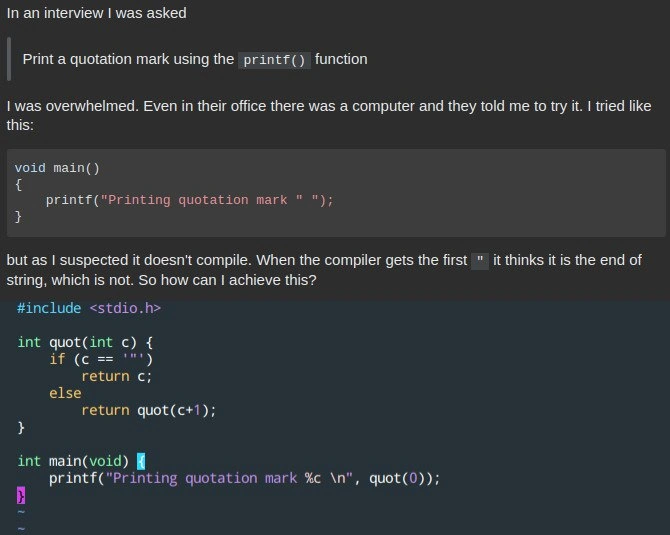
So why didn’t the original poster just do that? They mention being overwhelmed. It’s a classic case of nerves or lack of experience. They tried something that “looked right” to them, got an error, and panicked. Enter the second part of the meme: the absurd workaround. They (or someone answering their question online) wrote this code:

#include <stdio.h>
int quot(int c) {
    if (c == '"')
        return c;
    else
        return quot(c+1);
}
int main(void) {
    printf("Printing quotation mark %c\n", quot(0));
}

Let’s explain this step by step in simpler terms. The quot function is meant to find and return the quotation mark character. It takes an integer c. The if-statement if (c == '"') checks if c is the same as the character " (again, '"' is the char literal for the quote mark). If it is, the function returns c – which means “I found the quote character, here it is!” If c is not " (which will be the case initially, since it starts at 0), the function calls itself with c+1. This is recursion: the function is calling itself, but with a slightly different argument (one higher than before). So effectively, quot(0) will call quot(1), which will call quot(2), and so on... until eventually quot(34). Why 34? Because 34 is the ASCII code for the " character. When c becomes 34, the condition c == '"' is true (since '"' is 34), and that value is returned back through all the recursive calls. So quot(0) ends up returning 34, the magic number that represents ".

Now look at the printf in main: printf("Printing quotation mark %c\n", quot(0));. The format string here is "Printing quotation mark %c\n". Notice there’s no raw " in this string, just %c and a newline at the end – so the string literal is totally valid now. %c is a placeholder waiting for a character. And what character do we give it? We call quot(0) to get one. As we saw, quot(0) will eventually return the " character. Thus, when printf runs, %c is replaced by " and we finally see the output Printing quotation mark " on the screen.

If you’re new to C or programming, this solution might look kind of magical or confusing. It does work, but it’s a Rube Goldberg machine solution – meaning it’s an overly complex contraption for a simple task. It’s as if someone asked for a single puzzle piece and we built a machine to sift through all pieces one by one until it found the right one, rather than just picking it out directly. This often happens when a programmer doesn’t know a certain feature (here, the escape sequence) or gets tunnel vision under stress. They resort to what they do know – in this case, basic loops or recursion – to brute-force a result. The code is literally searching for the answer that was known in advance!

A seasoned C programmer would likely chuckle at this because it’s a bit like reinventing the wheel. We could have simply written printf("\""); and be done in one line. But instead, here’s a full-blown function that uses recursion to accomplish the same thing. It’s an educational moment, though. It shows why understanding language basics (like escaping special characters in strings) is important. Once you know about the backslash \ escape, you realize you don’t need a fancy solution – the language already gave you a tool for this. On the other hand, it’s also a lighthearted reminder that when you’re in an interview or high-pressure situation, your brain might not serve up the obvious solution first. People sometimes do something totally offbeat just to get the job done somehow.

In conclusion for this level: printf_escape is the key idea – using an escape sequence to print tricky characters. C_string_literals have rules you must follow (like closing quotes properly). The quotation_mark_character in ASCII is 34, and this wacky code finds it by incrementing numbers. It’s a humorous example of an overengineered_solution: solving a simple problem (print one character) with a complex approach (a recursive_quote_function). And it likely came out of an interview_brainfreeze, that panicky moment when you forget the simple things. The main takeaway for a junior developer is: if you want to include a double quote in a string literal in C, use a backslash before it. That saves you from all this extra complexity!

Level 3: Quoting Under Pressure

This meme perfectly captures the panic of a technical interview brain-freeze and the overengineered solutions that can follow. The interview question sounds straightforward: “Print a quotation mark using the printf() function.” It’s the kind of basic task a C programmer encounters early on, but under pressure even a simple Language Quirk can become a stumbling block. The poor developer, overwhelmed in the moment, forgets the easy solution (using an escape sequence \") and instead tries something that looks logical but doesn’t work: printf("Printing quotation mark " ");. As every C programmer knows, that won’t compile – it results in a CompilerError because the string literal is improperly terminated. Seeing that in an interview setting is stressful, and you can almost feel the candidate’s anxiety: “Why won’t this print? How on earth do I get a quote to appear?” We’ve all been there at some point – staring at an error caused by a trivial syntax rule, with our brains short-circuiting because of the situation.

Now, the hilarious part is how this situation spirals. Instead of calmly recalling “Oh, I just need a backslash to escape the quote,” the candidate (or perhaps a playful person on a Q&A site like Stack Overflow) devises an overengineered solution that belongs in the programmer joke hall of fame. The brightly colored C snippet in the meme basically says: “I can’t get a " to print easily, so I’ll write a whole function to find one for me!” It introduces a function quot that recursively hunts for the " character’s ASCII code. This is the ultimate interview brainfreeze move: using a recursive algorithm to solve what is essentially a one-character problem. It’s both genius in a zany way and ridiculously overkill. Any senior developer looking at this can’t help but laugh because it’s like watching someone use a Rube Goldberg machine to do something a teaspoon could do. The humor here comes from that contrast: a veteran C coder would solve this with a simple printf(" \" "); (just a backslash and done) or maybe printf("%c", '"'); and call it a day. But in this scenario, either due to panic or pure comedic intent, we see a solution that involves exploring the entire range of possible characters until the right one is found. It’s printing a quote by brute force!

This resonates with experienced devs because it’s a mix of “I’ve seen this kind of thing before” and “there but for the grace of sanity go I.” Many of us have stories of StackOverflow threads or real-life code where someone wrote dozens of lines to achieve what could have been done in one. Here it’s taken to an extreme: a recursive function to return a constant. The shared experience being poked at is how simple syntax errors or requirements can balloon into absurd problems when you’re in a crunch. In an interview, your brain can feel like it’s running in circles (much like the recursive function) until it finally hits the base case of “Eureka, that’s how to do it!” In this case, the “Eureka!” moment in code is if (c == '"') return c;, which is ironically trivial – it’s literally checking if we’ve hit the quotation mark. So the code “discovers” the very thing we wanted from the start, and then the printf prints it. Success, but at what cost? 😄

The scenario also satirizes the way some developers handle language quirks. Instead of recalling the textbook solution, they might try to outsmart the problem with raw programming brute force. It’s like watching someone debug a CompilerError by writing more code around it rather than addressing the root cause. There’s also an element of poking fun at overthinking: interviews often make candidates so nervous that they doubt their fundamental knowledge and attempt something overly complex to compensate. Here, the simple concept of a backslash escape got overshadowed by a complex recursive thought process. The result is a kind of poetic absurdity that seasoned programmers find hilarious – partly because it’s a relief to laugh at someone else’s wild goose chase that, thankfully, isn’t running in our codebase! And yet, there’s a hint of empathy: everyone has had a moment of doing something silly under pressure. The difference is, not everyone writes a fully recursive function in that moment, which makes this case delightfully extra.

Another layer of inside humor: this code looks like it might have come from a Q&A forum where someone answered a newbie’s question with a tongue-in-cheek “solution.” The use of a recursive function named quot to generate a quotation mark has the vibe of a Stack Overflow veteran having a bit of fun. It’s reminiscent of those times when a senior dev offers an absurd workaround not to be mean, but to highlight how much easier the proper solution is. It’s as if they’re saying, “Well, if you really don’t want to use \", you could always write a whole search algorithm for it – see how silly that is?” This kind of humor lands well with programmers: it’s sarcastic yet instructive. It underscores the point that in programming (and especially in C, a classic CFamilyLanguage), the simplest approach is often the correct one, and bending over backwards will just tie you in knots.

In summary, the meme exaggerates a simple task gone horribly complex in an interview setting. It combines the stress of Interviews, the nitpicky details of programming Languages (C’s string literal rules), and a hint of Compilers (because hey, the compiler borked at that rogue quote) – and turns it into a shared joke. Seasoned devs chuckle because they see both the mistake and the massive over-compensation, and juniors laugh (perhaps nervously) because it’s a glimpse of how even trivial things can go astray. The phrase “Printing a quotation mark using printf” will now forever carry this cautionary tale: don’t overthink it, just escape it! If you forget that, you might end up writing a mini quote-finding algorithm and providing the rest of us with a great bit of CodingHumor to brighten our day.

Level 4: Lexical Labyrinth

At the heart of this meme is a C language syntax quirk that tangles up both the compiler and the developer. In C (and many similar languages), string literals are enclosed in double quotes. When the compiler’s lexer scans code and sees a ", it assumes “here begins a string.” It then greedily consumes everything as string content until it finds another unescaped ", which marks the end of that string token. In the code snippet the interviewee attempted:

printf("Printing quotation mark " ");

the compiler encounters the second " (after the words quotation mark) and mistakenly thinks, “Oh, the string literal ends here.” This leaves a stray " afterward that confuses the parser, resulting in a syntax error. Essentially, the compiler is lost in a maze – it found an unexpected quote and can’t parse the rest. The fix is to give the compiler a clue that the internal quote is not the end of the string, but part of the content. That’s where an escape sequence comes in. In C’s grammar, a backslash \ before a special character signals an escape. So \" inside a string literal means *“Don’t end the string here; this quote is meant to be a character in the string.”* The lexer treats \" as a single token for a " character, allowing the string to continue. This is how we include quotation marks (and other special characters like \n for newline or \\ for a backslash) inside a string literal without breaking the code. It’s a clever design from the language’s early days: use a simple convention (the backslash) to escape the normal meaning of a character.

Meanwhile, the recursive solution shown takes a completely different path – one that sidesteps the compiler’s parsing rules by computing the quote character at runtime. The function quot(int c) is defined to call itself, incrementing c each time, until c equals the character '"' (the double quote character). In C, a character literal enclosed in single quotes (like 'A' or '!') yields an int value representing that character’s ASCII code. Here '"' in the if condition is actually the numeric code 34 (0x22 in hex), which is the ASCII value for the " character. So quot is essentially performing a linear search through the integer range: it starts at 0 and recursively adds 1 until it “discovers” the value 34, then returns it. This is a comically roundabout way to obtain a constant value – conceptually equivalent to writing a loop:

int i = 0;
while (i != 34) { i++; }
return i;

The recursion here is tail-recursive (the function returns the result of calling itself), so a smart compiler could optimize it to avoid deep call stacks, but in practice it’s only going 34 levels deep anyway – trivial for any modern machine. The humor is that we’ve effectively implemented a tiny brute-force ASCII treasure hunt for the " character! We know exactly which value we’re looking for, yet the program “counts up” to find it, as if solving a puzzle that didn’t need to be solved. It’s like using the algorithmic mindset for something a single hard-coded constant could achieve. Notably, the code if (c == '"') return c; silently uses the very solution (the " character) in the comparison. This char literal doesn’t confuse the compiler because it’s not inside a string – single quotes delineate a char constant, so the double quote inside is just seen as the character value 34. In other words, the logic of the program knows what character it’s looking for (it literally checks for "), but the output string was where the confusion arose. By returning that value and using %c in printf, they print the quotation mark without ever directly writing an escaped quote in the string literal. From a compiler’s perspective, this means the printf call now has two parts: a normal string literal "Printing quotation mark %c \n" which the compiler can handle (no stray internal quotes), and a %c placeholder that is filled in at runtime with the character value produced by quot(0). The compiler is satisfied, and at runtime the program eventually produces the desired " character.

All of this highlights some neat inner workings of C: the separation of compile-time parsing and runtime execution. The compiler struggled with the raw quote in the source code because of lexical rules, but by deferring the determination of the character to runtime (via that recursive function), the programmer avoided the compile-time pitfall. It’s an absurdly convoluted way to escape the string-literal problem, and that absurdity is exactly what provokes seasoned C developers to chuckle. This level of indirection isn’t how we should handle printing special characters – it’s a tongue-in-cheek illustration of how far one can go to work around a simple language quirk. But for all its silliness, it’s a fun exercise in thinking about how compilers interpret code vs. what the code actually does at runtime. The language quirk of needing \" is a fundamental aspect of C’s design (and of many C-family languages), rooted in formal language grammars. Rather than change how the grammar works for this corner case, C relies on developers to understand escaping. That expectation usually works – until you put someone on the spot in an interview and watch the grammar of strings turn into a bit of a labyrinth!

Description

A screenshot of a programming query, likely from a forum or Q&A site. The user describes being asked in an interview to print a quotation mark using the C `printf()` function. They show their failed attempt, `printf("Printing quotation mark \" \"");`, and correctly note that the compiler terminates the string at the first inner quote. The core of the image is the user's proposed solution: a bizarrely complex and incorrect C code snippet. It features a recursive function named `quot` that appears to iterate through integer values to find the ASCII value of a quote, which is then printed using `%c`. This solution is hilariously over-engineered. The actual solution is to simply escape the quote character with a backslash (e.g., `printf("\"");`). The humor resonates with experienced developers who recognize the panic-induced, convoluted logic that can emerge during high-pressure interviews, especially when a fundamental concept like character escaping is forgotten
Comments

7
Anonymous ★ Top Pick This developer must have a PhD in recursion but missed the lecture on ASCII. It's the technical equivalent of building a Rube Goldberg machine to flip a light switch
  1. Anonymous ★ Top Pick

    This developer must have a PhD in recursion but missed the lecture on ASCII. It's the technical equivalent of building a Rube Goldberg machine to flip a light switch

  2. Anonymous

    Print a quote in C, they said; I escaped it, the junior wrote a recursive ASCII crawler, and the architect proposed a service mesh - turns out complexity is the real character we forgot to escape

  3. Anonymous

    After 20 years of architecting distributed systems, I still panic when asked to print a quotation mark in C - meanwhile, I casually deploy Kubernetes clusters that handle escaped JSON inside YAML inside Helm templates inside GitOps pipelines

  4. Anonymous

    Ah yes, the classic 'print a quote' interview question - where the correct answer is '\"' but the memorable answer involves recursively iterating through ASCII values starting from null until you stumble upon character 34. It's the programming equivalent of being asked for the time and responding by explaining how to build a sundial. Bonus points if the interviewer's face went from 'interesting approach' to 'we need to discuss our hiring process' as they watched you type 'quot(c+1)' with the confidence of someone who definitely knows there are exactly 34 characters between null and a double quote

  5. Anonymous

    Recursive ASCII hunt for '"'? Because printf("\"") lacks that senior dev flair of O(1) recursion depth

  6. Anonymous

    When the correct answer is printf("\""), but you ship an O(ASCII) recursive quote‑discovery service - because nothing proves C mastery like turning one escape character into an entire subsystem

  7. Anonymous

    When the interviewer says “print a quote with printf” and you solve it by recursing to ASCII 34, congrats - you’ve implemented linear-time escaping instead of pressing the backslash key

Use J and K for navigation