Skip to content
DevMeme
3679 of 7435
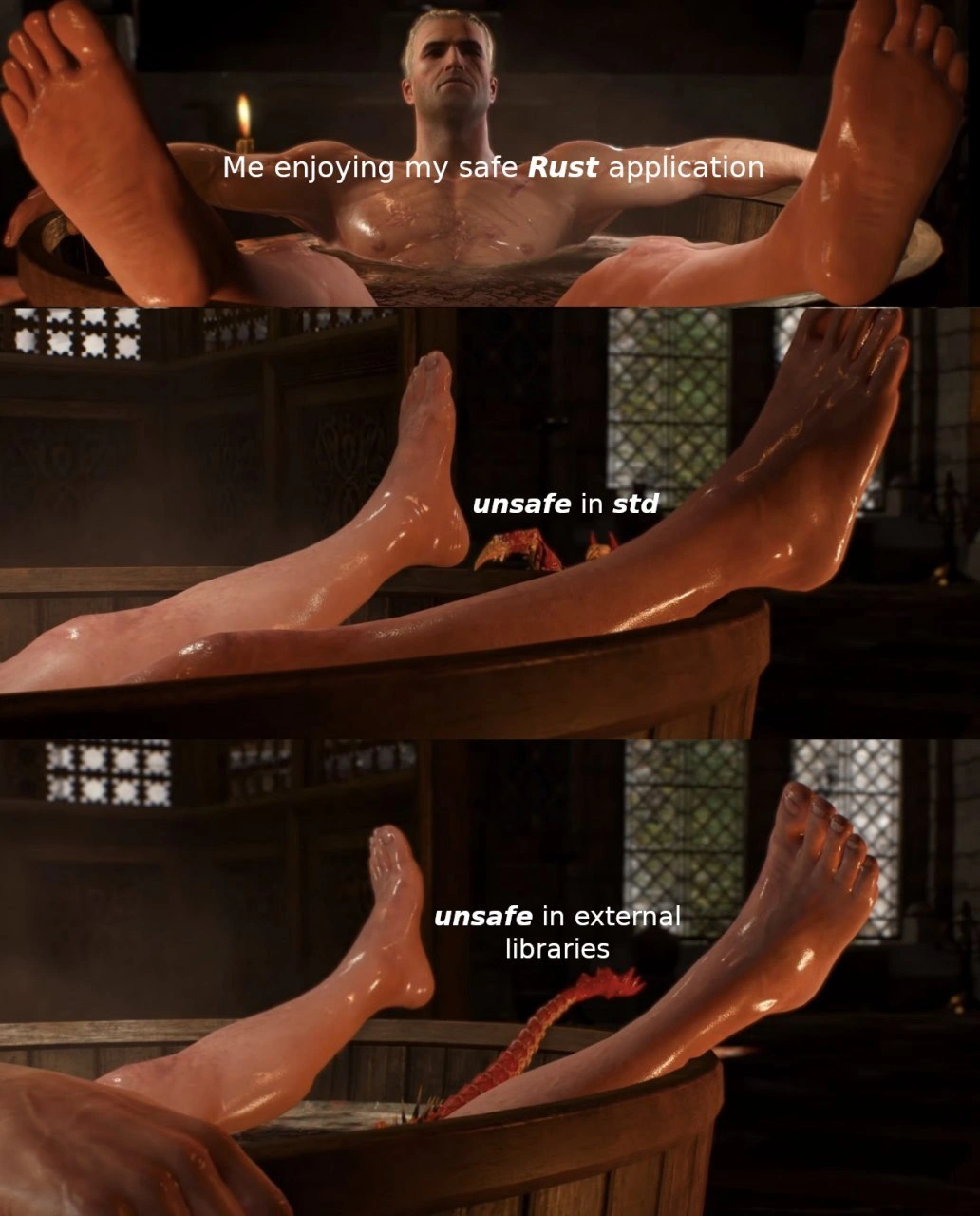
When your safe Rust code hides lurking unsafe blocks beneath the water
Languages Post #4018, on Dec 11, 2021 in TG

When your safe Rust code hides lurking unsafe blocks beneath the water

Why is this Languages meme funny?

Level 1: Monster in the Tub

Imagine you’re taking a nice, warm bath and you feel totally safe and relaxed. You’ve got your eyes closed, thinking everything is perfect. But then—surprise!—a little monster’s tail pops out of the water next to you. 😱 You had no idea there was a creature hiding under the water while you were so calm. This meme is funny for the same reason: the person in the bath (just like a confident programmer) feels completely safe, but secretly there’s a hidden danger lurking that they don’t see. It’s like thinking there are no sharks in the swimming pool, and then realizing one snuck in under the surface! The joke shows that even when we feel super safe and secure, there might be something risky hiding out of sight, which is both a little scary and kinda funny when we realize it.

Level 2: Safe vs Unsafe Rust

Let’s break down what this all means in more straightforward terms. Rust is a programming language beloved for its focus on memory safety and reliability. In practical terms, Rust helps developers avoid common bugs that plague languages like C or C++ – think of things like accidentally reading memory that you shouldn’t (buffer overflows) or forgetting to free memory (memory leaks) or using a piece of memory after it’s been given away (use-after-free). Rust’s secret weapon is its compiler, which uses a system of rules (the borrow checker and the ownership model) to make sure your code doesn’t compile if you attempt something potentially unsafe. Code that passes these checks is called safe code, and one of Rust’s proud guarantees is that safe code cannot cause undefined behavior (no wild crashes or corrupt data due to memory muck-ups) as long as the language’s rules are followed.

However, sometimes a programmer needs to do low-level tasks – maybe interact directly with the operating system, or call a function from another language like C, or implement a highly optimized data structure. In Rust, those operations are not allowed in regular safe code because they could be dangerous if used incorrectly. That’s where unsafe code comes in. Rust allows developers to mark a section of code or a function with the keyword unsafe. This is basically telling the compiler, “Hey, I got this. Let me do something risky here, and I promise I’ll do it right.” Inside an unsafe block, the normal safety checks are relaxed: you can dereference raw pointers, call foreign functions, or perform other actions that the compiler generally guards against. It’s a bit like taking off the training wheels. But importantly, Rust does not turn off safety everywhere – it’s just a contained block. The idea is that you use unsafe for the small parts that absolutely need it, and you keep the rest of your program in the safe territory.

Now, what about this standard library (“std”) mentioned in the meme? Rust comes with a standard library that provides lots of useful functionality – vectors, strings, file I/O, networking, etc. The standard library is written in Rust too! And yes, even the standard library has some unsafe inside it. Don’t worry, it’s not because the Rust team is careless – far from it. It’s because to implement certain features efficiently, they need to do a bit of low-level work. For example, a Vec<T> (a growable array list) needs to manage a chunk of memory internally. To make it fast, the implementation will allocate memory (ask the OS for a block of memory) and then use pointers to that memory. Managing raw pointers is not something safe Rust lets you do directly (since pointer mistakes = big problems), so the standard library uses unsafe internally, very carefully, to handle those pointers. When you, as a user, call safe methods like v.push(x) on a vector, you’re invoking that carefully written unsafe code under the hood. The key point: you don’t see or deal with the unsafe part – it’s all behind the scenes, below the water’s surface, as the meme would say.

Similarly, external libraries (in Rust we call them crates) might use unsafe internally. As a Rust beginner or even intermediate, you’ll often use tons of crates from the community to build your project. For instance, if you’re writing a web server, you might use an HTTP crate, a JSON parsing crate, a database crate, etc. Each of those crates might contain a few unsafe blocks. Perhaps the JSON crate uses unsafe to optimize parsing by manipulating bytes directly for speed. Or the database crate might call C code (like SQLite or Postgres client libraries) using unsafe FFI calls. When you include that crate, you usually just call its safe functions – you might never write unsafe yourself – but indirectly your program now contains some unsafe operations from those dependencies. Rust’s package manager Cargo doesn’t forbid crates from using unsafe; it just isolates it. Crates often call out in their documentation if they use unsafe, and the Rust community holds high standards: using unsafe is not “bad” per se, but it comes with responsibility. Library authors are expected to use it only when necessary and ensure it doesn’t break the safety guarantees for the users. There’s even an unofficial badge some crates use, “#![forbid(unsafe_code)]”, indicating they don’t use any unsafe at all, which some people seek out for extra peace of mind.

To connect back to the meme: it’s showing a person (the developer) enjoying their “safe Rust application.” That’s someone who wrote a program in Rust and didn’t use any unsafe themselves, feeling quite secure. Then it humorously reveals the two lurking dangers: “unsafe in std” (the Rust standard library’s hidden unsafe code) and “unsafe in external libraries” (any third-party crates’ hidden unsafe code). It’s calling attention to the fact that, yes, Rust largely protects you, but under the covers there is still some naughty, dangerous stuff going on – you’re just abstracted from it. Most of the time, that’s perfectly fine! Those standard and crate developers typically know what they’re doing, and Rust’s ecosystem is arguably safer than most because of this discipline. But the joke is a light poke at the possible anxiety a Rust developer might feel: “I trust Rust, but I sure hope all my dependencies got their unsafe code right!” It’s a bit like enjoying a well-built car – you feel safe with seatbelts and airbags (Rust’s safety guarantees), though you know under the hood there’s controlled explosions in the engine cylinders (the risky operations) that you trust were engineered correctly.

Finally, note the comedic format: this is a three-panel meme using a scene of a man in a bathtub from a medieval fantasy setting. The first panel’s caption, “Me enjoying my safe Rust application,” sets up the story – everything is great. The second and third panels deliver the punchline by showing the scary tail with the labels “unsafe in std” and “unsafe in external libraries.” It’s using a classic contrast for humor. As a newcomer, just understand: safe code is the code you (and the compiler) can feel good about, and unsafe code is a special-case tool that hides below your program’s waterline, used sparingly by Rust experts to make the whole thing possible. The meme is simply saying, “Don’t forget, even Rust has a little monster hiding in the tub – it’s usually chained up, but it’s there!” and that’s both funny and true.

// Even if your Rust code has no explicit 'unsafe', like this simple program:
fn main() {
    let mut numbers = Vec::new();  // create an empty vector
    numbers.push(42);             // add a number to the vector
    println!("{:?}", numbers);
}
// Behind the scenes, Vec::new() and Vec::push(...) use low-level operations.
// The Rust standard library uses a few `unsafe` tricks here to manage memory efficiently.
// You don't see it, but it's happening under the hood!

Level 3: Beneath Calm Waters

At the senior developer level, this meme hits on the ironic truth that even in a “safe” Rust program, there’s often some forbidden magic happening underneath. The first panel shows a contented bather (a medieval man in a tub, famously Geralt from The Witcher, looking very relaxed) labeled “Me enjoying my safe Rust application.” Rustaceans love to brag that their applications have no memory leaks or segmentation faults because Rust’s compiler won’t allow those mistakes in safe code. That’s the serenity you see on his face – the bliss of a developer who believes their code is untouchable by the usual C/C++ demons. The text even highlights Rust in orange, evoking Rust’s branding and its promise of safety. Everything above the waterline appears secure and comfortable.

But then, the second panel zooms in and we see a red, scaly tail starting to surface near his leg, labeled “unsafe in std.” Ah, the plot thickens! This is a cheeky nod to the Rust standard library (std): even though you might not write any unsafe in your own code, Rust’s standard library itself contains unsafe blocks. Seasoned Rust developers know that std is implemented with a sprinkling of low-level operations. For instance, when you do something as simple as let v = Vec::new(); v.push(42);, under the hood Rust may perform raw memory allocation and pointer arithmetic to make that vector work efficiently. The std library’s authors hid those nasty bits in unsafe blocks so you don’t have to see or worry about them. It’s like discovering that the relaxing warm bath you’re in has a few piranhas at the bottom – hopefully tamed, but they are there. The meme’s second panel reveals one “piranha” (unsafe code in std) nibbling at the toes of our unwitting Rustacean bather.

The third panel zooms out and reveals an even bigger threat: the tail fully breaches, now labeled “unsafe in external libraries.” This is the other foot many of us dip into Rust: using third-party crates (Rust’s term for libraries/packages). In any non-trivial project, you pull in dependencies from crates.io (Rust’s package registry) to get things done – maybe a JSON parser, a web framework, or a game engine. Each of those crates might contain their own unsafe code deep inside. Perhaps they interface with C code (for speed or to reuse existing libraries), or maybe they perform some performance trick that requires stepping outside the normal safety rails. As an experienced developer, you’ve likely encountered this phenomenon: you proudly declare “Our application is 100% safe Rust!” but an audit of the dependency tree reveals, say, 5 unsafe blocks in the JSON library, 12 in the database driver crate, and so on. In other words, there’s a whole ecosystem of hidden tails swishing around beneath your otherwise placid project waters.

The humor here comes from that contrast – the false sense of security versus the underlying reality. Rust gives you this wonderful feeling of safety (and in fairness, it does eliminate a huge class of bugs!), but if you’re an old-hand you know to be a bit wary. We can’t get too smug, because all those guarantees ultimately rest on the correctness of a relatively small amount of unsafe code spread across std and our Dependencies. The meme personifies this situation: the developer in the tub is blissfully ignorant of the danger inches away. It’s a playful jab at Rustacean hubris. A seasoned Rust developer might chuckle and think, “Heh, yep, there’s always a bit of unsafe somewhere.” We enjoy a safer language, but we know there’s no such thing as a free lunch – someone, somewhere had to wrestle with the memory demons.

This resonates as relatable humor in the Rust community. There’s even a common saying: “Safe Rust is safe, but unsafe Rust is ~sharp tools~**,” meaning if you go into unsafe territory, you better know what you’re doing. And even if you never touch those sharp tools, your friendly neighborhood library author might have. The meme’s monstrous red tail represents those sharp tools lurking in the depths. It also pokes at the slight anxiety a Rust developer might feel: “Am I really safe? What if one of those unsafe deep down has a bug?” There have been real incidents where a widely-used crate had an unsound unsafe bug, prompting patches and causing a stir – essentially a monster emerging and biting someone’s foot in production! So, the laughter is a coping mechanism: we laugh because we’ve all been that relaxed dev in the “bath”, then read an audit or a blog post about how some crate’s unsafe caused an issue, and thought, “Yikes, glad it wasn’t in my bathtub… or was it?” 😅

In summary, the meme uses the medieval bath scene to cleverly illustrate a software truth: Rust’s CodeSafety features let us kick back and relax most of the time, but under the calm surface of our high-level code, there be dragons – or at least a crab’s worst nightmare, an unsafe water serpent winding around our legs. Seasoned devs find it funny because it’s a gentle reminder: no matter how safe the language, you should still keep an eye open for what lurks beneath the abstractions. Keep those toes curled, just in case!

Level 4: Beyond the Borrow Checker

Rust’s memory safety model is built on strict compile-time guarantees enforced by the borrow checker. In safe Rust code (the normal Rust you write without any special markup), the compiler meticulously prevents dangerous actions like aliasing mutable references, use-after-free, or buffer overflows. Formally, safe Rust is designed to avoid Undefined Behavior (UB) – those nightmare scenarios where the program might crash or do crazy, unpredictable things due to memory errors. The core idea is that if it compiles, it’s memory-safe by construction. But here’s the twist: to achieve systems-level performance and interface with raw hardware or OS calls, some operations can’t be checked by the compiler’s rules. Enter the unsafe keyword – a way to opt out of these guarantees in controlled sections of code.

In a sense, unsafe in Rust is like opening a trapdoor beneath the fortress of guarantees. It lets you do low-level manipulations (raw pointer arithmetic, calling foreign C functions, interacting with the operating system) that the borrow checker would normally forbid. This escape hatch is absolutely necessary to implement many of Rust’s powerful features with zero runtime overhead (often called zero-cost abstractions). For example, the standard library’s implementation of a dynamic array (Vec<T>) or an atomic reference count pointer (Arc<T>) uses unsafe internally to manage memory directly. These abstractions remain high-level and safe to use because their unsafe bits are carefully written to uphold Rust’s rules manually. Think of it as a “safety contract”: the standard library developers write a bit of unsafe code but prove (through reasoning, tests, and sometimes formal verification efforts) that it’s used correctly so that you, the end programmer, can call a safe API with confidence.

It’s analogous to a Trusted Computing Base in security or a small kernel in an OS – we minimize and isolate the unsafe parts so that most of the system can be trusted. Academically, you could say safe Rust code is sound given the axioms set by those unsafe parts. If an unsafe block breaks the rules (introduces a bug), it’s like a crack in the foundation. This is why Rustaceans (Rust developers) are so careful about auditing and encapsulating unsafe: a single unsound unsafe block deep in the library can invalidate the guarantee for all the safe code built on top of it. In fact, the Rust compiler and community treat such issues very seriously – a flaw in an unsafe block that allows safe code to exhibit undefined behavior is called a soundness bug, and it’s a big deal to fix. The meme’s imagery of a hidden monster beneath calm waters perfectly captures this concept. Above the surface, everything obeys the rigorous rules of Rust’s type system (calm and safe), but below, there lurk those raw pointer manipulations and unchecked operations (the monster’s tail) that we trust are done correctly. It’s a reminder that under Rust’s friendly, orange Ferris the crab exterior (Rust’s unofficial mascot), there’s some unsafe machinery whirring away – mostly tame, but potentially bitey if misused.

Description

Three - panel meme using a cinematic medieval-bath scene. Panel 1 shows a relaxed bather reclining in a wooden tub, feet up, captioned “Me enjoying my safe Rust application” (the word “Rust” is orange for emphasis). Panel 2 zooms on one soaked leg while a red, claw-like tail begins to surface, overlaid text “unsafe in std”. Panel 3 pulls back to reveal the tail fully breaching near the other leg, label reads “unsafe in external libraries”. The joke contrasts Rust’s strong memory-safety guarantees with the unavoidable presence of unsafe code hidden inside the standard library and third-party crates, reminding developers that safety is sometimes only skin-deep

Comments

9
Anonymous ★ Top Pick Rust’s memory model is a spa day right up until std::mem::transmute pokes a claw out of the bubbles - then that FFI-stuffed crate you just cargo-add’ed starts negotiating toe ownership
  1. Anonymous ★ Top Pick

    Rust’s memory model is a spa day right up until std::mem::transmute pokes a claw out of the bubbles - then that FFI-stuffed crate you just cargo-add’ed starts negotiating toe ownership

  2. Anonymous

    After 15 years of chasing null pointer exceptions, you finally adopt Rust for its bulletproof memory safety, only to discover your entire dependency tree is basically a distributed unsafe block with better marketing. It's like hiring bodyguards who outsource their work to the people they're protecting you from

  3. Anonymous

    Rust's safety guarantee is airtight, modulo the 3,000 unsafe blocks in your dependency tree marked '// SAFETY: trust me'

  4. Anonymous

    Ah yes, the Rust developer's journey: You start by smugly explaining to C++ devs how the borrow checker eliminates entire classes of bugs, then you discover that 'unsafe' appears 1,547 times in std alone, and finally you realize that your 'safe' web server depends on 247 transitive dependencies where some maintainer in 2019 wrote 'unsafe { std::ptr::read_volatile() }' with a comment that just says '// YOLO'. Turns out memory safety is less 'guaranteed by the compiler' and more 'a gentleman's agreement that we all pinky-swear to audit our unsafe blocks.' At least when it segfaults, you can still blame C interop

  5. Anonymous

    We brag about “0 unsafe,” then Cargo pulls 180 crates - somewhere a transitive dep wrapped a C pointer in ManuallyDrop and marked it Send; the borrow checker’s just the bath attendant now

  6. Anonymous

    Safe Rust: pure bliss until std's unsafe whispers and crates.io's footguns turn your bath into a boiler

  7. Anonymous

    Rust’s bathtub feels safe; it’s the transitive FFI plumbing that leaks - audit the unsafe, not the bubbles

  8. @beton_kruglosu_totchno 4y

    There will be unsafe code somewhere, what's the point?

    1. @CcxCZ 4y

      Not necessarily, but indeed Rust isn't designed so you could formally verify all your codebase. There are languages that can facilitate that. Either way, the smaller TCB the better usually.

Use J and K for navigation