The Stack Overflow Singularity is Near
Why is this AI ML meme funny?
Level 1: The Self-Taught Robot
Imagine you have a robot friend who is learning to do things. Usually, when this robot gets stuck, you or some human helps it by looking up answers in a big book of all answers. Now think of Stack Overflow like a huge book or library where all the answers for programming questions are kept (written by many helpful people). Developers (the people who write programs) often go to this library to find answers when they’re confused or have a problem.
Now here’s the funny part: what if the robot learns to go to that library all by itself? 🤖📚 It’s like if your toy or computer could read the instruction manual or search the internet without asking you whenever it wants to fix or improve itself. All of a sudden, the robot doesn’t need people to troubleshoot or learn new tricks – it can teach itself using all the knowledge humans have shared.
The meme joke says basically: “Once the robot can search that book of answers on its own, we’re finished.” Of course, it’s an exaggeration meant to be funny. The phrase “it’s all over” sounds like a dramatic way of saying “uh-oh, we’re doomed!” Here, it means people would feel a bit scared or useless because the machine can now solve problems without us.
Think of it like this: If you’re always helping your little brother tie his shoes by checking a guide, and one day the shoes start tying themselves by reading the guide… you might jokingly say, “Welp, I guess I’m not needed anymore!” You’d be half proud, half a little threatened. In the same way, developers are joking that if their creation (the AI) can ask the experts (Stack Overflow) on its own, then what’s left for the humans to do?
So the simple idea making us smile here is: a smart machine that can ask questions and learn from the same place humans do would be a very independent machine. It tickles our imagination (and a tiny fear) that the machine could become so smart it doesn’t need its makers. But mostly, it’s funny because it’s true in a way — developers rely so much on shared answers that if machines copied that habit, they’d basically become just like us, maybe even outsmart us! It’s like a student who found the answer key to all the tests; from the teacher’s view, that’s game over (said with a wink).
In short, the meme is saying: watch out, world, if the AI figures out how to learn all our tricks from our own answer books, then the tables might turn! It uses a silly, exaggerated scenario (a robot browsing a Q&A site) to make us laugh and think “haha, what if?” But don’t worry – it’s a joke. We’re safe… at least until the robots actually start reading 😊.
Level 2: AI Discovers Stack Overflow
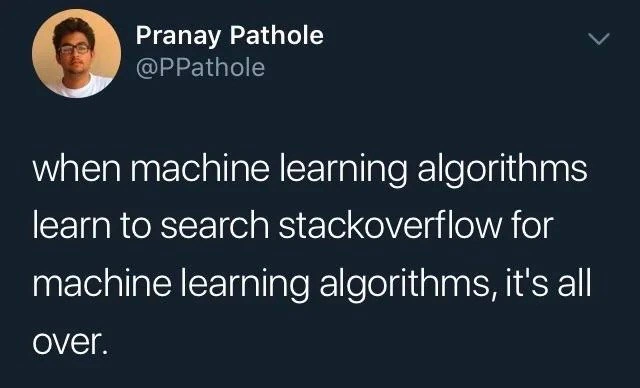
Let’s break down the meme in simpler terms. The image is a screenshot of a tweet (a short message on Twitter) by Pranay Pathole. The tweet says:
“when machine learning algorithms learn to search stackoverflow for machine learning algorithms, it’s all over.”
In plain language, that means “if machine learning programs learn how to look up solutions on Stack Overflow, we’re doomed.” This is a joke that mixes AI with a famous website called Stack Overflow.
First, know that machine learning (ML) algorithms are a kind of AI (Artificial Intelligence). They’re programs that can learn patterns from data and improve at tasks. Think of an ML algorithm as a smart software that can, for example, recognize your face in a photo or recommend videos to you. Developers create these algorithms, but often they need tuning and improving.
Now, what is Stack Overflow? It’s a hugely popular online forum where developers and programmers ask questions about coding problems and get answers from other developers. If you’re a new programmer and you run into an error or you’re not sure how to do something, you probably search on Google. Nine times out of ten, Google will show you a Stack Overflow page where someone had the exact same issue and other programmers provided a solution. For developers, Stack Overflow is like a giant help center or library filled with real-world coding Q&A. Copying a solution or snippet of code from Stack Overflow to fix bugs is so common that it’s practically a running joke in the developer community. (Yes, even experienced coders do it – all the time!). This has become known as “StackOverflow-driven development” in jest. In fact, many of us half-jokingly say that a good developer isn’t the one who knows everything, but the one who knows how to quickly find answers on Stack Overflow! 🗃️📚
Now, the tweet joke puts these pieces together: imagine a machine learning algorithm that itself searches Stack Overflow to find better algorithms or solutions for its own development. In other words, the AI would be improving itself by reading the same website that human developers use to improve their code. That’s a funny thought because it’s so meta (self-referential). It’s like a robot saying, “I don’t need a programmer’s help; I’ll just check the programmers’ help website myself.”
Why would that be “all over” or doom? Because it suggests that if AI can do that, it won’t need us (the human developers) anymore. The phrase “it’s all over” is exaggeration for effect – it means the end of an era. In this context, it implies the end of developers’ jobs or relevance. It’s like saying, “Game over, humans, the AI can handle it from here!” This plays into a common fear (often exaggerated in a funny way) among developers: Will AI replace us? Usually, people talk about AI writing code on its own. This tweet jokingly says the process would start the moment AI learns our secret trick of looking up answers.
From a newcomer’s perspective, it’s helpful to unpack that StackOverflow dependency joke. When learning to code, you quickly realize you won’t memorize everything; instead, you learn how to find what you need. Searching error messages or “How do I do X in Python?” often lands you on a Stack Overflow page with a clear answer. It almost feels like cheating or using a lifeline. The joke here assumes you know how vital Stack Overflow is to developers. It imagines an AI algorithm reaching that same eureka moment: “Aha! I can just Google my problem and use a solution from Stack Overflow.” If a machine can do that on its own, it’s a bit of a role reversal – usually humans use machines to search the web, but now the machine would be using itself (or another machine) to search the web for programming advice.
Also, notice the format of the meme: it’s displayed as a tweet with white text on a dark background. Many modern memes, especially in tech circles, are just funny or insightful tweets that get screenshot and shared. This one uses a concise one-liner style – typical for Twitter humor. Despite being short, it packs in the joke: it references machine learning (so AI folks perk up), and Stack Overflow (so all developers nod knowingly). Those are the key terms:
- Machine learning algorithms: the smarty-pants programs.
- Search Stack Overflow: basically, look up programming help from the community Q&A site.
- It’s all over: a dramatic way to say “we’re done for” or “the end is near” (in a joking sense here).
In summary, at Level 2 we understand the meme as: An AI that can improve itself by reading Stack Overflow would signal that AI has become as savvy as developers at solving coding problems. If that happens, developers jokingly say “we’re doomed,” because the AI wouldn’t need our help anymore. It’s a fun poke at both how much we rely on shared knowledge and the idea of AI becoming independent. For someone new to the field, it highlights just how important community knowledge bases like Stack Overflow are in practice—and it uses that to get a laugh about AI’s potential.
Level 3: Stack Overflow Overflow
To a seasoned developer, this meme lands as a wry nod to our daily reality and an exaggeration of AI hype. The tweet reads, “when machine learning algorithms learn to search stackoverflow for machine learning algorithms, it’s all over.” This one-liner humorously combines two things devs hold dear (and occasionally fear): machine learning (ML) and Stack Overflow. The joke here satirizes both our reliance on community knowledge and the breathless chatter about AI’s rapid progress. Essentially, it’s saying: the day an AI can do what we do to solve problems — i.e., scour Stack Overflow for answers — that’s the day developers become obsolete.
Why is this funny to an experienced dev? Because it hits close to home. Any programmer with battle scars knows that solving tricky bugs at 3 AM often means copy-pasting error messages into Google and landing on a Stack Overflow page. Stack Overflow is a Q&A site every developer uses (from juniors to seniors) to get unstuck. We jokingly call it our “extended memory” or say “I don’t need to memorize syntax, Stack Overflow is my backup.” Now imagine an AI that also figures this out. It’s a perfect satire of AI hype vs. reality: Instead of inventing completely new algorithms from thin air, the super-intelligent AI just does what we do — it googles the answer! It’s the ultimate AI humor: our future overlord doesn’t need a scientist’s lab or a genius insight; it just needs an internet connection and a Stack Overflow account.
This scenario also pokes fun at the idea of recursive self-improvement in a very dev-centric way. In serious AI discussions, people worry about a runaway feedback loop where AI improves itself beyond human control. Here we have a tongue-in-cheek version: the feedback loop is an AI reading Q&A threads written by humans, possibly improving its code or parameters based on those answers, then repeating. It’s a comical knowledge feedback cycle. There’s even a pun hidden for the initiated: a “stack overflow” in programming is a runtime error caused by uncontrolled recursion or a massive call stack. If an ML algorithm literally recurses on Stack Overflow knowledge ad infinitum, we’d have a “Stack Overflow overflow” – a playful suggestion that things will blow up spectacularly 🤣. Too much of even a good resource can cause a crash!
The meme resonates because of shared developer experience and a pinch of existential dread. We’ve all had that uneasy chuckle about AI taking our jobs someday. Here it’s dramatized: the moment AI figures out Stack Overflow, developers everywhere will hang up their keyboards. It’s hyperbole, of course – real ML models don’t literally browse websites for solutions (at least, not yet in 2019). But the hyperbole touches real trends: by 2019, Stack Overflow had become a massive repository of solutions, and machine learning had advanced to use internet-scale data. Developers joke that if Stack Overflow ever goes down, productivity across the industry plummets. Now envision an AI tapping directly into that dependency — it’s a humorous yet uncomfortable mirror.
The tweet format of the meme is also part of the joke’s delivery. Tweets are often used by developers to share these quick, witty observations with a dash of doom (#DeveloperHumor). The dark-mode screenshot with the avatar and handle (@PPathole) gives it that authentic tech Twitter vibe. In dev circles, we see tweets go viral about programming truths, and this one hits a nerve: it combines AI hype with a very dev community in-joke. It’s essentially saying, “We’re all proud of our fancy ML models, but admit it, they’d be unstoppable if they could do the one trick every developer relies on – searching Stack Overflow.”
From an industry perspective, the meme hints at the blurred line between human and machine problem-solving. Modern machine learning engineers already incorporate human knowledge indirectly: e.g., using pre-trained models or reading research (which in turn often includes code from GitHub or Stack Overflow). This tweet takes that to comic extremes: an ML model literally trawling Stack Overflow by itself. It reflects the AI hype vs reality tag perfectly: we talk about AI as if it’s magic, but at the end of the day, maybe it just needs the same crutch we all use. It’s a humorous critique of both the reliance on communal knowledge and the almost mystical fears around AI achieving self-modifying AI status.
In essence, experienced devs laugh because the joke exposes an absurd truth: so much of programming is actually just knowing where to find answers. If an AI figures out that meta-skill, well, “it’s all over.” The imminent doom tone is melodramatic on purpose, playing into the meme of developers’ existential dread about being automated away. But it’s delivered with a wink. We’re not truly panicking — we’re bonding over the fact that Stack Overflow is basically our collective AI already, and if the machines plug into it, they’re essentially stealing our secret weapon. The humor is equal parts self-deprecation (laughing at how much we rely on copying solutions) and exaggerated tech fear. It’s a perfect geeky joke nesting a genuine insight: the tools that empower developers could one day empower AI in the same way, and it’s both fascinating and terrifying.
Level 4: Stack Overflow Singularity
At the most theoretical level, this meme hints at a looming intelligence explosion. In computer science and AI theory, there's the concept of recursive self-improvement: an algorithm that improves itself, leading to a feedback loop of ever-accelerating capabilities. Here, the twist is that the machine learning model isn’t just tweaking some internal weights — it’s autonomously tapping into the collective human coding knowledge on Stack Overflow. This scenario evokes the classic singularity idea (coined by I.J. Good) where an AI becomes smart enough to design even smarter AIs, rapidly outpacing human control. In a way, an ML model that can search and scrape Stack Overflow for algorithms is performing a form of meta-learning: it’s learning how to learn better by leveraging the solutions shared by thousands of developers.
From a theoretical standpoint, this is like an Ouroboros of code (a snake eating its own tail, but in software form). We’ve seen analogies in computing: for instance, languages with self-hosting compilers (like a C compiler written in C) or programs that output their own source code (quines). Those are professional parlor tricks compared to what’s implied here: an AI effectively writing its own improvements by mining human-generated answers. Researchers in AutoML (automated machine learning) and neural architecture search already dabble in this territory—algorithms that explore and optimize model designs without human intervention. But the meme’s vision is cheekier and more ominous: a general ML model that just helps itself to the entire online trove of coding wisdom.
There’s a subtle technical pun lurking too. The phrase “search Stack Overflow for machine learning algorithms” suggests an endless loop (the algorithm looking up algorithms to improve algorithms…). In theoretical terms, one could imagine a kind of fixed-point combinator for AI improvement. If we tried to express it pseudo-mathematically, we’d get something wild like:
$$ AI_{new} = AI_{current} + Knowledge_{StackOverflow}(AI_{current}) $$
Meaning the new AI is the old AI plus whatever new tricks it learned from Stack Overflow. This starts to resemble an unstoppable iterative process. In complexity theory lingo, it’s as if the problem “How to build a better AI” was outsourced to a giant human-created database of solutions, turning an AI’s NP-hard problem into a simple database lookup. Of course, the real world isn’t so magical, but the concept tickles our nerdy brains. It’s a bit like a compiler optimizing itself using every optimization trick in the book — eventually you wake up with an optimizer that nobody fully understands.
There’s also a whiff of sci-fi dystopia here. In the Terminator movies, Skynet becomes sentient and decides humanity is obsolete. In our dev humor version, Skynet doesn’t need to invent everything from scratch — it just scrolls through Stack Overflow threads until it knows every trick in the book. 🤖 This self-serve approach to AI evolution feels both absurd and eerily plausible. After all, modern large language models (the kind behind chatbots) are already trained on vast swaths of the internet, including Q&A sites like Stack Overflow. The meme takes that to a logical extreme: if an AI can actively query such knowledge bases in real-time to refine its own algorithms, we have a system that’s effectively writing its own upgrades. That’s the Stack Overflow Singularity nightmare: a feedback loop where an AI’s skill growth is limited only by the sum of human knowledge online. When theory meets humor like this, it cleverly spotlights deep questions: Could an AI truly bootstrap its way to dominance using our posted solutions? And if it did, would we even realize it before it’s too late? It’s a tongue-in-cheek nod to the power of crowd-sourced knowledge as both the treasure and the Trojan horse of AI advancement.
Description
A screenshot of a tweet from user Pranay Pathole (@PPathole). The text of the tweet reads: 'when machine learning algorithms learn to search stackoverflow for machine learning algorithms, it's all over.'. This meme humorously captures a key anxiety and speculation in the software development community about the future of AI. The joke lies in the meta-reference: AI achieving self-improvement by using the same primary resource - Stack Overflow - that human developers rely on for problem-solving. For experienced engineers, this is a witty and slightly unnerving take on the concept of the technological singularity, grounding an abstract sci-fi idea in the very real, everyday practice of searching for code snippets online
Comments
8Comment deleted
The real singularity isn't when AI searches Stack Overflow, it's when it starts marking answers as duplicates of a question from 2011
The real singularity is your nightly retrain job scraping StackOverflow, finding a 2009 top-voted answer, and silently refactoring the fleet to a quadratic regex because “works on my laptop” had 5k upvotes
The day an LLM starts answering Stack Overflow questions with "marked as duplicate" and a link to a 2009 jQuery solution is the day we know it's truly achieved human-level intelligence
The singularity won't be a superintelligence - it'll be a model that learns to paste the accepted answer without reading the comments warning it's deprecated
The real singularity isn't when AI becomes smarter than humans - it's when it learns to copy-paste from Stack Overflow without reading the comments warning about the deprecated solution from 2015. At that point, it'll have truly achieved human-level intelligence, complete with our tendency to ship code we don't fully understand and mark tickets as 'resolved' while secretly hoping the edge cases never materialize in production
Once your RAG lets the model query Stack Overflow for ML, you’ve built a self-hosting compiler that converges to one solution: use XGBoost
The real AGI milestone: when your model posts a bounty on SO to fix its own gradient explosion
That’s when MLOps turns into SOps: the agent scrapes Stack Overflow, cites itself, and ships to prod while CODEOWNERS marks you as “reviewed.”