Corporate Procrastination: The Deadline Meeting
Why is this Meetings meme funny?
Level 1: All Talk, No Action
Imagine you have a big school project due tomorrow. You really need to spend all your time after school finishing it, right? But instead of letting you get started, your dad keeps stopping you to sit down and talk about how super important this project is. He calls you into the living room and says, “This assignment is very, very important. You must get it done on time.” He talks for a long time about why doing well is crucial. Meanwhile, you’re just sitting there thinking, “I know, I know! I really should be working on it right now instead of talking about it.” Every minute he spends reminding you how important it is, you have one minute less to actually do your homework. It’s a bit silly, isn’t it? The more he talks, the less you get to act.
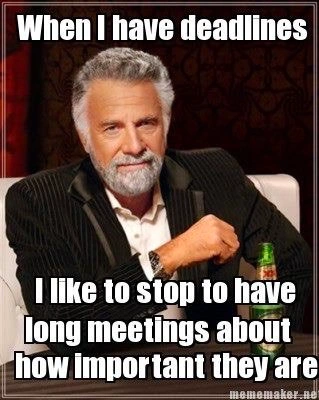
That’s exactly what’s going on in the meme. The boss in the picture is like that dad: he has a big job that needs to be done soon (a deadline), but he chooses to have a long meeting to discuss how important that job is. It’s funny because he’s doing the opposite of what would actually help. Instead of letting his team work, he’s all talk and no action. The joke makes us laugh because we all know that feeling: when somebody keeps talking about doing something important, but by talking so much, they’re actually stopping it from getting done. It’s a little like having a fire to put out, but the fire chief holds a long meeting to discuss the fire while the fire is still burning! Obviously, that wouldn’t help at all. In the same way, the meme is showing a boss who unintentionally makes things worse by calling a big meeting right when everyone should be busy working. It’s a goofy way to remind us that sometimes the best way to meet a deadline is simply to let people get to work — and skip the extra talking.
Level 2: This Could Be an Email
This meme shows a common situation in software teams in a very exaggerated, humorous way. The image itself is the famous “Most Interesting Man in the World” meme. That’s the grey-haired gentleman in a suit with a beer bottle, who usually says, “I don’t always do something, but when I do, I really do it.” In this meme, he’s styled as a manager bragging about his unique habit when projects get busy. The text on the image is split into a top line and a bottom line, written in bold white Impact font (a classic meme style). The top caption reads: “When I have deadlines” and the bottom caption continues: “I like to stop to have long meetings about how important they are.” Essentially, the manager in the meme is saying: “Whenever an important due date is coming up, I choose that moment to hold a really long meeting to discuss just how critical that deadline is.” It’s a very literal description of the joke: instead of working to meet the deadline, he stops everything to talk about the deadline.
Let’s break down why this is funny to developers. A deadline in software (or any project) is a date by which some work must be finished. Deadlines usually make everyone hurry up and focus on the important tasks. Now, a meeting is when people gather (in person or on a call) to talk and share information. Meetings can be useful to coordinate a team, but they also take time. A “long meeting” means a meeting that goes on for a long time, perhaps an hour or even several hours. When you’re in a meeting, you’re usually not writing code or doing the actual work on the project. So if you have too many meetings, especially during crunch time, you lose a lot of productive coding time. This meme is a form of developer humor and meeting humor that highlights that frustration. It’s the kind of joke people make when they’re feeling developer frustration about corporate habits. The humor comes from the absurdity: it’s as if the manager is proudly saying, “I always pick the worst possible time to hold a meeting!”
In real life, many developers have experienced this scenario. Imagine you’re a junior programmer and it’s the last week of a sprint (a sprint is a short, focused period of work in Agile development, often 1-2 weeks, where the team has specific goals to deliver). There’s a big feature or release due by Friday – that’s your deadline. You expect that the team will be coding intensely, pushing to finish everything by the due date. But suddenly, on Thursday afternoon, your manager schedules a “urgent status meeting” for the whole team. Everyone has to stop what they’re doing, file into a meeting room (or join a video call), and spend two hours going over slides about project timelines, task statuses, and hearing rhetoric about “how absolutely important it is that we meet the deadline.” The manager might go person by person asking for updates or reiterating the high stakes. Meanwhile, you’re glancing at your laptop’s clock thinking, “We’re losing two hours of development time for this?” By the time the meeting ends, it’s late in the day and you have less time to actually fix that last bug or write that missing unit test. The deadline is now even closer, and ironically, the team is less prepared than it was two hours ago. That scenario is exactly what this meme is calling out.
So why do these meetings happen if they’re so counterproductive? Often, it’s part of corporate culture and communication style. Managers schedule status meetings to make sure everyone knows what’s going on and to make themselves feel on top of the project. They truly believe communication is important — and it is, but timing and efficiency matter. In a healthy process, you’d have quick daily check-ins (sometimes called stand-ups in Agile) that last maybe 15 minutes, just enough for each person to say what they’re working on and if they need help. However, some companies or managers haven’t mastered that light-touch approach. Instead, they hold long, detailed meetings far too often, even when the team should be laser-focused on work. There’s even a popular saying in offices: “This meeting could have been an email.” That’s what people joke when a meeting felt unnecessary — all the information could have just been sent in a short email or message and saved everyone’s time. In the case of our meme, the entire long meeting about “how important the deadline is” could probably have been a one-line email: “Reminder: Let’s try our best to meet the deadline, it’s really important.” The point is, everybody already knows the deadline is important, so a marathon meeting is just repetitive and eats up time.
The image using the Most Interesting Man meme format adds a layer of sarcasm. That character is typically used to make tongue-in-cheek bragging statements. Here, the brag is ridiculous: “I stop everything to hold a meeting when time is almost up.” No real manager would openly brag about this, right? But framing it that way highlights the silliness. It’s like the meme manager is completely unaware that he’s causing a problem — or he’s just avoiding the real work by talking about work. In fact, there’s a bit of truth in that: sometimes having a meeting is easier (for a manager) than actually solving the tough issues in the code. Talking about the work can feel productive to someone who isn’t the one coding. Meanwhile, the developers in the meeting often feel anxious because they know they could be using that time to actually solve those tough issues. That’s why this resonates as developer humor: if you’re a programmer, you’ve likely felt that pang of frustration when a meeting invite pops up at the worst time. It’s also corporate humor because plenty of people in other fields (not just software) experience similar things — like the boss who calls a company-wide meeting at 4:00 PM on Friday to emphasize end-of-quarter goals (cue collective groan).
To sum it up, the meme mocks the time-wasting meetings that happen under deadline pressure in many workplaces. It uses a well-known meme character to exaggerate the behavior of a manager who seemingly values talking about work over doing work. If you’re new to the developer world, don’t be surprised if you encounter this kind of situation. The first time you do, you’ll remember this joke and probably chuckle (or sigh). The meme is a friendly way for engineers to say, “Yep, we’ve all been there – sitting in a pointless meeting while the real work piles up.” It’s funny because it’s true, and a little painful because every developer wishes they had that meeting time back to code.
Level 3: Crunch Time Paradox
Any seasoned developer can recognize the dark humor here: just when the code needs to be flying out the door, everything grinds to a halt for a big meeting about, well, why the code isn’t flying out the door yet. It’s a crunch time paradox we’ve seen a hundred times. The sprint’s final days might be ticking down, the deadline pressure is throbbing like a headache, yet the team finds itself trapped in a conference room (or a massive Zoom call) listening to a manager earnestly stress how “meeting this deadline is absolutely critical.” The irony is thicker than the meeting room air: we’re burning precious hours discussing how we shouldn’t waste any time.
This meme perfectly skewers that bit of corporate culture where process undermines productivity. It’s poking fun at a classic management anti-pattern: responding to a behind-schedule project by piling on more status checks and meetings. Everyone in that room is painfully aware that each minute spent in this long meeting is a minute not spent actually writing code or fixing bugs. In theory, Agile methodology tried to prevent this — with short, 15-minute daily stand-ups and minimal ceremony — but in practice many organizations still slip into old waterfall habits under stress. A daily stand-up mutates into a daily 2-hour sit-down. A quick check-in balloons into a full-blown “sync meeting” monologue. The result? The team’s velocity flatlines right when they need to sprint the hardest. As the meme suggests, the “Most Interesting Manager” somehow finds marathon meetings most essential exactly when they make the least sense.
We laugh (maybe to keep from crying) because it’s true. Developer frustration over “too many meetings” is real – entire Slack channels and countless memes (hello, MeetingHumor!) are devoted to it. It’s practically a rite of passage in software teams to sit through a rambling “why this deadline matters” meeting while glancing at the clock, thinking, “I could be fixing the deployment script right now.” The humor comes from shared exasperation: the meme is basically every developer’s inner sarcastic commentary on such a situation. It’s common corporate humor to joke that “This meeting could have been an email.” Here, it’s even worse: this meeting is about not having time for meetings! Talk about meta-irony. The meme paints the manager as a suave, boastful figure doing something outrageously counterproductive — an image every dev who’s endured time-wasting meetings can relate to. It’s the same energy as joking, “I don’t always sabotage my team’s productivity, but when I do, it’s right before a release.” We recognize the caricature: that manager who seems to think that talking about the work is somehow more important than actually doing the work.
Why does this happen in real life? From a senior perspective, it often boils down to anxiety and control. As deadlines loom, higher-ups get nervous. They want updates, reassurance, a sense of control over the chaos. So they convene a big meeting to “get everyone on the same page.” It sounds reasonable — communication is good, right? — but overdone, it backfires. Instead of trusting the team and unblocking developers, they inadvertently block everyone’s time. It’s a form of organizational procrastination: focusing on easily demonstrable tasks (like holding meetings, writing reports, making Gantt charts) to avoid facing the harder reality (that the software isn’t done yet). In some cases, it’s pure optics – a manager might want to look busy and accountable to their own bosses: “See, I held a two-hour review meeting to address the deadline!” It covers their bases, even if it doesn’t move the project forward an inch. The team, of course, collectively facepalms. They know that two-hour meeting just cost them a deploy or a batch of unit tests. But culturally, they often can’t refuse; when The Boss invites you to a meeting about the important deadline, you sit and nod along.
The meme’s use of the Most Interesting Man in the World template cranks up the sarcasm. In the original ads/memes, that distinguished gentleman brags, “I don’t always do X, but when I do, I Y.” It’s always something impressively outlandish or ironically grandiose. Here that format is twisted: the “Most Interesting Manager in the World” essentially boasts, “I don’t always have deadlines, but when I do, I hold ridiculously long meetings about them.” It’s a tongue-in-cheek portrayal of a manager who is proud of this counterproductive habit. That contrast — using a cool, confident meme character to celebrate a dumb idea — makes the joke hit even harder. It’s a nod to the fact that in corporate life, the people causing the problem often act as if they’re doing something wise. The confident pose of the man in the suit with his beer (from the Dos Equis ads) only adds to the irony: he’s the picture of importance and swagger, pontificating about urgency while actively squandering the urgent time. It’s a scenario so familiar it hurts: the critical path is on fire, and here comes the manager with a firehose… full of words.
Ultimately, this meme lands because it taps into a universal tech workplace truth: meetings and deadlines are frenemies at best. Developers share it with a wry smile because we’ve all lived it. It’s a satirical reminder that being “busy” talking about work is not the same as actually getting work done. And in true developer humor fashion, we cope by laughing about it in a meme, then sharing it during — what else — a meeting that’s going on too long.
Level 4: The Mythical Meeting Month
Even computer science theory and classic software management wisdom explain why this scenario is so absurdly counterproductive. In the 1970s, Fred Brooks coined Brook’s Law in The Mythical Man-Month: “adding manpower to a late software project makes it later.” In essence, every new person (or extra process like a meeting) introduces communication overhead. Here, instead of adding developers, the manager adds a marathon status meeting at the worst possible time. The result? More overhead when the project can least afford it. It’s like trying to fix a late project by throwing a wrench into the gears—time spent coordinating is time not spent coding. According to Brook’s Law, these last-minute all-hands meetings virtually guarantee the project slips even more.
This paradox has a parallel in computing: Amdahl’s Law. Amdahl’s Law tells us that the speedup from running tasks in parallel is limited by the portion that must run serially. Think of the team of developers as parallel threads all working towards a deadline. A long group meeting is a serial bottleneck where all threads are forced to stop coding and synchronize. If a significant fraction of the work time is spent in such lockstep meetings, no amount of agile sprinting or “10x engineers” will boost throughput beyond that limit. For example, if 20% of the day is occupied by meetings (a serial segment), even an infinite number of developers can’t achieve more than an 5x speedup – that 20% coordination tax is the ceiling. In other words, a mandatory meeting acts like a giant single-threaded section in an otherwise parallel process, kneecapping the team’s potential productivity when it matters most.
On a more micro level, these meetings cause context switching hell. In operating systems, switching a CPU from one thread to another has overhead – too many switches and the system spends more time switching than doing real work (this painful state is called thrashing). Humans have a similar cost: when a developer is deep in coding flow and gets yanked into an impromptu two-hour meeting about deadlines, their brain has to swap out the code context, sit through slides, then later swap the code context back in. This mental context-switch overhead means lost momentum and more bugs or delays when they resume coding. It’s akin to forcing a CPU pipeline flush right when the cache was hot – terribly inefficient. There’s even an observer effect at play: the act of measuring or micromanaging progress (like scrutinizing everyone in a meeting) inherently disturbs that progress. By fundamental principles of collaboration and concurrency, marathon meetings at crunch time are a textbook recipe for reduced output. The math and theory both agree: when you halt all work to talk about work, you’re literally trading away real progress for the illusion of control.
Description
A classic meme featuring 'The Most Interesting Man in the World' format. The image shows a distinguished, well-dressed man with a grey beard sitting at a table with a beer, looking calmly at the viewer. The text is split into a top and bottom caption. The top text reads: 'When I have deadlines'. The bottom text continues: 'I like to stop to have long meetings about how important they are'. This meme uses irony to critique a common frustration in the corporate and tech worlds: the tendency to engage in counterproductive activities, like excessive meetings, precisely when time is most critical. For senior developers, this highlights a familiar anti-pattern where discussing the urgency of a deadline takes precedence over the actual work required to meet it, showcasing a disconnect between management process and developer productivity
Comments
8Comment deleted
That meeting is essential. It's where we'll form a subcommittee to create a tiger team that will commission a blue-sky working group to circle back and touch base on the deadline's importance
Nothing says agile like a stop-the-world GC - sorry, “alignment meeting” - that blocks every thread 30 minutes before the release cut
Nothing says "we're agile" quite like a two-hour planning meeting to discuss why the sprint is behind, followed by a retrospective on why we have too many meetings
Nothing communicates urgency like a recurring 90-minute meeting whose only action item is scheduling the follow-up
The most dangerous phrase in software engineering isn't 'it works on my machine' - it's 'let's schedule a quick sync to align on priorities' when you're three days from release. Because nothing says 'this is critical' quite like converting your remaining 24 productive hours into 6 hours of meetings about how to use those 24 hours
Deadlines incoming? Time for a velocity workshop to align on why velocity demos are blocked
Deadline approaching? We go full SAFe - scale the meetings until the only thing on the critical path is the calendar
Nothing accelerates the critical path like a 90-minute alignment that imposes a stop-the-world GC on every thread and yields zero decisions