The Programmer's Love-Hate Relationship with Code
Why is this MentalHealth meme funny?
Level 1: A Puzzle You Can’t Quit
Imagine you’re working on a really hard puzzle, like a big jigsaw with thousands of pieces or a tricky riddle. At first, it’s fun because you’re putting pieces together and making progress. But then you hit a part that just doesn’t make sense — none of the pieces seem to fit, and you start feeling super annoyed. You might even want to throw the puzzle across the room and shout, “I hate this! It’s too hard!” That’s the “well yes” part — in that moment you really do hate the puzzle because it’s frustrating you. But here’s the thing: you don’t actually give up. Some part of you still loves the challenge and wants to see it finished. So you take a deep breath and keep trying different pieces. Finally, when you solve it — when that last piece clicks in or the riddle becomes clear — you feel happy and proud. You remember that you actually enjoyed the whole adventure, difficulties and all. That happy, proud feeling is the “but actually no” part — you realize you never truly hated it because the fun of solving it was worth the trouble.
Programming is just like that puzzle. Sometimes it makes developers feel upset and tired, and they say they “hate it.” But the only reason they get upset is because they care about it and want to solve it. And when they do solve it, they’re excited and remember why they love coding so much. In simple terms: coding can be hard like a tough puzzle, but that’s also what makes it fun. Developers might complain and groan while they’re stuck, but they keep going. Why? Because, deep down, they enjoy the challenge and love the feeling of creation and success at the end. So, do they hate programming? Well yes, when it’s being mean to them. But actually no, because it’s one of their favorite things to do. Just like you with that puzzle you refuse to quit, no matter how tricky it gets!
Level 2: Emotional Rollercoaster of Coding
For a junior developer or someone just learning to code, this meme conveys a very real phenomenon: programming can make you feel totally frustrated one moment and thrilled the next. Let’s break it down. Programming means writing instructions that tell a computer what to do (using a programming language). When you write those instructions, sometimes you make mistakes. A mistake in code is called a bug. Bugs cause your program to behave badly or crash. If you’ve encountered those red error messages or a program that just won’t run, you know how annoying bugs can be! The process of finding and fixing these errors is called debugging. Debugging can be tricky and time-consuming — it might involve checking your code line by line, running the program over and over, or googling for solutions. It’s during those frustrating debugging sessions that many of us feel like shouting “Ugh, I hate this… why is this so hard?!”. If you’re new to coding, don’t worry: developer frustration is completely normal. Feeling stuck or overwhelmed when things break is practically a rite of passage in the coding journey.
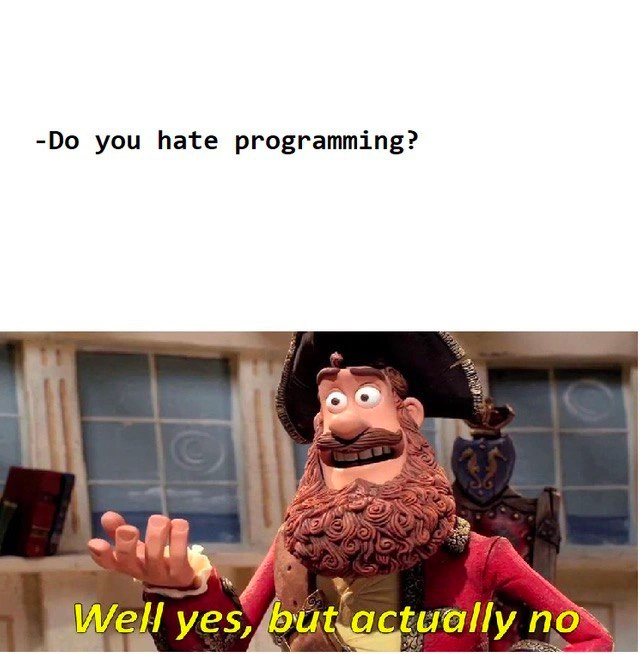
Now, look at the meme’s question and answer. The top panel asks plainly: “Do you hate programming?” It’s like someone is asking a developer if coding makes them miserable. The bottom panel has the pirate character responding: “Well yes, but actually no.” In simpler terms, he’s saying: “I do get angry at programming sometimes, yes, but in reality I don’t truly hate it.” This is exactly how most programmers feel. When your code isn’t working after the 100th attempt, you do feel like you hate programming (at least in that moment). You might step away from the computer ready to quit. But then — maybe after a break or with a fresh approach — you solve the problem! Suddenly the code works perfectly. That feeling is pure happiness and pride. In that moment you remember, actually, you love programming. You might even do a little victory dance or fist pump. The meme’s joke is that both of those opposite feelings can be true at once. Developers often jokingly say “I love programming, I just hate computers” or “I hate coding, except when it finally works!” It sounds confusing, but it makes sense when you’ve been through it. Basically, we hate the struggle but love the success.
This emotional back-and-forth is why we call coding an “emotional rollercoaster.” One minute you’re down in the dumps because nothing is working, and the next minute you’re on top of the world because you fixed a huge bug. It happens to beginners writing their first simple programs and to experienced engineers building complex systems alike. In fact, no matter how many years you’ve been coding, you never entirely outgrow this cycle. Even senior developers with a decade of experience sometimes groan “I can’t stand this!” when a project becomes stressful. They’ll rant about bad documentation or an impossible bug. But if you watch them, those same seniors won’t actually quit — a little while later they’re happily discussing new features or saying “Check out this cool solution I found!” It’s proof that this love-hate relationship with coding is a relatable developer experience at every level.
It might help to know that there’s a whole category of DeveloperHumor dedicated to these feelings. Programmers share jokes, comics, and memes (like this one) to remind each other that “Yep, we all go through this.” It creates a sense of camaraderie. For example, a common tongue-in-cheek saying is: “Programming is 10% writing code and 90% figuring out why it doesn’t work.” We laugh at quotes like that because they ring true. Another jokey saying you might hear is: “I don’t always test my code, but when I do, I do it in production” — which is a humorous way to admit we sometimes make mistakes that users find before we do, and it drives us crazy. By joking about the hard parts, developers make the stress feel more normal and less isolating. This meme with the pirate is a perfect example of that developer self-deprecation: we’re basically admitting “Haha, yeah I complain about coding a lot, but I secretly enjoy the challenge.”
So if you’re new to coding and have felt this mix of anger and joy, know that you’re not alone and you’re not doing anything wrong. In fact, feeling frustrated means you’re pushing yourself to solve problems — and that’s exactly how you get better. The developer experience (DX) isn’t just about the fancy tools or languages you use; it’s also about the emotional journey of building something from nothing. Every bug you encounter and fix is teaching you something and eventually giving you that “I did it!” high. The meme’s message “Well yes, but actually no” is a lighthearted way of saying “We programmers might sound like we hate our work when we rant, but deep down we really love what we do.” It’s a fun paradox that every coder comes to understand. Remember this next time you get stuck: the frustration will pass, and the excitement will return. Coding is challenging, but that’s exactly what makes it rewarding and (believe it or not) fun in the end.
Level 3: Infinite Love-Hate Loop
At a senior developer level, this meme hits like a debug session gone awry. The prompt “Do you hate programming?” is posed in plain monospace text — a yes/no question as binary as 0 or 1. But any experienced engineer immediately recognizes a trap: there’s no simple TRUE or FALSE here. It’s as if the question causes a type error in our emotional code. The pirate’s punchline “Well yes, but actually no” cleverly returns both values at once. It’s basically a boolean paradox, a Schrödinger’s cat of coding sentiments. Of course, the absurdity of blatantly contradicting a yes/no question is exactly what makes developer humor great. The meme format itself adds to the comedy: a stark, code-like question on top, then a goofy claymation pirate captain grinning below. The contrast is gold. It’s like receiving a stoic command-line prompt followed by an answer from Captain Jack Sparrow. The pirate’s awkward smile is the same face we developers make when a friend asks, “So you enjoy coding?” and we can only shrug: “Well… kinda both, actually.”
Beyond the format, the content speaks to a core relatable developer experience: the love_hate_programming paradox. Seasoned devs know this emotional whiplash all too well. One minute you’re sweating over a critical bug that crashed production at 3 AM, cursing under your breath “I hate programming, why did I choose this career?!” You’re exhausted, imagining a simpler life far away from keyboard and code (hello, goat farming!). This is peak developer frustration – when nothing works and everything seems doomed. But then, after countless log dives and maybe a sacrificial coffee to the code gods, Eureka! The bug is fixed. That rush of triumph floods in and suddenly you remember “I love programming! It’s so clever and rewarding.” It’s an almost absurd 180-degree flip in mood. This meme nails that whiplash in one snappy quote. Every battle-scarred programmer has felt that surge of giddy joy right after a stretch of misery. It’s the addictive cycle that keeps us coming back for more, project after project.
The humor also lies in how universally this pattern is recognized in the dev community. DeveloperHumor often revolves around exactly this kind of self-referential pain. We complain loudly about how terrible our code is, how NULL pointers and off-by-one errors ruin our day. That’s developer self-deprecation in action: we poke fun at our own struggles as a coping mechanism. You’ll hear seasoned engineers joking, “I have no idea what I’m doing” right after they solved a near-impossible bug. It’s not that they literally don’t know — it’s a way to laugh off the stress. We’ve all sent those Slack messages at 2 AM saying, “I quit, I hate coding, I’m becoming a chef,” only to show up the next morning excited to implement a new feature. This shared DeveloperFrustration turned comedy is practically the glue of developer culture. We bond over war stories of deployments gone wrong and laugh because we’ve survived them. The pirate_captain_meme perfectly voices that collective experience: an admission of pain immediately followed by a denial because, let’s face it, we secretly thrive on that pain.
In a way, programming is a form of masochistic problem-solving. The meme’s text captures it succinctly, and we can even express this cycle in code form. Here’s some tongue-in-cheek pseudocode that every developer will recognize:
while (true) {
// Developer writes code
if (bugFound()) {
printf("I hate programming!\n");
fix(bug); // battle the bug
} else {
printf("I love programming!\n");
addNewFeature(); // reward: time to build more
}
// ...and the cycle repeats forever
}
Look familiar? This loop of frustration and euphoria might as well be the engine running the software industry. We fix one problem and immediately take on the next challenge — by choice! It’s an infinite loop of hate it, love it, hate it, love it that drives our growth as developers. The moment everything is working perfectly is the same moment some of us get bored and say, “Alright, what can I break or build next?” It’s practically a form of Stockholm syndrome: we’re held hostage by code that tortures us, yet we’ve grown attached to it and won’t leave. One could say the entire DeveloperExperience_DX is defined by this love-hate dynamic. Good tools and practices might reduce the pain, but we all know even the best setup won’t eliminate those maddening bugs at 3 AM. And oddly enough, most of us wouldn’t have it any other way.
For historical context (because the programming_relationship_paradox is nothing new), the term bug itself in computing famously comes from a real moth found in an early computer in 1947. The engineers literally taped the moth into the logbook with the note “First actual case of bug being found.” They were annoyed by the glitch but also found humor in it — enough to coin the term debugging as a joke. Even in the 1940s, programmers were basically saying “Well yes, this problem is awful, but actually no, we still love tinkering with these machines.” From the days of punch cards to today’s AI-driven devops, that contradictory mindset persists. It’s why this meme makes devs smirk and nod. It shines a spotlight on the paradox at the heart of being a developer: we rant about coding and sometimes sincerely feel we hate it in the moment, yet we’re hopelessly in love with it as a whole. The pirate’s cheeky “Well yes, but actually no” is basically our daily internal dialogue. This blend of pain and passion is what makes the craft of programming so compelling—and such ripe material for CodingHumor. We’ve all been the pirate, admitting the truth with a grin: Yes, programming drives me crazy, but no, I wouldn’t give it up.
Description
A two-panel meme that captures the complex feelings developers have about their profession. The top panel, with a plain white background, simply asks the question: '-Do you hate programming?'. The bottom panel provides the answer using the popular 'Well yes, but actually no' meme format. It features a still image of the Pirate Captain from the Aardman Animations film 'The Pirates! In an Adventure with Scientists!', who, with a conflicted but cheerful expression, says, 'Well yes, but actually no'. This meme perfectly articulates the duality of a programmer's experience: the intense frustration and 'hate' felt during debugging or dealing with legacy code, contrasted with the deep satisfaction and 'love' of creative problem-solving and building functional software
Comments
8Comment deleted
My relationship with programming is simple. I hate it, but I also hate everything else more
I swear I hate programming every time I trace a request hop-by-hop through eight microservices, but ten minutes later I’m drafting the PR to add a ninth because “separation of concerns” - so yes, but actually no
I hate programming the same way I hate the codebase I've been maintaining for 15 years - it's a toxic relationship I can't leave because I know all its secrets and it pays for my mortgage
I hate programming the way I hate my legacy codebase: passionately, daily, and with zero intention of ever leaving it
This meme perfectly captures the Schrödinger's Developer state: simultaneously loving the elegant architecture you designed at 2 AM and despising the production incident it caused at 3 AM. It's the same energy as 'I hate JavaScript' typed in a .js file, or claiming you'll rewrite everything in Rust while secretly knowing you'll just add another dependency to package.json. We're all pirates sailing the seas of technical debt, convinced we hate the voyage while refusing to abandon ship
Whether I hate programming is a feature flag tied to CI status - off while wrangling YAML and version pinning, instantly on when a one‑liner drops p99 latency by 30%
We don't hate programming - it's the tech debt that compounds like interest on a legacy monolith
I don’t hate programming; I hate negotiating consensus between CI, staging, prod, and Product until they finally reach quorum