The High Cost of Forgetting a Recursion Base Case
Why is this Bugs meme funny?
Level 1: No End in Sight
Imagine you’re stacking toy blocks one on top of the other, higher and higher. Normally, you’d decide to stop at a safe height or when you run out of blocks. But what if you never stop? You just keep stacking blocks endlessly without thinking about when to quit. Sooner or later, the tower gets so tall and unstable that it topples over completely, making a big mess! This meme is poking fun at a programmer who did something like that in code. They made a little function that keeps calling itself (like adding another block on the tower) and forgot to tell it when to stop. The phrase “gonna cost us a full stack” is a funny way of saying “uh-oh, we piled things up way too high.”
In everyday terms, it’s like if you started an activity and didn’t know how to finish it – say you kept eating cookies without end or kept asking “Why? Why? Why?” without listening to the answer. Eventually, something bad happens: you feel sick from too many cookies, or everyone gets tired of the never-ending questions. In the same way, the program got stuck doing the same thing over and over until it crashed. The meme makes this serious mistake feel dramatic and silly at the same time. It’s funny because it shows how a tiny oversight (forgetting to say “stop”) can lead to a huge crash, as if an astronaut’s big mission went wrong. Even if you don’t know programming, you can laugh at the idea of someone forgetting an important brake and everything spinning out of control. It’s a joke about not knowing when to stop, told in a playful coding way.
Level 2: Stack Overflow Crash Course
So what’s going on here? The meme is highlighting a classic programming mistake: forgetting the base case in a recursive function. Let’s break those terms down. Recursion is when a function calls itself to solve a smaller piece of the problem. It’s like placing a mirror in front of a mirror – you get repeated reflections. To make sure the reflections don’t go on forever, you need a stopping condition (in coding, that’s the base case). The base case (or base condition) is a specific scenario where the function knows how to stop recursing and just returns a final answer directly. It’s the essential exit condition. If the base case is missing or never reached, the function keeps calling itself over and over, leading to infinite recursion.
Now, whenever a function is called (recursive or not), the computer uses a call stack to keep track of it. You can imagine the call stack like a stack of plates: each function call puts a new “plate” on the stack, and when a function returns, that plate is removed. With recursion, each new call adds another plate. If you forget to stop, you’ll keep piling on more plates without ever removing any. Eventually, this stack of plates grows so high that it topples over! In computing terms, that’s a stack overflow error – the program tried to use more stack memory than it had available. This usually causes the program to crash or throw a runtime exception. It’s a common RuntimeError scenario when dealing with recursion. New developers often encounter this when learning recursion, for example by writing a naive recursive solution to compute a factorial or traverse a data structure and forgetting to handle the ending condition. One moment you’re running your code, the next moment it’s like, “BOOM – StackOverflow!” (Not the website, but the actual error.) It’s a coding mistake that swiftly teaches you why that base case is so important.
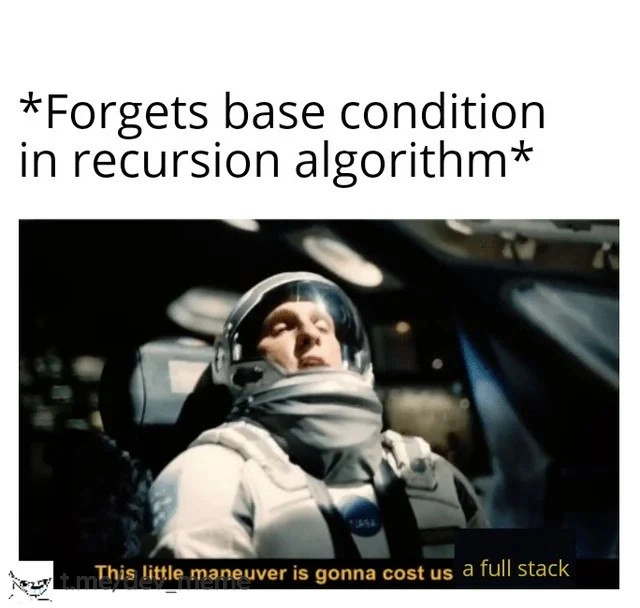
In the meme’s image, we have an astronaut sitting in a spaceship cockpit looking concerned. This is a scene taken from the movie Interstellar where things are extremely tense. The top text in the meme says “Forgets base condition in recursion algorithm” – describing the goof-up in a nutshell. And then the bottom text (styled as a movie subtitle) jokes, “This little maneuver is gonna cost us a full stack.” The phrase “cost us a full stack” is a humorous way to say “using up the entire call stack”. It’s playing on the double meaning of “full stack” – typically that means a developer skilled in all areas (front-end and back-end), but here it’s literally talking about the stack in memory being completely filled (a call_stack_exhaustion). So the meme effectively says: “Whoops, I forgot the stopping condition in my recursive algorithm, and now this tiny mistake is going to use up all our stack memory and crash the program.” The astronaut’s grave expression and the dramatic wording exaggerate how it feels when you realize your program is in an endless spiral. It might be a small bug, but it sure can have a big and immediate impact – your app just freezes or blows up. Anyone who’s been in the middle of debugging knows that dread when you suspect a recursion gone rogue.
For a junior developer (or a student) learning recursion, this is a rite-of-passage bug. Let’s say you write a simple recursive function, like a countdown, but you forget to tell it when to stop:
def countdown(n):
print(n)
countdown(n-1) # recursive call with no base case!
countdown(5)
If you run that, it will print 5, 4, 3, 2, 1, 0, -1, -2... and so on forever (in reality, Python will halt it after a maximum recursion depth, throwing a RecursionError, but the concept stands). The function never knows when to stop because we didn’t specify a condition to exit. The correct approach would be to add something like:
def countdown(n):
if n <= 0: # base case: once n hits 0 or below, stop recursing
print("Blast off!")
return # end the recursion
print(n)
countdown(n-1) # recursive step
Now, if you call countdown(5), it will print 5, 4, 3, 2, 1, then “Blast off!” and stop, as intended. The base case (if n <= 0) prevents the function from going into negative numbers infinitely. This little check saves the program from exhausting its call stack.
The meme is funny to folks who know this stuff because it takes that very dry concept – “always include a base case in recursion or you’ll get a stack overflow” – and turns it into a dramatic, relatable scenario. The astronaut saying “This little maneuver is gonna cost us a full stack” makes us laugh because we’ve all had a moment where a small oversight led to a crash, and we felt like we were drifting in space saying “oh no, what have I done.” It’s AlgorithmHumor meets pop culture. Even the phrasing “full stack” hints that the entire stack memory is lost due to our error, which is a clever play on words.
In simpler terms: the meme visualizes a debugging session gone wrong. The developer forgot a crucial line in their recursive algorithm. As a result, the code likely blew up with a stack_overflow_error. In real debugging, you’d probably see an error message or a very long log of repeated function calls. You’d scratch your head, then facepalm as it hits you – the base case is missing! The categories here (Bugs, CS_Fundamentals, Debugging_Troubleshooting) tell us it’s highlighting a fundamental bug and the troubleshooting drama around it. The humor works especially for those who have been through it: at first you might panic when the program crashes, but later you smile because it’s a lesson learned (and a meme-worthy moment).
Level 3: All Stack, No Base
At the heart of this meme is a recursion fiasco that every seasoned developer recognizes with a mix of horror and humor. In a recursive algorithm, a function keeps calling itself to break a problem into subproblems. But forget to include the base case – the condition where the function stops calling itself – and you’ve essentially lit the fuse on a bomb. The function will call itself again and again, infinitely (or until the system can’t handle it). Each call adds a new frame to the call stack, which is the memory structure that tracks function calls in a LIFO (last-in, first-out) order. If there’s no termination, that stack grows like crazy. Eventually, the program runs out of stack memory, triggers a stack overflow error, and crashes spectacularly. It’s as if we’ve told our code “keep going deeper, don’t stop until... well, never!” – the call stack exhaustion is inevitable. This scenario is a classic BugsInSoftware moment that often leads to a runtime crash. In fact, many of us discovered the Q&A site Stack Overflow in the first place by literally causing a stack overflow in our code and frantically searching for answers!
In the meme, the top caption *Forgets base condition in recursion algorithm* sets the stage. It’s a tongue-in-cheek “stage direction” style statement (the asterisks imply an action) describing the blunder. An astronaut in a spacecraft cockpit (a scene from the film Interstellar) delivers the punchline via a fake subtitle:
"This little maneuver is gonna cost us a full stack."
This is a brilliant pun. In the original movie scene, the line was about a risky space maneuver that would “cost us X” (fuel and time). The meme twists it to “cost us a full stack”, implying our little coding mishap will consume the entire call stack. “Full stack” here is wordplay: normally that term might refer to a full-stack developer (one who works on both front-end and back-end), but in this context it literally means the full stack memory gets used up. Goodbye, entire stack – the program has crashed! The humor lands because a minor oversight in code (forgetting a base case) is exaggerated as a dramatic, astronaut-level catastrophe. Seasoned developers chuckle since they’ve lived through this drama in a less cinematic way: one missing if condition and suddenly the app implodes.
Let’s unpack the technical drama: forgetting a base case in recursion is essentially creating an infinite recursion, analogous to an infinite loop. The difference is that a loop can spin forever using CPU, but infinite recursion quickly gobbles up memory because each recursive call allocates a new stack frame (holding local variables, return address, etc.). It’s a CS_Fundamentals lesson 101 that any recursive algorithm must have a base case to eventually stop, otherwise it’s mathematically and physically non-terminating. Experienced devs have an almost reflexive eye for this bug – if your program crashes with a RuntimeError or a suspiciously repetitive function call in the stack trace, the first thought is “Did I forget a base condition?”. The meme showcases this with cosmic flair: an astronaut lamenting the cost of our mistake, as if our code has fallen into a black hole of calls. And honestly, that’s not far off – an infinite recursive call is like a black hole for memory.
To make it concrete, consider a snippet of pseudo-code in a language without automatic recursion limits (for instance, C or Java will happily allocate until they can’t):
def infinite_recursion():
# Oops, no base case here
infinite_recursion() # This function calls itself unconditionally
# It will never reach a stopping point!
# Trigger the recursion:
infinite_recursion()
# The above will lead to a stack overflow error after consuming all call stack memory.
This tiny function infinite_recursion() calls itself forever. Each call is a “little maneuver” adding one more frame to the stack. Pretty soon, your call stack is completely filled with copies of infinite_recursion waiting for a result that will never come. The program either throws a fatal error or locks up until the runtime kills it. Different environments have different failure modes: e.g. Python raises a RecursionError after a certain depth (around 1000 calls by default) to stop the madness, Java throws a StackOverflowError, and C/C++ will just smash the stack and likely cause a segmentation fault. No matter the language, the result isn’t pretty. As the meme jokes, “this little maneuver” (our coding mistake) “is gonna cost us a full stack” – meaning we lose the entire stack to this infinite cascade.
To appreciate the wordplay and context, here’s a quick comparison of terms involved in the joke:
| Term/Phrase | Typical Meaning (in tech) | Meaning in this meme’s context |
|---|---|---|
| Full stack | The whole technology stack of an application (or a developer who works on both front-end and back-end) | The entire call stack filled up by recursive calls (resulting in a crash) |
| Stack Overflow | A popular Q&A website for programming help (StackOverflow.com) | A runtime error where the call stack space is exhausted by deep recursion |
The double meaning of full stack and stack overflow makes the meme extra delightful for developers. We get a mix of AlgorithmHumor and a dash of pop culture. Furthermore, the use of the Interstellar scene adds an epic sense of doom. In the movie, that line conveyed a huge consequence (losing decades of time) for a necessary action. In the meme, it humorously conveys a huge consequence (losing the entire program’s stability) for an unnecessary bug. It’s exaggeration comedy: in reality, fixing a missing base case is usually straightforward once identified, but the meme dramatizes the moment of crash as if we’re astronauts watching our systems fail. An experienced engineer can relate to that sinking feeling – “Oh no, I screwed up the recursion and now everything’s falling apart.” It’s both funny and painfully true.
On a more advanced note, seasoned developers might also think about how recursion is handled under the hood. There are compiler optimizations like tail-call optimization that can reuse stack frames for certain recursive calls to avoid growing the stack. But crucially, even tail-call optimization can’t save you if you’ve utterly omitted a termination condition – the program might avoid overflowing the stack by reusing the frame, but it will instead loop forever, pegging the CPU. In other words, forgetting a base case means your function doesn’t know when to stop at all. Whether it fails by crashing the stack or by spinning infinitely, it’s a bug. This is why having a well-defined base case (often a simple if-condition that returns a result without further recursion) is hammered into every CS student’s head. The meme gets a laugh because it’s a shared lesson almost everyone learns the hard way. If you listen carefully, you can almost hear every developer’s internal voice when they see this: “Whoops, that little oversight is gonna cost us... big time.” It’s a humorous nod to the Debugging_Troubleshooting adventures that bond all programmers.
Description
A two-part meme. The top part has white text on a plain background that reads, '*Forgets base condition in recursion algorithm*'. The bottom part is a cinematic still of the character Cooper from the movie Interstellar, looking stressed in an astronaut helmet inside a cockpit. Yellow subtitle text at the bottom reads, 'This little maneuver is gonna cost us a full stack'. There's a small watermark in the bottom-left corner for 't.me/dev_meme'. The meme creates a clever pun by replacing the original movie line, 'This little maneuver is gonna cost us 51 years,' with 'a full stack.' This directly relates to the consequence of omitting a base condition in a recursive function, which leads to an infinite series of function calls that consumes all available memory on the call stack, causing a 'stack overflow' error. It’s a humorous and relatable depiction of a fundamental but common programming error
Comments
7Comment deleted
I told my son a recursive story: 'Once upon a time, there was a programmer who forgot his base case. Once upon a time, there was a programmer who forgot his base case. Once upon a time...'
A missing base case is the most honest load test: the cloud bill scales linearly, the call stack still caps at 8 MB, and your “infinite” architecture gets to prove which limit hits first
The real tragedy isn't the stack overflow - it's explaining to the PM why a simple fibonacci function brought down production because you deployed on Friday thinking 'what's the worst that could happen with a recursive helper function?'
Every senior engineer has that one war story about debugging a production incident at 3 AM, only to discover a junior dev's recursive function was missing its base case. The stack trace was longer than the Interstellar runtime, and just like Cooper's docking maneuver, the fix required perfect timing before the entire system ran out of memory. The real kicker? The code review had been approved with 'LGTM' - clearly nobody actually tested the edge cases where n=0
Leaving out the base case is how you learn the JVM doesn’t do tail-call optimization - right after PagerDuty explains what “full stack” really means
Missing base case: turning O(n) elegance into a stack trace that outlives your codebase
Skip the base case and your algorithm’s complexity becomes O(PagerDuty) while the stack pointer hits escape velocity